
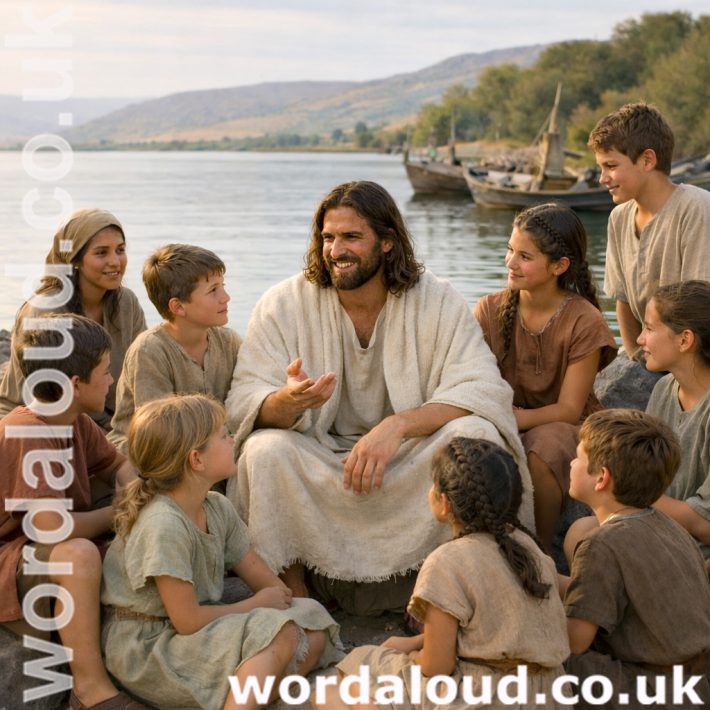
Christian Art | Jesus With The Children | Jesus, God, Is Love
Office Of Readings | Week 1, Tuesday, Ordinary Time | A Reading From The Longer Rules Of Saint Basil The Great | We Possess An Inborn Power Of Loving
‘The ability to love is within each of us.’
In this reading from the Longer Rules for Monks, Saint Basil the Great reflects on the origin of love for God and its place in the moral life. Basil’s starting point is significant: love of God is not presented as something imposed from outside or learned through instruction alone. Instead, Basil argues that the capacity to love God is already present within human nature.
Basil compares love of God to basic human inclinations such as the desire for life, light, and familial affection. These are not learned behaviours but natural tendencies rooted in human existence. In the same way, love for God belongs to the structure of human reason itself. When human beings come into existence, they receive a rational capacity that includes an orientation towards the good and, ultimately, towards God.
The role of God’s law and teaching is therefore not to create this love, but to cultivate and direct it. Basil uses the image of a seed: reason contains the potential for love, while divine instruction nurtures it so that it can grow to maturity. Grace does not replace human capacity but brings it to fulfilment.
This understanding allows Basil to make a further claim about moral responsibility. Because God has already given human beings the ability to obey his commands, these commands cannot be dismissed as unfair or impossible. Sin, in Basil’s definition, is not the absence of ability but the misuse of the powers God has given. Virtue, by contrast, is the right use of those same powers, guided by conscience and obedience.
Love fits squarely within this framework. The command to love God presupposes that human beings are already capable of doing so. Basil points to everyday experience as evidence: people naturally desire what appears good, feel affection for those close to them, and respond with goodwill to benefactors. Love of God, though it surpasses all other loves, grows from the same created capacity.
The final emphasis of the reading falls on purification. While the capacity for love is universal, its full expression depends on freedom from sin. Only a purified soul can perceive the beauty of God clearly and experience the intensity of desire that Basil describes. Divine beauty itself remains beyond description, but its effect on the human soul is unmistakable: it draws love toward its true end.
A Reading From The Longer Rules Of Saint Basil The Great | We Possess An Inborn Power Of Loving
Love of God is not something that can be taught. We did not learn from someone else how to rejoice in light or want to live, or to love our parents or guardians. It is the same – perhaps even more so – with our love for God: it does not come by another’s teaching. As soon as the living creature (that is, man) comes to be, a power of reason is implanted in us like a seed, containing within it the ability and the need to love. When the school of God’s law admits this power of reason, it cultivates it diligently, skilfully nurtures it, and with God’s help brings it to perfection.
For this reason, as by God’s gift, I find you with the zeal necessary to attain this end, and you on your part help me with your prayers. I will try to fan into flame the spark of divine love that is hidden within you, as far as I am able through the power of the Holy Spirit.
First, let me say that we have already received from God the ability to fulfil all his commands. We have then no reason to resent them, as if something beyond our capacity were being asked of us. We have no reason either to be angry, as if we had to pay back more than we had received. When we use this ability in a right and fitting way, we lead a life of virtue and holiness. But if we misuse it, we fall into sin.
This is the definition of sin: the misuse of powers given us by God for doing good, a use contrary to God’s commands. On the other hand, the virtue that God asks of us is the use of the same powers based on a good conscience in accordance with God’s command.
Since this is so, we can say the same about love. Since we received a command to love God, we possess from the first moment of our existence an innate power and ability to love. The proof of this is not to be sought outside ourselves, but each one can learn this from himself and in himself. It is natural for us to want things that are good and pleasing to the eye, even though at first different things seem beautiful and good to different people. In the same way, we love what is related to us or near to us, though we have not been taught to do so, and we spontaneously feel well disposed to our benefactors.
What, I ask, is more wonderful than the beauty of God? What thought is more pleasing and wonderful than God’s majesty? What desire is as urgent and overpowering as the desire implanted by God in a soul that is completely purified of sin and cries out in its love: I am wounded by love? The radiance of divine beauty is altogether beyond the power of words to describe.
Christian Prayer With Jesus Christ
God of all goodness,
You have placed within us the capacity to love,
and you call us to direct that love toward you.
Purify our hearts,
so that the love you have planted within us
may grow according to your will.
Teach us to use rightly the gifts you have given,
to turn away from misuse and sin,
and to walk in obedience and freedom.
Through your Spirit,
bring to fulfilment the love
you have already begun in us.
Amen
Glossary Of Christian Terms
Love of God | The innate human capacity and calling to desire and seek God as the highest good.
Reason | The God-given faculty through which human beings recognise truth, goodness, and order.
Seed | An image used by Basil to describe the implanted potential for love within human nature.
Divine law | God’s instruction that guides and cultivates what is already present in human reason.
Grace | God’s help that brings human capacity to fulfilment rather than replacing it.
Virtue | The right use of God-given powers in obedience to his commands.
Sin | The misuse of human abilities in a way contrary to God’s will.
Conscience | The inner judgement by which a person discerns right and wrong action.
Purification | The removal of sin and disorder so that the soul may perceive God clearly.
Beauty of God | God’s goodness and majesty, which draw the human soul toward love.
Commandment | God’s instruction, which presupposes the ability to respond.
Human nature | The created structure of the human person, including reason and freedom.
Holy Spirit | The divine agent through whom love is stirred, strengthened, and perfected.
Desire | The natural movement of the human will toward what is perceived as good.
Obedience | The free alignment of human action with God’s will.
Freedom | The capacity to act rightly by using God’s gifts according to their purpose.
Good | That which is fitting to human nature and ultimately fulfilled in God.
Divine beauty | The source of love’s attraction, beyond full description but known by its effect.
Innate capacity | The inborn ability placed in human beings by God to love and respond to him.
Perfection | The fulfilment of human potential through grace and right use of reason.



Psalm 128 is in some ways a didactic poem, instructing listeners on the path to a blessed life. The psalm provides an illustration of tangible and intangible rewards that accrue from a life oriented towards God. The psalm expresses truths about the relationship between divine reverence, moral living, and the blessings that flow from such a life [ … ]

Like and share a collection put up on YouTube. In each, a young King David in the Temple offers a Gospel passage – proclaims the Gospel. This thought is intended to imply deep connection between King David, and the heart of Jewish faith, and Jewish history, and the coming of the Lord in Jesus Christ [ … ]

Jesus has not confined his journey to Jerusalem to exclusively Jewish territories. He has wandered in Samaria, and indeed Galilee was what we might now call a multicultural environment, known as Galilee of the Gentiles. This would be greatly reassuring to those of Luke’s readership who were of Gentile rather than Jewish provenance. Christ’s physical journey to Jerusalem marks a journey from inward-looking and narrow sectarianism to a redemptive faith which is inclusive of all [ … ]
