

Christian Art | Jesus Christ Is Crucified | Christ Died For All
Office Of Readings | Week 16, Friday, Ordinary Time | A Reading From The Confessions Of Saint Augustine | Christ Died For All
‘Christ died for all.’
The Confessions, composed around 397–400 AD, is a retrospective narrative in which Saint Augustine recounts his spiritual development and his theological understanding of the human relationship with God. The Confessions moves from autobiographical content to more philosophical and theological reflection. This passage is a meditation on sin, salvation, and the mediating role of Christ.
Jesus Christ as Mediator | Theological Framework
Augustine refers to Christ as the ‘true Mediator’ between God and humanity. Augustine supports this with reference to 1 Timothy 2:5: ‘The man Christ Jesus, who gave himself as a ransom for all.’ Augustine states that Christ shares in mortality, which connects him with human beings, and in justice, which aligns him with God.
The passage presents Christ as mediating not only through position or authority but through shared nature: mortal like humans, and as God. This reflects Augustine’s emphasis on the incarnation as essential to salvation. Jesus Christ’s mediation is not simply intercessory but participatory—Jesus enters into human death in order to bring about reconciliation.
This is consistent with Augustine’s broader theological position: human beings cannot save themselves, and Christ’s dual nature as both God and man makes him the only viable mediator.
Substitution And Sacrifice
Augustine describes Christ as both ‘victim’ and ‘victor’, and also ‘priest’ and ‘sacrifice’. These dual roles reflect the theological claim that Christ not only offers a sacrifice (as priest) but is the sacrifice himself. This is derived from biblical typology found in Hebrews 9:11–14 and Old Testament sacrificial language.
The conceptual model is substitutionary: Christ, though innocent, undergoes death on behalf of sinners. Augustine states that Christ ‘willed to share death with them’, thereby annulling it for others. This is consistent with the Pauline view found in Romans 6:10 and 2 Corinthians 5:21.
The language is legal and liturgical: justice is satisfied through a sacrificial exchange, and human status is altered—from slaves to sons. Augustine articulates a change in status before God that depends not on merit but on the Son’s action.
The Role of Divine Initiative
The repeated phrase ‘for our sake’ underscores Augustine’s belief that the entire economy of salvation is initiated by God. He references Romans 8:32: ‘He did not spare his own Son but gave him up for us all.’
This reflects Augustine’s view that salvation begins not with human will but with God’s mercy. Human beings, burdened by sin, are unable to return to God without assistance. The sending of the Son is an act of divine initiative intended to heal the separation.
This also aligns with Augustine’s doctrine of grace: all human goodness begins with God’s movement towards humanity, not vice versa.
Illness and Healing | Sin as Infirmity
Augustine uses medical imagery to describe the condition of sin. He calls his sins ‘infirmities’ and describes Christ as ‘your medicine’. This metaphor is not unique to Augustine; it draws on Greco-Roman and biblical traditions where sin is associated with disease (cf. Isaiah 1:5–6, Luke 5:31).
In this framework, Christ’s death is not only a legal atonement but a therapeutic intervention. Sin weakens the soul, and divine grace restores health. The incarnation is presented as the method by which God administers healing: by becoming human, the divine medicine reaches the human condition.
The Desert And Contemplation
Augustine mentions a desire to ‘flee into the desert’, a traditional image of spiritual retreat or ascetic withdrawal. This reflects a common theme in late antique Christian literature: the desert as a site of encounter with God, inspired by monastic examples in Egypt and Syria.
However, the impulse is interrupted. Instead, God offers comfort with the words: ‘Christ died for all, that those who live might no longer live for themselves.’ This is a quotation from 2 Corinthians 5:15. Augustine uses it to express a reorientation: rather than turning inward or fleeing the world, the believer should live for Christ.
The point is not withdrawal but transformation: the death of Christ demands a response, not only of belief but of reordered living.
The Eucharist And Memory
In the final section, Augustine writes: ‘I meditate on my ransom, and I eat it and drink it and try to share it with others.’ This alludes to the Eucharist. Augustine sees the Eucharist not only as a sacrament but also as a form of active meditation on Christ’s death. To consume the body and blood of Christ is to reflect upon, internalize, and proclaim the meaning of the Passion.
The act is communal and participatory. He does not meditate in isolation but seeks to share the ‘ransom’ with others—suggesting a missionary or pastoral dimension. This also reflects his ecclesiology: salvation occurs within the community of faith, which is bound together by the shared memory of Christ’s death and resurrection.
A Reading From The Confessions Of Saint Augustine | Christ Died For All
The true Mediator was he whom you revealed to humble men in your secret mercy, and whom you sent so they might learn that same humility by following his example. This was the Mediator between God and man, the man Christ Jesus, who intervened between sinful mortals and the immortal Just One, himself mortal like men, and like God, just. Thus, since life and peace are the compensation for righteousness, he could, by a justice united with God, annul the death of sinners now justified, since he willed to share death with them.
Good Father, how you loved us, sparing not your only Son but delivering him up for us sinners! How you loved us, for whose sake he, thinking it no robbery to be equal with you, was made subject to death on the cross. He alone, free among the dead, had the power to lay down his life and the power to take it up again. For our sake he became in your sight both victor and victim – victor, indeed, because he was victim. For our sake, too, he became before you both priest and sacrifice – priest, indeed, because he was a sacrifice, changing us from slaves to sons by being your Son and serving us.
Rightly then have I firm hope that you will heal all my infirmities through him who sits at your right hand and intercedes for us. Otherwise I should despair. For great and numerous are these infirmities of mine, great indeed and numerous, but your medicine is mightier. We might have thought your Word remote from any union with man, and so have despaired of ourselves, if he had not become flesh and dwelt among us.
Crushed by my sins and the weight of my misery, I had taken thought in my heart and contemplated flight into the desert. But you stopped me and gave me comfort with the words: Christ died for all, that those who live might no longer live for themselves but for him who died for them.
Behold, Lord, I cast upon you my concern that I may live and I shall meditate on the wonders of your law. You know my ignorance and my weakness; teach me and heal me. Your only Son, in whom are hidden all the treasures of wisdom and knowledge, redeemed me with his blood. Let not arrogant men speak evil of me. For I meditate on my ransom, and I eat it and drink it and try to share it with others; though poor I want to be filled with it in the company of those who eat and are filled and they shall praise the Lord who seek him.
Christian Prayer With Jesus Christ
God of mercy,
You did not spare your only Son,
but gave him up for us all.
Through him, the true Mediator,
you have drawn near to our weakness
and lifted the burden of our sin.
Grant us the grace
to live not for ourselves
but for him who died and rose for us.
Teach us to trust in your justice and your mercy—
to find in Christ both our healing and our hope.
When we are weighed down by guilt or despair,
remind us that your Word became flesh
so that no human heart need remain distant from you.
May we remember his sacrifice,
receive his life in the Eucharist,
and share his love with those around us.
Through Christ our Lord,
Amen.
Glossary Of Christian Terms
Mediator – A person who stands between two parties. In Christian theology, Christ is the Mediator between God and humanity (see 1 Timothy 2:5), uniting divine and human natures in one person.
Victim and Victor – This paradox expresses how Christ, though he suffered death (victim), triumphed over sin and death (victor) through the resurrection.
Priest and Sacrifice – In Christ, the roles of priest (who offers sacrifice) and the sacrifice itself are combined. This reflects teaching in the Letter to the Hebrews (especially chapters 8–10).
Substitutionary Atonement – The idea that Christ died in the place of sinners, bearing the consequences of sin on their behalf, so that they might be reconciled to God.
Incarnation – The belief that God the Son became human in the person of Jesus Christ. The term comes from the Latin incarnatio, meaning ‘enfleshment’.
Grace – God’s free and undeserved help that enables humans to respond to his call and to share in his divine life. Central to Augustine’s theology.
Eucharist – The Christian sacrament commemorating the Last Supper, in which bread and wine become the Body and Blood of Christ. Augustine links this with meditating on Christ’s Passion and sharing in it.
‘Free among the dead’ – A phrase from Psalm 88:5 (Vulgate numbering), referring to Christ’s voluntary death. Though he died, he was not bound by death’s power.
Desert – In Christian tradition, especially in early monasticism, the desert is a symbol of solitude and spiritual struggle, often representing the soul’s desire to escape worldly distractions and seek God directly.
2 Corinthians 5:15 – ‘He died for all, that those who live might no longer live for themselves but for him.’ This verse encapsulates Augustine’s theme of reoriented life through Christ’s death.
Confessions – Augustine’s autobiographical work, written c. 397–400 AD. It is both a narrative of conversion and a theological reflection on the nature of God, time, memory, and salvation.




In this reading from his letter to the Church of Smyrna, Saint Ignatius of Antioch sets out a clear and careful confession of faith in Jesus Christ. Writing as a bishop on his way to martyrdom, he addresses a community he knows to be firm in faith and love, and he seeks to strengthen them in the truth of Christ’s person and saving work [ … ]

There is an extraordinary contrast between yesterday’s celebration of the birth of Jesus, and today’s of the first Christian martyr, Stephen, stoned to death because he had to the courage to believe in Jesus, and would not be cowed into silence by the repressive actions of the Jewish authorities [ … ]
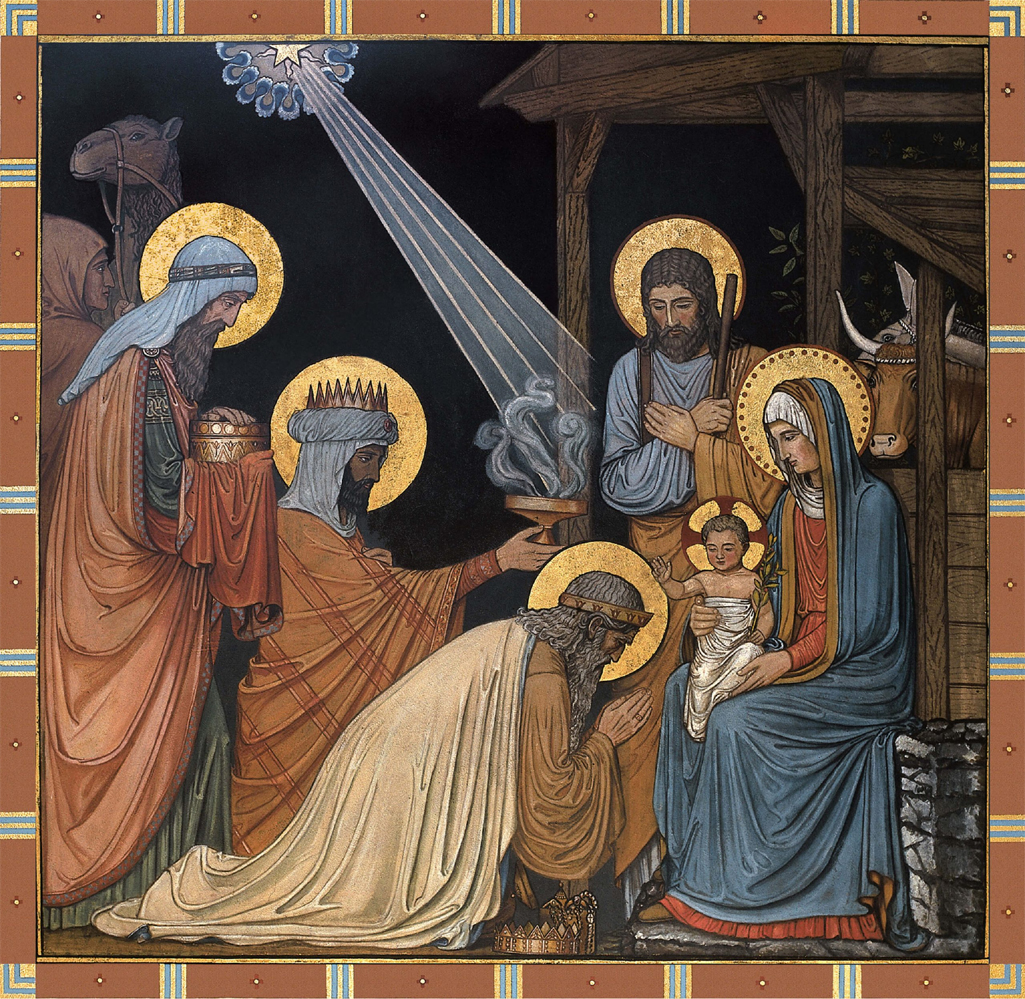
The Epiphany is an extraordinary event in the Bible, whereby we hear of the gift and revelation of Christ to all mankind. The three wise men have long studied the heavens; they have been looking for signs, for truths to guide them. They are of the east, of the orient, not of the Jewish people. They have seen the new star that is there to signify Christ and have come on pilgrimage to seek, to find and to worship Jesus [ … ]
