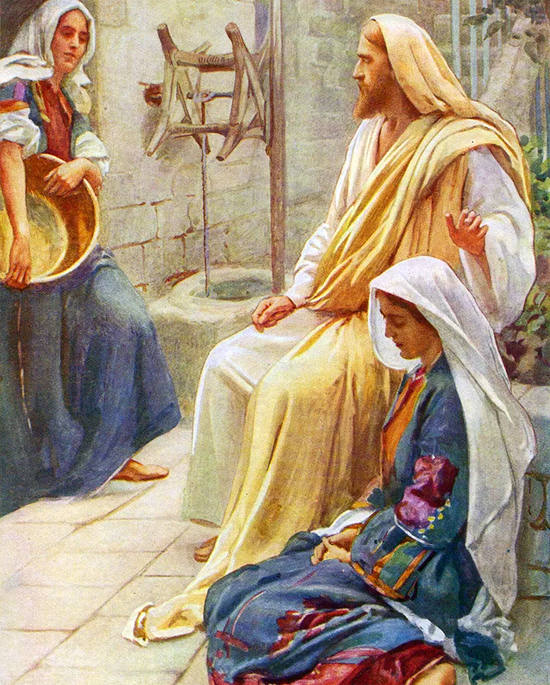
Christian Art | Jesus, Mary and Martha | Life Of Prayer
Office Of Readings | Week 29, Friday, Ordinary Time | A Reading From The Letter Of Saint Augustine To Proba | The Spirit Intercedes For Us
‘The Spirit pleads for us.’
Saint Augustine concludes his teaching on prayer by returning to its centre: the movement of the Holy Spirit within the believer. The true object of all prayer is the vision of God — the ‘life of happiness’ in which body and soul, made incorruptible, will behold the divine goodness for ever. Every other request is secondary and derives its meaning from this one desire. Without it, even good things lose their worth; with it, nothing is lacking.
Yet this ultimate good lies beyond our present understanding. We cannot imagine it as it truly is; whatever image arises in the mind must be rejected as inadequate. Thus the soul prays in a kind of ‘instructed ignorance’: it knows what it longs for but cannot describe it. This unknowing is not a defect of faith but its necessary condition, for the eternal life of God cannot be grasped by thought or language.
Here Augustine interprets Saint Paul’s words: ‘The Spirit helps our weakness; for we do not know how to pray as we ought.’ The Spirit’s intercession is not a speech distinct from ours, but the divine motion that gives life to our desire. When we sigh, when we long without words, it is the Spirit praying in us — the same Spirit who is one with the Father and the Son. The sighs ‘too deep for words’ are the form that hope takes in this life: an expression of love for a reality that cannot yet be seen.
Prayer, therefore, is not merely a human act directed toward God; it is also God’s own work within the human heart, drawing it toward what exceeds its power to name. To pray rightly is to be moved by the Spirit’s longing, to allow divine life to breathe within human weakness. The soul that prays in this way participates already, though obscurely, in the eternal peace for which it waits.
A Reading From The Letter Of Saint Augustine To Proba | The Spirit Intercedes For Us
The person who asks for and seeks this one thing from the Lord makes his petition confidently and serenely. He has no fear that, when he receives it, it may harm him, for if this is absent, anything else he duly receives brings no benefit at all. This is the one, true and only life of happiness, that, immortal and incorruptible in body and spirit, we should contemplate the Lord’s graciousness forever. It is for the sake of this one thing that everything else is sought and without impropriety requested. The person who has this will have all that he wants; in heaven, he will be unable to want, because he will be unable to possess anything that is unfitting.
In heaven is the fountain of life, that we should now thirst for in prayer as long as we live in hope and do not yet see the object of our hope, under the protection of his wings in whose presence is all our desire, so that we may drink our fill from the plenty of his house and be given drink from the running stream of his delights, for with him is the fountain of life, and in his light we shall see light, when our desire will be satisfied with good things, and there will be nothing to ask for with sighs but only what we possess with joy.
Yet, since this is that peace that surpasses all understanding, even when we ask for it in prayer we do not know how to pray for what is right. Certainly we do not know something if we cannot think of it as it really is; whatever comes to mind we reject, repudiate, find fault with; we know that this is not what we are seeking, even if we do not yet know what kind of thing it really is.
There is then within us a kind of instructed ignorance, instructed, that is, by the Spirit of God who helps our weakness. When the Apostle said: If we hope for something we do not see, we look forward to it with patience, he added, In the same way the Spirit helps our weakness; we do not know what it is right to pray for, but the Spirit himself pleads with sights too deep for words. He who searches hearts knows what the Spirit means, for he pleads for the saints according to God’s will.
We must not understand by this that the Holy Spirit of God pleads for the saints as if he were someone different from what God is: in the Trinity the Spirit is the unchangeable God and one God with the Father and the Son. Scripture says: He pleads for the saints because he moves the saints to plead, just as it says: The Lord your God tests you, to know if you love him, in this sense, that he does it to enable you to know. So the Spirit moves the saints to plead with sighs too deep for words by inspiring in them a desire for the great and as yet unknown reality that we look forward to with patience. How can words express what we desire when it remains unknown? If we were entirely ignorant of it we would not desire it; again, we would not desire it or seek it with sighs, if we were able to see it.
Christian Prayer With Jesus
Holy Spirit,
you search our hearts and stir them to prayer.
When we do not know how to speak,
interpret our sighs before the Father.
Teach us to desire what we cannot yet understand,
and to wait in patient hope
for the joy that words cannot express.
Let our weakness be your dwelling,
that your strength may bring us to the vision of God
and to the peace that surpasses understanding.
Amen.
Glossary Of Christian Terms
Life of happiness – Augustine’s term for eternal life: the full and unending contemplation of God.
Instructed ignorance – Knowledge taught by the Spirit that recognises the limits of human understanding and points beyond them.
Sighs too deep for words – From Romans 8:26; the inward movement of the Spirit expressing a desire for the unseen good that cannot be voiced.
Spirit pleads for the saints – The action of the Holy Spirit within believers, shaping their prayers according to God’s will.
Peace that surpasses all understanding – The divine peace described in Philippians 4:7, a peace not derived from knowledge or circumstance but from union with God.




The poem explores the spiritual journey of the poet, George Herbert, reflecting Herbert’s initial enthusiasm for the religious life and his later struggles with faith, disappointment, and suffering. The poem opens by recalling the poet’s early attraction to divine service, which he finds ‘brave’ and full of joy. He describes an idealized experience of religious devotion, where he expected to receive numerous blessings, both from his natural pleasures and the added benefits of God’s grace. At this stage, the poet sees everything in a positive light, imagining that both heaven and earth will provide him with endless happiness [ … ]
We are presented in these Bible verses with a peculiar sense of our understanding of time, our human time, in relation to God’s great plan for our salvation, and to the fact of God’s encompassing all time, from which perspective we are born and pass on within the blink of an eye. ‘A little while… and again, a little while…’ The Greek word, micron, is so translated [ … ]

The poem reflects on the numerous protective measures placed around individuals to guide them toward moral and spiritual growth, only to suggest that a single powerful sin can undo all these efforts. The poem opens by marvelling at the care with which human life is surrounded by formative influences, beginning with parents who ‘season’ or shape their children. This is followed by teachers, who hand them over to the ‘laws’ and ‘rules of reason’. These influences represent a rational, structured upbringing designed to lead a person towards a virtuous and ordered life [ … ]