Office Of Readings | Monday, Lent Week 2 | From The Catecheses By Saint John Chrysostom, Bishop
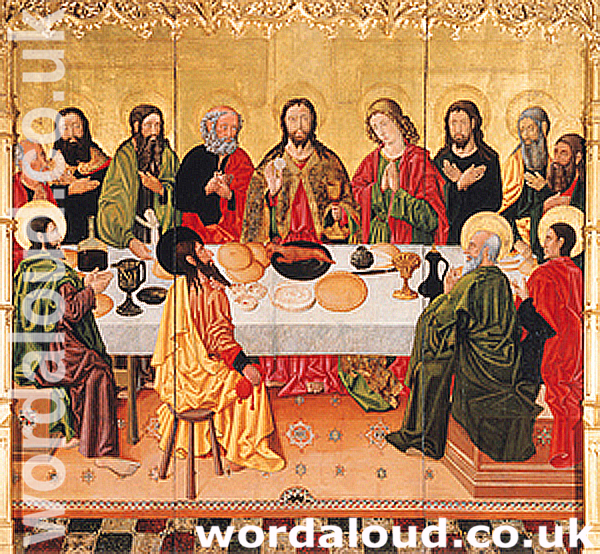
‘Christ and Moses.’
Saint John Chrysostom
The second reading for Monday of the Second Week of Lent comes from the Catecheses of Saint John Chrysostom, a 4th-century Archbishop of Constantinople known for his powerful preaching and deep theological insight. In this passage, Saint John Chrysostom reflects on the significance of Christ’s blood, drawing a direct connection between the Old Testament Passover and the sacrifice of Christ in the New Testament.
Saint Chrysostom recalls how, during the time of Moses, the Israelites in Egypt were commanded to sacrifice a spotless lamb and mark their doorposts with its blood. This sign protected them from the final plague, in which the firstborn of Egypt were struck down. However, Saint Chrysostom emphasizes that the true power of this act did not lie in the lamb’s blood itself but in what it foreshadowed—the sacrifice of Christ.
He explains that just as the lamb’s blood saved the Israelites from physical death, Christ’s blood brings salvation from sin and eternal death. Christ is the true Passover Lamb, and his sacrifice fulfils what was only symbolized in the Old Testament. Saint Chrysostom urges believers to recognize the immense power in Christ’s blood, which cleanses, redeems, and gives life.
This reading calls the faithful to a deeper understanding of Christ’s sacrifice and the way in which Old Testament events point forward to their fulfilment in him. It highlights the movement from the old covenant to the new, showing that what was once a temporary sign has now been replaced by the true and lasting reality of redemption in Christ. During Lent, a season of repentance and reflection, this passage invites believers to meditate on the depth of Christ’s gift and to respond with gratitude and renewed faith.

From The Catecheses By Saint John Chrysostom, Bishop
The Israelites witnessed marvels; you also will witness marvels, greater and more splendid than those which accompanied them on their departure from Egypt. You did not see Pharaoh drowned with his armies, but you have seen the devil with his weapons overcome by the waters of baptism. The Israelites passed through the sea; you have passed from death to life. They were delivered from the Egyptians; you have been delivered from the powers of darkness. The Israelites were freed from slavery to a pagan people; you have been freed from the much greater slavery to sin.
Do you need another argument to show that the gifts you have received are greater than theirs? The Israelites could not look on the face of Moses in glory, though he was their fellow servant and kinsman. But you have seen the face of Christ in his glory. Paul cried out: We see the glory of the Lord with faces unveiled.
In those days Christ was present to the Israelites as he followed them, but he is present to us in a much deeper sense. The Lord was with them because of the favour he showed to Moses; now he is with us, but not simply because of your obedience. After Egypt they dwelt in desert places; after your departure you will dwell in heaven. Their great leader and commander was Moses; we have a new Moses, God himself, as our leader and commander.
What distinguished the first Moses? Moses, Scripture tells us, was more gentle than all who dwelt upon the earth. We can rightly say the same of the new Moses, for there was with him the very Spirit of gentleness, united to him in his inmost being. In those days Moses raised his hands to heaven and brought down manna, the bread of angels; the new Moses raises his hands to heaven and gives us the food of eternal life. Moses struck the rock and brought forth streams of water; Christ touches his table, strikes the spiritual rock of the new covenant and draws forth the living water of the Spirit. This rock is like a fountain in the midst of Christ’s table, so that on all sides the flocks may draw near to this living spring and refresh themselves in the waters of salvation.
Since this fountain, this source of life, this table surrounds us with untold blessings and fills us with the gifts of the Spirit, let us approach it with sincerity of heart and purity of conscience to receive grace and mercy in our time of need. Grace and mercy be yours from the only-begotten Son, our Lord and Saviour Jesus Christ; through him and with him be glory, honour and power to the Father and the life-giving Spirit, now and always and forever. Amen.



The opening passages of John’s Gospel affirm key, central truths concerning the nature of Christ. He is the Word, the perfect, ideal and original Word giving meaning and life to all utterance. We sense here the influence of classical Hellenic philosophy on the developing understanding of Christ through the first century. And, from the very first verses of his Gospel, John affirms the divinity of Christ. Christ is with God, the Father, and he is God. God the Father and God the Son are distinct and too of one being; they are consubstantial [ … ]

Faith is not merely a passive acceptance but an active trust in God’s promises. It is a dynamic and living aspect of our relationship with God. When we face life’s challenges, our faith can be tested. These tests are opportunities for growth, allowing us to deepen our reliance on God [ … ]
Saint Cyprian, bishop and martyr of 3rd-century Carthage, continues his reflection on the Lord’s Prayer by turning to its eschatological heart: ‘Thy kingdom come.’ At first glance, this might seem strange—surely God always reigns? Indeed, Cyprian affirms, God’s kingship is eternal. But the petition is not for God’s benefit; it is for ours. We pray not for the beginning of God’s rule, but for the realization of His kingdom in us and for us [ … ]