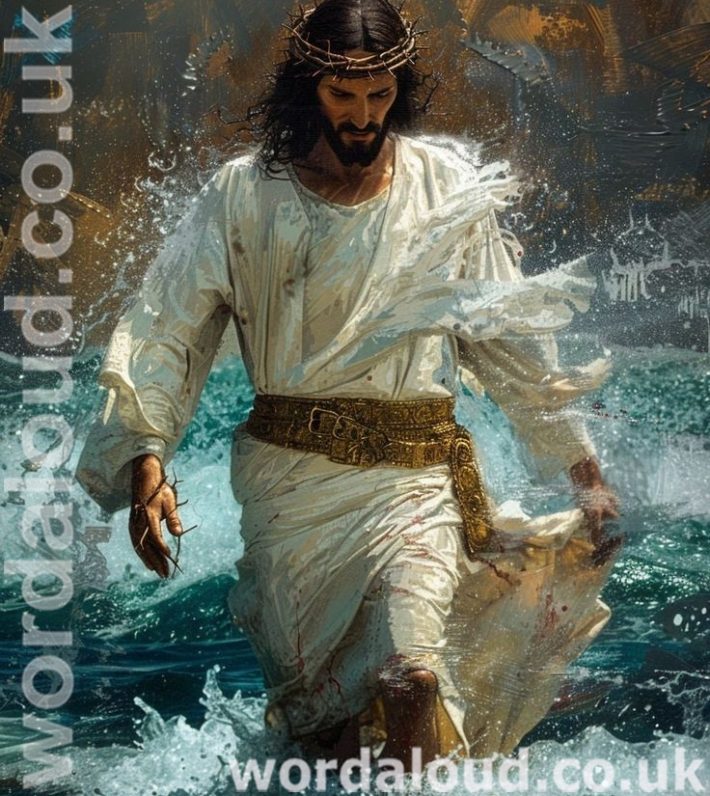
Christian Art | Jesus Walks Through Water | Our Baptism Of Christian Faith
Office Of Readings | Week 29, Saturday, Ordinary Time | A Reading From The Sermons Of Saint Peter Chrysologus | The Word, The Wisdom Of God, Was Made Flesh
‘The Word, the Wisdom of God, was made flesh.’
Saint Peter Chrysologus contrasts the two Adams to show the transformation of human nature through Christ. The first man, Adam, is the origin of the human race in its mortality; the second, Christ, is the origin of its renewal and life. Both share the same humanity, but they differ absolutely in their source and purpose. Adam received life; Christ gives it. Adam was shaped from the earth; Christ took flesh from the Virgin, raising human nature into union with God.
The structure of Chrysologus’s argument reflects the logic of early Christian theology: creation and redemption are bound together. The one who made Adam is the same who later became man to restore what had fallen. The ‘image’ stamped on the first Adam finds its completion in the second. What was made in the beginning is re-made in the Incarnation. Thus, when Christ calls himself ‘the first and the last’, he affirms both his eternal divinity and his redemptive action within time.
Chrysologus also draws on Saint Paul’s contrast between the earthly and heavenly man. The first is bound to the dust; the second belongs to heaven. Yet those who are born of the earth may still come to share in the heavenly life, not by natural descent but by spiritual rebirth. Through baptism — ‘the virginal font’ animated by the Spirit — human beings are recreated in the likeness of their Maker. The same Spirit who formed Christ in the Virgin’s womb now forms Christ’s image within the baptised.
The homily turns doctrine into exhortation. To be made in the image of the heavenly man is not only a state but a calling. The likeness of God is to be expressed in conduct: innocence, gentleness, humility, mercy, and peace. These are the visible signs of divine likeness within human life. In this moral transformation, the mystery of the Incarnation continues — the Word made flesh now refashioning human flesh into the image of God.
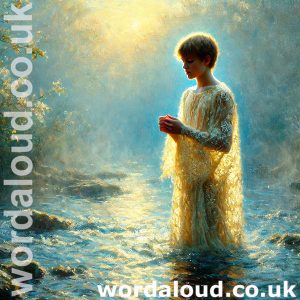
A Reading From The Sermons Of Saint Peter Chrysologus | The Word, The Wisdom Of God, Was Made Flesh
The holy Apostle has told us that the human race takes its origin from two men, Adam and Christ; two men equal in body but unequal in merit, wholly alike in their physical structure but totally unlike in the very origin of their being. The first man, Adam, he says, became a living soul, the last Adam a life-giving Spirit.
The first Adam was made by the last Adam, from whom he also received his soul, to give him life. The last Adam was formed by his own action; he did not have to wait for life to be given him by someone else, but was the only one who could give life to all. The first Adam was formed from valueless clay, the second Adam came forth from the precious womb of the Virgin. In the case of the first Adam, earth was changed into flesh; in the case of the second Adam, flesh was raised up to be God.
What more need be said? The second Adam stamped his image on the first Adam when he created him. That is why he took on himself the role, and the name, of the first Adam, in order that he might not lose what he had made in his own image. The first Adam, the last Adam; the first had a beginning, the last knows no end. The last Adam is indeed the first; as he himself says: I am the first and the last.
I am the first, that is, I have no beginning. I am the last, that is, I have no end. But what was spiritual, says the Apostle, did not come first, what was living came first, then what is spiritual. The earth comes before its fruit, but the earth is not so valuable as its fruit. The earth exacts pain and toil; its fruit bestows subsistence and life. The prophet rightly boasted of this fruit: Our earth has yielded its fruit. What is this fruit? The fruit referred to in another place: I will place upon your throne one who is the fruit of your body. The first man, says the Apostle, was made from the earth and belongs to the earth; the second man is from heaven, and belongs to heaven.
The man made from the earth is the pattern of those who belong to the earth; the man from heaven is the pattern of those who belong to heaven. How is it that these last, though they do not belong to heaven by birth, will yet belong to heaven, men who do not remain what they were by birth but persevere in being what they have become by rebirth? The reason is, brethren, that the heavenly Spirit, by the mysterious infusion of his light, gives fertility to the womb of the virginal font. The Spirit brings forth as men belonging to heaven those whose earthly ancestry brought them forth as men belonging to the earth, and in a condition of wretchedness; he gives them the likeness of their Creator. Now that we are reborn, refashioned in the image of our Creator, we must fulfil what the Apostle commands: So, as we have worn the likeness of the man of earth, let us also wear the likeness of the man of heaven.
Now that we are reborn, as I have said, in the likeness of our Lord, and have indeed been adopted by God as his children, let us put on the complete image of our Creator so as to be wholly like him, not in the glory that he alone possesses, but in innocence, simplicity, gentleness, patience, humility, mercy, harmony, those qualities in which he chose to become, and to be, one with us.
Christian Prayer With Jesus
Eternal Word,
you shaped the first man from the earth
and took flesh to restore your image in us.
Through the Spirit who gives new birth,
make us bear the likeness of the heavenly man.
Grant that our lives may reflect your gentleness and mercy,
your patience and humility,
until the glory of your image is complete in us
and we share the life you have made our own.
Amen.
A Brief Biography Of Saint Peter Chrysologus
Saint Peter Chrysologus was bishop of Ravenna in the fifth century and is honoured as one of the great Latin Fathers of the Church. His surname Chrysologus, meaning ‘golden-worded’, was given in recognition of his gift for eloquence and his ability to convey complex theological ideas with clarity and brevity. Though comparatively little is known about his life, his surviving sermons reveal a pastor of deep learning, precision of thought, and practical concern for his people.
Peter was born at Imola in northern Italy around the year 380. He was ordained deacon by Cornelius, bishop of Imola, who recognised his promise as a preacher and teacher. In about 433 he was appointed bishop of Ravenna, then the imperial capital of the Western Roman Empire. According to later tradition, his appointment followed a vision experienced by Pope Sixtus III, who saw Peter chosen by divine will for the see.
As bishop, Peter served at a time of doctrinal dispute and political uncertainty. The unity of the Western Church was strained by heresies such as Monophysitism and by the decline of imperial authority in Italy. Peter’s response was not polemical but pastoral. His surviving homilies — around 180 in number — address moral and doctrinal themes with striking economy of expression. He insists on the full humanity and divinity of Christ, the reality of the Incarnation, and the necessity of moral transformation through baptism and charity.
Peter’s preaching style reflects the classical rhetorical training of late antiquity, but his purpose is always practical: to lead his listeners to repentance and renewed life in Christ. He frequently employs vivid imagery drawn from Scripture — the womb, the seed, the mirror, the refashioned clay — to communicate how divine grace restores what sin has disfigured. His sermons on the Incarnation and the two Adams exemplify his theology: creation and redemption are two moments of the same divine act, the restoration of the image of God in humanity.
Saint Peter Chrysologus died around 450, probably in Imola, the city of his birth. He was declared a Doctor of the Church by Pope Benedict XIII in 1729. His feast is celebrated on 30 July, and he remains a model of concise preaching and theological clarity — a bishop whose ‘golden words’ continue to speak with pastoral insight and enduring relevance.
Glossary Of Christian Terms
Adam / Christ (Two Adams) – A theological comparison from 1 Corinthians 15:45; Adam represents humanity’s natural origin and mortality, Christ its renewal and immortality.
Living soul / life-giving Spirit – Paul’s contrast between Adam, who received life, and Christ, who imparts it.
Virginal font – A metaphor for baptism, comparing the baptismal waters to the Virgin’s womb, both made fruitful by the Holy Spirit.
Man of earth / man of heaven – The earthly and heavenly forms of humanity; the former marked by sin and death, the latter by divine likeness through grace.
Image of the Creator – Humanity’s original state as created in God’s image, restored through Christ’s Incarnation and the work of the Spirit.



Scripture: John 14:27 ‘Peace I leave with you; my peace I give you. I do not give to you as the world gives. Do not let your hearts be troubled and do not be afraid.’ In this verse, Jesus offers his peace to his disciples, a peace that is different from what the world provides. This divine peace is deep, abiding, and capable of calming troubled hearts and dispelling fear. It is a peace that surpasses all understanding and is rooted in the presence and promises of Christ. Prayer Dear Jesus, I come before you, seeking your peace in my life. The world around me is filled with chaos and uncertainty, but I know that your peace can calm the storm within my heart. Help me to trust in you more deeply, to rest in your promises, and to feel your presence in every moment. Fill me with your peace that surpasses all understanding, and help me to be a vessel of your peace to those around me. Amen. Personal Reflection What areas of your life are causing you anxiety or fear? How can you invite Jesus’ peace into these areas? Reflect on a time when you experienced Christ’s peace amidst turmoil. Meditation On Prayer And Gospel John 14:27 reveals a profound truth about the nature of Jesus’ peace. Unlike the fleeting and often superficial peace offered by the world, Jesus’ peace is enduring and deeply transformative. This peace is not dependent on external circumstances but is anchored in the character and promises of Christ. As we navigate through life’s challenges, it’s crucial to understand and embrace this divine peace. Jesus’ peace is rooted in his presence. When he says, ‘Peace I leave with you; my peace I give you,’ Jesus is assuring us of his continual presence. This peace is a gift that flows from his abiding presence in our lives. It is a reminder that we are never alone, no matter what we face. his presence brings comfort and security, allowing us to rest even in the midst of life’s storms. Furthermore, Jesus contrasts his peace with the peace that the world gives. The world’s peace is often conditional and temporary, based on circumstances that can change in an instant. In contrast, Jesus’ peace is steadfast and eternal. It is a peace that reassures us in our deepest fears and anxieties, reminding us that he is in control. This peace transcends our understanding, as it is grounded in the eternal and unchanging nature of God. To experience Jesus’ peace, we must cultivate a relationship with him. This involves spending time in prayer, meditating on his word, and seeking his presence in our daily lives. It also means surrendering our worries and fears to Jesus, trusting that Jesus will provide and protect. As we draw closer to Jesus, his peace fills our hearts and minds, transforming our outlook and calming our spirits. One practical way to embrace Jesus’ peace is through prayer and meditation. By setting aside time each day to be still before the Lord, we create space for his peace to fill us. Reflecting on scriptures like John 14:27 can remind us of his promises and help us focus on his presence. Additionally, practicing gratitude can shift our focus from our worries to the many blessings in our lives, further opening our hearts to his peace. Another aspect of embracing Jesus’ peace is learning to let go of control. Often, our anxiety stems from a desire to control our circumstances. Jesus invites us to trust in his sovereign plan, even when we do not understand it. By surrendering our need for control and placing our trust in Him, we open ourselves to the peace that comes from knowing that He holds all things in his hands. Living in Jesus’ peace also means becoming peacemakers in our relationships and communities. As we experience his peace, we are called to extend that peace to others. This involves forgiving those who have wronged us, seeking reconciliation, and promoting harmony wherever we go. By being agents of his peace, we reflect his love and grace to a world in desperate need of his presence. Prayer Lord Jesus, Your peace is a precious gift that the world cannot give. In times of turmoil and distress, remind me to turn to you. Let your peace guard my heart and mind, dispelling all fear and anxiety. Teach me to trust in your unfailing love and to rest in your promises. Help me to be a peacemaker, sharing your peace with those around me. May your peace reign in my heart, my home, and my relationships. Thank you for your constant presence and the gift of your peace. Amen. Scripture: Matthew 5:9 ‘Blessed are the peacemakers, for they will be called children of God.’ Blessing May the peace of our Lord Jesus Christ fill your heart and mind, guiding you through every challenge and bringing you comfort and joy. May you rest in his unending peace and share it generously with those around you. Amen.
Psalm 35 is a plea for divine intervention and justice. This psalm, attributed to King David, encapsulates turmoil of a soul unjustly persecuted, seeking vindication and deliverance from those who harm him [ … ]

This is among the most perfect of the parables to listen to during Lent – indeed, it has resonances that must extent to each and every time we receive the Eucharist. We are simply not worthy. And God’s mercy extends to us nonetheless. The prayer of the Pharisee is false. It is not true prayer. We see him, standing there in the presence of God and congratulating himself, as if he does not need God for his redemption, as if he can redeem himself [ … ]