
Christian Art | Do Not Be Afraid | It Is Possible | The Annunciation | The Angel Gabriel Visits Mary
Office Of Readings | Week 31, Monday, Ordinary Time | A Reading From The Pastoral Constitution On The Church In The Modern World Of The Second Vatican Council | Gaudium Et Spes | Re-education For Peace
‘Re-education for peace.’
This passage from Gaudium et Spes develops the Council’s moral and spiritual understanding of peace as a human vocation requiring renewal of thought and will. Peace is not sustained merely by diplomatic measures or institutional structures but depends on an inner conversion of persons and societies. The Council describes this as ‘re-education’ — a reshaping of conscience and culture to overcome hostility, prejudice, and indifference.
The text begins with an analysis of responsibility. Public officials and citizens are interdependent: statesmen rely on the moral and intellectual maturity of their peoples, and societies reflect the dispositions of individuals. As long as attitudes of ‘hostility, contempt and distrust’ persist, political strategies for peace remain ineffective. The work of peace, therefore, begins in the formation of opinion and the cultivation of virtue. Education, especially among the young, becomes a theological as well as civic task — to form minds capable of universal vision and wills disposed to justice.
The Council calls for a ‘change of heart’ — the biblical metanoia — as the essential foundation of this reeducation. It links personal conversion to global solidarity, urging humanity to see itself as one family. Without such conversion, even technological progress can become destructive, leading to the ‘awful peace of death’. This phrase encapsulates the paradox of modern civilisation: immense scientific advance coupled with moral peril.
The constitution insists, however, that Christian hope endures. The Church, though living amid anxiety and conflict, continues to proclaim the time of grace and conversion. Hope is not naïve optimism but the recognition that divine mercy is active in history.
Finally, the text examines the causes of discord — injustice, economic inequality, pride, domination, and envy — and identifies them as violations of the moral order. Peace cannot coexist with structures or attitudes that deny human dignity. The Council urges cooperation among international institutions to prevent violence and to promote justice through coordination and solidarity. Peace is presented as both task and grace: it demands structural reform and personal renewal, sustained by faith in the transforming power of God’s Spirit.

A Reading From The Pastoral Constitution On The Church In The Modern World Of The Second Vatican Council | Gaudium Et Spes | Re-education For Peace
Men must not be content simply to support the efforts of others in the work for peace; they must also scrutinize their own attitudes. Statesmen, responsible as they are for the common good of their own nation and at the same time for the well-being of the whole world, are very much dependent on the opinions and convictions of the general public. Their efforts to secure peace are of no avail as long as men are divided or set against each other by feelings of hostility, contempt and distrust, by racial hatred or by inflexible ideologies. There is then a very great and urgent need to reeducate men and to provide fresh inspiration in the field of public opinion.
Those engaged in education, especially among young people, and those who influence public opinion, should consider it a very serious responsibility to work for the reeducation of mankind to a new attitude toward peace. We must all undergo a change of heart. We must look out on the whole world and see the tasks that we can all do together to promote the well-being of the family of man. We must not be misled by a false sense of hope. Unless antagonism and hatred are abandoned, unless binding and honest agreements are concluded, safeguarding universal peace in the future, mankind, already in grave peril, may well face in spite of its marvelous advance in knowledge that day of disaster when it knows no other peace than the awful peace of death.
In saying this, however, the Church of Christ, living as it does in the midst of these anxious times, continues unwaveringly in hope. Time and again, in season and out of season, it seeks to proclaim to our age the message of the Apostle: Now is the hour of God’s favor, the hour for change of heart; now is the day of salvation.
To build peace, the causes of human discord which feed the fires of war must first be eliminated, and among these especially the violations of justice. Many of these causes are due to gross economic inequality and delay in providing necessary remedies. Others arise from a spirit of domination and from a contempt for others, and, among more fundamental causes, from human envy, distrust, pride and other forms of selfishness. Since man cannot bear so many violations of due order, the result is that, even where war does not rage, the world is constantly plagued by human conflict and acts of violence.
The same evils are also found in relations between nations. It is therefore absolutely necessary that international institutions should cooperate more effectively, more resolutely and with greater coordination of effort, in order to overcome or prevent these evils, and to check unbridled acts of violence. There must also be constant encouragement for the creation of organizations designed to promote peace.
Christian Prayer With Jesus
Lord of all peoples,
you call the world to conversion of heart and mind.
Dispel the fear and mistrust that divide your children;
teach us to see one another as members of one family.
Renew in us the desire for truth and justice;
strengthen all who work for reconciliation and peace.
May our learning and labour serve the common good,
and our hope be anchored in your steadfast mercy.
Grant that through your Spirit
we may build not the peace of silence or death,
but the living peace of your kingdom,
where justice and love endure for ever.
Through Christ our Lord.
Amen.
Glossary Of Christian Terms
Metanoia: A Greek term meaning conversion or change of heart; in Christian theology, the inner transformation that aligns human will with divine will.
Public Opinion: The collective moral and intellectual disposition of a society; shaped through education, media, and culture, it determines the effectiveness of political action.
Solidarity: The recognition of mutual responsibility among individuals and nations; the social virtue that sustains peace and justice.
Inequality: A structural or moral imbalance in the distribution of wealth, power, or opportunity; identified as a root cause of conflict.
Common Good: The set of conditions that allow all members of a community to flourish; the moral end of politics and international cooperation.
Structural Sin: The persistence of social or institutional patterns that perpetuate injustice and division, even beyond individual intentions.
Providence: The divine governance of history; the conviction that human effort toward peace participates in God’s sustaining will.
Moral Order: The network of principles that express the right relationship between persons and communities; the framework within which true peace is possible.
Reeducation: The deliberate effort to reshape thought, culture, and institutions toward moral and spiritual renewal; a continual task for both Church and society.




As Jesus offers prayer to God the Father we may find ourselves trying to fathom just what it might mean for Jesus to have been God incarnate, God the Son humbling himself to be born human [ … ]

Theodoret takes his starting point from Isaiah 53, the ‘Suffering Servant’ passage, which early Christians read as a direct prophecy of Christ’s passion. The language of wounds, bruises and chastisement is interpreted not as a description of punishment deserved by Jesus himself, but as the cost he bore to heal humanity. For Theodoret, the cross is not only an act of endurance but also a medicine—a deliberate remedy for the sickness of sin [ … ]
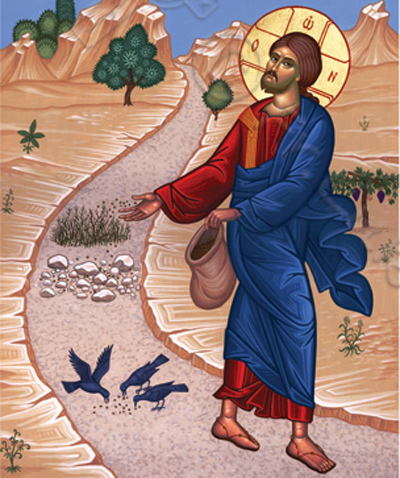
Jesus presents to his listeners an ideal of Christian purity, upon which we must act. There is a judgement, and there the sowings of the evil one will be burnt. It is that within us which is with God, with Jesus, which will shine for all eternity [ … ]