

Christian Art | Jesus Joy Of Our Salvation | To Heaven From Purgatory | Jesus Christ Is King
Office Of Readings | Week 32, Friday, Ordinary Time | A Reading From A Homily Of A Second-Century Author | Let Us Turn To God Who Has Called Us
‘Let us return to God who has called us.’
The homily reflects the concerns of an early Christian community navigating moral uncertainty, delayed fulfilment, and the practical demands of discipleship. Its tone is pastoral rather than speculative, grounding theological claims in concrete habits of life. The homilist’s central conviction is that the believer’s return to God is both possible and urgent, and that this return takes shape through self-control, repentance, charity, and mutual responsibility within the community.
The opening section links self-control with salvation. The homilist presents moral discipline not as a private achievement but as a response to divine initiative. God has already called; the human task is to return. This framework assumes a reciprocal relationship between divine generosity and human responsibility. The emphasis on advising, listening, and mutual benefit suggests an early Christian understanding of moral teaching as a shared task: the soul of the teacher is bound to the soul of the hearer.
The homilist then develops a theology of prayer grounded in divine readiness. God’s statement, ‘See, I am here!’ is interpreted as evidence that divine generosity precedes human request. The challenge is not persuading God to act but forming a life capable of receiving his gifts, hence the insistence on upright living, which is not presented as a way of earning favour but as the condition in which one prays without anxiety. A tension emerges between divine abundance and human negligence: the blessings available to the faithful bring either joy or judgement depending on one’s response.
The homily moves next to repentance. Time is described as an open opportunity, but not an indefinite one. Renouncing destructive desires and exercising self-control are framed as acts that align the believer with the mercy of Christ. This is not an abstract virtue but a turning away from the restless pursuit of fleeting pleasures. The underlying anthropology is sober: human desire, undirected, is capable of sabotaging its own good.
A vivid apocalyptic passage marks a shift in tone. The description of the day of judgement—cosmic dissolution, universal revelation of deeds—serves to situate present moral effort within an eschatological horizon. Divine scrutiny is universal and indiscriminate; nothing remains hidden. The ensuing comparison of practices—fasting, prayer, almsgiving—presents charity as the most far-reaching form of atonement, because it embodies the love that ‘covers a multitude of sins.’ The homilist does not dismiss prayer or fasting; rather, he orders them within a hierarchy of practices that restore communion with God and neighbour.
The reading turns to communal responsibility. The command to ‘rescue idolaters’ becomes an argument for even greater diligence toward those already within the Christian community. Moral failure is never purely individual; it affects the body to which one belongs. Warning, instructing, and supporting one another are presented as obligations, not optional acts of goodwill. This is an early expression of what later theology will describe as mutual edification: salvation is a shared endeavour.

A Reading From A Homily Of A Second-Century Author | Let Us Turn To God Who Has Called Us
With regard to self-control, I believe I have given you good advice. No one who follows it will have reason for regret but will save his own soul and mine as well, since I have been his counsellor. Indeed there is no small reward for converting an erring soul and saving it from perishing. Moreover, whether it is our duty to speak or to listen, we have it in our power to make some recompense to the God who created us, by speaking or listening with faith and love.
We must remain firm in our faith, therefore, and live upright and holy lives, for we shall then feel at ease and confident when we present our petitions to God, who says: While you are still speaking I will say: ‘See, I am here!’ In these words the Lord makes a wonderful promise, and shows us that he is more ready to give than we are to ask. We all have a share in this extraordinary goodness, so the great blessings we receive should never make us envy one another. In fact, the degree of pleasure these words bring to those who live by them is equalled only by the condemnation they will bring on those who disregard them.
So you see, my brothers, that we have been given every inducement to amend our lives. We have been called by God, and now it is up to us to return to him while we still have time and one who is ready to receive us. For if we renounce sinful pleasures and practice self control by refusing to yield to our evil desires, we shall share in the mercy of Jesus.
You must know, however, that the day of judgment, like a flaming furnace, is already approaching. Sun, moon and stars will be consumed, and the whole earth will become like lead melting in the fire. All that each man has done, whether openly or in secret, will then be brought to light. Therefore, a very good way of atoning for our sins is by being generous to the poor. Fasting is better than prayer, but almsgiving surpasses both, for love covers a multitude of sins. Nevertheless, prayer delivers the soul from death if it proceeds from a good conscience. Happy the man who is found rich in these virtues; by relieving the poor, he himself will be relieved of his sins.
To make sure that none of us is lost, we must repent from the bottom of our hearts. Since we have been commanded to go out and rescue idolaters and to instruct them, is it not even more important to save souls who already know God? If we are all to be saved, we shall have to help one another and support the weak in their struggle to live a good life. When one of us does wrong, it is for the others to warn him and persuade him of his error.
Christian Prayer With Jesus Christ
O God,
who call your people into the life of your Son
and form the Church as his living body,
grant that we may live with integrity
worthy of the grace we have received.
Cleanse our hearts, steady our conduct,
and unite our lives with the holiness of your Spirit,
that the world may see in us
the clarity of the gospel we confess.
Strengthen us to protect the weak,
to restore those who falter,
and to honour in one another
the image of Christ your Son.
Lead us towards the life that has no end,
where the glory prepared for your faithful people
is revealed beyond all telling.
Through Christ our Lord.
Amen.
Glossary Of Christian Terms
Ascetic – Relating to disciplined practices that restrain desire for the sake of spiritual focus.
Anthropology (theological) – Reflection on the nature, purpose and destiny of the human person in relation to God.
Corporeal – Pertaining to the body; used here to describe the physical dimension of Christian life in relation to the Church.
Ecclesiology – The theological study of the nature and structure of the Church.
Eschatological – Concerning the ultimate fulfilment of God’s purposes, including judgement, resurrection and the life of the world to come.
Hypocrisy – A discrepancy between what one professes and how one lives; a key concern of the homily’s moral critique.
Incarnation – The Christian belief that the eternal Word of God became human in Jesus Christ.
Nuptial imagery – Symbolic language using the relationship of bride and bridegroom to express the union between Christ and the Church.
Primordial – Existing from the beginning; used here to describe the Church’s pre-temporal reality in the divine will.
Sacramental – Referring to visible signs that express or communicate divine grace.
Theophany – A manifestation or disclosure of divine presence; implied in the idea that the Church makes visible an eternal reality.
Vicegerency – Acting on behalf of another, particularly in representing authority or purpose; relevant to the homily’s account of embodied witness.



Psalm 105, a hymn of praise in the Hebrew Bible, is testament to God’s enduring faithfulness and mighty deeds throughout the history of Israel. This psalm is a celebration of God’s covenant with Abraham and the fulfilment of God’s promises through subsequent generations, culminating in the deliverance of the Israelites from Egypt and their journey to the Promised Land [ … ]

Leo begins by asserting that the forty days following the Resurrection were not idle or incidental. Rather, they were filled with ‘great mysteries’ and ‘deep truths’ revealed by Christ. This aligns with Luke’s account (Acts 1:3), where Jesus ‘presented himself alive… by many convincing proofs, appearing to them during forty days and speaking about the kingdom of God’. The period is thus both transitional and transformational: it bridges the historical mission of Christ with the future mission of the Church, mediated by the Apostles [ … ]
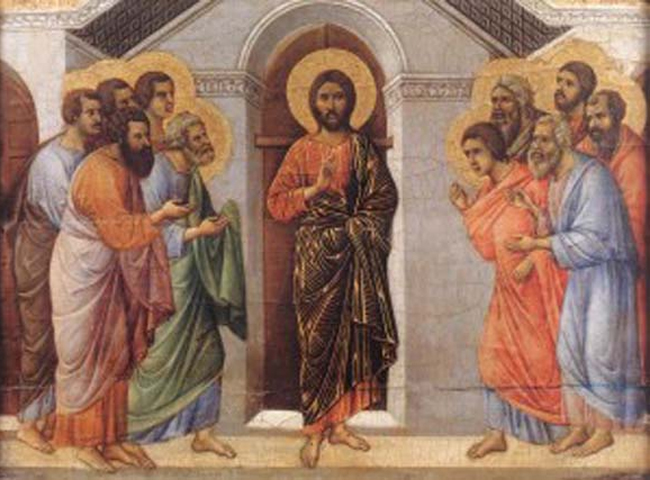
The disciples who encountered Jesus on their way to Emmaus have returned in haste to tell the disciples in Jerusalem what they have heard and seen. Jerusalem has long been a city special to God. It is the Holy City. The Church of Christ is described, in the New Testament, as the Jerusalem above, the heavenly Jerusalem, and the new Jerusalem. It is here that Christ suffered. It is from here that the Kingdom of God begins to spread [ … ]
