
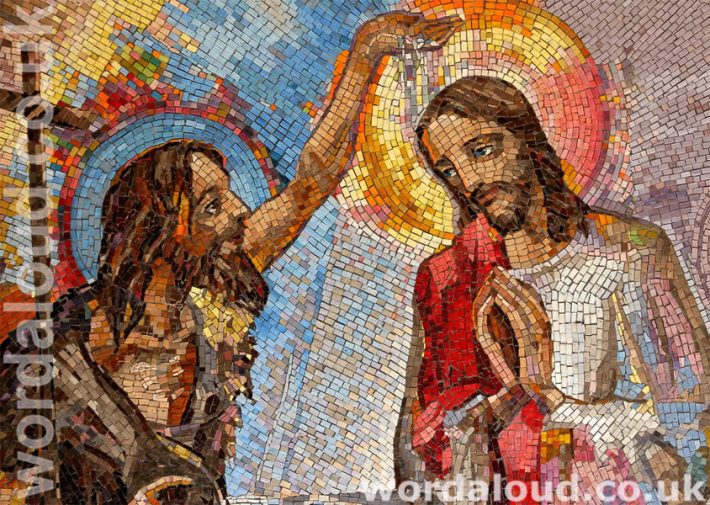
Christian Art: Baptism Of The Lord Jesus
Office Of Readings | Week 5, Ordinary Time, Friday | A Reading From The Sermons Of Pope Saint Leo The Great | Learn To Know The Dignity Of Your Nature
‘Let Christ be formed in you.’
This sermon, attributed to Leo the Great, develops the theme of ‘Christ being formed in the believer’ by situating it within a broader account of creation, incarnation, and eschatological fulfilment. In contrast to the more pastoral and introspective tone of Augustine of Hippo, Leo adopts a declarative and liturgical style, marked by rhetorical elevation and doctrinal clarity.
The opening establishes the central paradox of Christian faith: in Jesus Christ, true humanity and true divinity are united without diminution. Leo presents the Incarnation not merely as a redemptive intervention but as the inauguration of a ‘new creation’. The emphasis falls on origin: Christ’s birth is not only an event in time but the source of a transformed mode of human existence. This shift from natural to ‘spiritual origin’ frames the entire passage. The language of reversal—guilt to innocence, old to new, exclusion to inheritance—serves to underscore the radical nature of this transformation. It is not incremental but ontological.
Leo’s exhortation, ‘recognise the dignity of your nature’, echoes a familiar patristic concern to affirm the enduring significance of the imago Dei. Humanity, though ‘corrupted in Adam’, is not annulled but restored in Christ. This restoration is not abstract: it entails a renewed perception of the created world. Leo is careful to avoid any suggestion of dualism. Creation remains good, and its beauty is to be received with gratitude. Yet this affirmation is qualified by a hierarchy of perception. Sensory apprehension of the natural world is legitimate, but it must give way to a deeper, interior apprehension of the ‘true light’. The distinction here is not between material and immaterial as such, but between what is mediated through the senses and what is grasped by the soul.
The sermon’s treatment of creation is notably balanced. Leo resists both ascetic rejection and unreflective enjoyment. His appeal is for right use—measured, ordered, and directed towards the Creator. This reflects a classical theological ethic in which the value of created things lies not in themselves alone but in their capacity to lead the mind towards God. The citation from Second Epistle to the Corinthians—’the things that are seen are transient’—introduces an eschatological criterion. The visible world is affirmed, yet relativised. Its transience demands a reorientation of desire towards what endures.
This eschatological dimension becomes more explicit in the latter part of the text. Leo articulates a twofold birth: one into the present order, another into the future. The Christian life is thus defined by tension between what is and what is promised. The language drawn from Epistle to the Colossians—’your life is hidden with Christ in God’—reinforces this hiddenness. The believer’s true identity is not yet fully manifest; it awaits revelation in glory. This introduces a note of reserve into Leo’s otherwise confident tone. Transformation has begun, but its completion lies beyond present experience.
What distinguishes Leo’s treatment is the integration of cosmological, moral, and eschatological themes within a single framework. The formation of Christ in the believer is not described in psychological terms, as in Augustine, but in terms of participation in a new order of being inaugurated by Christ. The emphasis is less on interior process and more on objective status: adoption, inheritance, and future glorification.
In sum, the sermon presents a vision of Christian existence grounded in the Incarnation, sustained by right relation to creation, and oriented towards a future revelation of glory. Its theological coherence lies in its capacity to hold together affirmation of the world and detachment from it, present transformation and future fulfilment, human dignity and divine grace.
A Reading From The Sermons Of Pope Saint Leo The Great | Learn To Know The Dignity Of Your Nature
Our Lord Jesus Christ, born true man without ever ceasing to be true God, began in his person a new creation and by the manner of his birth gave man a spiritual origin. What mind can grasp this mystery, what tongue can fittingly recount this gift of love? Guilt becomes innocence, old becomes new, strangers are adopted and outsiders are made heirs. Rouse yourself, man, and recognize the dignity of your nature. Remember that you were made in God’s image; though corrupted in Adam, that image has been restored in Christ.
Use creatures as they should be used: the earth, the sea, the sky, the air, the springs and the rivers. Give praise and glory to their Creator for all that you find beautiful and wonderful in them. See with your bodily eyes the light that shines on earth, but embrace with your whole soul and all your affections the true light which enlightens every man who comes into this world. Speaking of this light the prophet said: Draw close to him and let his light shine upon you and your face will not blush with shame. If we are indeed the temple of God and if the Spirit of God lives in us, then what every believer has within himself is greater than what he admires in the skies.
Our words and exhortations are not intended to make you disdain God’s works or think there is anything contrary to your faith in creation, for the good God has himself made all things good. What we do ask is that you use reasonably and with moderation all the marvellous creatures which adorn this world; as the Apostle says: The things that are seen are transient but the things that are unseen are eternal.
For we are born in the present only to be reborn in the future. Our attachment, therefore, should not be to the transitory; instead, we must be intent upon the eternal. Let us think of how divine grace has transformed our earthly natures so that we may contemplate more closely our heavenly hope. We hear the Apostle say: You are dead and your life is hidden with Christ in God. But when Christ you life appears, then you will also appear in glory with him, who lives and reigns with the Father and the Holy Spirit for ever and ever. Amen.
Christian Prayer With Jesus
O God,
who in Jesus Christ have renewed our nature
and called us into a new creation,
grant that Christ may be formed within us.
Teach us to recognise the dignity you have given us,
restored not by our own striving but by your grace.
Order our desires,
that we may use the good things of this world rightly,
and seek above all what endures.
Strengthen us in faith,
that we may not be led astray,
but grow towards maturity in Christ.
Keep before us the hope of glory,
when what is now hidden shall be revealed.
Through the same Christ our Lord
Amen
Glossary Of Christian Terms
Incarnation
The doctrine that God became man in Jesus Christ, fully divine and fully human.
Grace
The free and unmerited gift of God’s favour, by which human beings are transformed and enabled to share in divine life.
Imago Dei (Image of God)
The belief that humanity is created in the image and likeness of God, giving each person inherent dignity.
Redemption
The act by which humanity is delivered from sin and restored to relationship with God through Christ.
Salvation
The process and state of being saved from sin and its consequences, culminating in eternal life with God.
Faith
Trust in God and assent to divine truth, not merely intellectual agreement but a lived commitment.
Church
The community of believers, understood both as a visible body and as a spiritual reality united in Christ.
Sanctification
The ongoing process by which a believer is made holy, growing in conformity to Christ.
Justification
The act by which God declares a person righteous, not on account of their own merit but through grace.
Eschatology
The study of ‘last things’: death, judgement, heaven, and the final fulfilment of God’s purposes.
Apostle
One sent with authority; in the New Testament, especially the early witnesses such as Paul the Apostle.
Epistle
A letter, particularly those written by apostles and included in the New Testament (e.g. the Epistle to the Galatians).
Glory
The manifestation of God’s presence and majesty, and the state of final blessedness promised to believers.
New Creation
The renewed state of humanity and the world brought about through Christ, marking a transformation of existence rather than mere reform.
Temple of the Holy Spirit
An image describing the believer as indwelt by God’s Spirit, signifying holiness and divine presence within.



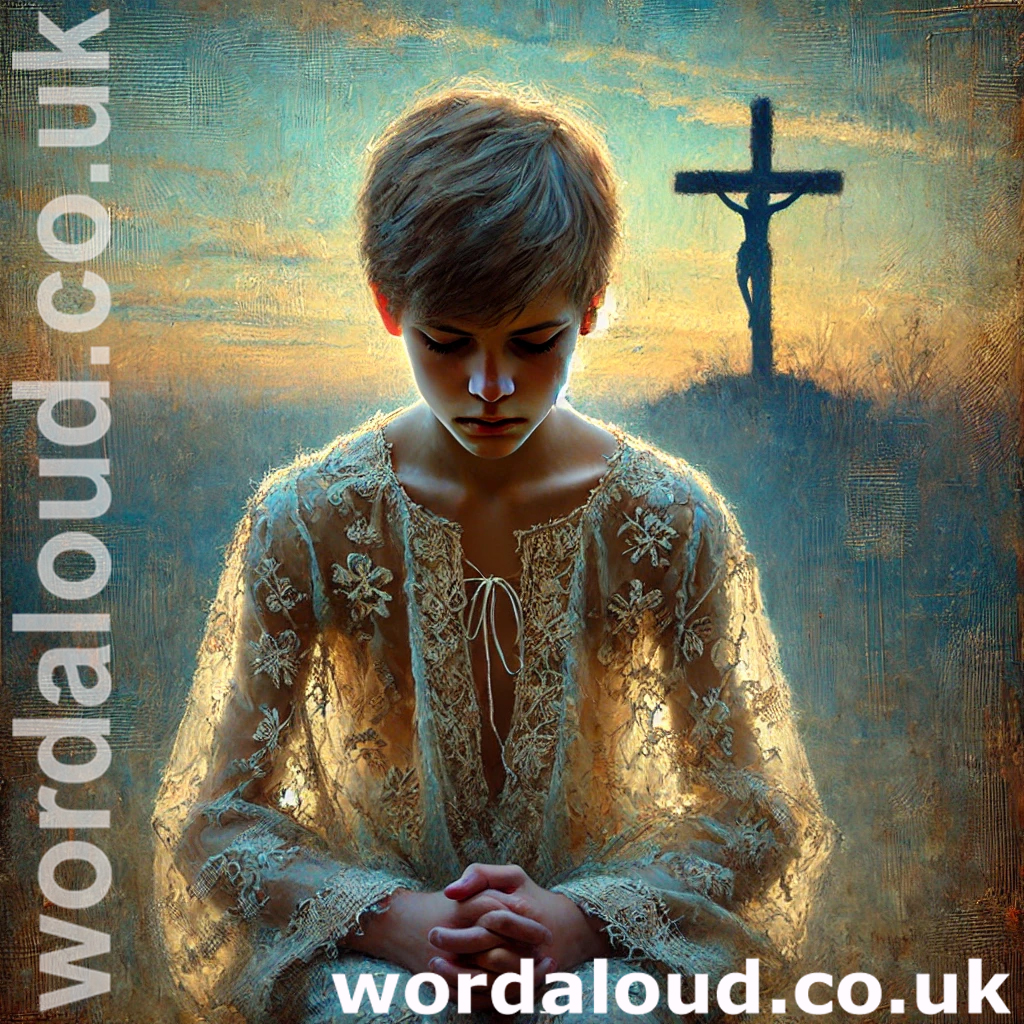
Saint Augustine begins by naming the Passion of Christ as ‘the hope of glory and a lesson in patience’. In other words, it is both a promise and a pattern. The Cross, he tells us, is not only what saves us—it also teaches us how to live. It shows us how God loves, and how we are called to love in return: not with power or prestige, but with endurance, humility, and self-giving [ … ]
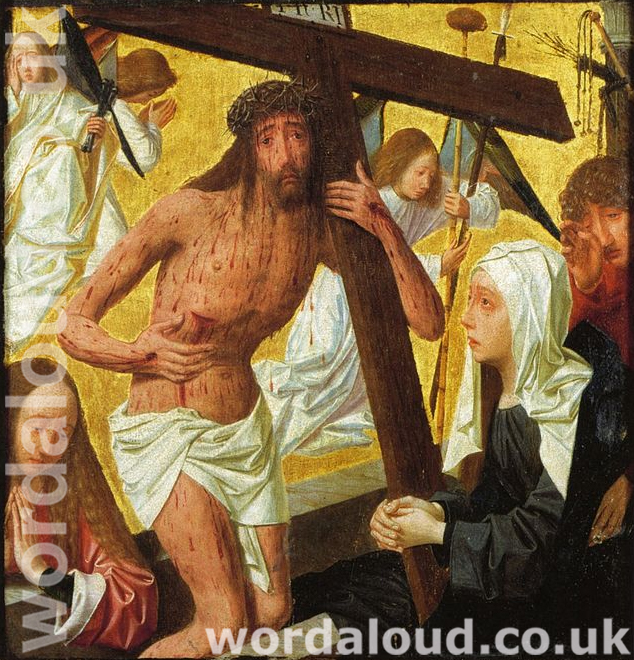
In this reading, Saint Ambrose reflects on Saint Paul’s teaching about life in the Spirit and the dignity given to believers as children of God. His focus is on adoption, inheritance, and hope, all of which shape the Christian understanding of suffering and future glory [ … ]
Attributed to Barnabas, companion of Paul, most scholars agree the letter was written anonymously between 70 and 135 AD, likely in the Eastern Mediterranean. It is addressed to a Christian audience, probably Gentile, who were negotiating their relationship with Judaism and the Mosaic Law. The destruction of the Jerusalem Temple in AD 70 likely influenced the letter’s critique of sacrificial worship, which could no longer be practised [ … ]
