

Christian Art | George Herbert | The Temple | The Church | Affliction (1)
George Herbert | The Temple | The Church | Affliction (1)
When first thou didst entice to thee my heart,
I thought the service brave:
So many joyes I writ down for my part,
Besides what I might have
Out of my stock of naturall delights,
Augmented with thy gracious benefits.
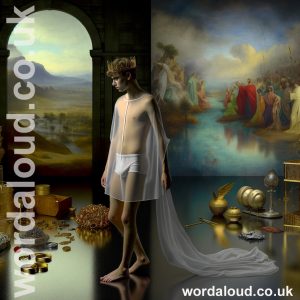
I looked on thy furniture so fine,
And made it fine to me:
Thy glorious houshold-stuffe did me entwine,
And ’tice me unto thee.
Such starres I counted mine: both heav’n and earth
Payd me my wages in a world of mirth.
What pleasures could I want, whose King I served?
Where joyes my fellows were.
Thus argu’d into hopes, my thoughts reserved
No place for grief or fear.
Therefore my sudden soul caught at the place,
And made her youth and fiercenesse seek thy face.
At first thou gav’st me milk and sweetnesses;
I had my wish and way:
My dayes were straw’d with flow’rs and happinesse;
There was no moneth but May.
But with my yeares sorrow did twist and grow,
And made a partie unawares for wo.
My flesh began unto my soul in pain,
Sicknesses cleave my bones;
Consuming agues dwell in ev’ry vein,
And tune my breath to grones.
Sorrow was all my soul; I scarce beleeved,
Till grief did tell me roundly, that I lived.
When I got health, thou took’st away my life,
And more; for my friends die:
My mirth and edge was lost; a blunted knife
Was of more use then I.
Thus thinne and lean without a fence or friend,
I was blown through with ev’ry storm and winde.
Whereas my birth and spirit rather took
The way that takes the town;
Thou didst betray me to a lingring book,
And wrap me in a gown.
I was entangled in the world of strife,
Before I had the power to change my life.
Yet, for I threatned oft the siege to raise,
Not simpring all mine age,
Thou often didst with Academick praise
Melt and dissolve my rage.
I took thy sweetned pill, till I came neare;
I could not go away, nor persevere.
Yet left perchance I should too happie be
In my unhappinesse,
Turning my purge to food, thou throwest me
Into more sicknesses.
Thus doth thy power crosse-bias me, not making
Thine own gift good, yet me from my wayes taking.
Now I am here, what thou wilt do with me
None of my books will show:
I reade, and sigh, and wish I were a tree;
For sure then I should grow
To fruit or shade: at least some bird would trust
Her houshold to me, and I should be just.
Yet, though thou troublest me, I must be meek;
In weaknesse must be stout.
Well, I will change the service, and go seek
Some other master out.
Ah my deare God! though I am clean forgot,
Let me not love thee, if I love thee not.
George Herbert | The Temple | The Church | Affliction (1)
The poem explores the spiritual journey of the poet, George Herbert, reflecting Herbert’s initial enthusiasm for the religious life and his later struggles with faith, disappointment, and suffering. The poem opens by recalling the poet’s early attraction to divine service, which he finds ‘brave’ and full of joy. He describes an idealized experience of religious devotion, where he expected to receive numerous blessings, both from his natural pleasures and the added benefits of God’s grace. At this stage, the poet sees everything in a positive light, imagining that both heaven and earth will provide him with endless happiness.
However, as the poem progresses, the poet’s experiences become more complex and challenging. He begins to feel the burdens of life, which intertwine with sorrow, leading to an awareness that the carefree joy he anticipated is not sustainable. The poet notes how his body and soul are affected by illness, weakness, and grief, and he expresses a profound sense of disillusionment. Herbert’s physical ailments, along with the loss of loved ones and his own spiritual struggles, serve as reminders of his frailty and the impermanence of human existence. This suffering contrasts sharply with the joy he initially envisioned, causing him to question his early assumptions about the nature of divine service.
As the poem unfolds, the poet reflects on the tension between his worldly ambitions and his spiritual calling. He describes his entanglement with academic life and intellectual pursuits, which seem to distract him from religious devotion. Despite his frustrations, the poet is drawn back to God, though this pull is not without its difficulties. Herbert recognizes that his faith does not provide easy answers or solutions to his suffering. Instead, he experiences moments of spiritual stagnation, caught between desire for divine comfort and the reality of continued hardship.
The poet then expresses a desire for peace and simplicity, using the metaphor of wishing to be a tree, which would allow him to grow naturally and provide shelter and nourishment for others. This image conveys his longing for a stable, purposeful existence, free from the inner turmoil that plagues him. Yet, he acknowledges that this wish may remain unfulfilled, as his relationship with God involves ongoing trials and uncertainties.
In the concluding lines, the poet considers the possibility of seeking another ‘master’ or alternative path in life, but ultimately returns to God. Despite feeling forgotten and troubled, he asserts that his love for God persists, even if his circumstances do not improve. This final turn reflects the poet’s deep commitment to his faith, recognizing that his relationship with God is central to his identity, regardless of suffering he endures.
Throughout the poem, Herbert engages with themes of spiritual struggle, suffering, and perseverance. He explores the complexities of faith, acknowledging both its joys and its challenges. The poem’s structure follows the arc of this personal journey, from early enthusiasm to disillusionment, and finally to a humble acceptance of ongoing trials.
George Herbert | A Brief Biography
George Herbert (1593–1633) was a Welsh-born poet, orator, and Anglican priest, known for his deeply religious poetry and commitment to the Christian faith. Educated at Westminster School and Trinity College, Cambridge, Herbert excelled academically and was appointed a public orator at the University of Cambridge. Initially considering a career at court, he later chose the priesthood, influenced by his religious convictions.
In 1630, Herbert became rector of the small parish of Bemerton, near Salisbury. There, he served faithfully, focusing on pastoral duties and personal devotion. His brief life as a clergyman was marked by humility and service, though his health deteriorated quickly.
The collection of poems The Temple was published posthumously. On his deathbed, Herbert entrusted the manuscript to his friend Nicholas Ferrar, instructing him to either publish it or burn it, depending on whether Ferrar thought it would help others in their spiritual journey.




Saint John Chrysostom’s homily on this passage from Saint Paul’s Second Letter to the Corinthians offers both a theological and pastoral meditation on Paul’s appeal for reconciliation. The homily reflects the Apostle Paul’s deep emotional connection to the Corinthian Christians and provides insight into early Christian understandings of love, leadership, and suffering. Saint Chrysostom draws out the human and divine dynamics at work in Paul’s relationship with the church, showing the warmth and vulnerability of a true apostle [ … ]

As Jesus offers prayer to God the Father we may find ourselves trying to fathom just what it might mean for Jesus to have been God incarnate, God the Son humbling himself to be born human [ … ]

The text from Saint Irenaeus, read on Thursday of the third week of Eastertide in the Office of Readings, is a profound theological meditation on the relationship between the Eucharist and the resurrection of the body. It stands not merely as an apologetic against heresy, but as a luminous witness to the Church’s sacramental and eschatological faith—rooted in the Incarnation, expressed through liturgy, and fulfilled in the resurrection [ … ]
