
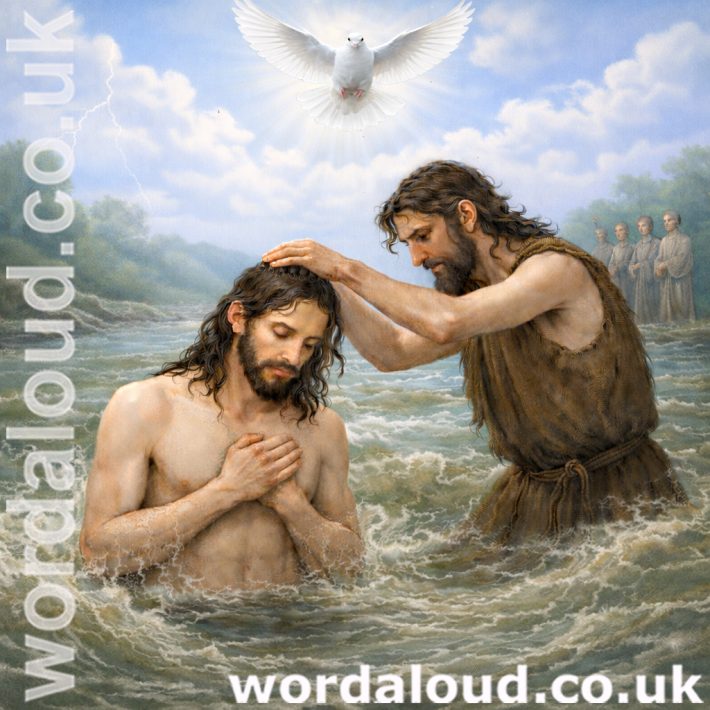
Christian Art: Theophany | Baptism By Jesus By John The Baptist In The River Jordan
Office Of Readings | 8th January | A Reading From The Discourse On The Holy Theophany Attributed To Saint Hippolytus | Water And The Spirit | Theophany
‘Water and the Spirit.’
The reading reflects on the baptism of Christ as a moment of revelation and renewal. The author begins by stressing the paradox of the event: Christ, who is the source of life, enters the waters of the Jordan. The language highlights the contrast between Christ’s divine identity and the humility of his action. The one who sustains creation submits freely to baptism, not out of need, but in obedience to the Father’s will.
The opening of the heavens and the voice of the Father identify Jesus publicly as the Son. This declaration confirms that the one who appears outwardly as a man is, in truth, the eternal Son of God. The discourse insists that Christ’s human weakness does not contradict his divine power. His hunger, weariness, and suffering belong to the same person who feeds, heals, and restores. The unity of divine and human action is central to the meaning of the Theophany.
Attention then turns to water as the means through which God acts. The baptism of Christ is presented as the source from which Christian baptism takes its meaning. Christ enters the water to sanctify it, not to be cleansed himself. Water becomes joined to the Spirit and takes on a new role in God’s saving work.
Baptism is described as a new birth that involves both body and soul. Through water and the Spirit, human beings receive a share in the life of God. Immortality is not presented as escape from the body, but as its renewal. The text links baptism, adoption as children of God, and future resurrection as parts of one continuous gift.
The reading also emphasises human response. Baptism involves renunciation and commitment: turning away from sin and pledging allegiance to Christ. It marks a change of status, from servitude to sonship. The language of inheritance underlines that baptism is not only forgiveness but participation in Christ’s own life.
The conclusion of the reading is doxological. The work of salvation, begun at the baptism of Christ and continued in the Church, is attributed to the Father, the Son, and the Holy Spirit together. The Theophany is therefore both revelation and invitation: God is made known, and humanity is drawn into communion with him.

A Reading From The Discourse On The Holy Theophany Attributed To Saint Hippolytus | Water And The Spirit
That Jesus should come and be baptized by John is surely cause for amazement. To think of the infinite river that gladdens the city of God being bathed in a poor little stream; of the eternal and unfathomable fountainhead that gives life to all men being immersed in the shallow waters of this transient world!
He who fills all creation, leaving no place devoid of his presence, he who is incomprehensible to the angels and hidden from the sight of man, came to be baptized because it was his will. And behold, the heavens opened and a voice said: This is my beloved Son in whom I am well pleased.
The beloved Father begets love, and the immaterial Light generates light inaccessible. This is he who was called the son of Joseph and in his divine nature is my only Son.
This is my beloved Son. Though hungry himself, he feeds thousands; though weary, he refreshes those who labour. He has no place to lay his head yet he holds all creation in his hand. By his suffering he heals all sufferings; by receiving a blow on the cheek he gives the world its liberty; by being pierced in the side he heals the wound in Adam’s side.
And now, please pay close attention, for I want to return to that fountain of life and contemplate its healing waters as they gush out.
The Father of immortality sent his immortal Son and Word into the world, to come to us men and cleanse us with water and the Spirit. To give us a new birth that would make our bodies and souls immortal, he breathed into us the spirit of life and armed us with incorruptibility. Now if we become immortal, we shall also be divine; and if we become divine after rebirth in baptism through water and the Holy Spirit, we shall also be heirs along with Christ, after the resurrection of the dead.
So I cry out, like a herald: Let peoples of every nation come and receive the immortality that flows from baptism. This is the water that is linked to the Spirit, the water that irrigates Paradise, makes the earth fertile, gives growth to plants, and brings forth living creatures. In short, this is the water by which a man receives new birth and life, the water in which even Christ was baptized, the water into which the Holy Spirit descended in the form of a dove.
Whoever goes down into these waters of rebirth with faith renounces the devil and pledges himself to Christ. He repudiates the enemy and confesses that Christ is God, throws off his servitude and becomes an adopted son. He comes up from baptism resplendent as the sun and radiating purity and, above all, he comes as a son of God and a co-heir with Christ.
To him be glory and power, to him and his most holy, good and life-giving Spirit, both now and for ever. Amen.
Christian Prayer With Jesus Christ
Almighty God,
you revealed your Son at the waters of the Jordan
and joined water and the Spirit for our rebirth.
Grant that we who have been baptised
may live as children of your adoption,
renouncing what leads us from you
and remaining faithful to Christ.
May your Spirit renew us day by day
until we share fully in the life you promise.
Through Jesus Christ our Lord.
Amen
Glossary Of Christian Terms
Theophany | The manifestation of God, especially at the baptism of Christ.
Baptism | The sacrament of rebirth through water and the Holy Spirit.
Holy Spirit | The third person of the Trinity, given to renew and sanctify.
Jordan | The river where Christ was baptised by John.
New birth | The transformation of a person through baptism into new life in Christ.
Adoption | The gift by which believers become children of God in Christ.
Immortality | Participation in the life of God that overcomes death.
Renunciation | The rejection of sin and allegiance to evil made at baptism.
Sonship | The relationship with God given through Christ to the baptised.
Resurrection | The future raising of the body to new life through Christ.

Theophany | How God Becomes Known Without Ceasing To Be God
The concept of theophany stands at the centre of biblical religion, yet it is often misunderstood. At its simplest, theophany means ‘the manifestation of God’. But this definition quickly raises deeper questions. What does it mean for God, who is invisible, infinite, and uncreated, to ‘appear’? What is actually revealed, and what remains hidden? And how does the idea of theophany change once Christians confess that ‘the Word became flesh’?
Theophany And Divine Transcendence
Biblical theophany always operates within a tension: God truly reveals himself, yet never becomes an object fully grasped by human perception. This is clear already in the Old Testament. Moses encounters God in the burning bush, but God is not identified with the bush (Exodus 3). Elijah hears God not in wind, earthquake, or fire, but in a ‘sound of sheer silence’ (1 Kings 19:12). Even Sinai, the most dramatic theophany of Israel’s history, is marked by boundaries, darkness, and warning (Exodus 19).
The point is not spectacle but relationship. God reveals himself as God, not as something manageable. As later Jewish and Christian interpreters observed, theophany protects divine transcendence even as it enables divine nearness. Gregory of Nyssa famously interpreted Moses’ ascent into the cloud as a sign that true knowledge of God involves recognising the limits of knowledge.
Thus, theophany is not a solution to the problem of God’s invisibility; it is the form God chooses to inhabit that problem.
Mediation| How God Appears
A striking feature of biblical theophanies is mediation. God is known through fire, cloud, angelic figures, prophetic speech, or symbolic action. Even when God ‘appears’, he does so through created realities.
This has important theological consequences. First, it affirms creation as capable of bearing divine meaning without becoming divine by nature. Second, it shows that revelation is not accidental or improvised. God chooses forms that both reveal and conceal.
Patristic writers often linked this to divine pedagogy. According to Irenaeus, God gradually trains humanity to receive him. Theophanies are moments in that training, preparing humanity for fuller revelation without overwhelming it. This explains why the Old Testament can speak both of God being seen and of God being unseeable without contradiction.
Theophany And Covenant History
Theophanies are never isolated events. They occur within the unfolding story of covenant. God appears to Abraham to promise descendants; to Moses to liberate Israel; to the prophets to correct, warn, and console. Revelation is tied to purpose.
This is crucial: theophany is not divine self-display, but divine self-giving for the sake of communion. The appearance of God always calls forth response: trust, obedience, worship, or repentance. When Israel turns revelation into possession or security, the prophets remind them that God cannot be controlled by sacred moments of the past.
Christ And The Transformation Of Theophany
With the incarnation, the meaning of theophany undergoes a decisive transformation. In Jesus Christ, God does not merely appear; he lives a human life. The New Testament does not present Christ as one theophany among others, but as the fulfilment of all theophany.
This is why the Prologue of John is so significant. The Word through whom all things were made becomes flesh and dwells among us (John 1:14). The Greek verb eskēnōsen (‘dwelt’) echoes the tabernacle of Israel, the place of God’s presence in the wilderness. What was once local and symbolic becomes personal and enduring.
The baptism of Christ exemplifies this shift. The event is called Theophany in the Eastern Church because it reveals the Trinity in action: the Father speaks, the Son stands in the waters, the Spirit descends. Yet the one revealed is not only God for us, but God with us. Christ’s baptism is not simply a sign pointing beyond itself; it is already participation in the saving work of God.
From Event To Pattern | Sacrament And Life
After Christ, theophany does not disappear. Rather, it becomes interiorised and sacramental. The Church comes to understand baptism, Eucharist, and the life of grace as participation in the one revelation of God in Christ. As Maximus the Confessor argues, Christ continues to be ‘born spiritually’ in those who receive him, not by repetition, but by participation.
Modern theologians have explored this further. Karl Rahner, Catholic theologian of the 20th Century, described revelation as God’s self-communication, not merely information about God. Eastern Christian theology has spoken of divine energies: God truly communicates himself without dissolving the distinction between Creator and creature.
For Pope Benedict XVI, theophany is never an abstract display of divine power but a personal, historical self-giving of God that culminates in Jesus Christ. In his theology, especially in Introduction to Christianity and the Jesus of Nazareth volumes, Benedict insists that God does not reveal himself by overwhelming human reason or bypassing history, but by entering it. Biblical theophanies, such as the burning bush, the cloud of glory, or the voice at Sinai, already show a God who both reveals and conceals himself, drawing human beings into relationship rather than coercing belief. This pattern reaches its definitive form in the Incarnation, where God’s self-manifestation takes place under the sign of humility: the Word made flesh.
For Benedict, the baptism of Christ in the Jordan is especially significant as a theophany, because the Trinity is revealed — the Father’s voice, the Son in the water, and the Spirit descending — while at the same time Christ identifies himself with sinful humanity. Thus, revelation is inseparable from love and self-emptying. God is made known not through spectacle, but through closeness, obedience, and sacrificial presence, inviting faith rather than forcing recognition.
In this light, theophany is not confined to extraordinary moments. It becomes a way of understanding how God relates to the world at every level: historically, sacramentally, and personally.
Theophany And Faith
Finally, theophany clarifies the nature of faith. Faith is not belief without evidence, nor possession of certainty. It is recognition: learning to see what God has made visible without demanding that God cease to be mystery.
This is why Scripture consistently links theophany with humility. God reveals himself to shepherds, exiles, fishermen, and the poor. Not because they are morally superior, but because revelation is received, not seized.
In this sense, theophany remains ever relevant. It names the paradox at the heart of biblical faith: God is nearer to us than we are to ourselves, yet always greater than our understanding.


It is as if to say: nothing that we hold in our heart of hearts is secret; nothing that we think is invisible; all that we are exists and is active in our relationships with others. Just as God sees through to the core of our being, so we inevitably share all we are with all other people in our lives, influencing their lives because they are in communion with us [ … ]

Man, then, was thus snared by the assault of the arch-fiend, and broke his Creator’s command, and was stripped of grace and put off his confidence with God, and covered himself with the asperities of a toilsome life (for this is the meaning of the fig-leaves); and was clothed about with death, that is, mortality and the grossness of flesh (for this is what the garment of skins signifies); and was banished from Paradise by God’s just judgment, and condemned to death, and made subject to corruption. (John Of Damascus, An Exact Exposition Of The Orthodox Faith, III.1)
This passage from Gaudium et Spes moves from principle to application, describing the Christian obligation to promote peace through justice, solidarity, and practical service. The Council presents this not as an abstract ideal but as a concrete expression of discipleship within a world divided by inequality and conflict [ … ]