
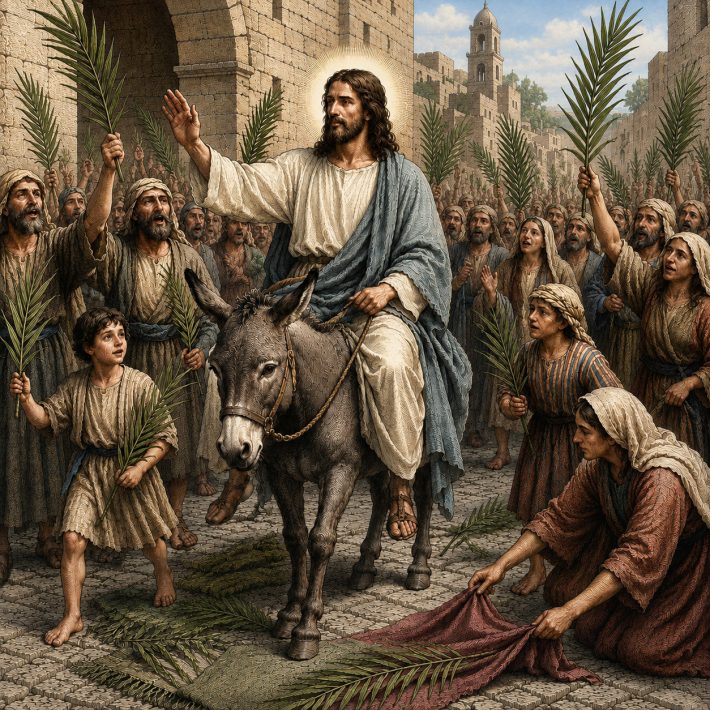
Christian Art | Palm Sunday | Jesus Enters In Triumph Into Jerusalem
The Letter To The Hebrews | Full Audio
The Mission | Bring Yourself – Bring All You Are – To God
Unlike the Pauline letters, The Epistle To The Hebrews lacks a conventional opening associated with ancient correspondence and begins instead with sustained theological declaration. This resembles extended homily more than a letter, though concluding with epistolary features. Its author is unknown. There is remarkable confidence concerning the person of Christ, the meaning of Israel’s scriptures, and the nature of Christian faith.
Recipients of the letter appear to have been Christians experiencing discouragement, weariness, and perhaps persecution. Repeated warnings against falling away suggest a community under pressure. The problem addressed is not primarily intellectual doubt but temptation to abandon perseverance. The letter seeks to strengthen endurance by directing attention away from immediate difficulties and toward significance of Christ. Theology serves a pastoral purpose. Reflection upon Christ is intended to sustain faithfulness.
The letter returns repeatedly to institutions and figures drawn from Israel’s religious life. Angels, Moses, Joshua, Aaron, Melchizedek, the priesthood, the covenant, the tabernacle, and the sacrificial system all appear. Yet these are not discussed as isolated historical curiosities. Each is interpreted as pointing beyond itself toward a fulfilment revealed in Christ. The argument proceeds through comparison. Christ is shown to be greater than angels, greater than Moses, mediator of a better covenant, priest of a better priesthood, and the proponent of a perfect sacrifice.
The dynamic of the letter expresses intersection of continuity and fulfilment. It does not reject Israel’s scriptures or institutions. On the contrary, it assumes their authority throughout. Yet the letter argues that their deepest significance becomes visible only in relation to Christ. The old covenant is not dismissed as false. It is understood as preparatory. Its ceremonies, sacrifices and structures possess genuine meaning precisely because they anticipate a greater reality.
This conviction shapes every thought. Hebrews seeks to demonstrate that the revelation given in Christ is final, that the access to God opened through Christ is complete, and that the faith required of believers is grounded in realities already established by God’s action. The Christian life remains one of pilgrimage and endurance, but it is a pilgrimage illuminated by the fulfilment of God’s purposes in the Son.
Final Revelation Of God In The Son
The letter begins with Christological statement. There is no greeting, no thanksgiving, and no preliminary discussion. Instead, we immediately address a question of revelation:
‘God, who at sundry times and in divers manners spake in time past unto the fathers by the prophets, Hath in these last days spoken unto us by his Son.’ (Hebrews 1: 1–2)
This opening establishes both continuity and contrast. God has always spoken. The revelation given through the prophets was genuine. The history of Israel is not treated as a period of divine silence. Yet revelation given through the Son differs from what came before. Earlier revelations were fragmentary, distributed across generations and conveyed through multiple forms. The revelation given in Christ possesses a unique finality.
The letter proceeds to describe the Son in terms that transcend ordinary categories of prophetic ministry. The Son is heir of all things. Through him the worlds were made. He is the brightness of God’s glory and the express image of God’s person. Such expression is extraordinary in both scope and precision. Christ is not merely one messenger among many. He belongs to the sphere of divine action itself.
This establishes a foundation. The argument of Hebrews does not begin with human need; it begins with divine revelation.
The Son is presented as sustainer of creation:
‘Upholding all things by the word of his power.’ (Hebrews 1:3)
Creation is not an event belonging to the past. Continued existence of the world depends upon the sustaining activity of the Son. The same Christ who reveals God is the one through whom the universe itself continues to exist.
There is a further theme that will dominate: purification from sin:
‘When he had by himself purged our sins, sat down on the right hand of the Majesty on high.’ (Hebrews 1:3)
This anticipates extensive discussion of priesthood and sacrifice that will follow. Even at the beginning, Christ is presented not only as revealer but as redeemer. The work of purification has already been accomplished. The image of sitting down indicates completion. Unlike the continual labour of earthly priests, the work performed by Christ has finality.
The opening chapter presents an integrated vision of Christ as creator, revealer, sustainer, redeemer, and exalted Lord. A purpose is not merely doctrinal precision, but to persuade readers that perseverance is justified because the one in whom they trust is fully sufficient.
Christ Greater Than Angels
Having established the unique status of the Son, the letter turns to a comparison with angels. Within Jewish tradition, angels occupied an important place as agents of divine communication and service. By demonstrating Christ’s superiority to angels, we say that the revelation given in the Son surpasses all previous forms of mediation.
The argument proceeds through a series of scriptural citations. Sayings originally applied to kings, messianic figures and divine rule are brought together to describe Christ. The cumulative effect is clear. Angels are servants; the Son is enthroned:
‘But unto the Son he saith, Thy throne, O God, is forever and ever.’ (Hebrews 1:8)
The distinction is not one of degree alone. The Son occupies a fundamentally different position. Angels minister before God. The Son shares in divine rule.
This comparison serves a pastoral purpose. If earlier revelations mediated through angels carried authority, how much more serious would it be to neglect the revelation given through the Son? The argument therefore leads directly into warning:
‘How shall we escape, if we neglect so great salvation?’ (Hebrews 2:3)
The warning is characteristic of Hebrews. Theological exposition repeatedly gives rise to exhortation. Knowledge of Christ entails responsibility. The greater the revelation, the greater the seriousness of neglect.
Yet there is immediately balanced Christ’s exaltation with an equally strong emphasis upon his humanity. The Son who is greater than angels also enters the human condition. He became lower than the angels for a time and shared fully in mortality.
This movement from exaltation to incarnation is essential. The greatness of Christ does not distance him from humanity. Rather, it enables him to act on humanity’s behalf. Redemption requires participation. Christ conquers death not from outside of the human condition but from within it:
‘Forasmuch then as the children are partakers of flesh and blood, he also himself likewise took part of the same.’ (Hebrews 2:14)
The letter insists that suffering is not incidental to Christ’s work. It belongs to the manner in which redemption is accomplished. By entering mortality, Christ destroys the power of death and liberates those held in bondage by fear.
Emphasis upon shared humanity prepares for the letter’s central theme of priesthood. A priest must represent those for whom he acts. Christ’s qualification for this role arises partly from his participation in human weakness and suffering:
‘For in that he himself hath suffered being tempted, he is able to succour them that are tempted.’ (Hebrews 2:18)
The result is a vision of Christ that holds together transcendence and solidarity. He is greater than angels, yet he shares fully in human experience. He is exalted, yet he suffers. He reigns, yet he sympathises. Such themes become increasingly alive as the argument develops.
Christ Greater Than Moses And Joshua | The Promise Of Rest
Thoughts concerning Christ’s humanity lead naturally into a comparison with Moses, the mediator of the covenant, recipient of the Law, leader of the Exodus, and the servant through whom God formed Israel into a people. To compare Christ with Moses is to engage a revered figure in Jewish tradition.
The letter approaches the comparison with considerable care. Moses is not criticised or diminished. On the contrary, his faithfulness is affirmed explicitly. The distinction lies elsewhere. Moses belongs within the house of God; Christ stands over it:
‘Moses verily was faithful in all his house, as a servant… But Christ as a son over his own house.’ (Hebrews 3:5–6)
A contrast between servant and son is key. Moses occupies a position of immense honour, yet his role remains preparatory. His ministry points beyond itself toward greater fulfilment. This thought is consistent with broader patterns of Hebrews. Earlier institutions and figures possess genuine significance, but their significance derives in part from realities they anticipate.
So we return to the problem of perseverance. The wilderness generation accompanied Moses, witnessed God’s works, and nevertheless failed to enter fully into the promise. Danger facing the reader is not unprecedented. Israel’s history provides a warning concerning unbelief and disobedience.
The text turns repeatedly to Psalm 95 (Vg. 94), to its urgent appeal:
‘Today if ye will hear his voice, harden not your hearts.’ (Hebrews 3:15)
Emphasis upon ‘today’ is significant. The wilderness generation belongs to the past, yet the warning remains present. Scripture speaks not merely about earlier generations but to the contemporary community. The voice of God continues to address believers through scriptural text.
Discussion gradually shifts from Moses to Joshua. At first the transition appears unexpected, but it emerges naturally from the question of rest. Joshua led Israel into the land after the wilderness wanderings. If entry into Canaan constituted a complete fulfilment of God’s promise, the argument concerning rest would be finished. Yet Psalm 95, written long after Joshua, continues to speak of rest yet still available.
The promise extends beyond historical conquest:
‘There remaineth therefore a rest to the people of God.’ (Hebrews 4:9)
This saying carries enormous theological weight. Rest is not merely geographical possession of the land. Nor is it simply freedom from labour. The concept acquires a broader significance, drawing together creation, covenant, worship, and future hope.
The text has already alluded to God’s rest at creation. By connecting the creation narrative with Israel’s history, it establishes a pattern extending across scripture itself. The rest promised to believers participates in something deeper than political settlement or historical achievement. It concerns participation in the purposes of God.
The result is a distinctly eschatological understanding of existence. Believers live within a tension between promise and fulfilment. The decisive work of God has already been accomplished in Christ, yet the final rest remains future. The Christian life is therefore characterised by expectation.
This perspective helps explain a repeated emphasis upon perseverance. The community addressed by Hebrews has not yet reached its destination. Like Israel in the wilderness, it exists between redemption and fulfilment. Danger lies in growing weary through the journey.
At this point the author introduces one of the most striking descriptions of scripture in the New Testament:
‘For the word of God is quick, and powerful, and sharper than any two-edged sword.’ (Hebrews 4:12)
In context, the word of God is not presented merely as source of information. Rather, it judges, exposes and penetrates. Nothing remains hidden before it. Warning against unbelief becomes intensely personal. The issue is not simply whether ancient Israel failed but whether present readers will respond faithfully to the word addressed to them.
This discussion culminates in a return to Christ:
‘Seeing then that we have a great high priest, that is passed into the heavens, Jesus the Son of God, let us hold fast our profession.’ (Hebrews 4:14)
This is a transition within the letter. The theme of priesthood, anticipated earlier, now comes to the forefront. The exhortation to perseverance rests upon a new foundation. Believers are not called merely to imitate earlier generations; we are encouraged because we possess a high priest who has entered the presence of God on our behalf.
The text immediately emphasises that Christ’s priesthood is inseparable from his humanity:
‘For we have not an high priest which cannot be touched with the feeling of our infirmities.’ (Hebrews 4:15)
This saying gathers together themes already developed in earlier chapters. Christ’s suffering, temptation and mortality are not obstacles to his priestly work. They are essential to it. Because he has entered fully into human experience, Jesus is capable of representing humanity before God with complete understanding.
The consequence is confidence:
‘Let us therefore come boldly unto the throne of grace.’ (Hebrews 4:16)
This must have sounded extraordinary in relation to Israel’s religious tradition. Access to divine presence was mediated through priests, sacrifices, rituals, and sacred boundaries. Yet Hebrews repeatedly argues that Christ has transformed our conditions of access. The throne remains holy, but believers may approach it with confidence because of the priestly work of Christ.
A progression from warning to confidence is characteristic of the letter. The author never minimises the seriousness of faithlessness, yet neither does he leave his readers in fear. Every warning is balanced by an assurance grounded in the sufficiency of Christ.
And having established Christ as the great high priest, we are brought to the question of priesthood itself. Why is priesthood necessary? What distinguishes Christ’s priesthood from that of Aaron? Why does the obscure figure of Melchizedek become so important? And how does Christ’s priestly work relate to covenant, sacrifice, and salvation?
Such questions energise Hebrews and provide the framework through which the text understands reconciliation of humanity with God.
Christ The Great High Priest
Discussion of priesthood is theologically central to Hebrews. Everything that precedes prepares for this theme, and much that follows depends upon it. A fundamental question in biblical religion is this: how can sinful humanity approach a holy God? Answers given throughout Israel’s history involved priests, sacrifices, covenants and sanctuaries. Hebrews accepts the significance of these institutions while arguing that they find their fulfilment in Christ.
There is description of priesthood. A high priest is appointed on behalf of others. He does not act for himself but represents the people before God. His role is mediatory. He offers gifts and sacrifices, intercedes for the community, and stands in a position between divine holiness and human weakness.
Because of this representative function, the priest must possess sympathy for those whom he serves:
‘Who can have compassion on the ignorant, and on them that are out of the way.’ (Hebrews 5:2)
The priest is not detached from the human condition. He understands weakness because he shares it. This observation becomes crucial for understanding of Christ. Earlier chapters established that the Son entered fully into human experience. He suffered, was tempted, and endured mortality. Those experiences now acquire priestly significance.
Christ is presented as uniquely qualified for priesthood. His qualification does not arise from hereditary descent but from divine appointment and human participation. He has entered completely into the realities of human existence and yet remains perfectly faithful before God.
The discussion introduces a theme we might find surprising: obedience learned through suffering:
‘Though he were a Son, yet learned he obedience by the things which he suffered.’ (Hebrews 5:8)
This does not imply that Christ moved from disobedience to obedience. Rather, it reflects conviction that obedience must be lived rather than merely possessed. The Son enters the concrete realities of human life and remains faithful within them. Suffering becomes the sphere in which obedience is enacted.
This emphasis reflects a broader concern throughout Hebrews. Recipients of the letter appear to be struggling with hardship and discouragement. By presenting Christ as one who endured suffering faithfully, the author provides both encouragement and example. The path of endurance is not alien to Christ; it belongs to the very manner in which his priestly work is accomplished.
At this point we discover the figure who dominates the next stage of the argument: Melchizedek:
‘Thou art a priest for ever after the order of Melchisedec.’ (Hebrews 5:6)
The appearance of Melchizedek might well seem unexpected. Melchizedek occupies only a brief place within the Old Testament narrative. In Genesis 14 he appears suddenly as king of Salem and priest of the most high God. He blesses Abraham and then disappears from the story. Yet Psalm 110 (Vg. 109) returns to him and associates the coming king with a priesthood of a different order from that of Aaron.
Hebrews seizes upon this connection and develops it extensively.
The significance of Melchizedek lies partly in what the Genesis narrative does not say. Unlike the Levitical priests, his authority is not grounded in genealogy. No ancestry is recorded. No succession is described. His priesthood appears independent of the hereditary structures that governed Israel’s later priestly system.
The text interprets this literary silence symbolically:
‘Without father, without mother, without descent.’ (Hebrews 7:3)
The point is not historical speculation about Melchizedek himself. Rather, the author reads the scriptural text as presenting a priesthood not defined by ancestry or succession. This provides the conceptual framework necessary for understanding Christ. Levitical priesthood depended upon continual succession because priests were mortal. One generation replaced another. Their ministry remained temporary because death interrupted it. Christ’s priesthood differs fundamentally:
‘But this man, because he continueth ever, hath an unchangeable priesthood.’ (Hebrews 7:24)
Permanence of Christ’s priesthood is a central claim of Hebrews. Earlier priests could never complete their work because mortality continually intervened. Christ’s resurrection transforms the situation entirely. Christ’s priesthood is permanent because he lives forever.
This permanence has profound implications for salvation:
‘Wherefore he is able also to save them to the uttermost that come unto God by him.’ (Hebrews 7:25)
The phrase ‘to the uttermost’ conveys completeness rather than merely duration. The saving work of Christ transcends limitations that characterised earlier priestly ministry. Nothing remains unfinished. Nothing requires supplementation by another priest.
There is a series of contrasts. The Levitical priests offer sacrifices repeatedly. Christ offers himself once. They minister in an earthly sanctuary. Christ ministers in the heavenly presence of God. They are subject to weakness and death. Christ possesses an eternal priesthood.
A cumulative effect is unmistakable. Institutions of the old covenant possessed genuine significance, yet their very structure pointed beyond themselves. Their repetition revealed incompletion. Their temporality anticipated permanence. Their earthly character anticipated a heavenly reality. This leads naturally into the discussion of covenant.
Priesthood and covenant cannot be separated. A change in priesthood implies a change in covenantal arrangement. If Christ’s priesthood is superior, then the covenant associated with it must likewise possess a greater efficacy.
The argument is delicate. Hebrews does not present the old covenant as mistake or failure. The covenant given through Moses remains part of God’s purpose. Yet its provisional character becomes increasingly evident. It points forward to something more complete.
The author therefore turns to the prophecy of Jeremiah:
‘Behold, the days come, saith the Lord, when I will make a new covenant.’ (Hebrews 8:8)
Jeremiah’s prophecy implies that the existing arrangement was not final. If a new covenant is promised, then the earlier covenant cannot represent the ultimate fulfilment of God’s purposes.
Yet the new covenant is not merely a replacement. It is a fulfilment. Promises associated with it concern inward transformation, knowledge of God, and forgiveness.
The Law will no longer stand primarily as external commandment. It will be written upon the heart. Relationship with God will become more immediate. Forgiveness will be complete.
Priesthood, covenant, sacrifice, sanctuary and access to God converge. There follows the thought that the earthly sanctuary itself was only a copy and shadow of a greater reality, and that Christ’s sacrifice accomplishes what repeated animal sacrifices could never finally achieve.
The New Covenant And Perfect Sacrifice
Discussion of priesthood leads naturally into discussion of sacrifice, for the two cannot be separated. Priests exist in order to offer sacrifices, and the significance of a priesthood is inseparable from the significance of offering associated with it. Having established the superiority of Christ’s priesthood, the author turns to the question of what Christ has offered and why that offering differs fundamentally from those of the old covenant.
Thoughts begin with the sanctuary. The tabernacle established under Moses possessed immense importance within Israel’s worship. It represented the dwelling place of God among his people and provided the setting in which priestly ministry occurred. Yet Hebrews insists that even the sanctuary possessed a provisional character:
‘Who serve unto the example and shadow of heavenly things.’ (Hebrews 8:5)
The shadow is significant. A shadow possesses reality, yet it derives its significance from something greater than itself. The earthly sanctuary was not meaningless. It was a genuine part of God’s covenantal arrangement. Yet it pointed beyond itself toward a heavenly reality.
This distinction between earthly copy and heavenly reality governs much of what follows. The author is not interested merely in describing ritual procedures. He seeks to demonstrate that the structures of Israel’s worship anticipate a deeper and more complete form of access to God.
The tabernacle embodied both nearness and distance. God dwelt among his people, yet access remained restricted. Boundaries, curtains, sacrifices and priestly mediation all testified to the seriousness of divine holiness. The very arrangement of the sanctuary communicated limitation. Most worshippers could never enter the holy places. Even priests entered only under prescribed conditions. The high priest alone entered the most holy place, and then only once each year.
The author interprets these arrangements symbolically:
‘The Holy Ghost this signifying, that the way into the holiest of all was not yet made manifest.’ (Hebrews 9:8)
The sanctuary reveals both the possibility of communion with God and an incompleteness of the means by which that communion was achieved. Access exists, yet remains partial. Repeated rituals testify simultaneously to divine mercy and to the persistence of separation.
Discussion then turns to the sacrificial system itself. Sacrifice occupied the centre of Israel’s worship. Through sacrifice, covenant relationships were maintained, purification was sought, and reconciliation was enacted. Yet Hebrews repeatedly emphasises a crucial limitation: the sacrifices must be offered continually.
Day follows day. Year follows year. The same rituals recur.
This repetition is not merely practical. It reveals something fundamental about the nature of the system:
‘For then would they not have ceased to be offered?’ (Hebrews 10:2)
The thought is that if sacrifices had fully accomplished their purpose, repetition would have become unnecessary. The fact that offerings continue demonstrates that something remains incomplete.
The author is careful here. He does not suggest that the sacrifices were fraudulent or worthless. Rather, they possessed a preparatory function. They pointed toward reconciliation without fully realising it. They symbolised cleansing without finally overcoming the problem of sin.
Contrast with Christ becomes decisive: where earlier priests offer sacrifices repeatedly, Christ offers one sacrifice; where earlier sacrifices involve animals, Christ offers himself; where earlier offerings belong to an earthly sanctuary, Christ enters the heavenly presence of God.
The difference is not quantitative but qualitative:
‘Neither by the blood of goats and calves, but by his own blood he entered in once into the holy place.’ (Hebrews 9:12)
The phrase ‘once’ recurs and carries immense theological significance. The work of Christ does not require repetition because it achieves what earlier sacrifices could only anticipate. This emphasis upon finality distinguishes Hebrews from many ancient religious systems, where ritual repetition is essential. There is insistence that Christ’s sacrifice possesses a completeness that transforms our understanding of worship.
This goes further. A problem addressed by sacrifice is not merely external impurity but human conscience. Repeated sacrifices could regulate ritual life and covenantal observance, yet they could not fully transform the inner condition of those who worshipped. Christ’s sacrifice, by contrast, reaches the level of conscience:
‘How much more shall the blood of Christ… purge your conscience from dead works to serve the living God?’ (Hebrews 9:14)
Progression from external ritual toward inward transformation reflects a theme already present in the discussion of the new covenant. The deepest problem confronting humanity is not ceremonial impurity but alienation from God. The work of Christ addresses this condition directly.
The text therefore understands Christ simultaneously as priest, sacrifice, and mediator. Earlier systems distributed these functions among different elements. The priest offered the sacrifice. The sanctuary provided the setting. The covenant established the framework. In Christ these dimensions converge. He is the priest who offers. He is the sacrifice that is offered. He is the mediator through whom reconciliation is accomplished.
The argument reaches a climax in chapter 10 through a reflection upon Psalm 40 (Vg. 39):
‘Lo, I come to do thy will, O God.’ (Hebrews 10:9)
The author interprets this passage Christologically. The deepest purpose of Christ’s ministry is obedience to the divine will. Sacrifice is not isolated from obedience but expresses it. The offering of Christ possesses efficacy because it arises from perfect faithfulness to God. This emphasis matters because Hebrews consistently resists reducing salvation to a mechanical transaction. The sacrifice of Christ cannot be understood apart from the life of obedience through which it is enacted. Priesthood, suffering, obedience and sacrifice belong together. The result is a radically transformed understanding of access to God:
‘Having therefore, brethren, boldness to enter into the holiest by the blood of Jesus.’
Few statements capture the practical significance of the letter more clearly. Earlier chapters described restrictions surrounding the sanctuary. Access was mediated, limited, and carefully controlled. Now the author declares that believers may enter with confidence.
The language is extraordinary. The holy presence of God remains unchanged in its holiness, yet conditions of approach have been transformed through Christ. A consequence is not complacency but confidence. Believers are encouraged to draw near, hold fast, and encourage one another. Once again theology gives rise to exhortation:
‘Let us draw near with a true heart in full assurance of faith.’ (Hebrews 10:22)
The repeated phrase ‘let us’ is definitive here. The author is not merely explaining doctrine but calling a community into faithful response. Such warnings as follow possess particular force. To abandon Christ would be to abandon the reality toward which the entire history of covenant, priesthood and sacrifice has pointed. The seriousness of the warning reflects the greatness of the gift. Yet even here the letter refuses to end with fear. The author reminds his readers of their earlier faithfulness, their endurance under suffering, and their need for continued perseverance. The life of faith remains future-oriented:
‘For ye have need of patience, that, after ye have done the will of God, ye might receive the promise.’ (Hebrews 10:36)
Having established the finality of Christ’s sacrifice and reality of access to God, there is question of how believers are to live while awaiting fulfilment of God’s promises.
The answer is faith.
Not faith understood as mere assent, but faith understood as steadfast trust amid uncertainty, delay and incompletion. The great catalogue of witnesses in chapter 11 will illustrate this reality through the lives of those who lived by promise long before the coming of Christ. Through their examples, the author develops profound reflection on faith.
Faith And Promise | Pilgrimage Of The People Of God
The eleventh chapter of Hebrews can be read as a collection of heroic examples intended to inspire admiration. While admiration is certainly invited, the text’s purpose is more profound. Figures gathered in this chapter are not celebrated because they achieved extraordinary success; they are presented because they lived in fidelity to promises whose fulfilment remained incomplete.
The chapter follows naturally from everything that has preceded it. Readers have been reminded that Christ is the definitive revelation of God, the great high priest, the mediator of a better covenant, and the offerer of a perfect sacrifice. Yet they continue to live in a world marked by suffering, uncertainty and delay. The question arises: what does faith look like within such conditions?
The answer begins as this:
‘Now faith is the substance of things hoped for, the evidence of things not seen.’ (Hebrews 11:1)
The language is rich and difficult. Faith is not mere optimism. Neither is it simply intellectual agreement with doctrinal propositions. Faith concerns trust directed toward realities that are not yet fully visible. It enables human beings to live in relation to promises that remain future.
This definition reflects a theme that has been present throughout the letter from the beginning. Christian existence unfolds between what God has already accomplished and what remains to be revealed. Believers possess confidence because of what Christ has done, yet they still await the complete manifestation of God’s purposes. Faith therefore belongs naturally to pilgrimage.
Abel acts in faith. Enoch walks with God. Noah responds to a warning concerning events not yet seen. In each case action is taken in response to a reality that remains largely hidden.
Noah’s example is especially significant:
‘Being warned of God of things not seen as yet, moved with fear, prepared an ark.’ (Hebrews 11:7)
The phrase ‘things not seen as yet’ could almost serve as a summary of the chapter. Faith does not wait for complete visibility before acting. It responds to the word of God while fulfilment remains future.
Abraham’s significance lies not merely in obedience but in the form that obedience takes. He leaves what is familiar without possessing a detailed map of the future. His life becomes a continual movement toward promise:
‘By faith Abraham, when he was called to go out into a place which he should after receive for an inheritance, obeyed.’ (Hebrews 11:8)
Abraham is depicted as the paradigmatic pilgrim. He receives promise, yet he does not possess fulfilment. He journeys, waits, hopes, and trusts. Even after entering the land, Abraham continues to live as stranger:
‘For he looked for a city which hath foundations, whose builder and maker is God.’ (Hebrews 11:10)
We note the image of the city. Throughout Hebrews there exists a contrast between what is temporary and what endures. Abraham’s tents symbolise transience. The city represents permanence. Yet the city is future. Abraham’s faith therefore consists partly in orienting his life toward a reality he does not yet possess.
The text extends this observation beyond Abraham alone:
‘These all died in faith, not having received the promises.’ (Hebrews 11:13)
This lies near the centre of the chapter’s theology. The faithful may not experience complete fulfilment within their own lifetimes. Promise exceeds possession. God’s purposes extend beyond the horizon of individual experience. The consequence is a particular understanding of human existence:
‘They confessed that they were strangers and pilgrims on the earth.’ (Hebrews 11:13)
Language of pilgrimage echoes themes already developed elsewhere in the letter. The Christian life cannot be understood primarily in terms of settlement or arrival. Believers remain travellers. We belong ultimately to a reality not yet fully revealed.
This perspective transforms interpretation of suffering and delay. If fulfilment remains future, then incompletion need not be interpreted as failure. Abraham’s life appears unfinished in many respects. It is an example of faith precisely because Abraham trusted amid incompletion.
Sarah’s inclusion reinforces this point. Her story contains uncertainty, delay, and apparent impossibility. Promise of descendants confronts biological realities that render fulfilment improbable. Yet faith persists because its object is not human capacity but divine faithfulness.
There follows reflection upon a difficult episode in the Bible as in Abraham’s life: the offering of Isaac.
‘Accounting that God was able to raise him up, even from the dead.’ (Hebrews 11:19)
Interpretation offered is striking. Abraham’s willingness to offer Isaac is understood through the lens of resurrection. The promise appears threatened, yet Abraham trusts that God remains faithful even beyond apparent impossibility.
The chapter continues through Isaac, Jacob, Joseph, Moses and others. Yet the emphasis remains remarkably consistent. The text is less interested in individual achievements than in a common pattern of trust.
Joseph provides an especially revealing example:
‘By faith Joseph, when he died, made mention of the departing of the children of Israel.’ (Hebrews 11:22)
The reference is brief, yet significant. Joseph dies in Egypt rather than in the promised land. His final act concerns a future he will not personally witness. Faith therefore extends beyond immediate circumstances. It remains oriented toward the promises of God even when fulfilment lies beyond one’s own lifetime.
Moses receives particularly extensive treatment. His faith is expressed through refusal as much as through action:
‘Choosing rather to suffer affliction with the people of God, than to enjoy the pleasures of sin for a season.’ (Hebrews 11:25)
The contrast reflects a recurring theme throughout Hebrews. Immediate advantage is measured against enduring reality. Moses accepts suffering because he perceives something greater than present comfort.
The letter explains this perspective through a remarkable phrase:
‘For he had respect unto the recompence of the reward.’ (Hebrews 11:26)
Faith directs vision toward realities beyond immediate experience. Moses is able to endure because he evaluates the present in light of the future.
As the chapter progresses, the pace accelerates. Gideon, Barak, Samson, Jephthah, David, Samuel and the prophets are mentioned rapidly. Victories, miracles, and acts of courage are recalled. Yet the narrative takes an unexpected turn.
Rather than concluding with triumph, we recount suffering. Some were tortured. Some endured mockings and scourgings. Some experienced imprisonment. Some wandered in deserts and mountains. The effect is deliberate. Faith cannot be identified with visible success alone.
‘Others were tortured, not accepting deliverance.’ (Hebrews 11:35)
The faithful include both conquerors and sufferers. Some receive remarkable deliverances. Others die without seeing resolution. The chapter resists every attempt to reduce faith to a guarantee of earthly prosperity or visible triumph. Indeed, one of the most striking features of the chapter is its refusal to distinguish sharply between victorious and defeated lives. Both belong within the same story because both are interpreted through trust in God’s promises.
The chapter concludes with a final observation of profound importance:
‘And these all, having obtained a good report through faith, received not the promise.’ (Hebrews 11:39)
The faithful live by promise rather than possession. Their lives point forward. Fulfilment remains incomplete. Yet God’s purpose extends beyond any individual generation. The promise moves toward completion in Christ. The faithful of earlier ages and the Christian community addressed by Hebrews belong within a single story. The same God who spoke to Abraham, Moses and the prophets has now spoken through the Son. The result is that chapter 11 becomes far more than a catalogue of examples. It is a theology of pilgrimage. It portrays the people of God as travellers who live in trust amidst uncertainty, who endure incompletion without surrendering hope, and who orient their lives toward realities that remain unseen.
This vision prepares directly for the exhortation of chapter 12. Having described the great company of witnesses, there is call to perseverance. Examples of the past are not provided merely for admiration. They summon the present community to continue the race set before them, looking to Christ, who stands both at the origin of faith and at fulfilment.
Endurance, Discipline, And The Heavenly Jerusalem
The faithful of earlier generations form a surrounding company of witnesses. Their lives testify that perseverance amidst uncertainty is neither unusual nor unexpected. The Christian community stands within a long history of faithfulness extending back through Israel’s scriptures.
There is the image of a race:
‘Let us run with patience the race that is set before us.’ (Hebrews 12:1)
The metaphor is carefully chosen. A race requires endurance rather than momentary enthusiasm. Progress occurs through persistence rather than sudden achievement. The image also implies direction. The faithful are not wandering aimlessly. Their lives possess orientation and purpose, even when the destination remains partially hidden. Yet the focus of the exhortation does not remain upon the runners themselves. As throughout the letter, attention is directed toward Christ:
‘Looking unto Jesus the author and finisher of our faith.’ (Hebrews 12:2)
Christ is not simply another example added to the list of chapter 11. He stands in unique relation to faith itself. The faithful lives of Abraham, Moses and the prophets find their meaning within a larger story whose centre is Christ. Such language of author and finisher suggests both origin and completion. Christ stands at the beginning and end of the path which believers travel. Faith is not merely directed toward him; it is also shaped and sustained by him.
We reflect upon the suffering of Christ:
‘Who for the joy that was set before him endured the cross, despising the shame.’ (Hebrews 12:2)
An emphasis falls upon endurance. Earlier chapters demonstrated that Christ suffered and learned obedience through suffering. Now his endurance becomes the model through which believers are to interpret their own difficulties.
The cross occupies a central place in this interpretation. It represents the point at which suffering appears most intense and divine purpose most obscured. Yet it is precisely through this event that exaltation comes. The pattern established in Christ becomes normative for the Christian life. Glory does not bypass suffering. Fulfilment is reached through endurance rather than avoidance.
Discouragement arises from isolation. Suffering can appear meaningless when viewed in isolation from a larger narrative. By directing attention toward Christ, we understand hardship within a broader theological framework.
There is discussion of discipline. We might approach these verses of the book with hesitation because the language can appear severe. Yet the purpose of the text is fundamentally pastoral. There is an aim to prevent believers from interpreting hardship as evidence of divine abandonment.
‘Whom the Lord loveth he chasteneth.’ (Hebrews 12:6)
Each instance of suffering does not possess simple explanation. Hebrews does not offer a comprehensive theology of suffering. Rather, it insists that hardship need not be understood as proof of divine rejection.
The image employed is familial rather than judicial. Discipline belongs to the relationship between parent and child. The concern is formation rather than punishment. This distinction is important. The faithful are not encouraged to seek suffering or to romanticise it. Instead, we are urged to recognise that God remains active even amidst difficulty. Present pain does not reveal divine absence.
This reflects a broader pattern. Again and again apparent contradictions are held together: Christ is exalted yet suffers; believers possess confidence yet endure trials; promises are fulfilled yet still awaited; access to God is open yet pilgrimage continues; Christian life remains characterised by tension; fulfilment has begun but is not complete. This again returns to the theme of perseverance:
‘Lift up the hands which hang down, and the feeble knees.’ (Hebrews 12:12)
Imagery recalls exhaustion after prolonged effort. The community appears weary. Exhortation acknowledges this reality rather than denying it. Faithfulness is not presented as effortless. The need for encouragement arises precisely because perseverance can be difficult. We turn to holiness and peace. These themes emerge naturally from discussion of discipline. The purpose of divine formation is not merely endurance for its own sake but participation in the life of God:
‘Follow peace with all men, and holiness, without which no man shall see the Lord.’ (Hebrews 12:14)
This saying reflects a conviction present throughout Hebrews: access to God transforms those who approach him. The Christian life cannot be reduced to intellectual belief alone. Faith expresses itself through conduct, relationships and character.
The argument reaches a dramatic contrast. The text invites readers to compare two mountains: Sinai and Zion. Sinai represents the covenant established through Moses. The imagery associated with it is overwhelming: fire; darkness; storm; trumpet blast; fear; distance. Even Moses trembles before the manifestation of divine holiness.
The description is drawn from the Exodus narrative and serves as a reminder of the majesty and seriousness of God’s presence. Yet now believers have approached something different:
‘But ye are come unto mount Sion, and unto the city of the living God, the heavenly Jerusalem.’ (Hebrews 12:22)
The contrast is not between an angry God and a loving God. Hebrews never suggests that God’s holiness has diminished. The God encountered at Zion is the same God encountered at Sinai. What has changed is the manner of access. Barriers that once restricted approach have been overcome through Christ. The heavenly Jerusalem represents a fulfilment toward which earlier covenantal structures pointed.
Our imagery becomes increasingly expansive. Angels gathered in worship, the assembly of the faithful, the spirits of the righteous made perfect, and Jesus himself as mediator of the new covenant all appear within the vision.
The effect is remarkable. Throughout the letter the author has spoken of pilgrimage, promise, priesthood, sacrifice, and access. Here these themes converge within a single picture of heavenly worship. The faithful remain upon earth, yet their true citizenship belongs elsewhere. Their lives are directed toward a reality that transcends present circumstances. The heavenly Jerusalem functions not merely as future destination but as present orientation. It provides the horizon within which Christian existence acquires meaning.
There is renewed emphasis upon reverence:
‘Let us have grace, whereby we may serve God acceptably with reverence and godly fear.’ (Hebrews 12:28)
Such confidence encouraged throughout Hebrews never becomes presumption. Access to God does not diminish holiness. The God who welcomes believers remains the God whose majesty inspired awe at Sinai.
The chapter ends by holding together two realities that might otherwise appear opposed: confidence and reverence. Through Christ, believers approach God boldly, yet they approach him as the holy and living God.
This balance prepares for the final chapter of the letter. Having developed a theology of revelation, priesthood, covenant, sacrifice, faith, endurance and heavenly worship, the author now turns toward the practical shape of Christian life. Concluding exhortations concerning love, hospitality, worship, leadership and perseverance are not an afterthought. They represent the lived expression of everything that has been established throughout the argument.
Christian Life And Worship | The Pilgrim Community
A sustained theological argument of earlier chapters gives way to brief instructions concerning love, hospitality, marriage, leadership, worship and perseverance. Yet this appearance is misleading. Practical exhortations of chapter 13 are deeply connected to a theological vision developed throughout the letter. They represent the lived expression of what it means to belong to the people of God under the new covenant.
The chapter begins with a simple but significant command:
‘Let brotherly love continue.’ (Hebrews 13:1)
The instruction assumes continuity rather than innovation. The community already possesses bonds of mutual affection. A concern is that these bonds should endure. Throughout Hebrews, perseverance has been understood not merely as an individual achievement but as communal reality. Faith is sustained within relationships. The Christian life is never presented as an isolated spiritual journey.
This communal emphasis becomes clearer in the discussion of hospitality:
‘Be not forgetful to entertain strangers: for thereby some have entertained angels unawares.’ (Hebrews 13:2)
The reference recalls Israel’s scriptures, particularly the story of Abraham receiving unexpected visitors. Yet the point extends beyond the historical allusion. Hospitality becomes an expression of attentiveness to realities that may not be immediately visible. Through Hebrews, the visible and invisible repeatedly intersect. Divine purposes often appear concealed beneath ordinary circumstances.
The command therefore reflects a broader theological conviction. The faithful must learn to live attentively within a world in which God’s activity is not always obvious. There are those who suffer:
‘Remember them that are in bonds, as bound with them.’ (Hebrews 13:3)
This exhortation reflects the situation of the community. Earlier passages suggest that readers have experienced opposition and hardship. Some have endured public reproach. Others have suffered loss. The instruction to remember those in bonds is not abstract. It arises from a context in which suffering forms part of communal experience.
Compassion becomes an expression of solidarity. The faithful are called to recognise that the suffering of others concerns all. Christian identity creates obligations that transcend individual interests. Discussion of marriage and personal conduct follows naturally from this concern with holiness.
Through Hebrews, access to God is never detached from ethical transformation. The reality of the new covenant affects every dimension of life. Worship, relationships, sexuality and material possessions all fall within scope of discipleship.
Particularly striking is the warning against the love of money:
‘Let your conversation be without covetousness; and be content with such things as ye have.’ (Hebrews 13:5)
This instruction reflects one of the letter’s recurring themes: the faithful live in relation to promises greater than immediate possessions; their security does not depend ultimately upon wealth or material stability. This conviction is reinforced through citation from scripture.
‘I will never leave thee, nor forsake thee.’ (Hebrews 13:5)
The promise redirects the source of confidence. Earlier chapters grounded perseverance in the priesthood and sacrifice of Christ. Here confidence rests in the continuing presence of God. Material uncertainty need not lead to despair because divine faithfulness remains constant.
This idea reaches clear and definitive expression:
‘Jesus Christ the same yesterday, and today, and forever.’ (Hebrews 13:8)
The verse functions almost as a summary of the letter’s Christology. Earlier chapters emphasised permanence of Christ’s priesthood, the finality of his sacrifice, and the enduring validity of the covenant established through him. All these themes converge here: human circumstances change; empires rise and fall; communities flourish and decline; individuals suffer, age and die; yet Christ remains unchanged.
Significance of this permanence becomes clearer when considered against the background of the readers’ situation. They face uncertainty. The future appears unstable. The author therefore directs attention toward the one reality that remains constant. This constancy provides a basis for resistance to false teaching.
Throughout the history of the Church, believers have faced competing claims, novel doctrines, and pressures to compromise. Hebrews responds not by encouraging intellectual rigidity for its own sake but by directing attention repeatedly toward Christ. Stability arises from fidelity to Jesus.
The letter returns briefly to sacrificial language. Sacrifice has occupied a central place throughout, yet the meaning of sacrifice has undergone transformation. Earlier chapters focused upon the definitive sacrifice of Christ. Now the emphasis falls upon the response of believers.
‘By him therefore let us offer the sacrifice of praise to God continually.’ (Hebrews 13:15)
Worship remains sacrificial in character, yet the sacrifice offered is no longer an animal brought to an altar. Praise, thanksgiving and obedience become the appropriate response to the completed work of Christ. This development reflects one of the letter’s deepest convictions. The old covenant sacrificial system pointed toward a reality now fulfilled. The worship of the new covenant arises not from repeated attempts to secure reconciliation but from gratitude for reconciliation already accomplished.
The text immediately expands the point:
‘But to do good and to communicate forget not: for with such sacrifices God is well pleased.’ (Hebrews 13:16)
Worship extends beyond formal acts of devotion. Generosity, compassion and practical care become sacrificial offerings acceptable to God. A distinction between worship and daily life begins to dissolve. Faithfulness is expressed through ordinary acts of love.
The chapter addresses matters of leadership. This exhortation to remember and obey leaders is not primarily concerned with institutional authority. Rather, it reflects the importance of faithful teaching and example within the Christian community. Throughout Hebrews, faith is transmitted through witness. The examples of chapter 11 demonstrated this principle on a grand scale. Here it appears in a more immediate form. The lives of faithful leaders encourage perseverance within the present generation.
Yet even this discussion ultimately returns to Christ. Human leaders remain important, but their authority is derivative. They point beyond themselves toward the true shepherd of God’s people.
This is Christian identity:
‘For here have we no continuing city, but we seek one to come.’ (Hebrews 13:14)
The verse gathers themes echoed throughout the letter: the faithful are pilgrims; Abraham lived in tents while looking toward a city whose builder and maker is God; Moses chose future reward rather than immediate privilege; heroes of faith died without fully receiving what was promised; believers approach the heavenly Jerusalem even while living within earthly societies.
The Christian life is fundamentally eschatological. Present realities matter, yet they do not possess ultimate permanence. The faithful remain oriented toward a future fulfilment that transcends present circumstance.
This perspective explains why endurance occupies such a prominent place throughout Hebrews. The community has not yet arrived. The journey continues. Yet the destination has been disclosed.
The chapter concludes with a benediction that gathers together many of the letter’s central themes:
‘Now the God of peace, that brought again from the dead our Lord Jesus, that great shepherd of the sheep, through the blood of the everlasting covenant.’ (Hebrews 13:20)
Resurrection, covenant, priesthood, sacrifice and pastoral care converge within a single sentence. The God who raised Jesus is the God who sustains the Church. The covenant established through Christ is everlasting. The shepherd who guides the faithful remains alive.
The benediction therefore serves as more than formal conclusion. It provides a final statement of confidence. Everything the author has argued culminates here. The Christian community may persevere because God has acted decisively in Christ and continues to sustain his people. A new and distinctive theological understanding of Christian living has emerged.




The people who have been fed through the miracle of the loaves and the fishes now seek Jesus and are mystified that he should not be near. They have seen that there was only one boat and that the disciples of Jesus have gone alone into the boat to pass across the Sea of Galilee. The events that have taken place overnight, as Jesus walked across the water, would have been completely beyond their comprehension [ … ]

In this reflection on Psalm 126, Saint Augustine teaches that the true Solomon is not simply Israel’s famous king, but Jesus Christ himself. Solomon’s name means ‘Bringer of Peace’. While Solomon built the first temple in Jerusalem, Christ builds the true temple, the Church—made not from stones but from living people, drawn from every nation and brought into unity [ … ]

Psalm 56 is a heartfelt prayer and an expression of profound trust in God amid distress and persecution. The psalmist begins by pleading for God’s mercy, feeling besieged by adversaries who seek to oppress and swallow him up. This prayer encapsulates the psalmist’s raw emotions and the desire for divine intervention in the face of adversity [ … ]