
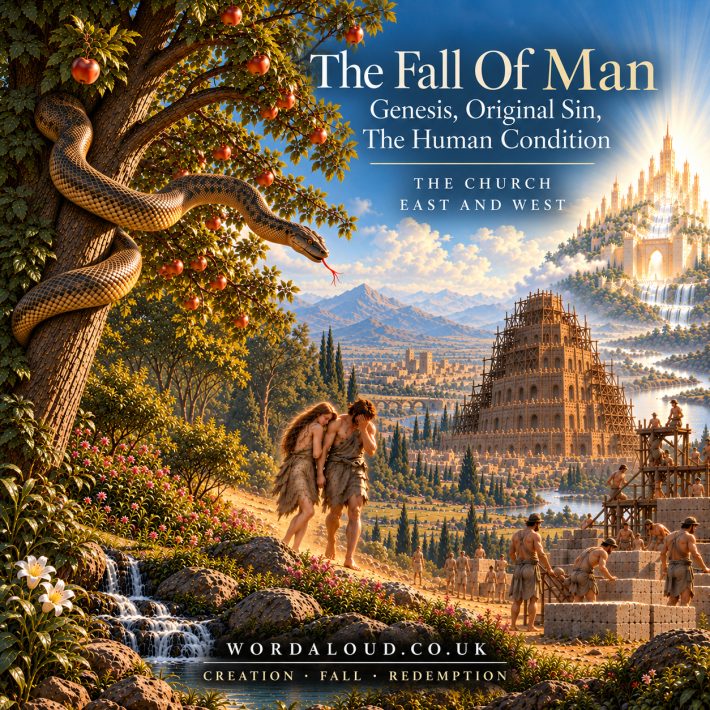
Christian Art | Original Sin | The Fall | East Of Eden
Proposition: The Orthodox Church does not believe in Original Sin.
The proposition is both true and false, depending upon what is meant by original sin.
Orthodox Christianity does not teach that Adam’s personal guilt passes to his descendants. Adam sinned. His descendants inherit mortality and corruption, not his personal act. This is described as ancestral sin.
Man, then, was thus snared by the assault of the arch-fiend, and broke his Creator’s command, and was stripped of grace and put off his confidence with God, and covered himself with the asperities of a toilsome life (for this is the meaning of the fig-leaves); and was clothed about with death, that is, mortality and the grossness of flesh (for this is what the garment of skins signifies); and was banished from Paradise by God’s just judgment, and condemned to death, and made subject to corruption. (John Of Damascus, An Exact Exposition Of The Orthodox Faith, III.1)
Having become mortal, [Adam and Eve] conceived mortal children, and mortal beings are necessarily subject to passions and fears, to pleasures and sorrows, to anger and hatred. (Theodoret Of Cyrus, Commentary On The Psalms, on Psalm 50)
Catholic doctrine also denies that Adam’s descendants are personally guilty of Adam’s act. The Catechism Of The Catholic Church describes original sin as ‘contracted’ rather than ‘committed’ and says that it ‘does not have the character of a personal fault’ in Adam’s descendants.¹
What, then, is inherited?
Genesis does not say that Adam’s guilt passes to his descendants. Adam and Eve leave Eden. Cain kills Abel. Violence increases. The earth becomes corrupt. The flood follows. Babel follows. Genesis shows sin spreading. It does not describe the transmission of Adam’s guilt.
In the New Testament, Saint Paul goes further. ‘By one man sin entered into the world, and death by sin.’ (Romans 5: 12) ‘By one man’s disobedience many were made sinners.’ (Romans 5: 19) Paul connects Adam’s act with the condition of his descendants. He does not explain how the connection works. Paul gives us solidarity: Adam’s act has consequences for those who come after him, so that his sin and death concern not Adam alone but humanity in Adam. Paul does not, however, explain how that solidarity operates or how Adam’s act becomes the inherited condition of his descendants.
Do Adam’s descendants inherit sin, guilt, mortality, corruption, deprivation, or some combination of these? If they do not inherit Adam’s personal guilt, in what sense is what they inherit sin? If they inherit only mortality and corruption, what does Paul mean when he says that through one man’s disobedience ‘many were made sinners’?
Such questions underlie the doctrine of original sin.
Original Sin | Ancestral Sin
Athanasius of Alexandria, the fourth-century bishop and theologian, approaches the inherited consequence of the fall through the distinction between created nature and the incorruptible life of God. In On The Incarnation, he begins with creation from nothing. Humanity, because it is created, does not possess incorruptibility by nature. Left to itself, created nature tends towards corruption and dissolution; continued life is received from God. God nevertheless created humanity for communion with himself and granted human beings participation in the Word, through whom they might remain in incorruption. Incorruption is consequently not an autonomous possession of human nature but a divine gift, dependent upon participation in God.
God that made the world and all things therein, seeing that he is Lord of heaven and earth, dwelleth not in temples made with hands; Neither is worshipped with men’s hands, as though he needed anything, seeing he giveth to all life, and breath, and all things; And hath made of one blood all nations of men for to dwell on all the face of the earth, and hath determined the times before appointed, and the bounds of their habitation; That they should seek the Lord, if haply they might feel after him, and find him, though he be not far from every one of us: For in him we live, and move, and have our being; as certain also of your own poets have said, For we are also his offspring. (Acts 17: 24–28)
Thus then God has made man and willed that he should abide in incorruption; but men having despised and rejected the contemplation of God and devised and contrived evil for themselves received the condemnation of death with which they had been threatened; and from thenceforth no longer remained as they were made but were being corrupted according to their devices; and death had the mastery over them as king.
For transgression of the commandment was turning them back to their natural state so that just as they have had their being out of nothing so also as might be expected they might look for corruption into nothing in the course of time.
For if out of a former normal state of non-existence they were called into being by the Presence and loving-kindness of the Word it followed naturally that when men were bereft of the knowledge of God and were turned back to what was not (for what is evil is not but what is good is) they should since they derive their being from God who IS be everlastingly bereft even of being; in other words that they should be disintegrated and abide in death and corruption. (Athanasius, On The Incarnation, §4)²
Athanasius makes the relation between created nature and divine gift explicit:
For God has not only made us out of nothing; but He gave us freely by the Grace of the Word a life in correspondence with God. But men having rejected things eternal and by counsel of the devil turned to the things of corruption became the cause of their own corruption in death being as I said before by nature corruptible but destined by the grace following from partaking of the Word to have escaped their natural state had they remained good.
For because of the Word dwelling with them even their natural corruption did not come near them as Wisdom also says: ‘God made man for incorruption and as an image of His own eternity; but by envy of the devil death came into the world.’
But when this was come to pass men began to die while corruption thence-forward prevailed against them gaining even more than its natural power over the whole race inasmuch as it had owing to the transgression of the commandment the threat of the Deity as a further advantage against them. (Athanasius, On The Incarnation, §5)³
The fall disrupts that participation. Athanasius describes humanity returning towards the corruption proper to a creature made from nothing, while the work of Christ restores what humanity cannot secure for itself. The Word assumes a mortal human body in order to overcome corruption and death and communicate incorruption to humanity:
None, then, could bestow incorruption, but He Who had made, none restore the likeness of God, save His Own Image, none quicken, but the Life, none teach, but the Word. And He, to pay our debt of death, must also die for us, and rise again as our first-fruits from the grave. Mortal therefore His Body must be; corruptible, His Body could not be. (Athanasius, On The Incarnation, §20)⁴
Athanasius’ account does not require the first human creature to have possessed by nature the final immortality of the resurrected saints. Adam’s life in communion with God and the incorruptible life bestowed in Christ are related, but they are not identical states. Human immortality is gift, not possession.
That thou keep this commandment without spot, unrebukeable, until the appearing of our Lord Jesus Christ: Which in his times he shall shew, who is the blessed and only Potentate, the King of kings, and Lord of lords; Who only hath immortality, dwelling in the light which no man can approach unto; whom no man hath seen, nor can see: to whom be honour and power everlasting. Amen. (1 Timothy 6: 14–16)
Augustine of Hippo (354–430), bishop of Hippo in North Africa and one of the most influential theologians of the Latin Church, presses the question further. Writing more than three centuries after Paul, Augustine sought to explain how Adam’s sin could affect people who had not personally committed Adam’s act. The question became particularly urgent in his controversy with Pelagius and his followers in the early fifth century. Pelagius emphasised human moral responsibility and resisted accounts of the fall which made Adam’s descendants guilty or morally incapacitated before their own acts of choice. Augustine argued that the universality of sin and death required an account in which Adam’s fall had altered more than the circumstances into which later human beings were born.
Infant baptism became important to his reasoning. The Church baptised infants for the remission of sins even though they had committed no personal sins capable of explaining the need for remission. Augustine states the argument directly:
But what can be plainer than the many weighty testimonies of the divine declarations, which afford to us the clearest proof possible that without union with Christ there is no man who can attain to eternal life and salvation; and that no man can unjustly be damned, – that is, separated from that life and salvation – by the judgment of God? The inevitable conclusion from these truths is this, that, as nothing else is effected when infants are baptized except that they are incorporated into the church, in other words, that they are united with the body and members of Christ, unless this benefit has been bestowed upon them, they are manifestly in danger of damnation. Damned, however, they could not be if they really had no sin. Now, since their tender age could not possibly have contracted sin in its own life, it remains for us, even if we are as yet unable to understand, at least to believe that infants inherit original sin. (Augustine, On The Merits And Forgiveness Of Sins, And On The Baptism Of Infants, III.7)
The Adamic inheritance could not, on Augustine’s account, be described only as an external consequence, such as mortality, a corrupt society or the influence of bad example. Humanity after Adam was implicated in the fall before the personal sins of individual human beings were added to it. Augustine states this solidarity more strongly:
Nor, indeed, are those sins of infancy so said to be another’s, as if they did not belong to the infants at all, inasmuch as all then sinned in Adam, when in his nature, by virtue of that innate power whereby he was able to produce them, they were all as yet the one Adam; but they are called another’s, because as yet they were not living their own lives, but the life of the one man contained whatsoever was in his future posterity. (Augustine, On The Merits And Forgiveness Of Sins, And On The Baptism Of Infants, III.14)⁶
Augustine’s doctrine became more severe and more precisely formulated during the Pelagian controversy, but it did not arise from a single mistranslated phrase. The Latin rendering of Romans 5: 12 affected Western interpretation, particularly the rendering of Paul’s Greek ἐφ’ ᾧ / in quo, which could be understood as ‘in whom all sinned’. Augustine’s doctrine nevertheless drew upon a larger body of argument: Paul’s comparison between Adam and Christ, the universality of death, the practice of infant baptism, the disorder of desire which Augustine described as concupiscence, and his understanding of humanity as possessing a real solidarity in Adam. Augustine was attempting to explain how Paul’s claim that through one man’s disobedience ‘many were made sinners’ could be true of people who had not themselves performed Adam’s act.
His account locates the origin of inherited sin in the first human exercise of a corrupt will:
‘If,’ says he, ‘sin comes from the will, it is an evil will that causes sin; if it comes from nature, then nature is evil.’ I at once answer, Sin does come from the will. Perhaps he wants to know, whether original sin also? I answer, most certainly original sin also. Because it, too, was engendered from the will of the first man; so that it both existed in him, and passed on to all. As for what he next proposes, ‘If it comes from nature, then nature is evil,’ I request him to answer, if he can, to this effect: As it is manifest that all evil works spring from a corrupt will, like the fruits of a corrupt tree; so let him say whence arose the corrupt will itself – the corrupt tree which yields the corrupt fruits. (Augustine, On Marriage And Concupiscence, II.48)
Augustine’s answer gave Western Christianity its most developed account of inherited original sin.
Three categories remain distinct: Adam’s personal transgression, the condition inherited by his descendants, and the personal sins those descendants commit. A categorical confusion obscures both Eastern and Western accounts.
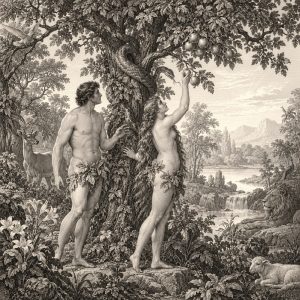
Genesis | Analogical History
Genesis does not begin with original sin. It gives a story. In the Hebrew of Genesis 2, the human being is הָאָדָם / hāʾādām and the ground from which he is formed is הָאֲדָמָה / hāʾădāmāh. The words are deliberately related: God forms הָאָדָם / hāʾādām from the dust of הָאֲדָמָה / hāʾădāmāh – the human from the ground. The King James Version renders the verse, ‘And the LORD God formed man of the dust of the ground’ (Genesis 2: 7), but the Hebrew wordplay is lost in English. The relationship between the two words places human existence within creaturely dependence. The human is made from material already given and receives life from God. He is neither a disembodied soul accidentally placed in matter nor a self-originating intelligence. God forms, breathes, plants, gives and commands. Human life begins as received life.
The Catechism states the Catholic position on the literary form and historical claim of the narrative:
The account of the fall in Genesis 3 uses figurative language, but affirms a primeval event, a deed that took place at the beginning of the history of man. Revelation gives us the certainty of faith that the whole of human history is marked by the original fault freely committed by our first parents. (Catechism Of The Catholic Church, §390)²⁴
Work is present before the fall. The man is placed in the garden ‘to dress it and to keep it’ (Genesis 2: 15). Labour cannot simply be identified with the curse. What changes after the transgression is the relation between the human and the ground: thorns, resistance and sweat enter the description. The good capacity for cultivation remains, while its mode becomes burdensome.
The command also precedes acquisition of the knowledge associated with the tree. This complicates any interpretation in which the humans possess no moral agency before eating. A command addressed to beings incapable of understanding obedience would be difficult to interpret as a genuine command. The narrative presupposes sufficient agency for obedience while still presenting the tree as conferring a form of knowledge which the humans do not yet possess.
The statement that it is ‘not good that the man should be alone’ establishes that created goodness need not mean completion at every stage. The woman is not introduced as a repair for sin. Sexual differentiation, companionship and the one-flesh relation belong to the pre-fall order, which rules out any simple identification of sexuality with the fall.
Genesis does not explicitly call the serpent Satan. Later Jewish and Christian texts identify the primordial serpent with the devil, but the literary figure in Genesis must first be allowed to perform its role within the narrative. The serpent begins not with an outright denial of God but with a question which reframes divine abundance as deprivation. The garden full of permitted trees recedes behind the one prohibition.
The woman sees that the tree is good for food, pleasant to the eyes and desirable to make one wise. The objects of desire are not evil. Food is good. Beauty is good. Wisdom is normally praised in Scripture. The temptation concerns goods – even a commodification: food, beauty, wisdom.
The immediate result resists a simple account of deception and loss. The eyes of Adam and Eve are opened; they know that they are naked; and God later says, ‘Behold, the man is become as one of us, to know good and evil.’ (Genesis 3: 22) The narrative does not say that the promised knowledge was wholly false. The serpent’s words and God’s later statement correspond at this point: the humans have acquired something. That correspondence ought not be removed by calling the knowledge counterfeit before asking what the text says.
The words ‘as one of us’ raise a separate question. Genesis does not identify the ‘us’. A similar divine plural appears earlier when God says, ‘Let us make man in our image.’ (Genesis 1: 26) Elsewhere in the Old Testament, God is represented as presiding over a heavenly assembly, as in 1 Kings 22: 19–22 and Job 1–2, and the plural in Genesis has often been understood against that background. It does not require the conclusion that Genesis presents several equal gods. Later Christian interpretation could read the plural in the light of the Trinity, but Genesis 3: 22 does not state the developed Christian doctrine of the Trinity. The difficulty should remain visible. God says that the human has become ‘as one of us’ in knowing good and evil. The serpent had said that this would happen, and at this point God confirms it. Adam and Eve have gained knowledge. The question is what kind of knowledge they have gained, and what it has cost them.
The fall includes an acquisition as well as a loss. Knowledge is gained; access to the tree of life is lost. The conjunction creates a tension rather than resolving one. According to God’s justice, humanity leaves the garden knowing good and evil but unable to live forever: such is knowledge without immortality. Genesis does not explain whether the knowledge is the evil, whether its acquisition is evil because it violates the command, or whether the problem lies in a human possession of knowledge that approaches the divine while immortality remains withheld.
Nakedness is the first object of the new knowledge. The bodies have not changed anatomically between Genesis 2: 25 and 3: 7. Consciousness of the bodies has changed. The humans make coverings, and the first human manufacture recorded after the transgression answers a newly experienced vulnerability. Culture begins, in this small instance, as a response to the changed human condition. This does not make manufacture sinful. God later clothes the humans more adequately, incorporating rather than abolishing the response to bodily vulnerability.
Hiding follows covering. Adam’s answer to God joins nakedness and fear: ‘I was afraid, because I was naked; and I hid myself.’ The divine question, ‘Who told thee that thou wast naked?’, draws attention to the change in consciousness. Blame then enters the conversation. The man points to the woman and, indirectly, to God who gave her; the woman points to the serpent. The relation between self, other and God has changed.
The judgements affect domains already present in creation: childbearing, the relation between man and woman, cultivation of the ground, food and bodily life. Genesis does not describe the creation of sex, work or embodiment after sin. It describes their fallen condition. The human pair is then excluded from the garden lest the man take also of the tree of life and live forever.
The tree of life governs the conclusion of the episode. Genesis 3: 22–24 does not simply say that Adam and Eve become mortal because they have sinned. Instead, God expels them from the garden and guards the way to the tree of life, ‘lest’ the man eat from it and ‘live forever’. This raises a question which Genesis itself does not answer. Were the first humans already immortal, were they mortal creatures whose life was sustained by God, or did they possess the possibility of immortality through access to the tree of life? The text does not say. Nor does it fully explain why access to the tree is now forbidden. Exclusion is a consequence of disobedience, but it may also prevent fallen humanity from living indefinitely in its fallen condition. Later theology develops these possibilities beyond what Genesis itself states. The theological significance of the tree need not depend upon treating it as a literal botanical mechanism of immortality.
Cain is born outside the garden. He does not stand beside Adam and repeat the historical act of eating. He begins within the world produced by that act. Genesis thus begins to distinguish an originating act from the condition inherited by those who live east of Eden.
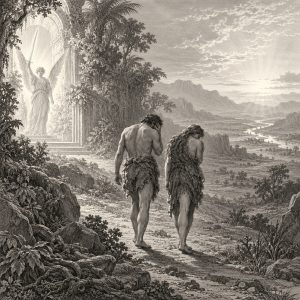
Knowledge | Nakedness | Life
What, then, is ‘the knowledge of good and evil’? It cannot simply mean the ability to recognise that some actions are right and others wrong. Before eating from the tree, Adam and Eve already receive a command from God and are capable of obeying or disobeying it. Some moral understanding must therefore precede the fall.
The expression may have a broader meaning. In the Old Testament, knowing ‘good and evil’ can describe the developed judgement associated with maturity or wisdom. Deuteronomy 1: 39 speaks of children who ‘had no knowledge between good and evil’, while Solomon asks God for an understanding heart ‘that I may discern between good and bad’ (1 Kings 3: 9). The two opposites can also express a whole range – good and evil, and everything between them – so that the phrase may suggest a more comprehensive knowledge. Genesis does not tell us precisely which meaning is intended.
Another interpretation goes further. The issue may not be knowledge alone, but the attempt to possess moral knowledge independently of God: not merely to know good and evil, but to claim the authority to determine them. That reading fits the act of disobedience, but Genesis does not explicitly say that this is what the phrase means. What the narrative does say is more limited and more difficult. Adam and Eve already possess enough moral agency to disobey God; after eating, they possess a knowledge they did not possess before. The first thing they know is their own nakedness. The text leaves us to ask what has changed in the way they know themselves, one another, good and evil, and God.
Wisdom is not condemned. The woman’s desire to become wise prevents any crude opposition between obedience and intelligence. Irenaeus supplies one early Christian form of the distinction. Humanity is created for growth into likeness to God, but growth must occur within creaturely dependence and obedience. Genesis does not say that the forbidden tree would later have been permitted, and the text should not be made to say so. The narrower claim is enough: a genuine good can be sought through a disordered mode.¹⁰
For the LORD giveth wisdom: out of his mouth cometh knowledge and understanding. (Proverbs 2: 6)
Wisdom is the principal thing; therefore get wisdom: and with all thy getting get understanding. (Proverbs 4: 7)
The serpent’s promise is partly confirmed. The eyes are opened; a form of godlike knowledge is acquired. The promise is also deceptive, but Genesis does not make every element of the deception equally easy to identify. The humans do not become self-sufficient gods. They become ashamed, afraid and divided, and they are excluded from the tree of life.
Ancient Near Eastern comparisons sharpen the pattern without reducing Genesis to a copy of another story. The Adapa tradition joins extraordinary wisdom to a lost opportunity for immortality; the Gilgamesh tradition joins mortality, the quest for life, a life-restoring plant, a serpent and the return to the city. The parallels establish a shared ancient field of reflection upon wisdom, mortality and the limits of human life; they do not establish literary identity.
Christian theology adds another dimension because the New Testament speaks openly of human participation in divine life. The serpent’s promise, ‘ye shall be as gods’, resembles, at a distance, the Christian teaching that humanity is called to share in the life of God. The Second Epistle of Peter says that Christians may become ‘partakers of the divine nature’ (2 Peter 1: 4). Athanasius of Alexandria later expresses the same idea in stronger language: the Word became human so that human beings might share, by grace, in the divine life. Christian tradition came to describe this as deification or theosis. It does not mean that human beings cease to be creatures or become gods equal to God. It means that God calls human beings into a participation in his life which they could never possess by nature or acquire for themselves.
According as his divine power hath given unto us all things that pertain unto life and godliness, through the knowledge of him that hath called us to glory and virtue: Whereby are given unto us exceeding great and precious promises: that by these ye might be partakers of the divine nature, having escaped the corruption that is in the world through lust. (2 Peter 1: 3–4)
The Catechism states the same vocation in the language of participation:
The Word became flesh to make us ‘partakers of the divine nature’. ‘For the Son of God became man so that we might become God.’ (Catechism Of The Catholic Church, §460)²⁶
The problem in Genesis, then, cannot simply be that the human creature desires something beyond ordinary mortal existence. Christianity itself teaches that humanity is called beyond mortality into communion with God. The question is whether the serpent offers as something to be seized what God gives as a gift.
In the light of Irenaeus, Athanasius and the later Greek Christian understanding of theosis, the temptation can be read as a form of counterfeit theosis: the attempt to obtain by disobedience and self-assertion what humanity is ultimately called to receive from God by grace. The phrase is ours, not of Genesis. Genesis does not say that God intended eventually to give the humans the forbidden knowledge, or that the sole error was trying to obtain a promised good too soon. The Christian contrast between godlikeness received by grace and godlikeness sought by seizure may illuminate the story, but it also goes beyond what the story states. Genesis leaves a more difficult fact unresolved: the forbidden act does result in knowledge, and God himself acknowledges that ‘the man is become as one of us, to know good and evil’.
Let this mind be in you, which was also in Christ Jesus: Who, being in the form of God, thought it not robbery to be equal with God: But made himself of no reputation, and took upon him the form of a servant, and was made in the likeness of men: And being found in fashion as a man, he humbled himself, and became obedient unto death, even the death of the cross. Wherefore God also hath highly exalted him, and given him a name which is above every name. (Philippians 2: 5–9)
The Catechism makes this later Christian reading explicit:
In that sin man preferred himself to God and by that very act scorned him. He chose himself over and against God, against the requirements of his creaturely status and therefore against his own good. Created in a state of holiness, man was destined to be fully ‘divinized’ by God in glory. Seduced by the devil, he wanted to ‘be like God’ but ‘without God, before God, and not in accordance with God’. (Catechism Of The Catholic Church, §398)²⁵
Genesis deliberately places ‘naked, and were not ashamed’ beside the later statement that the humans knew they were naked. The contrast describes a change in the experience of embodiment. The bodies remain sexually differentiated bodies, but they are no longer inhabited with the same unselfconscious ease.
Sex cannot be the forbidden fruit. Male and female exist before the transgression, and the one-flesh relation is already declared. Genesis 4 later uses the verb ‘to know’ for sexual intercourse, but the Hebrew verb has a much wider semantic range and cannot turn the tree of knowledge into a coded reference to sex. Any interpretation which makes sexuality the fall collides with the structure of Genesis 2.
Sexuality can still belong to the changed consciousness which follows. The coverings concern parts of the body associated with sexual difference and vulnerability. A person can now know not only the other but himself as seen by the other. The gaze becomes reflexive: I know that you see me, and I can experience my embodied exposure as danger, shame or invitation to control what is visible.
Puberty offers an analogy without becoming an explanation of the fall. Human adolescence often brings a new consciousness of the sexual body, the gaze of others, desire, privacy, comparison and shame. It can illuminate the movement from embodied innocence to reflective bodily self-consciousness, but Genesis is not describing puberty, and biological maturation is not sinful.
Irenaeus develops the comparison by describing early humanity as childlike. Augustine approaches the same question from another direction. For Augustine, sexual union and procreation would have existed without the fall, but lust as an involuntary desire resistant to rational willing belongs to fallen disorder. His account is not that sex is evil, but that the relation between will and bodily desire has lost its original integration.⁸, ¹⁰
Genesis and Paul give different accounts of the relation between Adam and death. Paul writes that ‘by one man sin entered into the world, and death by sin’ (Romans 5: 12), and that ‘in Adam all die’ (1 Corinthians 15: 22). Genesis describes the matter differently. Adam is formed ‘of the dust of the ground’ (Genesis 2: 7); after the fall God tells him, ‘dust thou art, and unto dust shalt thou return’ (Genesis 3: 19); and he is then excluded from the tree of life ‘lest he put forth his hand, and take also of the tree of life, and eat, and live forever’ (Genesis 3: 22). The question ‘Was Adam immortal?’ cannot be answered by treating these statements as though they said the same thing.
Athanasius offers a further distinction. The creature made from nothing is by nature corruptible. Incorruption comes through participation in God. Athanasius can therefore describe the fall both as judgement and as consequence: separation from the source of life leaves the creature subject to the corruption proper to what is created from nothing. This is a theological account of the relation between sin and death; Genesis does not formulate the relation in these terms.¹¹
Augustine later distinguishes Adam’s original possibility of not dying from the final condition of the redeemed, in which death is no longer possible. Eden is not identical with resurrection. Even within a stronger Western doctrine of original immortality, Adam’s condition can be understood as sustained and conditional rather than the intrinsic eschatological immortality of the glorified body.¹²
The distinction bears directly upon biological history. Death existed among living organisms long before human beings appeared. A theology which requires the first human sin to introduce the first biological death into the biosphere creates a conflict not required by Genesis. Creaturely biological mortality can be natural in one sense while death remains unnatural in another: natural to finite biological constitution, but contrary to humanity’s theological vocation to incorruptible life.
Human beings do not merely die; they know that they will die. That knowledge can affect the way they live long before death occurs. The Epistle to the Hebrews speaks of those ‘who through fear of death were all their lifetime subject to bondage’ (Hebrews 2: 15). Fear of death can produce attempts to secure life against loss: the accumulation of possessions, competition for resources, the pursuit of power and the use of violence for self-preservation. Death can therefore exercise power over human life before anyone actually dies.
Genesis does not itself set out this chain of consequences, and it should not be attributed to the text as though it did. The argument is theological rather than exegetical: once mortal human beings know that their lives will end, mortality can influence desire, choice and relations with other people. Death is then more than the biological event which ends a life. The knowledge and fear of death can become part of the conditions under which human beings sin. ‘Fear is the mind-killer.’
Human culture can resist death in limited ways. We preserve bodies, names, stories, property, monuments, institutions and descendants. The Gilgamesh epic makes the relation vivid: the death of Enkidu awakens Gilgamesh to his own mortality, the quest for immortality fails, and the king returns to the walls of Uruk. Civilisation can function as a human answer to mortality, even though no city can give resurrection.
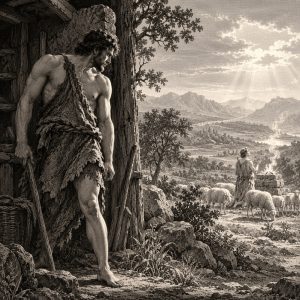
From Adam To Cain
Cain’s life begins east of Eden. He does not inherit Adam’s historical act; he inherits the world produced by Adam’s act. His existence is already marked by mortality, difficult labour, damaged relation and distance from the garden. Yet Genesis addresses Cain as a responsible agent. God warns him before the murder: sin lies at the door, its desire is towards Cain, and he, Cain, is commanded to rule over it.
Sin appears as a power seeking mastery. Paul later personifies sin as a reigning and enslaving force. No direct literary dependence need be claimed. The conceptual resemblance is enough: wrongdoing is more than a sequence of isolated mistakes, because repeated sin acquires power over persons and over human history.
Cain nevertheless acts. The inherited condition does not remove responsibility. Cain kills Abel and adds the act to the world he has inherited. Cain does not inherit Adam’s act. He inherits the world produced by Adam’s act.
The ground – the earth – again becomes a participant in the narrative. Abel’s blood cries from it, and the ground which received Adam’s labour now receives the brother’s blood. God asks Cain, ‘Where is Abel thy brother?’ Cain replies, ‘I know not: Am I my brother’s keeper?’ (Genesis 4: 9) The answer can be read with a bitter irony after the acquisition of the knowledge of good and evil in Eden. Cain does know what has happened to Abel: he has killed him. The first story after Eden therefore gives us a man who possesses moral agency, commits murder and answers God by denying knowledge of his brother. Whatever humanity has acquired through the knowledge of good and evil, it has not produced love of the brother.
God’s mark upon Cain is protective as well as judicial. Cain has been condemned to become ‘a fugitive and a vagabond’, but when he fears that whoever finds him will kill him, God places a mark upon him so that this will not happen. Judgement is therefore accompanied by protection.
Cain goes on to build a city and names it after his son Enoch. The first city thus appears in the story of the first murderer, but Genesis does not permit the conclusion that cities are intrinsically evil. The Bible will end with the New Jerusalem.
Cain’s descendants develop pastoralism, music and metallurgy. Human capability continues. Jubal’s music is not condemned; neither is Tubal-cain’s metalworking. The King James Version’s ‘brass’ belongs to older English usage for copper or bronze, and the genealogy should not be treated as a modern archaeological chronology. Its theological function is to compress the emergence of recognisable cultural capacities into the primeval family.
And Adah bare Jabal: he was the father of such as dwell in tents, and of such as have cattle. And his brother’s name was Jubal: he was the father of all such as handle the harp and organ. And Zillah, she also bare Tubalcain, an instructer of every artificer in brass and iron: and the sister of Tubalcain was Naamah. (Genesis 4: 20–22)
The escalation continues with Lamech, a descendant of Cain. He should not be confused with the later Lamech in the genealogy of Seth, who becomes the father of Noah. Cain’s Lamech is the first man in Genesis explicitly said to have two wives, Adah and Zillah, and the genealogy associates his family with developments in human culture. Jabal is ‘the father of such as dwell in tents, and of such as have cattle’; Jubal is ‘the father of all such as handle the harp and organ’; and Tubal-cain is ‘an instructer of every artificer in brass and iron’ (Genesis 4: 20–22). Pastoral life, music and metalworking thus appear within the line of Cain. Genesis does not present these developments as themselves sinful. Human cultural and technical capacities continue to develop east of Eden.
The same passage then gives one of the earliest pieces of poetry in the Bible, spoken by Lamech to his wives, Adah and Zillah:
‘Hear my voice; ye wives of Lamech, hearken unto my speech: for I have slain a man to my wounding, and a young man to my hurt. If Cain shall be avenged sevenfold, truly Lamech seventy and sevenfold.’ (Genesis 4: 23–24)
Lamech’s words mark an escalation from Cain. Cain kills Abel and fears vengeance; Lamech speaks of killing and announces a vengeance exceeding Cain’s. The ‘sevenfold’ protection associated with Cain has become ‘seventy and sevenfold’ in Lamech’s speech. The genealogy therefore places cultural development and the intensification of violence beside one another. Genesis does not say that pastoralism, music or metalworking cause violence. It shows instead that increasing human capability does not by itself overcome the disorder introduced into human relations. Civilisation develops, but so does the human capacity to use power against other human beings.
Genesis 4–11 repeatedly presents human capability developing faster than human moral maturity. The problem is not that humanity develops. The problem is that development takes place east of Eden.
Genesis 5 repeats the refrain ‘and he died’. Enoch forms the conspicuous exception, but the genealogy as a whole places mortality over the expanding human family. Genesis 6 generalises violence until the earth is described as corrupt and filled with violence. The flood judges this condition, yet after the flood the human heart is still described as inclined towards evil. External destruction has not healed the inner source.
Sin now spreads in at least three ways. There is vertical inheritance: each generation receives mortality and an already damaged human condition. There is horizontal propagation: people learn violence, desire, language, custom and social practice from one another. There is personal appropriation: each morally responsible person makes choices and adds new acts to the history received.
From Adam through Cain and Lamech to the flood and Babel, Genesis depicts sin spreading rather than Adam’s personal act being mechanically transmitted. Paul later gives Adamic solidarity a different theological account.
And Cain talked with Abel his brother: and it came to pass when they were in the field that Cain rose up against Abel his brother and slew him. (Genesis 4: 8)
And Lamech said unto his wives Adah and Zillah Hear my voice; ye wives of Lamech hearken unto my speech: for I have slain a man to my wounding and a young man to my hurt. If Cain shall be avenged sevenfold truly Lamech seventy and sevenfold. (Genesis 4: 23–24)
And GOD saw that the wickedness of man was great in the earth and that every imagination of the thoughts of his heart was only evil continually. (Genesis 6: 5)
The earth also was corrupt before God and the earth was filled with violence. And God looked upon the earth and behold it was corrupt; for all flesh had corrupted his way upon the earth. (Genesis 6: 11–12)
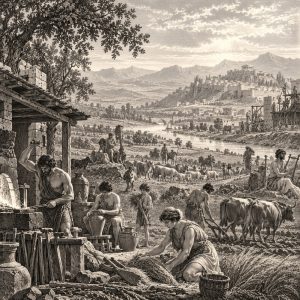
Civilisation And Babel
Eden supplies fruit directly from trees; east of Eden humanity eats bread in the sweat of the face. Bread is a cultural food. Grain must be cultivated, harvested, processed and transformed. The contrast does not make agriculture a punishment, since cultivation already belongs to Adam’s vocation in Genesis 2: 15. The curse concerns resistance: the ground produces thorns, labour becomes toil, and subsistence is marked by sweat.
The long transition to agriculture in human history cannot be identified with a single Biblical event. Cultivation, domestication and permanent settlement developed over long periods in several regions. Agriculture nevertheless altered the scale of human social capability. Surplus could be stored. Land and inheritance became more consequential. Larger populations could be sustained. Specialised crafts, administration, taxation, organised warfare and ruling classes became possible in new forms. These developments produced genuine goods and new vulnerabilities.
Bioarchaeology does not support a simple story in which the development of agriculture automatically improved human life. Clark Spencer Larsen, an American biological anthropologist and bioarchaeologist, whose research examines health and living conditions through human skeletal remains, has studied the effects of the transition from hunting and gathering to settled agriculture. In a major comparative review published in 1995, Larsen found a general, though variable, pattern of declining oral and general health among early farming populations. Skeletal and dental remains indicate increased disease and nutritional stress in many populations after the adoption or intensification of agriculture. Later research has connected settled agricultural life with less varied diets in some populations, declining mobility, larger and denser settlements, and increased opportunities for infectious disease to spread.
The evidence differs considerably between regions and periods. It does not establish that hunting and gathering was invariably healthier, or that agriculture was inherently harmful. The narrower point is that greater productive capacity did not necessarily produce better health. Agriculture could support larger populations, permanent settlements and increasingly complex societies while also creating new forms of nutritional stress and disease. Increased human capability and increased human flourishing are not the same thing.¹³
A city is a social technology: a way of coordinating large numbers of people, concentrating labour, preserving goods, organising defence, administering law and transmitting culture among people who are not members of one household. The city can make forms of cooperation possible which small kin groups cannot achieve. It can also make domination possible at a scale a household cannot achieve.
Music and metallurgy extend the same ambiguity. A metal tool can cultivate, construct or kill. The moral character of capability depends upon its use and the loves which direct it. The genealogy places cultural brilliance beside Lamech’s violence without reducing one to the other.
Writing belongs to the same history even though Genesis 4 does not mention its invention. The earliest Mesopotamian writing is closely connected with administration and economic record. Writing extends memory beyond the individual mind, makes institutions durable and allows commands, debts and identities to persist across distance and time. It is one of humanity’s greatest instruments of knowledge and one of the foundations of large-scale institutional power.
Genesis repeatedly presents increasing capability without corresponding wisdom. Human beings become increasingly able to alter their environment and organise one another, but increased power does not guarantee moral maturation. Capability does not justify its use.
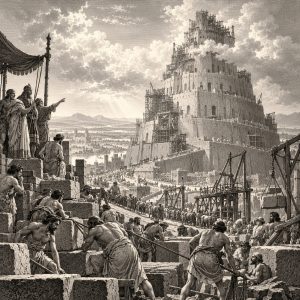
And they said, Go to, let us build us a city and a tower, whose top may reach unto heaven; and let us make us a name, lest we be scattered abroad upon the face of the whole earth. And the LORD came down to see the city and the tower, which the children of men builded. And the LORD said, Behold, the people is one, and they have all one language; and this they begin to do: and now nothing will be restrained from them, which they have imagined to do. (Genesis 11: 4–6)
Civilisation solves vulnerabilities and creates new ones. Storage protects against scarcity but can be monopolised. Walls protect inhabitants but can become instruments of exclusion or imperial power. Writing preserves knowledge but also records debt and administration. Political organisation can restrain violence and can organise violence. Technology enlarges the range of possible action without determining which actions should be chosen.
Mortality adds another dimension. Human beings build and generate things and people which outlast them: names, children, texts, monuments, cities and dynasties all offer forms of continuity. Civilisation cannot be reduced to fear of death, but the mortal creature’s desire for permanence plainly belongs to the history of monuments, inheritance, reputation and political continuity.
Babel presents the largest organised human project in Genesis 2–11. The setting is Mesopotamian: the land of Shinar, baked brick and bitumen. Hebrew Babel is Babylon. Genesis associates the name with the verb balal, ‘to confound’, as a literary wordplay rather than an historical etymology.
The tower naturally evokes the ziggurats of Mesopotamian cities, though identifying it confidently with one particular monument goes beyond what the text permits. The builders propose a city, a tower, a name and a defence against scattering. Pride belongs to the story, but the explicit fear of dispersion should not be lost behind the general label.
‘Let us make us a name’ contrasts with God’s later promise to Abram, ‘I will make thy name great.’ (Genesis 12: 2) Human beings attempt to manufacture for themselves what Abram receives as gift. The contrast echoes Eden: possession apart from God set against reception from God.
The builders also say, ‘lest we be scattered abroad upon the face of the whole earth’. Genesis 1 and 9 had commanded humanity to fill the earth. The scattering which Babel fears becomes, in judgement, a fulfilment of the wider distribution humanity had resisted. The divine descent to inspect the tower adds deliberate irony: the structure intended to reach heaven remains something God must ‘come down’ to see.
Genesis 11: 6 takes human capability seriously. Unified language and coordinated purpose make collective action possible. Babel is the first narrative in Genesis in which technological construction, political concentration and common language appear together as an organised project. Adam denotes the human couple, Cain the brother, Lamech the lineage, the flood generalised violence, and Babel institutional coordination.
Language provides the infrastructure for collective power. Common speech permits common planning. The judgement fragments communication. Pentecost later answers Babel without abolishing linguistic plurality: people from many nations hear the apostles in their own tongues. Communion becomes possible across difference rather than through enforced sameness.
Babel attempts permanence without the tree of life: the city, tower and name promise continuity against scattering and disappearance. The phrase is interpretative rather than Biblical wording, but the themes already belong to the primeval history.
Identification of Babel with Babylon gives the narrative later historical force. Babylon destroyed Jerusalem and the Temple in the early sixth century BC and carried part of Judah into exile. Exile became a setting in which Israel reflected intensely upon land, covenant, judgement and return. The Adam story and Israel’s story begin to illuminate one another: a place is given, a command is violated, and expulsion follows.
Exilic literature sharpens the distinction between inherited consequence and personal culpability. Lamentations can say that the fathers sinned and the descendants bear the consequences, while Ezekiel insists that the son shall not bear the iniquity of the father in the sense of personal moral judgement. Both can be true: later generations can suffer consequences they did not originate without being personally guilty of the ancestral act.
Jeremiah tells the exiles to build houses, plant gardens, marry, have children and seek the peace of the city in which they live. Cultural life continues outside the sacred land. Exile is not a command to cease being human. This resembles the larger Genesis pattern: development continues outside Eden.
Babylon later becomes a symbol in Revelation for an entire order of idolatrous power, wealth and violence. Yet the Biblical answer to Babylon is not the abolition of the city. It is another city, the New Jerusalem. Babel builds upwards to secure a name; the holy city descends from God. The tree of life appears within it. The city becomes garden.
And they said Go to let us build us a city and a tower whose top may reach unto heaven; and let us make us a name lest we be scattered abroad upon the face of the whole earth. (Genesis 11: 4)
And I John saw the holy city new Jerusalem coming down from God out of heaven prepared as a bride adorned for her husband. (Revelation 21: 2)
Adam Discovered Through Christ
Saint Paul’s Adam appears within Saint Paul’s proclamation of Christ rather than in an independent treatise on human origins. Romans 5 has been concerned with justification, reconciliation and Christ. Adam enters as the counterpart to Christ. This means that Paul develops the significance of Adam beyond anything stated explicitly in Genesis, but it also cautions against asking Romans 5 to provide a mechanism of inherited sin that Paul does not set out to describe.
Paul writes: ‘By one man sin entered into the world, and death by sin; and so death passed upon all men, for that all have sinned’ (Romans 5: 12) The meaning of the final words have been disputed for centuries because they bear directly upon the relation between Adam’s sin and the sins of his descendants. What exactly does Paul mean by ‘for that all have sinned’?
The difficulty lies in the Greek expression ἐφ’ ᾧ πάντες ἥμαρτον / eph’ hō pantes hēmarton. The King James Version renders it ‘for that all have sinned’; many modern translations give the sense ‘because all sinned’. On that reading, Paul says that death reaches all human beings in a world into which sin has entered through Adam, and all human beings themselves sin. An influential Latin form of the verse, however, contained the words in quo omnes peccaverunt, which could be understood as ‘in whom all sinned’. Augustine understood the passage in relation to Adam: humanity was implicated in the sin of the one man. The Latin wording consequently contributed to the development of the Western doctrine of original sin.
The translation problem should not be made to carry more than it can bear. Joseph A. Fitzmyer, the twentieth-century Jesuit Biblical scholar, devoted a detailed study to ἐφ’ ᾧ / eph’ hō in 1993 and argued that the expression could indicate consequence or result rather than simply ‘because’. Other interpretations remain in discussion. Paul’s argument does not depend upon Romans 5: 12 alone. A few verses later he says that ‘by one man’s offence death reigned by one’ (Romans 5: 17), that ‘by the offence of one judgment came upon all men to condemnation’ (5: 18), and that ‘by one man’s disobedience many were made sinners’ (5: 19). Whatever precise translation is given to ἐφ’ ᾧ / eph’ hō, Paul connects Adam’s act with the condition of those who come after him.
What Paul does not explain is how that connection operates. Romans 5 establishes a relation between Adam’s sin, human sin and death, but it does not give a mechanism by which Adam’s act becomes consequential for people who did not perform it. Later Christian arguments about inherited guilt, inherited corruption, mortality and original sin attempt to answer a question which Paul raises without fully answering.¹⁵
Paul repeatedly speaks of sin and death as powers which reign. Death reigns even over those who have not sinned after the likeness of Adam’s transgression. An imitation-only theory is not enough. At the same time, Romans 1–3 has already insisted upon actual human sins. Paul does not exchange personal responsibility for ancestral determinism.
Romans 5: 19 intensifies the corporate language: through one man’s disobedience many were made sinners, while through the obedience of one many shall be made righteous. The relation between the act of the one and the condition of the many cannot be reduced to imitation. Yet the verse does not specify whether the inherited reality should be described as guilt, corruption, mortality, an altered corporate status, a propensity to sin, or some combination of these. Later traditions supply accounts of that relation. Paul supplies the relation itself more securely than its mechanism.
Paul gives us solidarity, but he does not explain the mechanism by which Adam’s act affects his descendants. The distinction should remain open rather than being filled automatically with an Augustinian, federal, biological or sociological theory.
Sin also appears as an enslaving power. Romans 6 speaks of bondage and liberation; Romans 7 describes a divided human subject in whom knowledge of the good does not produce the good. The law can reveal and name sin without supplying the power to overcome it. Knowledge is not salvation.
For that which I do I allow not: for what I would that do I not; but what I hate that do I. (Romans 7: 15)
For the good that I would I do not: but the evil which I would not that I do. (Romans 7: 19)
For I delight in the law of God after the inward man: But I see another law in my members warring against the law of my mind and bringing me into captivity to the law of sin which is in my members. O wretched man that I am! who shall deliver me from the body of this death? (Romans 7: 22–24)
Baptism in Romans 6 is participation in Christ’s death and resurrection, not the cancellation of a legal entry alone. The Christian is joined to a new corporate humanity. This already warns against explaining Adamic solidarity in purely genetic terms, since being ‘in Christ’ cannot be reduced to biological descent.
The Adam-Christ comparison is asymmetrical. Paul repeatedly says ‘much more’. Grace does not balance the offence. The gift exceeds the loss. Christ is not Adam run backwards.
1 Corinthians 15 makes the point in the context of resurrection. If Christ is not raised, Christian faith is vain and believers remain in their sins. Paul joins sin and death in the argument. ‘As in Adam all die, even so in Christ shall all be made alive.’ death is the last enemy.
The resurrection body is not an immaterial soul escaping matter. Paul’s ‘spiritual body’ is a body transformed and animated by the Spirit. The first Adam becomes a living soul; the last Adam becomes a quickening spirit. Adam receives life; Christ gives life. The first is earthy, the later humanity heavenly, and believers are called to bear the image of the heavenly.
And so it is written, The first man Adam was made a living soul; the last Adam was made a quickening spirit. Howbeit that was not first which is spiritual, but that which is natural; and afterward that which is spiritual. The first man is of the earth, earthy: the second man is the Lord from heaven. As is the earthy, such are they also that are earthy: and as is the heavenly, such are they also that are heavenly. And as we have borne the image of the earthy, we shall also bear the image of the heavenly. (1 Corinthians 15: 45–49)
The first is not final. Mortal humanity must put on immortality. The final human condition is gift and transformation, not the recovery of ignorance. Paul reads the first human in the light of the last Adam; Christ determines the theological significance Paul assigns to Adam.
For this corruptible must put on incorruption, and this mortal must put on immortality. So when this corruptible shall have put on incorruption, and this mortal shall have put on immortality, then shall be brought to pass the saying that is written, Death is swallowed up in victory. O death, where is thy sting? O grave, where is thy victory? The sting of death is sin; and the strength of sin is the law. But thanks be to God, which giveth us the victory through our Lord Jesus Christ. (1 Corinthians 15: 53–57)
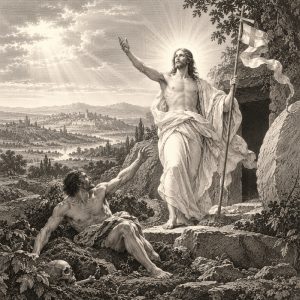
Irenaeus, Athanasius And The Greek Fathers
Irenaeus of Lyons, writing in the later second century, developed his theology partly in opposition to movements which claimed possession of a higher or secret knowledge, or gnosis. He did not oppose knowledge or theological enquiry as such. His objection was to speculation which displaced the public faith received from the apostles, divided Christians into ordinary believers and a supposedly enlightened spiritual elite, or separated the supreme God from the Creator of the material world. Against this, Irenaeus insisted upon the unity of Christian faith: one God created the world; the material creation is good; the Word truly became flesh; and the human creature God made is the human creature whom Christ saves. The theologian may explain this faith more fully than the unlearned believer, but cannot replace it with a higher faith. Irenaeus consequently combines theological enquiry with deliberate intellectual restraint. What God has revealed may be investigated deeply; what has not been revealed need not be supplied by elaborate speculation. His account of Adam belongs within this larger argument. Humanity is God’s good creation, made for life with God, and its perfection consists not in escaping created existence but in growing towards the end for which the Creator made it.
As I have already observed, the Church, having received this preaching and this faith, although scattered throughout the whole world, yet, as if occupying but one house, carefully preserves it. She also believes these points of doctrine just as if she had but one soul, and one and the same heart, and she proclaims them, and teaches them, and hands them down, with perfect harmony, as if she possessed only one mouth. For, although the languages of the world are dissimilar, yet the import of the tradition is one and the same. Nor will any one of the rulers in the Churches, however highly gifted he may be in point of eloquence, teach doctrines different from these; nor, on the other hand, will he who is deficient in power of expression inflict injury on the tradition. For the faith being ever one and the same, neither does one who is able at great length to discourse regarding it, make any addition to it, nor does one, who can say but little diminish it. (Irenaeus, Against Heresies, I.10.2)
Irenaeus describes humanity in developmental terms that differ from the later Augustinian account. He makes the argument explicitly in Against Heresies, Book IV, chapter 38, a chapter entitled ‘Why Man Was Not Made Perfect From The Beginning’. Irenaeus asks whether God could have created humanity perfect from the first. His answer is that God could do so, but newly created humanity was not yet capable of receiving and retaining such perfection. The limitation lies not in God but in the creature.
Irenaeus compares early humanity with an infant. A mother can give solid food to a child, but the child cannot yet receive it. In the same way, humanity at its creation was good but immature: capable of growth towards God, but not yet possessing the maturity for which it had been created. Irenaeus says that what is made must receive ‘beginning, and middle, and addition, and increase’, and that humanity receives ‘advancement and increase towards God’. Perfection, on this account, is not simply a complete condition possessed at the first moment of creation. It is also something into which the creature must grow.⁹
If, however, any one say, ‘What then? Could not God have exhibited man as perfect from beginning?’ let him know that, inasmuch as God is indeed always the same and unbegotten as respects Himself, all things are possible to Him. But created things must be inferior to Him who created them, from the very fact of their later origin; for it was not possible for things recently created to have been uncreated. But inasmuch as they are not uncreated, for this very reason do they come short of the perfect. Because, as these things are of later date, so are they infantile; so are they unaccustomed to, and unexercised in, perfect discipline. (Irenaeus, Against Heresies, IV.38.1)
Created goodness does not require created completion. A creature can be good at the stage appropriate to its beginning while still having a future. Irenaeus can speak of humanity making progress and ascending towards perfection. Dependence upon God is not a defect to be overcome but the condition of continuance in life.
But being in subjection to God is continuance in immortality, and immortality is the glory of the uncreated One. By this arrangement, therefore, and these harmonies, and a sequence of this nature, man, a created and organized being, is rendered after the image and likeness of the uncreated God – the Father planning everything well and giving His commands, the Son carrying these into execution and performing the work of creating, and the Spirit nourishing and increasing, but man making progress day by day, and ascending towards the perfect, that is, approximating to the uncreated One. For the Uncreated is perfect, that is, God. (Irenaeus, Against Heresies, IV.38.3)
Irenaeus develops the same idea elsewhere. In The Demonstration Of The Apostolic Preaching, a short account of Christian belief written for a Christian named Marcianus, he describes Adam and Eve before the fall as possessing an ‘innocent and childlike mind’. Their nakedness is associated not with sexual disorder but with innocence: Irenaeus describes them as embracing one another ‘in purity after the manner of children’. In Against Heresies he goes further, arguing that Adam and Eve had been created only a short time before and had not yet reached the maturity required for procreation. They would first have had to reach adulthood and then multiply.
This is a distinctive element of Irenaeus’ account. Adam and Eve are not wicked before the fall, nor are they defective creations. They are good but immature. Their condition belongs to Irenaeus’ larger understanding of humanity as created for growth towards God. This is not the only patristic interpretation. Augustine later insists that sexual union and procreation belonged fully to the good order of creation before the fall, although without the disordered desire which he associates with fallen sexuality.⁸, ¹⁶
Irenaeus gives the command a pedagogical place within human growth. On that reading, the fall interrupts maturation rather than destroying a finished adult perfection. This is Irenaeus’ theological construction of the narrative. Genesis does not describe Adam as an immature child progressing towards an eschatological adulthood.⁹
For if man, who had been created by God that he might live, after losing life, through being injured by the serpent that had corrupted him, should not any more return to life, but should be utterly abandoned to death, God would in that case have been conquered, and the wickedness of the serpent would have prevailed over the will of God. But inasmuch as God is invincible and long-suffering, He did indeed show Himself to be long-suffering in the matter of the correction of man and the probation of all, as I have already observed; and by means of the second man did He bind the strong man, and spoiled his goods, and abolished death, vivifying that man who had been in a state of death. (Irenaeus, Against Heresies, III.23.1)
The pattern may be called ‘counterfeit theosis’ only as a later theological synthesis. Irenaeus distinguishes humanity’s destiny of likeness to God from disobedient grasping, but neither he nor Genesis says that the forbidden fruit was a good reserved for a later stage. The formulation clarifies one Christian reading of the temptation; it should not close the exegetical question raised by Genesis 3: 22.¹⁰
Human development does not stop after the fall. People continue to learn, reproduce, build and organise. Divine pedagogy continues within fallen history. The Incarnation becomes recapitulation: Christ takes up the human story and lives it rightly, carrying humanity through obedience towards the end for which it was made.
It was necessary, therefore, that the Lord, coming to the lost sheep, and making recapitulation of so comprehensive a dispensation, and seeking after His own handiwork, should save that very man who had been created after His image and likeness, that is, Adam, filling up the times of His condemnation, which had been incurred through disobedience. But this is Adam, if the truth should be told, the first formed man, of whom the Scripture says that the Lord spoke, ‘Let Us make man after Our own image and likeness;’ and we are all from him: and as we are from him, therefore have we all inherited his title. But inasmuch as man is saved, it is fitting that he who was created the original man should be saved. (Irenaeus, Against Heresies, III.23.1–2)
Christ is the mature Adam in the sense that human nature in him attains the obedient communion which the first human beginning had not yet completed. The claim concerns fulfilled humanity, not Jesus reaching adulthood.
Irenaeus’ anti-Gnostic insistence upon the goodness of matter completes this aspect of his anthropology. The body is not the problem from which salvation rescues us. Eucharist and resurrection make bodily continuity indispensable. Redemption fulfils embodied humanity.¹⁷
Irenaeus permits the fall to be read as both loss and failure to attain, but the two claims do not have the same textual basis. Genesis plainly narrates losses: the garden, ease, unashamed nakedness and access to the tree of life. The claim that humanity also failed to attain a further maturity belongs to a developmental Christian interpretation. It may be persuasive without being made into something Genesis explicitly says.
Athanasius begins from the metaphysical difference between creator and creature. Created from nothing, human beings are naturally liable to corruption. God grants them participation in the Word and a vocation to remain in incorruption. Transgression turns humanity away from the source of life and back towards the corruption proper to created existence.¹¹
For God has not only made us out of nothing; but He gave us freely, by the Grace of the Word, a life in correspondence with God. But men, having rejected things eternal, and, by counsel of the devil, turned to the things of corruption, became the cause of their own corruption in death, being, as I said before, by nature corruptible, but destined, by the grace following from partaking of the Word, to have escaped their natural state, had they remained good. For because of the Word dwelling with them, even their natural corruption did not come near them. (Athanasius, On The Incarnation, §5)
Athanasius can hold judgement and ontological consequence together: death is connected with divine judgement, while corruption also follows from turning away from the source of life. This provides a Christian account of why death follows sin. Genesis 3 itself is less systematic. It speaks of return to dust and then depicts God actively preventing access to the tree of life. Athanasius may be permitted to interpret the narrative, but Genesis itself does not state his metaphysics directly.¹¹
Repentance alone cannot solve the problem because corruption is not a bad decision that another decision can reverse. Athanasius’ argument for the Incarnation depends upon the need for recreation. The Word through whom humanity was made enters creation to restore the image and overcome death.¹¹
But repentance would, firstly, fail to guard the just claim of God. For He would still be none the more true, if men did not remain in the grasp of death; nor, secondly, does repentance call men back from what is their nature – it merely stays them from acts of sin. Had it been a case of a trespass only, and not of a subsequent corruption, repentance would have been well enough; but when once transgression had begun men came under the power of the corruption proper to their nature and were bereft of the grace which belonged to them as creatures in the Image of God. No, repentance could not meet the case. What – or rather Who was it that was needed for such grace and such recall as we required? Who, save the Word of God Himself, Who also in the beginning had made all things out of nothing? His part it was, and His alone, both to bring again the corruptible to incorruption and to maintain for the Father His consistency of character with all. (Athanasius, On The Incarnation, §7)
The thought that the Word became man so that we might be made godly states the true end which the serpent’s promise distorts. Deification is gift through the Incarnate Word, not autonomous seizure.
John Chrysostom (c. 347–407), bishop of Constantinople and a Greek-speaking Father of the Church, addresses the question directly in his homilies on Romans. ‘Chrysostom’, meaning ‘golden-mouthed’, was the name later given to him because of his reputation as a preacher. Commenting on Paul’s comparison between Adam and Christ in Romans 5, he asks what it means to say that Adam’s descendants suffer because of Adam’s transgression.
Chrysostom distinguishes Adam’s act from the consequence which follows it. Adam alone ate from the tree, yet those who came after him became mortal. They did not personally perform Adam’s act, but they entered a human condition in which death reigned. A distinction: Adam’s descendants can receive a consequence of his sin without becoming the personal performers of that sin; Death is inherited; Adam’s individual act is not repeated by inheritance.
But what means, ‘for that all have sinned?’ This; he having once fallen, even they that had not eaten of the tree did from him, all of them, become mortal. (John Chrysostom, Homilies On Romans, Homily X)
Chrysostom does not thereby reduce the fall to biological mortality, nor does his account remove judgement or responsibility from Greek theology. Paul says more than that human beings happen to die, and Chrysostom knows that Adam’s transgression has universal consequences. His point is narrower. The fact that Adam’s descendants are affected by Adam’s act does not mean that each descendant personally committed Adam’s act. This provides one of the patristic foundations for the Eastern distinction between Adam’s personal transgression and the mortality and corruption inherited by those who come after him.¹⁸
What then is the question? It is the saying that through the offence of one many were made sinners. For the fact that when he had sinned and become mortal, those who were of him should be so also, is nothing unlikely. But how would it follow that from his disobedience another would become a sinner? For at this rate a man of this sort will not even deserve punishment, if, that is, it was not from his own self that he became a sinner. What then does the word ‘sinners’ mean here? To me it seems to mean liable to punishment and condemned to death. Now that by Adam’s death we all became mortals, he had shown clearly and at large. (John Chrysostom, Homilies On Romans, Homily X)
Gregory of Nyssa complicates any attempt to speak of one uniform Greek anthropology. In On The Making Of Man he links sexual differentiation and the present form of reproduction with divine foreknowledge of the fall and speculates about another mode by which humanity might have multiplied. His speculation differs from Irenaeus and from Augustine.¹⁹
Now the resurrection promises us nothing else than the restoration of the fallen to their ancient state; for the grace we look for is a certain return to the first life, bringing back again to Paradise him who was cast out from it. If then the life of those restored is closely related to that of the angels, it is clear that the life before the transgression was a kind of angelic life, and hence also our return to the ancient condition of our life is compared to the angels. Yet while, as has been said, there is no marriage among them, the armies of the angels are in countless myriads; for so Daniel declared in his visions: so, in the same way, if there had not come upon us as the result of sin a change for the worse, and removal from equality with the angels, neither should we have needed marriage that we might multiply; but whatever the mode of increase in the angelic nature is (unspeakable and inconceivable by human conjectures, except that it assuredly exists), it would have operated also in the case of men, who were ‘made a little lower than the angels,’ to increase mankind to the measure determined by its Maker. (Gregory Of NyssaOn The Making Of Man, XVII.2)
Patristic interpretations of the coats of skins vary. Gregory of Nyssa, for example, connects the post-fall condition with mortality and passibility within a wider anthropology in which sexual differentiation receives speculative treatment. Such readings belong to Christian reception of Genesis; the Hebrew phrase in Genesis 3: 21 refers to garments provided by God.¹⁹
Maximus the Confessor offers another set of categories. Human nature remains good while the mode of its movement becomes disordered. Reason, desire and spirited energy are not evil substances. Their direction can be distorted. Desire can turn from God towards possessive pleasure; fear of pain and death can generate defensive and destructive patterns.
When God created human nature, he did not create sensible pleasure and pain along with it; rather, he furnished it with a certain spiritual capacity for pleasure, a pleasure whereby human beings would be able to enjoy God ineffably. But at the instant he was created, the first man, by the use of his senses, squandered this spiritual capacity – the natural desire of the mind for God – on sensible things. (Maximus The Confessor, Questions To Thalassius, 61)
Maximus’ analyses of pleasure, pain, mortality and the passions help explain how an inherited condition can shape human existence without making personal culpability hereditary. A child can be born into mortal, passible humanity before committing a voluntary sin. Personal guilt requires personal willing, but the field within which willing develops is already damaged.
Christ assumes mortal and passible human nature without sin. The distinction follows from Christology. Mortality and vulnerability cannot themselves be identical with personal guilt, since Christ truly assumes human weakness while remaining sinless. Salvation does not abolish the human will. It heals and perfects it. Freedom is not endless neutrality between good and evil. Deification fulfils rather than diminishes human nature.²²
He willingly submitted to the condemnation of nature in its passibility, and he made that very passibility a weapon for the destruction of sin and death, which is the consequence of sin. For by giving our nature impassibility through His Passion, relief through His sufferings, and eternal life through His death, He restored our nature, renewing its capacities by means of what was negated in His own flesh. (Maximus The Confessor, Questions To Thalassius, 61)
Augustine And The Integrated Adam
Augustine presents another Adam. His Adam is not chiefly an infantile beginning awaiting ordinary maturation but a human being endowed with an original integration which sin disrupts. The doctrine develops across Augustine’s career and becomes especially sharp in controversy with Pelagius and Julian of Eclanum, but its foundations are broader than the controversy.⁸
God, desiring not only that the human race might be able by their similarity of nature to associate with one another, but also that they might be bound together in harmony and peace by the ties of relationship, was pleased to derive all men from one individual, and created man with such a nature that the members of the race should not have died, had not the two first (of whom the one was created out of nothing, and the other out of him) merited this by their disobedience; for by them so great a sin was committed, that by it the human nature was altered for the worse, and was transmitted also to their posterity, liable to sin and subject to death. (Augustine, The City Of God, XIV.1)
Infant baptism drives Augustine’s argument at this point. If infants require baptism for the remission of sins before they have committed personal acts, something called sin must be present as inherited condition. Augustine distinguishes original from actual sins but gives original sin a stronger culpability than characteristic Eastern accounts.⁵
The inevitable conclusion from these truths is this, that, as nothing else is effected when infants are baptized except that they are incorporated into the church, in other words, that they are united with the body and members of Christ, unless this benefit has been bestowed upon them, they are manifestly in danger of damnation. Damned, however, they could not be if they really had no sin. Now, since their tender age could not possibly have contracted sin in its own life, it remains for us, even if we are as yet unable to understand, at least to believe that infants inherit original sin. (Augustine, On The Merits And Forgiveness Of Sins, And On The Baptism Of Infants, III.7)
This challenges the formulation that Cain inherits the world produced by Adam. Augustine would say that Cain inherits a damaged human nature and a liability associated with Adamic solidarity as well. The Latin term reatus concerns objective liability rather than a subjective feeling of guilt.
Nor, indeed, are those sins of infancy so said to be another’s, as if they did not belong to the infants at all, inasmuch as all then sinned in Adam, when in his nature, by virtue of that innate power whereby he was able to produce them, they were all as yet the one Adam; but they are called another’s, because as yet they were not living their own lives, but the life of the one man contained whatsoever was in his future posterity. (Augustine, On The Merits And Forgiveness Of Sins, And On The Baptism Of Infants, III.14)
The Latin reception of Romans 5: 12 mattered, but it did not alone create Augustine’s doctrine. Romans 5: 19, infant baptism, the universality of death and Augustine’s account of concupiscence all contribute. The history should not be reduced to one mistranslated preposition.⁵, ⁷, ¹⁵
Augustine’s pre-fall Adam is integrated. The command is not impossibly difficult; grace is sufficient; the will is capable of obedience. Pride precedes the outward act because the deeper movement is the creature turning towards itself as an improper final end.⁸
Our first parents fell into open disobedience because already they were secretly corrupted; for the evil act had never been done had not an evil will preceded it. And what is the origin of our evil will but pride? For pride is the beginning of sin. And what is pride but the craving for undue exaltation? And this is undue exaltation, when the soul abandons Him to whom it ought to cleave as its end, and becomes a kind of end to itself. (Augustine, The City Of God, XIV.13)
The punishment mirrors the sin. The human will refuses its relation of obedience to God, and the human body and desires cease to be subordinate to the rational will. Augustine’s account of sexual shame belongs here. He does not teach that marriage, sex or procreation are evil. He imagines pre-fall procreation without involuntary lust. Concupiscence is broader than sexuality, but sexual arousal becomes a sign that the body does not simply obey conscious command.⁸
They experienced a new motion of their flesh, which had become disobedient to them, in strict retribution of their own disobedience to God. For the soul, revelling in its own liberty, and scorning to serve God, was itself deprived of the command it had formerly maintained over the body. And because it had willfully deserted its superior Lord, it no longer held its own inferior servant; neither could it hold the flesh subject, as it would always have been able to do had it remained itself subject to God. (Augustine, The City Of God, XIII.13)
Augustine’s account differs from Irenaeus’ childlike Adam, yet the difference need not be absolute. Adam could be originally integrated without being complete in the eschatological sense. Augustine distinguishes the original possibility of not dying from the final impossibility of dying. Eden is not the resurrection state.
Augustine’s theology of the fall gives weight to the divided will. Human beings can know the good and fail to will it effectively. Habit can become bondage. Desire can resist judgement. Grace must heal the will from within rather than supply information alone.
Augustine’s account of generation and concupiscence attempts to explain transmission without treating sin as a physical substance in semen. The virgin birth of Christ acquires a particular theological function within this system. Yet the exact mechanism of transmission remains difficult, and Augustine’s hardest conclusions about unbaptised infants should not be softened.²⁰
Sin does come from the will. Perhaps he wants to know, whether original sin also? I answer, most certainly original sin also. Because it, too, was engendered from the will of the first man; so that it both existed in him, and passed on to all. As for what he next proposes, ‘If it comes from nature, then nature is evil,’ I request him to answer, if he can, to this effect: As it is manifest that all evil works spring from a corrupt will, like the fruits of a corrupt tree; so let him say whence arose the corrupt will itself – the corrupt tree which yields the corrupt fruits. (Augustine, On Marriage And Concupiscence, II.48)
His The City Of God also prevents his anthropology from becoming individualistic. The two cities are distinguished by their loves. The city itself is not condemned; social order expresses what a community loves. This brings Augustine unexpectedly close to the Genesis pattern in which civilisation is morally ambiguous rather than intrinsically fallen in its material forms.
Irenaeus and Augustine give different accounts of what was lost. Irenaeus emphasises a maturation that was not completed; Augustine emphasises an original integration disrupted by sin. If humanity were only immature, it is difficult to explain why redemption rather than development is necessary. If Adam already possessed final perfection, it is difficult to explain what Christ fulfils beyond restoration.
The two accounts can be combined only as a synthesis. Human development continues after the fall, while desire, will and reason are disordered. The first claim reflects the Irenaean emphasis on maturation; the second the Augustinian emphasis on internal damage.
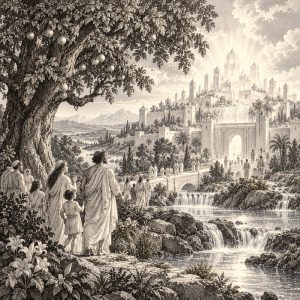
East And West | Original Sin
Our opening proposition can now be stated more precisely. Orthodox Christianity accepts a universal inherited condition following Adam’s fall but rejects the claim that every descendant is personally culpable for Adam’s individual act.
The labels ‘original sin’ and ‘ancestral sin’ can clarify this difference but can also obscure the large field of agreement. Eastern theology is not concerned with death alone. Mortality shapes fear, desire and the passions. Western theology is not concerned with guilt alone. Augustine writes extensively about corruption, disordered desire, death and bondage.
The contrast between a Western courtroom and an Eastern hospital is equally inadequate. Scripture and both traditions use legal and therapeutic language. A guilty person can also be sick; a sick person can also perform guilty acts. Salvation can include forgiveness and healing without one metaphor cancelling the other.
The Council of Trent insists that original sin is propagated rather than imitated and that baptism remits it. Trent also distinguishes concupiscence remaining in the baptised from sin in the strict sense. Modern Catholic teaching describes original sin as ‘contracted’ rather than ‘committed’, a state rather than an act, and denies that it has the character of personal fault in Adam’s descendants. The Catechism also says that the mode of transmission is a mystery that cannot be fully understood. These formulations protect the distinction between Adam’s act and the infant’s personal responsibility, but they leave a conceptual pressure in place: if the descendant has committed no act and bears no personal fault, in what sense is the inherited state itself properly called sin? Catholic doctrine answers in terms of a deprivation of original holiness and justice and calls ‘sin’ analogical here; the question is clarified, not made to disappear.¹, ²¹
The Catechism formulates both the inherited state and the limit upon the language of guilt:
Still, the transmission of original sin is a mystery that we cannot fully understand. But we do know by Revelation that Adam had received original holiness and justice not for himself alone, but for all human nature. By yielding to the tempter, Adam and Eve committed a personal sin, but this sin affected the human nature that they would then transmit in a fallen state. It is a sin which will be transmitted by propagation to all mankind, that is, by the transmission of a human nature deprived of original holiness and justice. And that is why original sin is called ‘sin’ only in an analogical sense: it is a sin ‘contracted’ and not ‘committed’ – a state and not an act. Although it is proper to each individual, original sin does not have the character of a personal fault in any of Adam’s descendants. (Catechism Of The Catholic Church, §§404–405)²⁷
Thomas Aquinas (c. 1225–1274), a Dominican friar and one of the principal theologians of the medieval Western Church, gives a more systematic account of the inherited condition. Drawing upon Augustine, Aquinas describes original sin in terms of the loss, or ‘privation’, of original justice. By original justice he means the ordering which should have governed human life: the human will ordered towards God, the other human powers properly ordered under reason, and the whole person possessing an integrity which fallen humanity no longer has.
‘Privation’ does not mean that an additional evil substance has entered human nature. It means the absence of a good which ought to be present. Blindness, for example, can be described philosophically as a privation of sight: it is not another substance added to the eye but the absence of a capacity which should be there. Aquinas applies the same kind of reasoning to original sin. Human nature remains human and remains God’s creation, but it no longer possesses the original ordering which it ought to possess.
Accordingly the privation of original justice, whereby the will was made subject to God, is the formal element in original sin; while every other disorder of the soul’s powers, is a kind of material element in respect of original sin. Hence original sin is concupiscence, materially, but privation of original justice, formally. (Thomas Aquinas, Summa Theologiae, I–II, q. 82, a. 3)
As bodily sickness is partly a privation, in so far as it denotes the destruction of the equilibrium of health, and partly something positive, viz. the very humors that are inordinately disposed, so too original sin denotes the privation of original justice, and besides this, the inordinate disposition of the parts of the soul. Consequently it is not a pure privation, but a corrupt habit. (Thomas Aquinas, Summa Theologiae, I–II, q. 82, a. 1, Reply to Objection 1)
Original sin, on this account, is not another personal act committed separately by every descendant of Adam. Aquinas describes it as a condition belonging to fallen human nature and transmitted with that nature. Individual human beings subsequently commit their own personal sins, but they are born into a human condition already deprived of original justice. This gives the Western tradition another way of distinguishing Adam’s personal act from what his descendants inherit.²³
Orthodox accounts are not exhausted by the slogan ‘mortality, not guilt’. Adam’s personal transgression belongs to Adam. His descendants inherit its consequences. John Chrysostom states the distinction directly in his interpretation of Romans 5: 12:
But what means, ‘for that all have sinned?’ This; he having once fallen, even they that had not eaten of the tree did from him, all of them, become mortal. (John Chrysostom, Homilies On Romans, Homily X)
Chrysostom identifies mortality as the condition transmitted from Adam. The descendants share the consequence of his transgression without becoming the historical agents of that transgression. Theodoret of Cyrus develops the consequences of mortality:
All therefore, as having sprung from him, inherited a mortal nature. Now such a nature has need of many things, food, and drink, and clothing, and houses, and various arts, and the use of these oftentimes excites the passions into excess, and excess begets sin. (Theodoret Of Cyrus, Commentary On Romans, on Romans 5: 12)
Theodoret gives mortality a wider significance than physical death. Mortal existence brings bodily needs and the possibility that the passions generated around those needs will become excessive. These conditions precede the personal choices of Adam’s descendants and affect the circumstances in which those choices are made. The inheritance is consequently more substantial than the eventual necessity of dying.
John of Damascus gives an even fuller description of the condition produced by the fall:
Man, then, was thus snared by the assault of the arch-fiend, and broke his Creator’s command, and was stripped of grace and put off his confidence with God, and covered himself with the asperities of a toilsome life (for this is the meaning of the fig-leaves); and was clothed about with death, that is, mortality and the grossness of flesh (for this is what the garment of skins signifies); and was banished from Paradise by God’s just judgment, and condemned to death, and made subject to corruption. (John Of Damascus, An Exact Exposition Of The Orthodox Faith, III.1)
John’s account includes loss of grace, judgement, exclusion from Paradise, mortality and corruption. The familiar formula ‘mortality, not guilt’ therefore requires qualification. It identifies the rejection of inherited personal guilt; it does not define the whole inherited condition. Chrysostom emphasises death, Theodoret connects mortality with bodily need and the passions, and John of Damascus speaks of mortality, corruption and loss of grace. Their accounts overlap without becoming identical.³¹
The comparison with Augustine can now be stated more precisely. Augustine also understands Adam’s descendants as inheriting mortality and a damaged human condition. The difference lies partly in the status he gives that inheritance. Augustine calls the condition present from birth original sin and associates it with a liability requiring remission even in infants. The Greek Fathers cited above describe consequences inherited before personal sin without assigning Adam’s personal act to his descendants.
Eastern and Western accounts therefore resist reduction to ‘mortality’ on one side and ‘guilt’ on the other. The disagreement concerns the theological character of the inherited condition: what passes from Adam to his descendants, why it is called sin, and in what sense a person can require deliverance from Adamic sin before committing personal sin. The Fathers supply related answers rather than two uniform Greek and Latin systems.³¹
Infant baptism raises the question in a particularly direct form. What does the infant need Christ to save him from? The child has not personally eaten from the tree and has not yet committed mature voluntary sins. Yet Christian traditions which baptise infants do not treat the child as though he stood in an untouched Eden. He is mortal and belongs to a humanity already affected by the fall. The disputed question is whether he also inherits anything that can properly be described as guilt or sin before committing any personal sin.
The practice of infant baptism does not, by itself, establish one particular account of what is inherited from Adam. Eastern Orthodoxy baptises infants, while distinguishing the consequences of Adam’s transgression, above all mortality and corruption, from personal culpability for Adam’s act. Lutheranism also baptises infants, but the Augsburg Confession describes the condition inherited from Adam as truly sin and as condemning apart from rebirth through baptism and the Holy Spirit. Paedobaptist Reformed theology likewise retains a strong doctrine of original sin; the Westminster Confession speaks explicitly of the imputation of Adam’s guilt and places infant baptism within the covenant of grace. Anglican formularies combine infant baptism with similarly strong language about original sin: Article IX calls it the ‘fault and corruption of the Nature of every man’, while Article XXVII describes baptism as a sign of regeneration and expressly retains the baptism of young children. The four traditions therefore share the practice of infant baptism while giving different accounts of the inherited condition and of what baptism signifies or effects in relation to it.
The inherited condition need not be identified at once with inherited culpability. A newborn can belong to mortal humanity, be born into a history already shaped by sin, and become subject to disordered desire without personally having performed Adam’s act. Whether corruption names natural creaturely corruptibility, a condition consequent upon the fall, or both in different senses requires further distinction. Whether this inherited complex should itself be called ‘sin’, and on what grounds, is precisely one of the questions under examination rather than a definition to be assumed at the outset.
Vertical inheritance, horizontal propagation, and personal appropriation describe three different processes. Biological and familial descent places us within mortal humanity; culture and institutions transmit accumulated patterns; personal willing adds actual sin. None of the three can replace the others.
What Is The Fall?
Genesis does not identify the fall with the body, sexuality, work, creativity, agriculture, technology, political organisation, or the city. Knowledge is harder: the tree is forbidden, the humans acquire knowledge, and God acknowledges the acquisition. Genesis gives disobedience, acquired knowledge, changed relations, return to dust, and exclusion from life. Later theology relates these elements in different ways.
The serpent says, ‘ye shall be as gods’; God later says that the man has become ‘as one of us, to know good and evil’. Christian theology also speaks of humanity’s vocation to participation in divine life. These statements can be brought into a theology of true and counterfeit theosis, but they should not be collapsed into one another. Genesis presents the dangerous acquisition of godlike knowledge; Christian deification concerns participation in God by grace. The relation between the two is an interpretation, not an identity supplied by the text.
God confirms that knowledge has been acquired and then bars access to the tree of life. Humanity leaves Eden with knowledge and without immortality. The text does not say that the knowledge is subsequently removed, nor does it explain the exclusion from the tree in the later categories of grace, ontological corruption or deification. Those categories may interpret the narrative; they do not replace its unresolved questions.
Mortality raises a separate problem. Dust belongs to the human creature from the beginning, while the tree of life represents a gift of continuing life. Athanasius distinguishes natural corruptibility from the vocation to incorruption. Biological death can precede human beings while Christian theology still treats death as contrary to humanity’s final end.
Cain shows the distinction between an inherited condition and personal sin. He is born into mortal humanity outside Eden and into a world already marked by Adam’s act. None of this makes Adam’s transgression Cain’s personal act or guilt. Cain’s murder of Abel is his own sin arising from his own willing within that inherited condition. Sin then spreads further through action, imitation, fear, violence, language, family, social memory, power, institutions, and culture. Vertical inheritance, horizontal propagation, and personal appropriation must therefore remain distinct.
Paul goes beyond an account of historical influence. Through one man’s disobedience the many are constituted sinners; death reigns; condemnation and justification are set in corporate contrast. This language is stronger than imitation, but it still does not tell us whether Adam’s descendants inherit Adam’s culpability, a corrupted condition, mortality, a corporate status, or some combination of these. Paul establishes Adamic solidarity but does not explain its mechanism.¹⁵
By ‘the Adamic condition’ we mean the condition in which humanity exists after Adam’s transgression. The phrase gathers together several realities without identifying them. Mortality means subjection to bodily death. Corruption refers more broadly to the deterioration and disorder of human life under the power of death, although Athanasius also uses corruptibility for the natural condition of a creature made from nothing. Disordered desire concerns the impaired ordering of human wants and affections. Personal sin begins when a morally responsible person wills or performs what is wrong. The first three can describe conditions into which a person is born; the fourth concerns that person’s own acts. ‘The Adamic condition’ therefore describes humanity’s relation to Adam and the consequences associated with his fall without deciding whether the inherited condition should be called guilt, original sin, ancestral sin, corruption, or mortality. Contemporary Catholic teaching speaks of a deprivation of original holiness and justice which is ‘sin’ analogically, while denying personal fault in Adam’s descendants. The formulation states a doctrine; it does not remove every conceptual difficulty within it.¹
Development and fall may be distinguished, but the exact relation between them remains open. Irenaeus supplies a developmental account; Augustine supplies a stronger account of lost integration. ‘Originally integrated but not finally complete’ is a proposed synthesis of those trajectories, not a proposition stated by Genesis or Paul. It should stand or fall by how well it accounts for the texts without muting their differences.
Human development and internal disorder coexist. Human capacities continue to develop, but development does not by itself bring humanity to its proper end. Knowledge, desire and will no longer possess effortless harmony.
Evolutionary history removes several bad identifications rather than removing the fall. The first biological death, the first sexual reproduction, the first tool, sociality, agriculture and urban life cannot plausibly be made identical with sin. An historical fall, if Christian doctrine requires one, concerns morally responsible creatures capable of relation to God and capable of a genuine refusal.
A cautious modern reconstruction might imagine mortal human life reaching a form of rational, symbolic and moral agency in which genuine relation and vocation to God become possible, followed by an originating rupture whose consequences spread through the human community. This is not exegesis of Genesis and should not be presented as though Scripture supplied the scientific sequence. It is one attempt to hold theological claims and human natural history together.
A real rupture is required by the theological claim. If sin is the inevitable cost of being a finite developing animal, redemption becomes little more than further development. Christianity claims more: creation is good, evil is not necessary to creatureliness, and Christ heals a condition which ought not to rule humanity.
Mortality remains the hardest case because it is biologically natural and theologically an enemy. Athanasius permits a distinction between a creature naturally liable to corruption and a creature called by grace to incorruption. That distinction can make evolutionary history and Christian theology less directly contradictory, but it does not prove that this is what Genesis 2–3 means. The proposal that the fall turns biological mortality into ‘human death’ in a fuller theological sense is ours and should remain visibly provisional.¹¹
The Catechism states the distinction directly:
Death is a consequence of sin. The Church’s Magisterium, as authentic interpreter of the affirmations of Scripture and Tradition, teaches that death entered the world on account of man’s sin. Even though man’s nature is mortal God had destined him not to die. Death was therefore contrary to the plans of God the Creator and entered the world as a consequence of sin. (Catechism Of The Catholic Church, §1008)²⁸
Christ provides an important distinction. He assumes a human nature subject to mortality and suffering: he experiences hunger, exhaustion, pain and death. The theological term for this capacity to suffer is ‘passibility’. Yet Christ is without sin. Mortality and the capacity to suffer cannot therefore be identical with personal guilt. A human being may possess the mortal and vulnerable condition of fallen humanity without personally having committed the sin which brought that condition about.
The resurrection makes a different point. Christ does not merely share humanity’s mortality; he overcomes death. Mortal existence is therefore not the final condition of human nature. The risen Christ reveals the incorruptible life for which redeemed humanity is destined.
Forasmuch then as the children are partakers of flesh and blood, he also himself likewise took part of the same; that through death he might destroy him that had the power of death, that is, the devil; And deliver them who through fear of death were all their lifetime subject to bondage. (Hebrews 2: 14–15)
Knowledge, capability and love belong together in the argument. Knowledge expands what humanity can understand; capability expands what humanity can do; love orders knowledge and capability towards their proper ends. Genesis repeatedly shows the first two advancing without any automatic guarantee of the third. Eden gives knowledge, Cain gives city, the genealogy gives arts and metalwork, and Babel gives organised collective power.
Capability does not justify its use. The sentence does not condemn capability. It denies that the ability to do something establishes that it ought to be done. Human progress is real, but progress in power is not identical with progress in wisdom.
All things are lawful unto me, but all things are not expedient: all things are lawful for me, but I will not be brought under the power of any. (1 Corinthians 6: 12)
The Bible is not anti-city. Its final answer to Babel and Babylon is the New Jerusalem. The canonical movement is garden, fallen city, Babel and Babylon, then city-garden. Human culture is not erased; it is healed and ordered.
For he looked for a city which hath foundations whose builder and maker is God. (Hebrews 11: 10)
But now they desire a better country that is an heavenly: wherefore God is not ashamed to be called their God: for he hath prepared for them a city. (Hebrews 11: 16)
For here have we no continuing city but we seek one to come. (Hebrews 13: 14)
Revelation does not take humanity backwards through history until knowledge, civilisation, cultural difference and developed human consciousness disappear. It takes the Biblical story forwards until that which Genesis divided is reconciled. The garden returns within a city; the nations remain nations; human beings remain embodied creatures. Innocence no longer requires ignorance, and the tree from which humanity was excluded becomes accessible when the rupture between creature and creator is overcome.
And the nations of them which are saved shall walk in the light of it: and the kings of the earth do bring their glory and honour into it. And the gates of it shall not be shut at all by day: for there shall be no night there. And they shall bring the glory and honour of the nations into it. (Revelation 21: 24–26)
Genesis and Revelation can be read as the two ends of one canonical movement. Genesis begins with creation; Revelation ends with new creation. Genesis gives a garden watered by a river; Revelation gives ‘a pure river of water of life, clear as crystal, proceeding out of the throne of God and of the Lamb’ (Revelation 22: 1). Genesis places the tree of life in the garden; Revelation places it ‘in the midst of the street of it’ (22: 2). Genesis ends the Eden narrative with the way to the tree guarded; Revelation declares that the leaves of the tree are ‘for the healing of the nations’. Genesis gives the curse; Revelation says, ‘there shall be no more curse’. Adam hides from the presence of God; the redeemed ‘shall see his face’. Humanity returns to dust; in the New Jerusalem death has been abolished.
Continuity is accompanied by transformation. Revelation does not describe Eden reopened exactly as it was. The tree now belongs within a human world which has passed through history. There are nations and kings; there is a city; there is human glory and honour brought into it. The Biblical end does not cancel the history between Genesis and Revelation. It judges, purifies and fulfils it.
The Catechism describes the Christian end in the same terms of renewal rather than simple return:
At the end of time, the Kingdom of God will come in its fullness. After the universal judgment, the righteous will reign for ever with Christ, glorified in body and soul. The universe itself will be renewed. Sacred Scripture calls this mysterious renewal, which will transform humanity and the world, ‘new heavens and a new earth.’ It will be the definitive realization of God’s plan to bring under a single head ‘all things in [Christ], things in heaven and things on earth.’ In this new universe, the heavenly Jerusalem, God will have his dwelling among men. (Catechism Of The Catholic Church, §§1042–1044)³⁰
The city is redeemed, after the Biblical history of Cain, Babel and Babylon. Cain builds the first city after murdering his brother; Babel concentrates human capability around the determination to ‘make us a name’; Babylon becomes the Biblical symbol of imperial splendour, idolatry, economic power and violence. Scripture does not conclude that the city as such is the problem. Babylon falls and Jerusalem descends.
The contrast is not between civilisation and nature. It is between two orders of human common life. Babylon is civilisation organised around possession, domination and self-exaltation; the New Jerusalem is human common life received from God. Babylon consumes the world into itself. Jerusalem receives its life from beyond itself. Babylon’s glory depends upon commerce, power and blood; the glory of Jerusalem is the presence of God and the Lamb.
Babel’s builders say, ‘let us make us a name’; Revelation says of God’s servants that ‘his name shall be in their foreheads’ (Revelation 22: 4). The contrast is exact in theological direction: humanity attempts to manufacture or seize what the redeemed receive as gift. Babel seeks permanence through its own name; the redeemed bear God’s name.
Pentecost belongs within the same thought. Babel’s common language enables a common project, and the judgement introduces linguistic division. Acts 2 does not restore one universal human language. The Spirit makes the apostles intelligible to people from many nations in their own tongues. Difference remains while alienation is overcome. Christian communion is not a return to undifferentiated human uniformity.
The fall is also a disorder of dependence. Dependence itself is not the problem. Every creature depends upon what it did not create. Adam receives breath, ground, food, vocation, command, companion and life. The serpent teaches the creature to reinterpret received existence as restriction. The possibility that freedom might consist in faithful participation rather than independence is displaced by the possibility of seizure.
The mature human being is not less dependent upon God than Adam. Maturity consists in participating freely and knowingly in the relation which constitutes human good. The opposite of childish dependence is not metaphysical independence; it is mature communion.
The serpent’s promise returns at the end of the argument. ‘Ye shall be as gods’ resembles a true Christian claim closely enough to expose the nature of the deception. Salvation does culminate in participation in divine life: the Fathers speak of deification, and Second Peter of becoming ‘partakers of the divine nature’ (2 Peter 1: 4). The opposition is not between godlikeness and permanent creaturely abasement, but between participation and possession, communion and autonomy, gift and seizure.
The fall is not a rejection of humanity’s destiny so much as a corruption of the manner in which the destiny is sought. The object resembles the promise; the mode contradicts it. The serpent offers a shortcut which destroys the relation through which the destination can be reached.
‘Counterfeit theosis’ names this theological contrast rather than a phrase used by Genesis or the Fathers. The serpent offers God apart from God. Christ gives humanity God in communion with God.
The Incarnation answers the temptation at its deepest level. Humanity does not ascend into divinity by autonomous acquisition. God descends into humanity. The Word becomes flesh. The movement is gift before it becomes human response.
The Biblical story repeatedly describes life with God as gift. Adam receives the garden; Abraham receives the promise; Israel receives the land and Torah; the kingdom, grace and Spirit are given; resurrection is given; the New Jerusalem descends. The tree of life is available not because humanity has learned how to manufacture immortality but because God dwells with humanity.
This does not reduce human beings to passivity. Abraham must go; Israel must obey; the Christian must believe, love, repent and act. Grace creates and liberates human agency rather than replacing it. The opposition is not between divine action and human action but between human action grounded in gift and human action imagined as self-originating.
Freedom can be understood relationally. The creature is most free not when it possesses no end, but when it can act without bondage towards the good for which it exists. In Christian eschatology, the redeemed do not lament that they can no longer become murderers or apostates. Freedom has reached stability in the good.
The first Adam cannot, on this account, be the final measure of humanity. Adam can fall; the redeemed in glory will not fall. Augustine gives this distinction a precise form when he contrasts Adam’s posse non peccare, the possibility of not sinning, with the eschatological non posse peccare, the inability to sin of perfected freedom.¹² If the ability to sin were the essence of freedom, the eschatological state would be less free than Eden. Augustine’s distinction makes the opposite claim: freedom reaches perfection when the will is stably united to the good.
The last Adam does more than reproduce the first Adam’s condition. Christ reveals freedom fulfilled in obedience. His obedience to the Father is not the suppression of human willing but its perfection. Gethsemane does not display a human automaton. ‘Not my will, but thine, be done’ (Luke 22: 42) reveals human willing freely ordered to the Father even under suffering and death.
The fall can therefore be understood, within the theological synthesis developed here, as a failure of human vocation. By vocation we mean not simply what human beings are, but what they are created to become in relation to God. Genesis presents human capacities as good: bodily life, knowledge, sexual desire, social existence, work and creativity belong to humanity as created, not merely to humanity as fallen. The fall does not make these capacities evil. It disorders their use and their relation to the ends for which they were given.
The human being formed from dust receives life from God and is called beyond mortality into the life which only God can give. The capacity for knowledge is good, but knowledge must become wisdom: Adam and Eve acquire knowledge in Eden without thereby acquiring the wisdom to live rightly. Sexuality and desire are already present within the good creation, but desire requires an ordering in which the other person is loved rather than possessed or used. Human beings are social creatures, but social existence must become communion: after Eden, Genesis shows human relationships increasingly marked by accusation, murder, vengeance and division. Human creativity is likewise good. Humanity cultivates the earth, keeps animals, makes music, works metals and builds cities. Yet the capacity to make and organise does not determine whether what is made or organised is good. Babel shows human beings using genuine collective capability in the attempt to secure themselves and ‘make us a name’ apart from God.
The Fathers would develop another way of describing the same vocation through the Biblical language of the image and likeness of God. Humanity is created in God’s image, but some patristic writers distinguish that created image from the likeness to God towards which human beings are called to grow. On that account, humanity is created good without already possessing the completed condition for which it was created. The fall does not consist in possessing natural human capacities. It consists in their disorder: life sought apart from the giver of life, knowledge without wisdom, desire without rightly ordered love, society without communion, and capability without obedience to the good. Human beings seek through their own powers what Christian theology ultimately understands as something received from God.
If we search for one empirical phenomenon corresponding to the fall our search is likely to mislead. If we ask whether the fall was the emergence of language, puberty, symbolic consciousness, agriculture, private property, metallurgy or urbanisation, we are trying to identify a theological act with one of the capacities through which human nature develops. Genesis resists such identification.
A fall requires a human being, or humanity, capable of moral relation to God. It requires freedom sufficient for a real refusal. It requires a distinction between the good creature as intended by God and the disordered condition which follows.
Genesis 2–3 is not a modern scientific report. The narrative speaks theologically through garden, trees, serpent, command, fruit, nakedness and exile. To say that the narrative is theological is not to say that nothing happened. Historical meaning and literary form are different questions.
Human beings can inherit conditions for which they are not personally responsible and subsequently become responsible agents within those conditions. Ordinary history demonstrates this constantly. We inherit languages, institutions, debts, conflicts, privileges and injuries produced by people long dead. We did not perform their acts, but we do not live outside their consequences. Our choices reinforce, redirect or resist the inheritance.
The Adamic claim goes deeper because the inheritance concerns humanity rather than particular social arrangements alone. Every person belongs to a mortal race. Every person enters a world in which communion with God is not naturally possessed as an effortless condition. Every person encounters disordered desire. Every person who reaches moral responsibility adds personal sin. No human historical reform can place a new generation outside mortality.
Education cannot alone answer this inherited condition. Ignorance is real and education is good, but humanity’s problem is not ignorance alone. Adam’s eyes open. Knowledge increases. The law gives knowledge of the good, yet Paul can describe sin exploiting the commandment. Knowledge can reveal disorder without supplying the power to heal it.
Political reform cannot alone answer fallen human existence. Just institutions are goods and unjust institutions can intensify sin enormously. Yet even a perfectly just state could not resurrect its citizens. Political order can address injustice and restrain some consequences of sin; it cannot abolish mortality and corruption.
Psychological integration cannot alone answer disordered desire and mortality, although psychological healing is a good. A person at peace with himself remains mortal. The Christian claim is not that human beings need to feel differently about death but that death will be destroyed.
Technological mastery cannot alone overcome mortality and corruption. Medicine can cure diseases and prolong life. Agriculture can resist famine. Engineering can protect against natural hazards. Information technology can preserve and distribute knowledge. These achievements can reduce suffering. Christianity has no reason to deny their good because they do not constitute salvation.
The danger appears when a limited good is asked to perform the work of the tree of life. The human attempt to abolish finitude through accumulation, reputation, political power or technology can become another form of the ancient temptation: the creature seeking to secure through its own capability what Christian theology holds can be received only from God.
The doctrine of the fall rejects both despair and self-salvation. Despair mistakes corruption for the final truth about humanity; self-salvation mistakes human capability for the power to overcome corruption. The resurrection of Christ denies both conclusions: humanity can be healed, but it cannot be its own healer in the final sense.
The argument converges on Christ’s relation to Adam. Paul does not present Jesus as a teacher who explains Adam correctly. Christ changes the condition Adam represents. Where death reigns, Christ rises; where sin enslaves, Christ liberates; where condemnation stands, Christ justifies; where corruption dissolves the body, Christ gives incorruption.
The correspondence is not exhausted by reversal. Paul repeatedly insists that grace exceeds the offence. If Christ returned humanity to the precise state before Genesis 3, Adam and Christ would form a symmetrical equation. Paul’s ‘much more’ says otherwise. The gift is greater than the loss.
Irenaeus describes salvation as maturation and recapitulation; Athanasius as participation and deification; Paul as resurrection and the heavenly image; Augustine as freedom secured in the good. Despite their differences, none describes salvation as a return to an unfallen beginning. Each describes a final condition beyond Adam’s beginning.
Christ is, in this sense, the mature Adam; the expression is interpretative rather than a quotation. He is mature humanity because in him human nature reaches perfect relation to God. Knowledge, freedom, desire, embodiment and love are integrated in obedient communion.
Christ’s obedience extends to death. Christ does not escape the Adamic world by refusing to die. He enters death. The last Adam passes through the condition which reigns over the children of the first Adam.
The resurrection changes the meaning of the entire history. If Christ returned to ordinary mortal life, death would have been postponed rather than defeated. Resurrection is not resuscitation. The risen Christ does not resume the biological condition of Lazarus, who must eventually die again. Resurrection inaugurates incorruptible human existence.
The Catechism makes the same distinction between resurrection and return to ordinary mortal life:
Christ’s Resurrection was not a return to earthly life, as was the case with the raisings from the dead that he had performed before Easter: Jairus’ daughter, the young man of Naim, Lazarus. These actions were miraculous events, but the persons miraculously raised returned by Jesus’ power to ordinary earthly life. At some particular moment they would die again. Christ’s Resurrection is essentially different. (Catechism Of The Catholic Church, §646)²⁹
1 Corinthians 15 brings the anthropological argument into the doctrine of resurrection. ‘It is sown in corruption; it is raised in incorruption’ (15: 42). The human body remains body, but its mode of existence is transformed. ‘This corruptible must put on incorruption, and this mortal must put on immortality’ (15: 53). What humanity could not seize from the tree of life is given in Christ.
The final human condition is not disembodied immortality. Revelation’s city and Paul’s resurrection both resist that conclusion. Christian hope concerns the renewal of creation and the resurrection of the body. The earth-creature is not saved by ceasing to be creature.
Deification may be distinguished from absorption. Participation in God does not erase the difference between creator and creature. Humanity becomes godlike by grace while remaining human. The original boundary which the serpent presented as deprivation proves to be the condition of communion: God remains God, the creature remains creature, and the difference makes gift possible.
Theosis is the opposite of the serpent’s promise even though the language of godlikeness appears similar. The serpent makes divine likeness appear obtainable through autonomous appropriation. Christian deification is endless reception.
Freedom and obedience need not be opposites. Fallen imagination can construe freedom as action originating solely from the self and obedience as its surrender. Christian theology treats obedience to God differently because God is not one finite competitor among others. To be ordered to the creator is to be ordered to the source of one’s being and good; such obedience can perfect rather than extinguish freedom.
Obedience to God cannot be transferred without qualification to human authority. God is the creator and final good of the creature; no ruler, institution, parent, priest or state occupies that relation. Creaturely authority remains finite, accountable and subject to judgement. The theological claim that obedience to God can perfect freedom gives no human authority an unlimited claim upon another person’s will.
The primeval history depicts domination. From Eden to Babel, human power becomes organised on a larger scale. Scripture does not warrant the sanctification of every hierarchy because hierarchy exists. The question is what power serves and whether it conforms to justice, truth and love.
The same can be said of knowledge, sexuality, work and civilisation. Knowledge before God becomes wisdom; knowledge turned towards autonomous self-establishment can become manipulation. Sexual difference and one-flesh relation belong to creation; fallen desire can turn another person into an object of possession. Work belongs to the garden; toil belongs to the curse. Human common life can embody justice, beauty, memory, cooperation and care, and can also embody violence, inequality and idolatrous power. Redemption does not abolish these human capacities. It orders them towards their proper good.
The fall cannot be located in human capacities. It lies in their disordered mode and direction within a rupture of communion with God.
No human being begins morally and historically from nothing. We receive a humanity already existing. We receive bodies, mortality, language, relationships and histories. We receive a world in which good and evil have already been enacted and institutionalised. We receive capacities whose exercise is already shaped by others. Christian doctrine adds that this received humanity is estranged from the original communion through which it reaches its proper end.
We do not inherit Adam’s memory; we inherit Adam’s condition. We do not stand beside the tree and perform Adam’s historical act again; we begin east of Eden.
Personal sin occurs when the inherited condition becomes the field of our own willing. The child becomes capable of moral action; desire, fear, love, habit and judgement develop; choices acquire consequences. What was received without personal action becomes a life for which the person increasingly bears responsibility.
Legal and therapeutic language need one another. Sin involves guilt because persons do wrong; sickness because the wrong has become embedded in the human condition; bondage because sin can acquire power; death because corruption reaches the body; exile because communion is ruptured. No single metaphor exhausts the fall.
The Biblical account is larger because the human being is larger. The human creature is body and agent, individual and member of a people, biological organism and moral subject, inheritor and originator, maker of culture and product of culture, mortal animal and image of God. The fall affects human existence across these dimensions because it concerns the relation which orders the whole creature towards its end.
The terms ‘original sin’ and ‘ancestral sin’ describe, in different theological traditions, the inherited consequences of the originating fall rather than Adam’s personal act alone. The synthesis proposed here keeps inherited mortality, corruption, and disordered desire distinct from the personal sins which morally responsible human beings commit within that condition.
Adam’s personal act must be distinguished from the condition inherited by his descendants. His descendants did not personally eat from the tree or commit Adam’s act of disobedience. The remaining question is what they inherit because he did so.
Catholic teaching answers that the inherited loss of original holiness and justice is properly called ‘original sin’, while insisting that it is a state rather than a personal act and that it does not have the character of personal fault in Adam’s descendants. Characteristic Eastern accounts place greater emphasis upon the inheritance of mortality and corruption and are more reluctant to describe that inheritance as sin. The difference is not merely one of terminology. It concerns what passes from Adam to his descendants and in what sense a condition which they did not personally choose can properly be called sin.
Paul establishes the connection without explaining how it operates. Through Adam, sin and death enter the world; judgement and condemnation follow the offence of one man; and through one man’s disobedience ‘many were made sinners’ (Romans 5: 19). Paul therefore says more than that Adam provided a bad example which others subsequently followed. He does not, however, explain precisely what passes from Adam to his descendants or how they become implicated in his act. Later Christian traditions give different answers to that question, and the disagreement remains.
The fall names the originating rupture; Original sin names, in Western theology, the inherited condition which follows it. The fall is the misuse of genuine human freedom within humanity’s vocation to communion with God: a grasping at knowledge and godlikeness apart from obedient participation. Its consequences include mortality and disorder in human desire; subsequent personal sins belong to Adam’s descendants themselves.
‘Grasping at knowledge’ is already an interpretation of the act. Genesis says that the humans take and eat what God prohibited and that they come to know good and evil. It does not say that knowledge as such is evil, and it does not explicitly say that the same knowledge would later have been given legitimately. Christian theology can distinguish godlikeness by autonomous seizure from participation in God by grace, but that distinction should be offered as theological interpretation rather than substituted for narrative.
The result is knowledge without immortality. Human beings know, but die. They create, but cannot create human life without mortality. They preserve memory, but cannot resurrect the remembered. They build cities, but cities fall. They make names, but names do not give life.
Human development nevertheless continues after the fall. Human history after Eden contains achievements as well as horrors. Fallen humanity can discover truths, produce beauty, perform acts of natural virtue, create just institutions and care sacrificially for others. The fall does not mean that every human act is maximally evil.
The developmental account requires another element. Fallen humanity is not merely immature. Something has also become disordered within the human person. Augustine is particularly important here. He describes a human being whose reason, will and desires no longer exist in the harmonious relation which they ought to possess. The problem is not simply that humanity has further to develop. Human beings must develop while already affected by an internal disorder which development alone cannot cure.
Ordinary moral experience illustrates the problem. A person can know that an action is wrong and still desire it. He can sincerely intend to act differently and find that an established habit resists that intention. Fear can cause him to protect himself at the expense of someone he loves. Intelligence does not necessarily correct these disorders, because intelligence can be employed to justify them. Reason can construct an explanation for conduct whose real origin lies in appetite, resentment, fear or self-interest. Increased knowledge therefore does not necessarily produce increased goodness.
Augustine gives particular attention to this division of the will. Fallen human beings are not simply choosing between alternatives from a position of complete inner freedom. They can experience themselves as wanting incompatible things: desiring the good while also desiring what they know to be contrary to it. Augustine’s account of concupiscence belongs here. Concupiscence is not simply sexual desire. It describes the wider disorder of desire by which created goods can be wanted in the wrong way, in the wrong order or apart from their proper relation to God.
This supplies a necessary qualification to the developmental account associated with Irenaeus. If humanity were merely unfinished, further growth might appear sufficient. Augustine insists that fallen humanity is both unfinished and disordered. Human beings have not yet reached the completion for which they were created, but neither are they simply continuing an undamaged process of maturation. The capacities through which they develop – reason, desire, freedom, sexuality, sociality and creativity – are themselves exercised under conditions of disorder. Human development can consequently increase capability without producing a corresponding increase in wisdom or holiness.
One synthesis is possible. Humanity is good and creaturely, dependent upon God and called to participation in divine life. Original integrity need not mean final perfection. The fall can then be understood as a misuse of freedom which disorders human life without destroying human nature. Human development continues under mortality, alienation and divided desire; Adam’s descendants inherit a condition they did not choose and add their own sins within it. Christ restores what was lost and fulfils what had not yet been attained. This synthesis draws upon Irenaeus, Athanasius and Augustine; it is not the explicit anthropology of Genesis.
For of him, and through him, and to him, are all things: to whom be glory for ever. Amen. (Romans 11: 36)
For whom he did foreknow he also did predestinate to be conformed to the image of his Son that he might be the firstborn among many brethren. (Romans 8: 29)
And not only they but ourselves also which have the firstfruits of the Spirit even we ourselves groan within ourselves waiting for the adoption to wit the redemption of our body. (Romans 8: 23)
The fall is not embodiment, sexuality or work: all precede it. Nor can it simply be identified with knowledge, agriculture, technology or the city. Scripture treats wisdom as a good, and the Bible ends with a city. These creaturely capacities continue after the fall; the dispute concerns what has happened to the human beings who exercise them.
So God created man in his own image in the image of God created he him; male and female created he them. And God blessed them and God said unto them Be fruitful and multiply and replenish the earth and subdue it: and have dominion over the fish of the sea and over the fowl of the air and over every living thing that moveth upon the earth. (Genesis 1: 27–28)
And the LORD God took the man and put him into the garden of Eden to dress it and to keep it. (Genesis 2: 15)
And Adam said This is now bone of my bones and flesh of my flesh: she shall be called Woman because she was taken out of Man. Therefore shall a man leave his father and his mother and shall cleave unto his wife: and they shall be one flesh. (Genesis 2: 23–24)
Irenaeus and Augustine provide two different accounts of Adam. Irenaeus describes created humanity as good without being finished. Augustine describes fallen humanity as more than unfinished. Athanasius argues that creaturely humanity does not possess life autonomously and that incorruption is received from God. Maximus argues that human faculties are good but can be used wrongly. Paul interprets Adam through Christ.
Adam is discovered through Christ.
The resurrection tells us what death means because it shows death being overcome. The last Adam tells us what the first Adam lacked because he reveals humanity’s end. The heavenly image tells us that the earthy image was not final. Christ does not restore a damaged past. He opens a future.
Christian doctrine of the fall is inseparable from eschatology. What has gone wrong is interpreted in relation to what humanity is for. Resurrection, incorruption, communion and deification give later Christian theology its account of the Adamic loss.
‘Was Adam immortal?’ cannot be answered without distinguishing beginning from end. Adam need not possess the final incapacity for death of the glorified saints; he can be capable of death yet sustained towards life. What sin loses need not be an already completed resurrection condition, but the communion and vocation through which the creature was to reach incorruption.
‘Was Adam perfect?’ requires the same distinction. Adam can be good and ordered at the beginning of human vocation without possessing the completed eschatological maturity revealed in Christ. Good does not mean complete; integrated does not mean finished.
Real fall and real development can coexist within this account. Humanity can have an authentic beginning in communion with God without possessing every later intellectual, cultural or biological development from the first moment. A historical human population can grow in knowledge and culture without those developments constituting evidence against an original vocation to holiness.
Civilisation remains morally ambiguous. Fallen history is not a simple decline from intelligent Adam to increasingly degenerate descendants. Genesis gives the opposite in material terms: capabilities accumulate. Human beings learn more ways to transform the world. Capability can increase without a corresponding increase in wisdom.
Capability does not justify its use. Augustine describes moral disorder in terms of disordered love: a finite good becomes destructive when treated as ultimate. Wealth, political community, sexual love, reputation, bodily life and knowledge can all be goods; disorder begins when a lesser good is treated as the highest.⁸
The Christian answer to mortality does not condemn the desire to endure. It promises more than human permanence can achieve. A remembered name is not resurrection; a surviving civilisation is not eternal life. Gilgamesh returns to Uruk, while Christianity announces an empty tomb. Human culture can answer mortality symbolically, socially and historically. Christ answers it bodily.
Jesus said unto her, I am the resurrection, and the life: he that believeth in me, though he were dead, yet shall he live: And whosoever liveth and believeth in me shall never die. Believest thou this? (John 11: 25–26)
Moral education, political justice, psychological integration, technological progress and cultural memory address real human goods, but none overcomes death or reconciles humanity to God. Christian theology gives that role to Christ.
Christ forgives because sin is guilt, heals because human nature is wounded, liberates because sin enslaves, enlightens because humanity is ignorant, reconciles because humanity is alienated, matures because humanity’s vocation remains unfinished, and raises the dead because death is the last enemy. No single theory of original sin which cannot accommodate these dimensions is large enough for the Christian claim.
The New Testament describes salvation as justification, reconciliation, redemption, adoption, sanctification, liberation, new creation and resurrection. Christian accounts of the fall likewise speak of transgression, exile, corruption, bondage, mortality and disordered desire. No single term contains the whole account.
The tree of life prevents the argument from becoming too neat. Life is present in the garden, but after the transgression God prevents the humans from taking it and living for ever. Genesis does not say why endless fallen life is denied: punishment, mercy, preservation of the divine-human boundary and other explanations belong to interpretation. Revelation later places the tree of life in the New Jerusalem after the removal of the curse. The canonical juxtaposition is suggestive, but it does not erase the unresolved question in Genesis 3: 22–24.
Eternal life is not endless fallen existence. An immortal Cain would not yet be redeemed; an everlasting Babel would not be the Kingdom of God. The Christian promise is not indefinite biological continuation of the present human condition. Life must be healed before endlessness can be blessing.
The eschatological human being can know without knowledge becoming autonomous possession, desire without desire becoming domination, love without fear of loss, act without bondage to sin, and live without death. Human capacities are not erased. They reach their proper order.
The Biblical story has not travelled in a circle. Eden is not restored unchanged; Eden is fulfilled. The garden has become a city-garden. The nations are healed. The servants of God see his face. His name is upon them. They reign. The tree of life stands open. The first Adam was a living soul; the last Adam is a quickening spirit. The first is not final.
original sin belongs within the Christian account of creation and redemption. Sin is not original in the absolute sense: creation is prior, and the final Christian account of humanity is defined by Christ rather than by sin.
To say that humanity is fallen is not to say that humanity is contemptible. Fallen humanity is capable of extraordinary good because human nature remains God’s creation. Human beings can reason, love, cooperate, sacrifice, make beauty and seek truth. None of these requires denial of the fall. The doctrine does not say that corruption has annihilated nature.
Fallen human beings can do genuine good; the harder question is whether humanity can reach its final good by its own power. It cannot overcome death by its own power. Every programme of human self-redemption reaches that boundary.
The doctrine of the fall concerns a creature whose powers remain astonishing but whose final end lies beyond those powers. Human intelligence can investigate the universe; it cannot make the creature uncreated. Human medicine can extend life; it cannot transform mortality into incorruptibility. Human civilisation can preserve memory; it cannot restore the dead. Human ethics can identify the good; it cannot guarantee that the will loves the good. Human law can restrain violence; it cannot abolish sin.
The fall can be described as a disorder of creaturely dependence: the creature seeks a good apart from the giver. Redemption does not abolish dependence upon God but restores communion with God.
Genesis 3 contains a final irony. Humanity reaches for godlikeness and becomes more conscious of its naked creatureliness. It reaches for knowledge and discovers shame; seeks elevation and returns to dust; seeks a good apart from the giver and loses access to life. The Gospel does not answer by denying the good which humanity sought. It gives the good in its proper form: wisdom in the Word, godlikeness through conformity to Christ, freedom through liberation from sin, life through resurrection and participation through grace. The creature receives what it could not seize.
The fall is not the final revelation of what it means to be human. Christ is.
Christian traditions agree that Adam’s act has consequences beyond Adam, but they do not describe those consequences identically. Mortality and life within a human history already marked by sin provide the least disputed elements. Corruption, disordered desire, loss of original communion, inherited deprivation and culpability are described differently and do not carry the same theological meaning in every tradition. Whether all of these belong to what is inherited, and in what sense, remains disputed.
We did not personally perform Adam’s historical act. Our personal sins are our own. What, beyond mortality and participation in a history already marked by sin, is inherited from Adam remains the disputed question. Romans 5 will not allow the relation to be reduced to imitation, but neither does it specify a mechanism by which Adam’s personal act becomes the personal culpability of another human being.¹⁵
Inherited culpability remains a point of disagreement among Christian traditions. Augustine refuses to make Adamic inheritance morally neutral; Greek patristic trajectories more often distinguish inherited mortality and corruption from the personal culpability of Adam’s act. Paul complicates both accounts: through one man’s disobedience the many are made sinners, yet death reigns even over those who have not sinned after the likeness of Adam’s transgression. The text establishes Adamic consequence more securely than it establishes a later theory of how culpability is transmitted.¹⁵, ³¹
Act and condition must remain distinct. Adam commits the originating act; humanity receives the resulting condition; each morally responsible human being commits further acts within it.
Therefore as by the offence of one judgment came upon all men to condemnation; even so by the righteousness of one the free gift came upon all men unto justification of life. For as by one man’s disobedience many were made sinners, so by the obedience of one shall many be made righteous. (Romans 5: 18–19)
The inherited problem cannot be reduced to the external influence of a sinful society. Mortality affects the body, and human beings are born into social conditions already shaped by previous human acts. Christian traditions also speak of corruption, disordered desire, and impairment of the will, but they differ over what these terms mean and how they are related to Adam. None of these claims requires us to say that a newborn child has personally chosen Adam’s choice.
Wherefore, as by one man sin entered into the world, and death by sin; and so death passed upon all men, for that all have sinned: (For until the law sin was in the world: but sin is not imputed when there is no law. Nevertheless death reigned from Adam to Moses, even over them that had not sinned after the similitude of Adam’s transgression, who is the figure of him that was to come.) (Romans 5: 12–14)
‘Ancestral sin’ distinguishes Adam’s act from its consequences; ‘original sin’ names an inherited human condition that Western theology describes as more than biological mortality. Neither term settles what is inherited. Catholic doctrine calls the inherited state sin while denying personal fault; Eastern formulations commonly reject inherited personal culpability.¹, ³¹
The Biblical narrative is not exhausted by either set of technical terms. It begins with a good creation and a dependent human creature, gives a command and a transgression, and describes knowledge acquired and access to life lost. Genesis proceeds from Adam to Cain, from personal violence to wider violence, and from family to city and Babel. Human capacity increases while human wrongdoing continues. Humanity is scattered and Abraham is called; Israel repeats patterns of gift, disobedience, and exile; Jewish texts give different accounts of Adam’s relation to later death and sin¹⁴; Paul sets Adam opposite Christ.
The Fathers illuminate different dimensions of Adamic humanity. Irenaeus sees a good creature still needing maturation; Athanasius a naturally corruptible creature called by grace to incorruption; Chrysostom distinguishes Adam’s act from the mortality inherited by those who did not eat; Gregory demonstrates the diversity of Greek interpretation; Maximus distinguishes good nature from its disordered mode; Augustine insists that the catastrophe reaches the will itself and cannot be reduced to mortality or imitation. Their differences are part of the evidence, not an obstacle to be flattened into a single patristic theory.⁸, ¹⁰, ¹¹, ¹⁸, ¹⁹, ²²
Humanity is created good in Genesis, but the text does not tell us how the first human condition should be related to final human perfection. Irenaeus permits us to speak of maturation; Augustine places greater weight upon an original integration subsequently lost; Athanasius distinguishes creaturely corruptibility from the gift of incorruption. These accounts can be brought together, but their synthesis remains theological construction. Genesis presents a real disobedience, acquired knowledge, changed human relations, return to dust, and exclusion from the tree of life. Whether these are best understood as derailed maturation, lost integration, loss of a vocation to incorruption or through some combination of these descriptions remains part of the question.
Christian theology reads the human condition described in these different ways through Christ, who does not only tell humanity how Adam should have behaved: he becomes human. The Word enters mortal human life, assumes the body and accepts creaturely dependence. He grows, hungers and loves; he obeys, suffers and dies; and he rises. These claims state the Christian answer to Adam; they do not settle every question about the condition inherited from Adam.
Genesis gives disobedience, acquired knowledge, altered human relations, return to dust, and exclusion from the tree of life. Paul gives Adamic solidarity, sin, death, and condemnation in contrast with Christ, but not a mechanism of transmission. Later Christian traditions describe what is inherited differently. ‘Adamic condition’ remains a descriptive term for that disputed inheritance rather than an explanation of its mechanism.
Revelation returns to the tree of life in the New Jerusalem. The city descends from God. Its nations are healed; human beings see God’s face and reign; death is absent. The Biblical conclusion is not a return to the conditions of Genesis 2.
And there shall be no more curse: but the throne of God and of the Lamb shall be in it; and his servants shall serve him: And they shall see his face; and his name shall be in their foreheads. And there shall be no night there; and they need no candle, neither light of the sun; for the Lord God giveth them light: and they shall reign for ever and ever. (Revelation 22: 3–5)
Genesis says, ‘lest he put forth his hand, and take also of the tree of life, and eat, and live for ever.’ Revelation says, ‘Blessed are they that do his commandments, that they may have right to the tree of life.’ Access to life is barred near the beginning of the Biblical story and restored at its end. The contrast between grasping and receiving is a Christian interpretation of that relation; Genesis does not explain the expulsion in those terms.
And the LORD God said Behold the man is become as one of us to know good and evil: and now lest he put forth his hand and take also of the tree of life and eat and live for ever: Therefore the LORD God sent him forth from the garden of Eden to till the ground from whence he was taken. So he drove out the man; and he placed at the east of the garden of Eden Cherubims and a flaming sword which turned every way to keep the way of the tree of life. (Genesis 3: 22–24)
Blessed are they that do his commandments that they may have right to the tree of life and may enter in through the gates into the city. (Revelation 22: 14)
Christian theology places Genesis 3 beside a later claim which creates another difficulty rather than simply resolving the first. Genesis associates the attempt to become ‘as gods’ with transgression; Christian theology speaks of participation in divine life as humanity’s destiny. Athanasius can say that the Word became man so that humanity might be made god by grace. The distinction between godlikeness seized and godlikeness received provides one Christian interpretation of the contrast. Genesis itself does not tell us that the serpent was offering, by a false route, the destiny God always intended to give.
The answer is not a return to ignorance. The history of human knowledge is not undone; the city does not disappear; the body is not discarded; human difference is not erased. What disappears is the curse, alienation, the reign of sin and death. Revelation says: ‘there shall be no more curse’; ‘they shall see his face’; ‘there shall be no night there’; ‘they shall reign for ever and ever’.
Genesis describes humans taking from the forbidden tree of knowledge, acquiring knowledge of good and evil, and then being excluded from the tree of life. Christianity reads that narrative in relation to the last Adam, resurrection and eternal life. Paul and later Christian theology place Adam’s condition in relation to Christ, but this does not make every element of Genesis 3 transparent. The doctrine of the fall attempts to describe the condition from which humanity requires redemption; disagreement over the exact nature and transmission of that condition remains within Christian theology.
Christianity consequently reads the story of Adam in the light of Christ. Paul himself establishes this relationship. Adam is not understood only as the first human being who sinned; he is contrasted with Christ, whom Paul calls ‘the last Adam’ (1 Corinthians 15: 45). The meaning of Adam’s mortality is likewise read in the light of Christ’s resurrection: ‘as in Adam all die, even so in Christ shall all be made alive’ (1 Corinthians 15: 22). For Christian theology, the story which begins with humanity losing access to the tree of life does not end outside Eden. Revelation returns to the same image and places the tree of life within the New Jerusalem, where ‘there shall be no more curse’ (Revelation 22: 3).
The later Biblical texts therefore affect the Christian interpretation of the earlier ones. Genesis tells us of Adam’s disobedience, expulsion and the loss of access to the tree of life. Paul interprets Adam through Christ and connects Adam’s act with the universal reign of sin and death. Revelation takes imagery from Eden and uses it to describe the final restoration of humanity to life with God. The Christian reader consequently knows an end to the story which the reader of Genesis alone would not yet know.
This does not mean that everything Paul or Revelation says can simply be read back into Genesis as though Genesis had already stated it. Genesis, Paul and Revelation were written in different historical and literary circumstances, and they do not formulate the human problem in identical terms. Christian theology reads them together, but it should still distinguish what Genesis itself says from what later Biblical writers come to understand about Adam in the light of Christ.
Christian anthropology permits neither pessimism nor confidence in autonomous progress. Humanity is good in its creation, fallen in its historical condition, responsible in its personal action, capable of genuine natural goods, incapable of reaching its final end by its own power, redeemed in Christ and destined for incorruptible communion with God.
Genesis describes real losses, while Irenaeus and later Christian theology also speak of a destiny still to be attained. Human responsibility remains although no person chooses the conditions of birth. Paul makes Adam consequential for all without explaining the mode of that solidarity. Catholic doctrine calls an inherited state ‘sin’ while denying personal fault in Adam’s descendants. Mortality belongs to biological creaturehood and is also an enemy overcome in resurrection. Christian theology answers these conditions in Christ and resurrection; their exact relation to Adam remains disputed.¹, ¹¹, ¹⁵
The history which begins with dust does not end with dust. It ends with life. The tree stands open in the city, the river proceeds from the throne, the curse has gone, and the servants of God see his face. Humanity has not returned to ignorance; it has passed through knowledge, mortality and history into the communion for which it was created. The answer to the fall is not a return to ignorance. The answer to the fall is life.
The thief cometh not, but for to steal, and to kill, and to destroy: I am come that they might have life, and that they might have it more abundantly. (John 10: 10)
Endnotes
- Catechism Of The Catholic Church, §§404–405. The Catechism describes original sin as ‘contracted’ rather than ‘committed’, as a ‘state and not an act’, and states that it ‘does not have the character of a personal fault’ in Adam’s descendants.
- Athanasius of Alexandria, On The Incarnation Of The Word, §4, trans. Archibald Robertson, in Nicene And Post-Nicene Fathers, Second Series, vol. 4, ed. Philip Schaff and Henry Wace (Buffalo, NY: Christian Literature Publishing Co., 1892).
- Athanasius of Alexandria, On The Incarnation Of The Word, §5, trans. Archibald Robertson, in Nicene And Post-Nicene Fathers, Second Series, vol. 4.
- Athanasius of Alexandria, On The Incarnation Of The Word, §20, trans. Archibald Robertson, in Nicene And Post-Nicene Fathers, Second Series, vol. 4.
- Augustine of Hippo, On The Merits And Forgiveness Of Sins, And On The Baptism Of Infants, III.7, trans. Peter Holmes and Robert Ernest Wallis, rev. Benjamin B. Warfield, in Nicene And Post-Nicene Fathers, First Series, vol. 5, ed. Philip Schaff (Buffalo, NY: Christian Literature Publishing Co., 1887).
- Augustine of Hippo, On The Merits And Forgiveness Of Sins, And On The Baptism Of Infants, III.14, trans. Peter Holmes and Robert Ernest Wallis, rev. Benjamin B. Warfield, in Nicene And Post-Nicene Fathers, First Series, vol. 5.
- Augustine of Hippo, On Marriage And Concupiscence, II.48, trans. Peter Holmes and Robert Ernest Wallis, rev. Benjamin B. Warfield, in Nicene And Post-Nicene Fathers, First Series, vol. 5.
- Augustine of Hippo, The City Of God, Book XIV, especially §§21–26, on the fall, the will, desire, sexuality and the disorder following Adam.
- Irenaeus of Lyons, Against Heresies, IV.38.1–4; Robert F. Brown, ‘On The Necessary Imperfection Of Creation: Irenaeus’ Adversus Haereses IV, 38’, Scottish Journal Of Theology 28 (1975), pp. 17–25.
- Irenaeus, Against Heresies, IV.38.1–3, on humanity’s created infancy, growth and progressive capacity to receive perfection.
- Athanasius, On The Incarnation, §§4–6, 8–10, 20–21, 54.3, on creation, corruption, the Incarnation, resurrection and participation in divine incorruption.
- Augustine, The City Of God, XXII.30; compare Enchiridion, 105, on the final condition of redeemed humanity and the distinction between the original and perfected conditions.
- Clark Spencer Larsen, ‘Biological Changes In Human Populations With Agriculture’, Annual Review Of Anthropology 24 (1995), pp. 185–213.
- 2 Baruch 54: 15; compare Sirach 25: 24; Wisdom 2: 23–24; 1 Enoch 6–16; 4 Ezra 3: 20–22, 7: 116–131.
- Joseph A. Fitzmyer, ‘The Consecutive Meaning Of ΕΦ’ Ω In Romans 5.12’, New Testament Studies 39 (1993), pp. 321–339; Pier Franco Beatrice, The Transmission Of Sin: Augustine And The Pre-Augustinian Sources, trans. Adam Kamesar (New York: Oxford University Press, 2013), especially chs. 5–7.
- Irenaeus, The Demonstration Of The Apostolic Preaching, §§14–15, on the innocent and childlike condition of Adam and Eve; Against Heresies, III.22.4, for the suggestion that the first humans had not yet reached the maturity required for procreation.
- Irenaeus, Against Heresies, III.18.1; III.21.10; III.22.4; V.21.1, on Adam, recapitulation and Christ’s assumption and restoration of human nature.
- John Chrysostom, Homilies On Romans, Homily X, on Romans 5 and the distinction between Adam’s transgression and the mortality of his descendants.
- Gregory of Nyssa, On The Making Of Man, XVI–XVII; for the complexity of Gregory’s account of sexual differentiation and the fall, see Morwenna Ludlow, Gregory Of Nyssa, Ancient And (Post)Modern (Oxford: Oxford University Press, 2007), ch. 11.
- Augustine, On Marriage And Concupiscence, I.23–27, on generation, concupiscence and the transmission of original sin.
- Council of Trent, Session V, Decree Concerning Original Sin, §§3–5; compare Catechism Of The Catholic Church, §§404–405.
- Maximus the Confessor, Questions To Thalassius, 42 and 61; see Maximos the Confessor, On Difficulties In Sacred Scripture: The Responses To Thalassios, trans. Maximos Constas, The Fathers Of The Church 136 (Washington, DC: The Catholic University of America Press, 2018); Demetrios Bathrellos, ‘Passions, Ascesis, And The Virtues’, in Pauline Allen and Bronwen Neil (eds), The Oxford Handbook Of Maximus The Confessor (Oxford: Oxford University Press, 2015), pp. 287–306.
- Thomas Aquinas, Summa Theologiae, I–II, q. 81, a. 1; q. 82, aa. 1–3, especially q. 82, a. 3, on original sin as formally the privation of original justice and materially the disorder of the soul’s powers.
- Catechism Of The Catholic Church, §390.
- Catechism Of The Catholic Church, §398.
- Catechism Of The Catholic Church, §460.
- Catechism Of The Catholic Church, §§404–405.
- Catechism Of The Catholic Church, §1008.
- Catechism Of The Catholic Church, §646.
- Catechism Of The Catholic Church, §§1042–1044.
- Theodoret Of Cyrus, Interpretatio In Psalmos, on Psalm 50, PG 80, 1245A; John Meyendorff, Byzantine Theology: Historical Trends And Doctrinal Themes, 2nd ed. (New York: Fordham University Press, 1983), pp. 144–46.



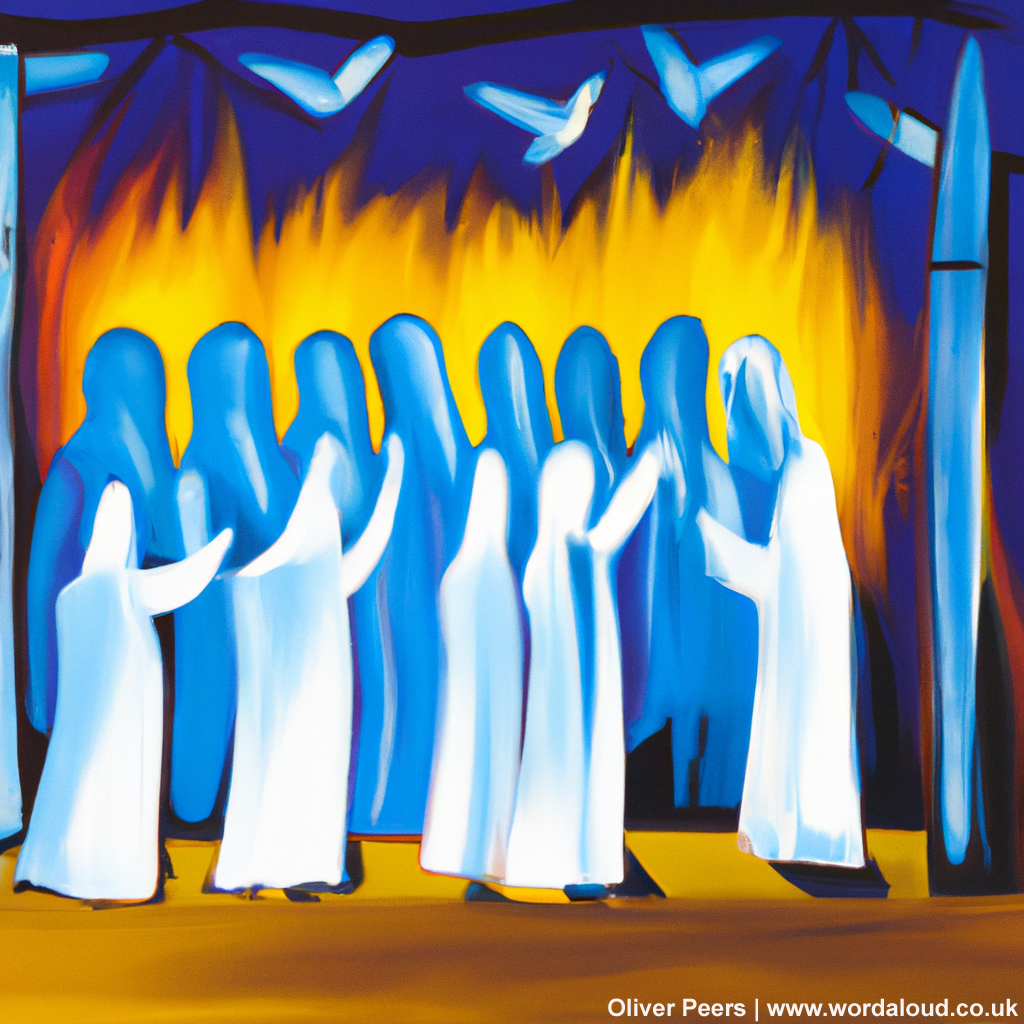
The Holy Spirit is the third person of the Holy Trinity. The Holy Spirit is a person, not a force or energy. The Catechism of the Catholic Church states: ‘The Holy Spirit is a personal and uncreated Love, the source and giver of all holiness.’ (CCC 733) This means that the Holy Spirit is not a thing, but rather a divine person who is coequal with God the Father and Jesus Christ the Son [ … ]
Hagar’s encounter with the angel of the LORD illustrates how God intervenes in the lives of the oppressed and the outcasts. In her moment of desperation, God reached out to her personally, comforting her and providing guidance for her path. Hagar’s response was profound; she acknowledged that God sees her and cares for her well-being. Despite the hardships she faced, Hagar found reassurance in the divine presence, recognizing that God’s plan was at work even in her struggles [ … ]
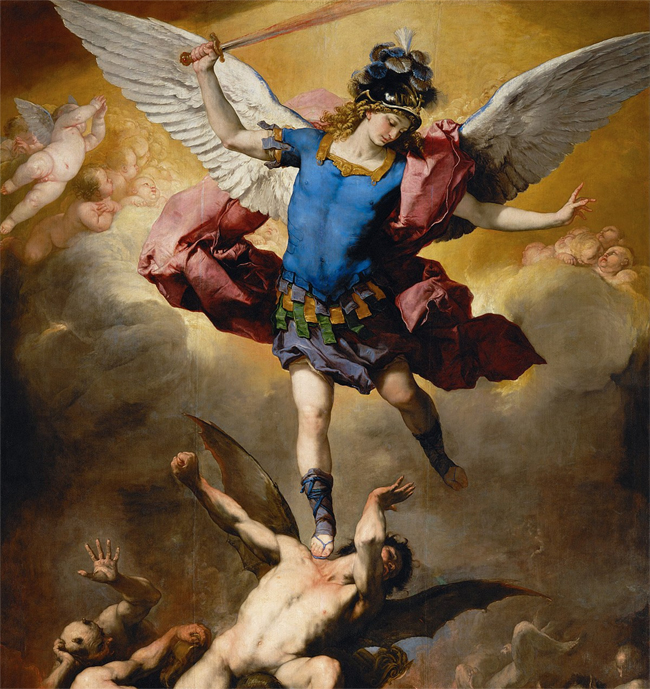
Saint Michael the Archangel is one of the most well-known angels in the Bible. Saint Michael is mentioned by name five times in the Old and New Testaments. In the Book of Daniel, Saint Michael is described as a ‘great prince’ who protects the people of Israel. In the New Testament, Saint Michael is mentioned in the Book of Revelation, where he leads the battle against the dragon and his angels [ … ]
