
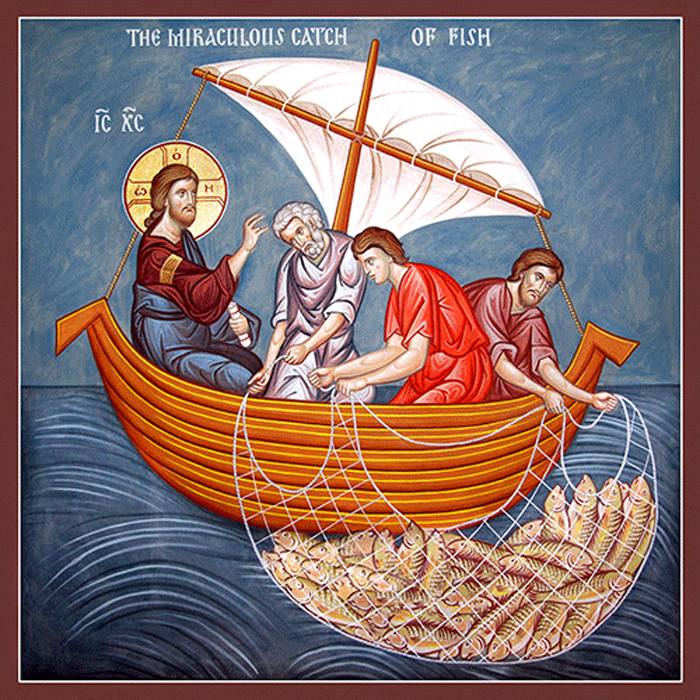
Christian Art | Fishers Of Men | King James Audio Bible | Daily Gospel Verses | KJV
Luke 5: 1-11 – Week 22 Ordinary Time, Thursday (King James Audio Bible KJV, Spoken Word)
1 AND it came to pass, that, as the people pressed upon him to hear the word of God, he stood by the lake of Gennesaret,
2 And saw two ships standing by the lake: but the fishermen were gone out of them, and were washing their nets.
3 And he entered into one of the ships, which was Simon’s, and prayed him that he would thrust out a little from the land. And he sat down, and taught the people out of the ship.
4 Now when he had left speaking, he said unto Simon, Launch out into the deep, and let down your nets for a draught.
5 And Simon answering said unto him, Master, we have toiled all the night, and have taken nothing: nevertheless at thy word I will let down the net.
6 And when they had this done, they inclosed a great multitude of fishes: and their net brake.
7 And they beckoned unto their partners, which were in the other ship, that they should come and help them. And they came, and filled both the ships, so that they began to sink.
8 When Simon Peter saw it, he fell down at Jesus’ knees, saying, Depart from me; for I am a sinful man, O Lord.
9 For he was astonished, and all that were with him, at the draught of the fishes which they had taken:
10 And so was also James, and John, the sons of Zebedee, which were partners with Simon. And Jesus said unto Simon, Fear not; from henceforth thou shalt catch men.
11 And when they had brought their ships to land, they forsook all, and followed him.
Luke’s Gospel places the calling of the first disciples after the fame of Jesus has already spread across the region. Simon Peter listens to Jesus’ words, then he experiences the miraculous catch of fish, and then he throws himself down before Jesus, acknowledging his sins and placing his life in Jesus’ hands. This is Simon Peter’s call. He gives away everything he has to follow Jesus.
The Church Fathers saw in Simon’s boat a symbol of the pilgrim Church on earth. ‘This is the boat which according to Saint Matthew was in danger of sinking and according to Saint Luke was filled with fish. Here we can see the difficult beginnings of the Church and its later fruitfulness.’ (Saint Ambrose.)
Jesus has taught in the synagogues. Now he gets into the boat to teach the crowds. We can imagine just how many people must have flocked to listen to Jesus, all wanting a piece of him. Jesus gets into the boat in order to be able to satisfy the hunger of the people, to teach the crowds. Here is an image of Christ’s preaching to us now through the Church, the barque of Peter, reaching out across the whole world to call all humanity to God through Jesus.
There is a sense of commission and of perseverance as Jesus tells Simon to take the ship out into the sea again and to drop the nets. Simon’s response expresses exhaustion, disbelief and also obedience. He does what Jesus tells him to do. Now here is a miraculous catch of fish! This is what happens when we are disheartened, as must be so often the case, and as we keep going with Jesus. Suddenly, just when we feel we have reached the limit, there is a miraculous catch! This is our sharing of faith.
Perhaps it might be good for us to recall that, when we experience difficulty in prayer, when our prayer is dry and we feel we are getting nowhere, God doesn’t mind. What matters to God is that we are still praying, even as we experience no immediate reward. Difficult as it may seem, when it seems to us as if our prayers are not communicating, God still hears our prayers, and their work is done.

King James Audio Bible | Endnotes
What Did Jesus Mean By Fishers Of Men?
Luke 5:1-11 tells the story of Jesus calling his first disciples, who were fishermen by trade. As they were cleaning their nets by the shore of the Sea of Galilee, Jesus got into one of their boats and asked Simon (later called Peter) to push off from the shore. Jesus then taught the crowds from the boat and told the fishermen to cast their nets into the deep water, where they caught such a large number of fish that their nets began to break. This miraculous catch of fish led the fishermen to recognize Jesus as the Son of God and to follow him.
The phrase ‘fishers of men’ comes from Jesus’ words to the fishermen after the miraculous catch of fish, when he tells them: ‘Fear not; from henceforth thou shalt catch men.’ (Luke 5:10) In this phrase, Jesus uses the imagery of fishing to describe the disciples’ new mission of spreading the Gospel and bringing people into the kingdom of God.
The imagery of fishing is not unique to the New Testament, however. In the Old Testament, fishing is often used as a metaphor for judgment and destruction. For example, in Amos 4:2, the prophet warns the people of Israel that they will be ‘drawn away with hooks’ like fish, and in Jeremiah 16:16, God tells Jeremiah that he will send fishermen to catch the people of Israel and bring them back to their land.
In the New Testament, the image of fishing is used in a more positive sense, as a metaphor for evangelism and discipleship. In Matthew 4:19, Jesus calls his first disciples, who were also fishermen, and tells them: ‘Follow me, and I will make you fishers of men.’ Similarly, in Mark 1:17, Jesus calls Simon and Andrew and says to them: ‘Come ye after me, and I will make you to become fishers of men.’
Throughout Christian history, the phrase ‘fishers of men’ has been used to describe the work of evangelism and discipleship. Saint Augustine, in his work The City Of God, writes: ‘Thus, the apostles were sent as “fishers of men”, not to kill them, but to catch them alive for salvation.’ Similarly, in his sermon ‘The Fishers of Men’, Charles Spurgeon says: ‘The apostles became fishers of men because they had been caught themselves by the Gospel net.’
In the Catholic tradition, the image of fishing is often associated with the papacy. Saint Peter, the first bishop of Rome, was a fisherman before he became a disciple of Jesus. In Matthew 16:18, Jesus tells Peter: ‘Thou art Peter, and upon this rock I will build my church; and the gates of hell shall not prevail against it.’ This passage is often interpreted to mean that Peter was the rock upon which the church was built, and that the papacy is therefore the spiritual successor of Peter.


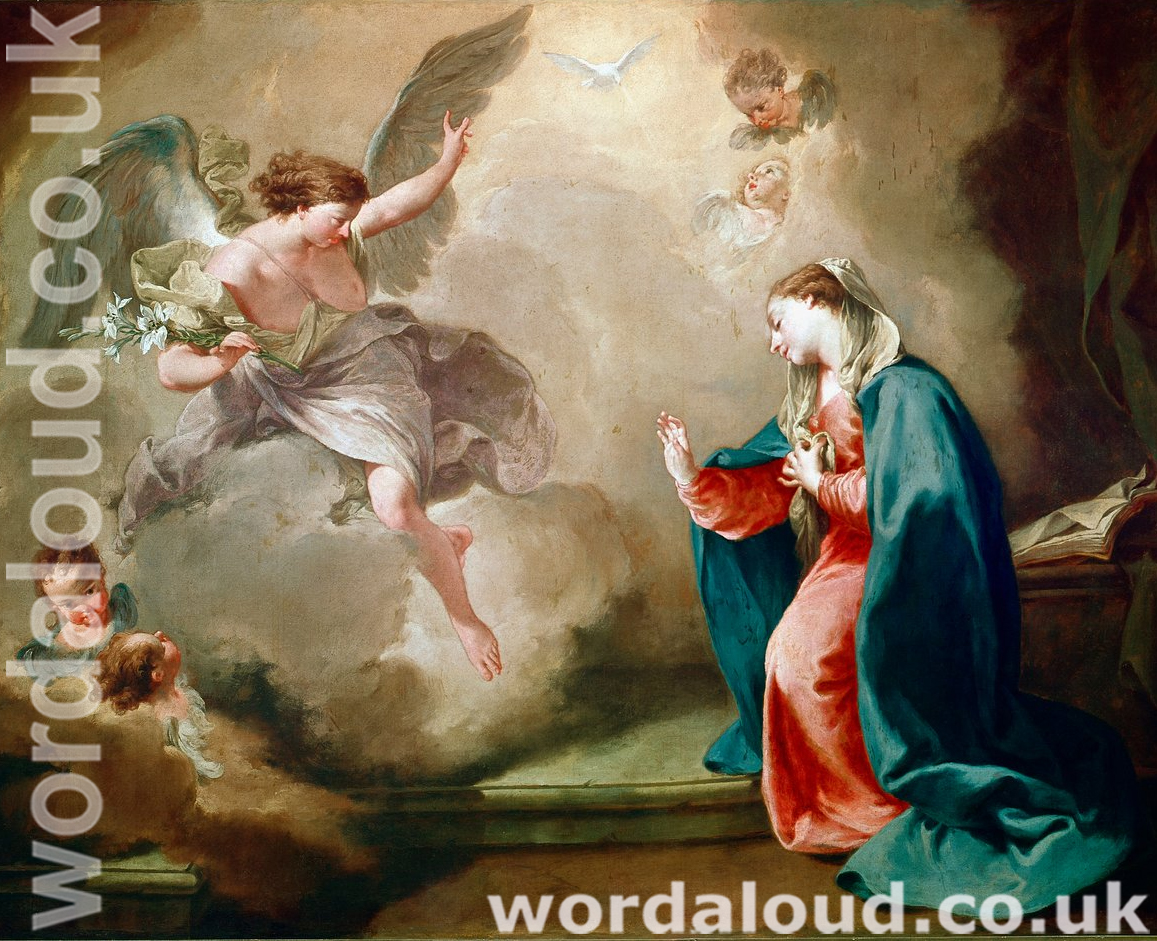
In this reading, Bernard of Clairvaux reflects on the moment of the annunciation, focusing on Mary’s reply to the angel Gabriel. The reading does not retell the biblical narrative in a descriptive way but pauses at the moment before Mary speaks, treating her response as a decisive point in salvation history [ … ]
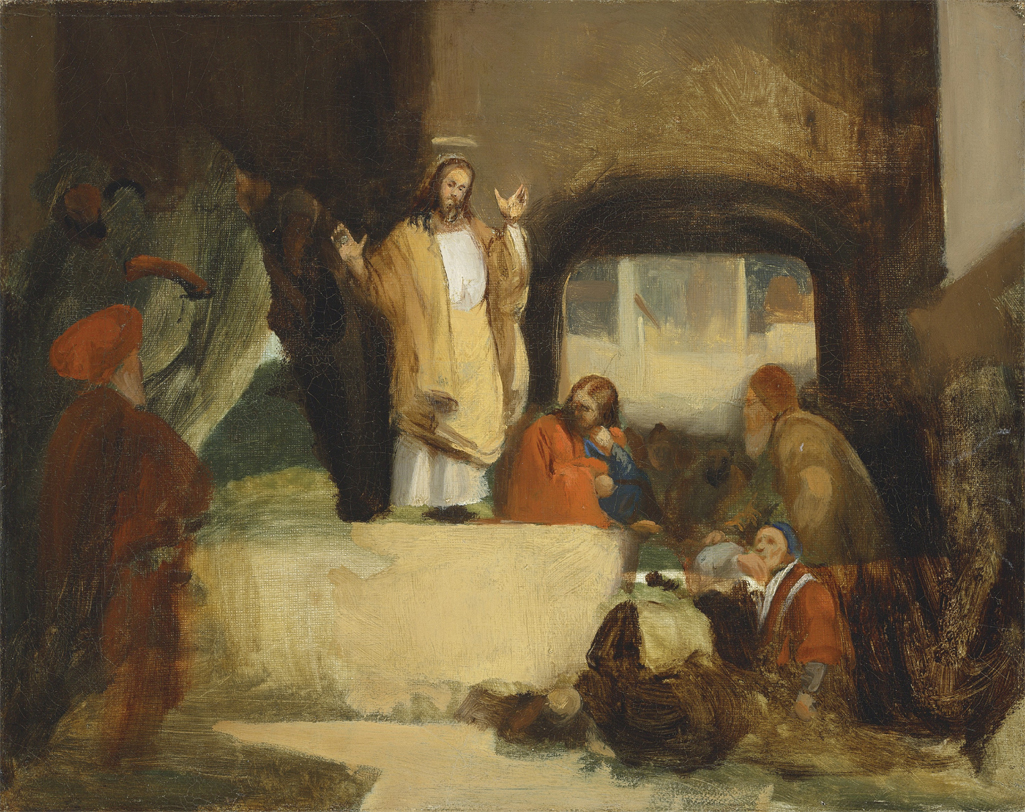
The three synoptic Gospels tell us of this episode of Jesus’ life, when he returned home to Nazareth and preached in the synagogue there. Luke’s Gospel gives us the text of Isaiah read by Jesus, in which Jesus’ announces his messianic mission – to bring the good news to the poor, to live and to identify with the poor, to heal us and set us at liberty from sin. As Jesus closes the book, he omits the following from Isaiah 61: 2: ‘…and the day of vengeance of our God.’ This is deliberate interruption. Jesus is not come to maintain old enmities. Jesus’ way is peace. It is the people of all the world who are to be blessed in Christ [ … ]

As a Christian martyr who endured the torments of persecution and ultimately gave his life for his faith, Saint Sebastian is a powerful intercessor for those who seek protection in the face of adversity. Through his steadfast devotion and unshakable faith in God, Saint Sebastian serves as a beacon of hope and inspiration for those who seek to overcome the challenges and dangers of this world [ … ]
