

Christian Art | Jesus’ Friends And Family Think Jesus Is Crazy
Mark 3: 20-21 – Week 2 Ordinary Time, Saturday (Audio Bible KJV, Spoken Word)
20 And the multitude cometh together again, so that they could not so much as eat bread.
21 And when his friends heard of it, they went out to lay hold on him: for they said, He is beside himself.
There are times elsewhere in the Gospels when Jesus’ enemies accuse him of being possessed by a devil. In today’s very short Gospel reading, we listen to how Jesus’ friends are worried for him, to the point where they wish to save him from himself, thinking that he has gone out of his mind – that he is mad.
We are told that Jesus is giving himself to the multitudes to such an extent that he and his disciples cannot find a chance to eat. Jesus’ very active mission is using up all his time and must have been overwhelming. Perhaps it was this pushing of himself to the limits of his human resources which led his friends to think him beside himself.
We may also gain a further insight as we listen to these verses into just how unconventional a figure Jesus was. We know Jesus’ teaching was radical – and dangerous, deliberately so, to Jewish orthodoxy – and we hear of the fear and amazement as the crowds listened to Jesus and witnessed his healing miracles. Perhaps we learn something here of how Jesus comported himself. While we are used to depictions of Jesus’ teaching which show a man very serene and still, often positively ethereal, one leaned finger raised as he elucidates some finer point of Scriptural detail, the truth may have been different, full of power, energy, urgency, gripping his listeners, throwing his whole body – and heart and soul and mind – as he seizes on every exigency to make opportunity to drive his message home.
There is division between Jesus and his friends and family. Things are not turning out as they might have planned. It can be enjoyable to speculate as to what expectations and plans may have been formed in relation to Jesus during the hidden years. A little later (Tuesday’s reading), Jesus will rebuff his mother and others of his family as they come to find him, and when once more he is in the midst of an attentive crowd, saying: Who are my mother and my brethren? This may seem strange and harsh, however we also think of those in the crowds who might previously not have known family or community: lepers, the possessed, publicans , foreigners, the sick, mutilated persons, paraplegics. There is conflict as Jesus rebuffs a narrow, exclusive domesticity to bring love, life, hope to everyone.
Lord God,
living light of eternal love,
grant that always aglow with charity,
we may love you above all else
and our brethren for your sake,
with one and the self-same love.
Through Christ our Lord.

Audio Bible KJV | Endnotes
Jesus’ Friends Thought He Was Crazy
In Mark 3:20-21, we see a scene where Jesus’ friends and family thought Jesus was crazy. The passage reads:
‘And the multitude cometh together again, so that they could not so much as eat bread. And when his friends heard of it, they went out to lay hold on him: for they said, He is beside himself.’
The phrase ‘beside himself’ in this context means ‘out of his mind’ or ‘insane.’ It is clear from this passage that Jesus’ friends and family were concerned about Jesus’ behavior.
The idea of Jesus being thought of as crazy or insane is not uni que to this passage. Throughout the Gospels, we see instances where Jesus’ actions and teachings were seen as strange or even dangerous by those around him. For example, in John 10:20, we read: ‘And many of them said, he hath a devil, and is mad; why hear ye him?’
But why would Jesus’ friends and family think he was crazy? One possible explanation is that Jesus was doing things that were outside the norm. Jesus was healing the sick, casting out demons, and challenging the religious leaders of the day. Jesus’ teachings were also radical and went against the traditional Jewish beliefs of the time. All of this may have made those around Jesus uneasy.
Theologians and religious scholars have offered interpretations of this passage. Some have suggested that Jesus’ friends and family were simply worried about his safety and wanted to protect him from harm. Others have proposed that this passage is evidence of Jesus’ humanity and the difficulties Jesus faced in carrying out his mission.
One influential figure who commented on this passage was Saint Augustine, Christian theologian of the fourth and fifth centuries AD. Saint Augustine believed that Jesus’ friends and family were being influenced by the devil when they thought Jesus was crazy. Saint Augustine wrote:
‘The devil makes use of men’s tongues, as his instruments, to calumniate the works of Christ, and to pervert the minds of men against them; so that he that is in the highest degree of wisdom is accounted a fool, and he that hath performed the most wonderful works, is esteemed to be beside himself.’
In other words, Saint Augustine believed that the devil was trying to undermine Jesus’ mission by convincing those around him that he was crazy. Saint Augustine’s interpretation highlights the spiritual warfare that is often present in the Bible, where the forces of good and evil are constantly at odds.
In more recent times, scholars have continued to explore the meaning of this passage. Pope Benedict XVI wrote about this passage in his book Jesus Of Nazareth. Pope Benedict suggested that Jesus’ friends and family were struggling to understand his teachings, which were so different from what they had been taught. He wrote:
‘Jesus’ relatives saw him as completely mad. His words seemed like incomprehensible gibberish to them. They could no longer interpret them. What he said was so new and so different that his words simply did not fit into the preconceived notions that had hitherto structured their world.’
Pope Benedict’s interpretation highlights the radical nature of Jesus’ teachings, which were so revolutionary that they could not be understood by those who were steeped in traditional Jewish beliefs.
Martin Luther, the 16th-century Protestant theologian and leader of the Reformation saw Jesus’ friends and family’s reaction as evidence of the opposition that often arises when someone tries to bring about significant change. Martin Luther wrote:
‘Christ is indicating that such an opposition should not be a surprise or a cause for discouragement. Rather, it is to be expected when people try to bring about important changes in society, politics, or religion.’
Luther’s interpretation suggests that Jesus’ experience was not unique and that anyone who tries to make significant changes in society or religion is likely to face opposition. This interpretation also highlights the importance of perseverance and faith in the face of adversity.
In modern times, this Gospel passage continues to resonate with Christians. Some see it as a reminder that even when others misunderstand or criticize us, we must stay true to our convictions and trust in God’s guidance. Others see it as a call to empathy and understanding, encouraging us to try to see the world from the perspective of those around us who may be struggling to understand our actions or beliefs.


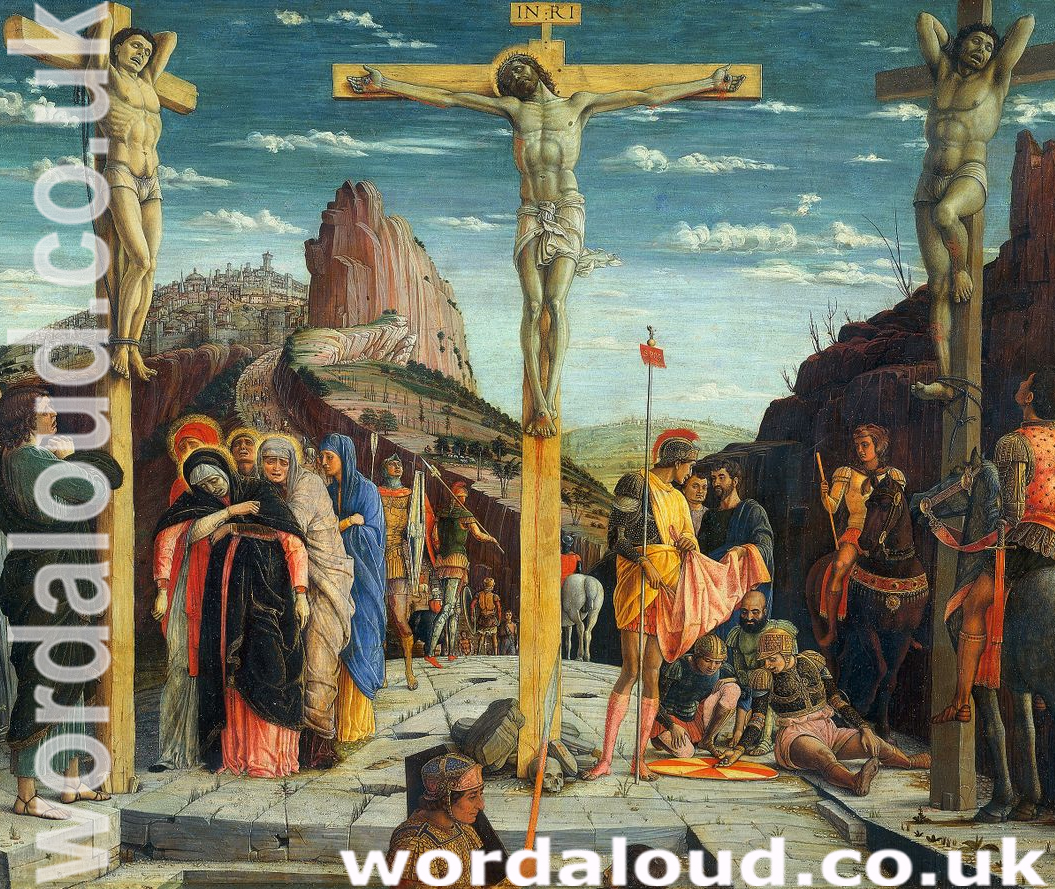
Christian Art | Our Lord Jesus On The Cross | God The Father | God The Son Office Of Readings | Advent December 23rd | A Reading From The Treatise Of Saint Hippolytus Against The Heresy Of Noetus | The Hidden Sacrament Is Revealed ‘The hidden sacrament is revealed.’ In this reading, Saint Hippolytus writes against the Noetic heresy, which denied the real distinction between the Father and the Son by treating them as the same person acting under different names. The purpose of Saint Hippolytus is to defend the Church’s confession of one God who is not solitary, but who exists with his Word and Spirit. Hippolytus begins by setting a principle: knowledge of God comes from the Holy Scriptures, not from speculation or private reasoning. Faith is not shaped by human preference but by what God has chosen to reveal. The Father determines how He is believed, the Son how He is glorified, and the Spirit how He is received. This establishes Scripture as the rule of faith and guards against theological invention. Hippolytus then affirms that God existed alone before creation, with nothing co-eternal alongside Him. At the same time, God was not without reason, wisdom, or power. Hippolytus insists that plurality within God does not compromise divine unity. God contains within himself Word, wisdom, and counsel. Creation begins when God wills and manifests His Word. The Word is not created from nothing but proceeds from God and acts as the agent of creation. The Word is first invisible to the created world, though known to God. When God chooses, He makes the Word visible, described as ‘Light of Light’. This language safeguards both distinction and unity: the Word comes from God and reveals God, without being separate from Him. The manifestation of the Word is ordered towards salvation, so that the world may see and be saved. Hippolytus identifies this Word clearly with the Son of God. Through him all things were made, and he alone comes forth from the Father. The Law and the prophets belong to the same saving plan. God speaks through them by the Holy Spirit, so that they proclaim not their own ideas but the Father’s will. Revelation is therefore coherent: creation, prophecy, and incarnation belong to one divine purpose. Hippolytus appeals to the Gospel of John to show continuity between prophecy and fulfilment. The Word spoken of by the prophets is the Word made flesh. Though the world was made through him, it failed to recognise him. This failure does not negate God’s plan but reveals the depth of the mystery now disclosed. A Reading From The Treatise Of Saint Hippolytus Against The Heresy Of Noetus | The Hidden Sacrament Is Revealed There is, brethren, one God, the knowledge of whom we gain from the Holy Scriptures and from no other source. Whatever things the Holy Scriptures declare, at these let us look; and whatever they teach, let us learn it; and as the Father wills our belief to be, let us believe; and as he wills the Son to be glorified, let us glorify him; and as he wills the Holy Spirit to be bestowed, let us receive him. Not according to our own will, nor according to our own mind, nor yet storming by force the things which are given by God, but even as he has chosen to teach them by the Holy Scriptures, so let us discern them. God, subsisting alone, and having nothing coeval with himself, chose to create the world. And conceiving the world in mind, and willing and uttering the Word, he made it; and at once it appeared, formed it in the way he desired. For us it is sufficient simply to know that nothing was coeval with God. Outside him there was nothing; but he, while existing alone, yet existed in plurality. For he did not lack reason, or wisdom, or power, or counsel. All things were in him, and he was the All. At a time and in a manner chosen by him he made his Word manifest, and through his Word he made all things. He bears this Word in himself, as yet invisible to the created world. He makes him visible, uttering the voice first, and begetting him as Light of Light. He presents him to the world as its Lord; and whereas the Word was visible formerly to God alone, and invisible to the world which is made, God makes the Word visible in order that the world might see him and be able to be saved. This is the mind which came forth into the world and was manifested as the Son of God. All things came into being through him, and he alone comes from the Father. He gave us the Law and the prophets; and in giving them, he made them speak by the Holy Ghost, in order that, receiving the inspiration of the Father’s power, they might declare the Father’s counsel and will. Thus, then, was the Word made manifest, even as the blessed John says. For he sums up the things that were said by the prophets, and shows that this is the Word, by whom all things were made. In the beginning was the Word, and the Word was with God, and the Word was God. All things were made by him, and without him nothing was made. And later, The world was made by him, and the world did not know him; he came to his own, and his own did not receive him. Christian Prayer With Jesus Lord God,You are one, and from You come the Word and the Spirit.You have chosen to make Yourself known, not by human effort,but by what You have revealed in the scriptures. You spoke Your Word, and all things were made.You made that Word visible, so that the world might see and be saved.Grant that we may receive what You give,believe what You teach,and worship You as You have shown Yourself to be. Keep us […]
In this image, Athanasius collapses the categories of subject and object. Christ is not only the one who invites us to the feast; he is the feast. The sacrificial lamb, the priest who offers it, and the table at which it is shared—these are all fulfilled in the person of Jesus Christ. This theological density reflects Athanasius’ wider understanding of the Incarnation: that in Christ, God has assumed all dimensions of our reality to redeem them [ … ]

Christ offers himself to the people as the good shepherd, recalling a favourite theme of Old Testament prophecy. Priests and kings are so described, and indeed God is spoken of as a shepherd, as we hear, for example, in Psalm 23: THE Lord is my shepherd; I shall not want [ … ]
