
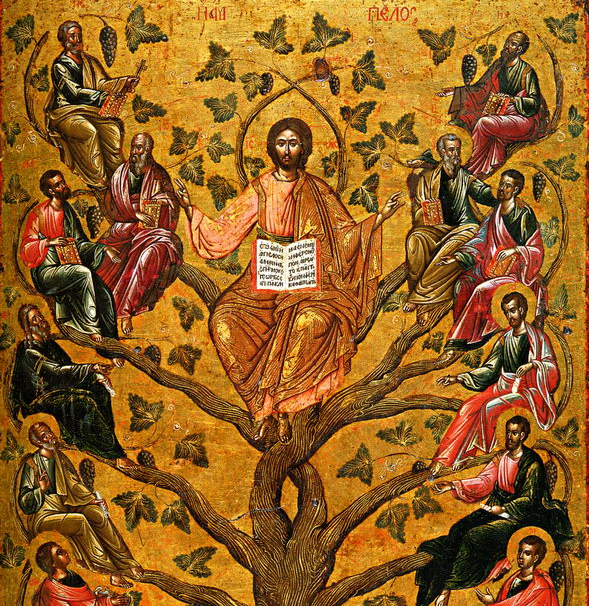
John 15: 1-8
I AM the true vine, and my Father is the husbandman.
2 Every branch in me that beareth not fruit he taketh away: and every branch that beareth fruit, he purgeth it, that it may bring forth more fruit.
3 Now ye are clean through the word which I have spoken unto you.
4 Abide in me, and I in you. As the branch cannot bear fruit of itself, except it abide in the vine; no more can ye, except ye abide in me.
5 I am the vine, ye are the branches: He that abideth in me, and I in him, the same bringeth forth much fruit: for without me ye can do nothing.
6 If a man abide not in me, he is cast forth as a branch, and is withered; and men gather them, and cast them into the fire, and they are burned.
7 If ye abide in me, and my words abide in you, ye shall ask what ye will, and it shall be done unto you.
8 Herein is my Father glorified, that ye bear much fruit; so shall ye be my disciples.
In the Old Testament, the chosen people of Israel have been compared to a vine. We may think, for example, of Isaiah’s Song of the Vineyard (Isaiah 5:1-7) in which God complains that, despite the care he has lavished upon it, his vineyard has only produced wild grapes:
NOW will I sing to my wellbeloved a song of my beloved touching his vineyard. My wellbeloved hath a vineyard in a very fruitful hill:
2 And he fenced it, and gathered out the stones thereof, and planted it with the choicest vine, and built a tower in the midst of it, and also made a winepress therein: and he looked that it should bring forth grapes, and it brought forth wild grapes.
3 And now, O inhabitants of Jerusalem, and men of Judah, judge, I pray you, betwixt me and my vineyard.
4 What could have been done more to my vineyard, that I have not done in it? wherefore, when I looked that it should bring forth grapes, brought it forth wild grapes?
5 And now go to; I will tell you what I will do to my vineyard: I will take away the hedge thereof, and it shall be eaten up; and break down the wall thereof, and it shall be trodden down:
6 And I will lay it waste: it shall not be pruned, nor digged; but there shall come up briers and thorns: I will also command the clouds that they rain no rain upon it.
7 For the vineyard of the Lord of hosts is the house of Israel, and the men of Judah his pleasant plant: and he looked for judgment, but behold oppression; for righteousness, but behold a cry.
In Matthew’s Gospel, Jesus uses this imagery of the vineyard in his parable of the tenants, who injure and murder the messengers of the lord of the vineyard, this signifying the rejection of Jesus by the Jews and the call to the Gentiles to follow Christ. Here Jesus develops our understanding of the symbolism, explaining that he is the true vine and that, to be fruitful in our lives, and to receive the gift of eternal life, we as the branches must be joined to him. In short, we can do nothing without him. Jesus is the air that we breathe. Our very existence is through Christ.
We are to abide in Christ, and to welcome and rejoice in Christ as he enters to abide in us. Through this, Christians then become part of one body. Our faith, then, goes beyond our private experience of God; it is communal, each member of Christ’s body, the Church, working for the good of others, and exhorting one another to greater faith.
The vine, Jesus tells us, is good only if it bears fruit. It is not fit for carpentry. Should a branch not bear fruit, it is then only fit to be burned. Through the parable, we are additionally taught that through pruning we may be brought to bear more fruit. Jesus speaks here of the ways in which we may suffer for our faith, and of sacrifices that may be entailed. Through this discipline of faith, we may come to full fruition in Christ Jesus.
‘Have you not heard the Master himself tell the parable of the vine and the branches? Here we find consolation. He demands much of you, for you are the branch that bears fruit. And he must prune you… to make you bear more fruit. Of course, that cutting, that pruning, hurts. But afterwards, what richness in your fruits, what maturity in your actions.’ St Josemaria Escriva
Audio Bible KJV | Endnotes
The Parable of the Vine and the Branches (John 15:1-8) is a teaching of Jesus of Nazareth concerning the nature of the relationship between Jesus and his disciples. In the parable, Jesus compares himself to a vine and his followers to the branches. Jesus emphasizes the importance for Christians of our connection with Jesus in order to bear fruit.
Jesus says: ‘I am the true vine, and my Father is the husbandman. Every branch in me that beareth not fruit he taketh away: and every branch that beareth fruit, he purgeth it, that it may bring forth more fruit.’ (John 15:1-2 KJV) Jesus explains that his followers must abide in him, just as a branch must stay connected to the living vine in order to produce fruit.
Interpretations of the parable have included:
- The importance of a close relationship with Jesus: The main message of this parable is the importance of having a close relationship with Jesus in order to produce fruit. Just as a branch must stay connected to the vine, Christians must remain connected to Jesus in order to bear fruit.
- The purging of the branches: The parable also emphasizes the idea that the branches must be pruned or purged in order to bear more fruit. This is seen as a symbol of the discipline and transformation that takes place in the lives of believers as they grow closer to Jesus.
- The nature of spiritual fruit: The fruit mentioned in the parable is often interpreted as spiritual fruit, such as love, joy, peace, and kindness, which are the result of a close relationship with Jesus. This highlights the idea that the goal of the Christian life is not just to do good works, but to cultivate a relationship with Jesus that produces these spiritual qualities.
- The role of the Holy Spirit: Some interpretations of this parable also emphasize the role of the Holy Spirit, who is seen as the life-giving source of spiritual fruit. In this view, the Holy Spirit is the source of the connection between Jesus and his followers, and it is through the Spirit that the branches are able to produce fruit.
The Parable of the Vine and the Branches is related to other teachings of Jesus, including the Sermon on the Mount, the Parable of the Prodigal Son. Also it relates to the prayer of Jesus in the Garden of Gethsemane.
In the Sermon on the Mount, Jesus teaches his followers the importance of living a life that is pleasing to God. This message is similar to the message of the Parable of the Vine and the Branches, as both emphasize the importance of staying connected to Jesus in order to produce fruit. In the Sermon on the Mount, Jesus says: ‘Blessed are they which do hunger and thirst after righteousness: for they shall be filled.’ (Matthew 5:6 KJV) This idea of hungering and thirsting after righteousness is similar to the idea of staying connected to the vine in order to produce fruit.
The Parable of the Prodigal Son relates to the message of the Parable of the Vine and the Branches, as both emphasize the idea of being restored to a close relationship with God. In the Parable of the Prodigal Son, the younger son returns to his father, confessing his sins and seeking forgiveness. This is seen as a symbol of the restoration of the relationship between God and the sinner. Similarly, in the Parable of the Vine and the Branches, Jesus emphasizes the importance of staying connected to him in order to produce fruit, and highlights the idea of the purging of the branches as a symbol of the transformation that takes place in the lives of believers as they grow closer to Jesus.
The Parable of the Vine and the Branches is related to the prayer of Jesus in the Garden of Gethsemane, where Jesus prayed for strength to face his upcoming Crucifixion. In the garden, Jesus said: ‘My Father, if it be possible, let this cup pass from me: nevertheless not as I will, but as thou wilt.’ (Matthew 26:39) This prayer highlights the idea of submitting to God’s will, just as the branches in the parable must submit to the will of the husbandman. In both cases, Jesus and the branches must surrender their own desires in order to do what is right and pleasing to God.



Psalm 96 opens with an impassioned exhortation: ‘O sing unto the Lord a new song: sing unto the Lord, all the earth.’ This vibrant call to sing a new song is not mere repetition of familiar tunes; it is invitation to explore fresh melodies of praise that resonate with ever-renewing wonders of God’s salvation. Scope of this call is universal—reaching to each corner of the earth, summoning all nations and peoples to join in celestial chorus [ … ]

Psalm 140 is a prayer for deliverance from evil, invoking God’s protection against the schemes and violence of wicked adversaries. The psalmist appeals to God as shield and saviour, expressing trust in divine intervention to preserve from harm. Central to Psalm 140 is a contrast between the malice of the wicked and the steadfastness of divine justice. The psalm concludes with confidence in the Lord’s ability to uphold the cause of the afflicted and the assurance that righteousness will ultimately dwell in God’s presence [ … ]

The creation of the King James Bible was an extraordinary event in literary and religious history. This was a political act of nation-building and it was a great spiritual gift, of ‘one more exact translation of the Holy Scriptures into the English tongue’, this new translation stamped with royal approval [ … ]
