
Christian Art | Christian Faith And Healing
Mathew 12: 14-21 – Week 15 Ordinary Time, Saturday (King James Audio Bible KJV, Spoken Word)
14 ¶ Then the Pharisees went out, and held a council against him, how they might destroy him.
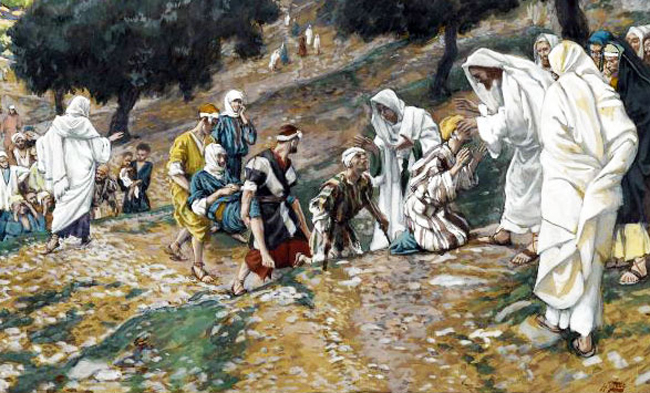
15 But when Jesus knew it, he withdrew himself from thence: and great multitudes followed him, and he healed them all;
16 And charged them that they should not make him known:
17 That it might be fulfilled which was spoken by Esaias the prophet, saying,
18 Behold my servant, whom I have chosen; my beloved, in whom my soul is well pleased: I will put my spirit upon him, and he shall shew judgment to the Gentiles.
19 He shall not strive, nor cry; neither shall any man hear his voice in the streets.
20 A bruised reed shall he not break, and smoking flax shall he not quench, till he send forth judgment unto victory.
21 And in his name shall the Gentiles trust.
Jesus has challenged the malice of the Pharisees by curing the man with a withered hand on the Sabbath. In response to the pure goodness of Jesus, the Pharisees take council together and decide to kill Jesus. Their response to absolute good is evil, even as Jesus gives the Pharisees every reason to see the ways in which they have fallen into error. The refusal of the Pharisees to respond to Jesus’ call to reform compounds their evil. They have locked their hearts.
Knowing the threat, Jesus departs from this place, and what happens next is extraordinary. No matter the Pharisees’ condemnation of Jesus, the people follow Jesus. This demonstrates the clear and simple knowledge of the truth of God, of which the humble people are capable, and for which Jesus has thanked his Father. There is a drawing toward Jesus which is unencumbered by the Pharisees’ burdensome distortions of key precepts of Law, to the detriment of God’s honour and men’s welfare. Jesus heals all the people, and then far from wishing his acts of healing to be proclaimed, Jesus enjoins the people to secrecy.
The words of the prophet Isaiah are thusly proven in Jesus’ careful choice of action – of when to act and when not to act: ‘He shall not strive, nor cry; neither shall any man hear his voice in the streets.’ We are called inwardly to Jesus; and Jesus is not to be forced upon us by brazen, street-side show. This precept may inform our own evangelizing as Christians. Our witness to Christ must be so gentle.
In citing the words of the prophet Isaiah, Matthew highlights the contrast between the contemporary and mistaken Jewish notions of a spectacular messianic kingdom, and the truth of the Kingdom that Jesus proclaims to the faithful, to those who follow Jesus, often outside of the usual limitations of their contemporary society, to witness and accept Jesus’ teaching and miracles. No matter contemporary authorities, the people, in their heart of hearts, know how to discern Jesus’ love.
By providing the quotation from Isaiah, Matthew in his Gospel tells us that Jesus is the one in whom the prophecy of the servant of God is fulfilled: a loving and gentle teacher has come to bring the light of truth. Jesus, without ceasing to be the Son of God, has taken the form of a servant. Through this humility, Jesus has come to heal us all: ‘And in his name shall the Gentiles trust.’
Concluding Prayer
O God of my fathers, and Lord of mercy, who hast made all things with thy word,
And ordained man through thy wisdom, that he should have dominion over the creatures which thou hast made,
And order the world according to equity and righteousness, and execute judgment with an upright heart:
Give me wisdom, that sitteth by thy throne; and reject me not from among thy children:
For I thy servant and son of thine handmaid am a feeble person, and of a short time, and too young for the understanding of judgment and laws.
For though a man be never so perfect among the children of men, yet if thy wisdom be not with him, he shall be nothing regarded.
And wisdom was with thee: which knoweth thy works, and was present when thou madest the world, and knew what was acceptable in thy sight, and right in thy commandments.
O send her out of thy holy heavens, and from the throne of thy glory, that being present she may labour with me, that I may know what is pleasing unto thee.
For she knoweth and understandeth all things, and she shall lead me soberly in my doings, and preserve me in her power. (Wisdom 9: 1-6, 9-11 – King James Version – KJV)

King James Audio Bible | Endnotes
The Secret Jesus
In the Gospels, we find a Jesus who is often shrouded in secrecy. Jesus performs miracles but tells people to keep the miracles a secret. Jesus speaks in parables and uses symbolism to reveal deeper truths about God’s character and purpose. Jesus reveals himself gradually and selectively, avoiding being misunderstood by the people of his time who had certain preconceptions about what the Messiah would be like.
One reason for Jesus’ secrecy is to avoid being misunderstood. The people of Jesus’ time expected a political saviour who would overthrow the Roman occupiers. However, Jesus’ mission was not primarily about political liberation but was rather about spiritual redemption and the establishment of God’s kingdom on earth. By revealing himself gradually and selectively, Jesus could be said to have set himself up to be misunderstood and in this sense and through the Cross was able to reveal the truth about himself and his mission in a way that was not distorted by people’s preconceptions.
Jesus’ secrecy is to preserve his life until the appointed time. Religious authorities of his time were threatened by Jesus’ teachings and his popularity, and they sought to kill him.
The secrecy of Jesus is – now – also a way of participating in a larger pattern of divine hiddenness and mystery throughout the Bible. According to Alan E. Lewis, the God of the Bible is a God who hides, and this hiddenness is not accidental but is rather integral to the nature of God’s self-revelation. God often reveals himself in unexpected ways, such as through burning bushes, clouds, and other mysterious phenomena. In a similar way, Jesus’ secrecy is a way of participating in this divine hiddenness and revealing God’s character and purpose in a deeper way.
According to Alan E. Lewis, the pattern of divine hiddenness and mystery in the Bible serves a twofold purpose. First, it creates a sense of expectancy and anticipation among God’s people. When God’s presence and action are hidden, it creates a longing and a hunger for His manifestation. This is why the psalmist cries out, ‘My soul thirsts for God, for the living God. When shall I come and appear before God?’ (Psalm 42:2)
Second, divine hiddenness and mystery reveal the limits of human understanding and knowledge. God’s ways are higher than our ways, and his thoughts are higher than our thoughts (Isaiah 55:9). When God reveals himself, it is always in a way that challenges and expands our understanding, rather than confirming our preconceptions. This is why Jesus’ parables and symbolic actions often left his listeners puzzled and questioning.
The secrecy of Jesus participates in this pattern of divine hiddenness and mystery in several ways. First, it creates a sense of expectancy and anticipation among his followers. As Jesus gradually revealed more about himself and his mission, his disciples began to understand that he was not just a political or military leader, but rather the Messiah who had come to establish God’s kingdom on earth.
Second, the secrecy of Jesus reveals the limits of human understanding and knowledge. Jesus often spoke in parables and used symbolism to convey deeper truths about God’s character and purpose. He challenged his listeners to think in new and radical ways about the nature of God’s kingdom and the way in which it would be established on earth.
Finally, the secrecy of Jesus reveals the nature of God’s self-revelation as a gradual and unfolding process. Just as God’s revelation of himself throughout the Bible was gradual and progressive, so too was Jesus’ revelation of himself and his mission. His disciples were not able to grasp the full significance of his teachings and actions until after his resurrection and the outpouring of the Holy Spirit at Pentecost.
In conclusion, the secrecy of Jesus is not just a matter of practical necessity but is rather a way of participating in a larger pattern of divine hiddenness and mystery throughout the Bible. As Alan E. Lewis has shown, this pattern serves a twofold purpose of creating expectancy and expanding our understanding of God’s character and purpose. By understanding the significance of Jesus’ secrecy, we can deepen our appreciation of the mysterious and transformative nature of God’s self-revelation.



In this reflection on Saint Paul’s letter to the Galatians, Saint Augustine explores the Apostle’s pastoral concern and the meaning of the phrase ‘until Christ be formed in you’. His focus is on spiritual growth, imitation of Christ, and the role of patient guidance within the Church [ … ]

‘Behold the Lamb of God.’ Throughout the Bible, we are called to know and to develop our relationship with the Lamb. It is in Genesis the Lamb is first mentioned, provided by God as a sacrifice to take the place of Isaac. Through the history of Jewish ritual, a lamb is offered in sacrifice, for expiation, reparation, sanctification. The prophets speak of a meek, tame lamb, sheared without opening its mouth. In the Book of Revelation, or Apocalypse, the full meaning of the Lamb will be revealed, as the king, the Spouse, the lamp, the temple, the place of our eternal dwelling. The Lamb spans all history. And John the Baptist has already, in John’s Gospel, recognised and declared Christ as the Lamb of God who will take away the sins of the world [ … ]

Saint Cyril of Jerusalem’s catechetical reflection on the Holy Spirit, presented through the metaphor of ‘living water,’ offers an astonishingly rich meditation for catechumens and the faithful. His teaching, drawn from both Scripture and the lived experience of the Church, connects deeply with biblical imagery, theological reflection, liturgical practice, and mystical spirituality [ … ]
