
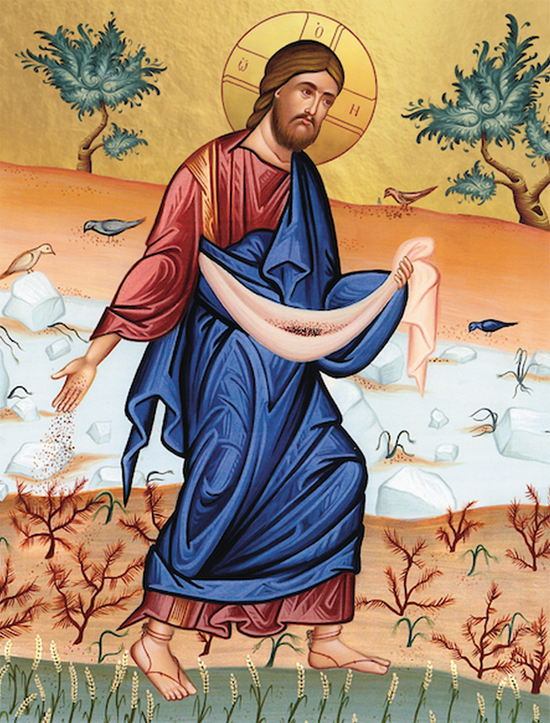
Christian Art | Parables Of The Kingdom | Parable Of The Sower
Matthew 13: 1-9 – Week 16 Ordinary Time, Wednesday (King James Audio Bible KJV, Spoken Word)
1 THE same day went Jesus out of the house, and sat by the sea side.
2 And great multitudes were gathered together unto him, so that he went into a ship, and sat; and the whole multitude stood on the shore.
3 And he spake many things unto them in parables, saying, Behold, a sower went forth to sow;
4 And when he sowed, some seeds fell by the way side, and the fowls came and devoured them up:
5 Some fell upon stony places, where they had not much earth: and forthwith they sprung up, because they had no deepness of earth:
6 And when the sun was up, they were scorched; and because they had no root, they withered away.
7 And some fell among thorns; and the thorns sprung up, and choked them:
8 But other fell into good ground, and brought forth fruit, some an hundredfold, some sixtyfold, some thirtyfold.
9 Who hath ears to hear, let him hear.
With Chapter 13 of Matthew’s Gospel begins the Discourse of the Parables, which concerns the Christian mystery of the Kingdom Of God present in life now. The parables draw us to Jesus, whose divinity is the central fact of the parables. Christ is the veiled truth of each parable. As we uncover the meaning of each of the parables we discover Jesus.
Today’s parable is one of several told by Jesus which include the idea and image of the seed. Jesus’ teachings, his Mission as a whole, are to be understood as seeds. The seeds, Jesus tells us, will grow through time. Jesus did not wish us to think that the end of time was literally imminent. Rather, Jesus intended that Christianity, belief in Jesus, should grow through the millennia like a seed, and from such humble beginnings as we find here at the time of Jesus in the Holy Land.
In today’s Gospel verses, so many people have come to hear what Jesus might have to say that he has been driven from the shore, to go into a boat in order to be able to preach to the people. There is already a mass following, and the parables Jesus now gives to the people are intended to enable the people to find the truth of the Kingdom in their own lives, as they live those lives now. Jesus wants the people to know that, far from their happiness hinging on a Messianic hope for some warrior king, and the political victory this warrior could bring to them, the Kingdom has already come. This coming of the Kingdom in each moment of our lives is a part of what we pray for now through the Lord’s Prayer, the Our Father.
We may ask when hearing Jesus’ parables: why should the message of the Kingdom be veiled as a parable? And: why does Jesus explain his parables to his closest disciples, and deliberately does not do so to the majority of his audience? One suggestion is that the parables are a part of a process by which Jesus gradually reveals his true identity and the purpose of his mission, when the multitudes simply would not be able to accept or to understand these Christian truths at this stage. Jesus’ identity and purpose must remain obscure.
The parables also direct us to discover God in the daily, lived reality of our lives. We are asked to look again and to think again and pray, to uncover unexpected truths concerning the presence of God in our lives and our relationship with God. In today’s parable, by finding our relationship with God and Christ’s teaching reflected in the image of seeds being sown, our sense of the importance of our calling to be good, fertile ground for God’s word may strike us anew. It is with renewed conviction that we pray that our faith and the body of the Church may grow, that we may be fruitful in response to God’s Word.

King James Audio Bible | Endnotes
How Are We To Understand The Crucifixion As A Record Of God Crucified?
When we consider the crucifixion as a record of God crucified, we must look not only at the historical event itself, but also at its theological implications. The crucifixion of Jesus Christ represents the ultimate sacrifice of God for the redemption of humanity, and it has been the subject of theological reflection for centuries.
One theologian who has made a significant contribution to this conversation is Alan E. Lewis. In his book Between Cross And Resurrection: A Theology Of Holy Saturday, Lewis explores the theological significance of the crucifixion and the day between the crucifixion and the resurrection. He argues that the crucifixion is not only a historical event, but a cosmic event that has profound implications for all of creation.
Lewis contends that the crucifixion is the ultimate act of self-sacrifice on God’s part. He writes:
‘The cross represents God’s self-sacrifice in and for the creation that has rejected God, has claimed autonomy from God, has sought to be God, and has crucified God’s Son…In the crucifixion, God takes responsibility for the rebelliousness of the creation, absorbing the consequences of sin and evil into God’s own self, while bearing witness to God’s own invincible love.’ (Between Cross And Resurrection, p. 1-2).
For Lewis, the crucifixion is a cosmic event because it has implications not only for humanity, but for all of creation. Through the crucifixion, God takes responsibility for the brokenness and rebellion of the entire created order, and seeks to reconcile all things to Himself.
Furthermore, Lewis argues that the crucifixion and the day between the crucifixion and the resurrection are significant because they represent a period of waiting and uncertainty. He writes:
‘Holy Saturday is the pause between the fierce loyalty of God to us and our unfaithfulness to God…The cross proclaims the glory of God, but on Holy Saturday, we see the cost of that glory. The triumph of the resurrection is real, but it is also deferred. In the silence of Holy Saturday, we learn to wait in hope.’ (Between Cross And Resurrection, p. 111).
Thus, for Lewis, the crucifixion is not only a record of God crucified, but also a reminder of the cost of God’s love and the need for patience and hope in the face of uncertainty.
In conclusion, Alan E. Lewis’s work on the crucifixion provides important insights into the theological significance of this event. Through his writing, we are reminded of the cosmic implications of the crucifixion, the self-sacrificing love of God, and the importance of waiting in hope. As we reflect on the crucifixion as a record of God crucified, we are called to deepen our understanding of God’s love and the significance of this event for our lives and the world around us.
This idea of God’s self-sacrifice has deep roots in the Christian tradition. One of the most famous passages in the New Testament, John 3:16, states that ‘God so loved the world, that he gave his only begotten Son, that whosoever believeth in him should not perish, but have everlasting life.’ This passage has been interpreted as a statement of God’s self-sacrificing love for humanity, as God gave up His only Son in order to save humanity from sin and death.
The idea of God’s self-sacrifice also has important implications for our understanding of the nature of God. In his book The Crucified God, theologian Jürgen Moltmann argues that the crucifixion represents a fundamental shift in our understanding of God’s nature. He writes:
‘The God who becomes a fellow sufferer is the God who is love…This is the God whom we can love with our whole heart, not only because he loves us, but because he is love. Once we have known this love, once we have experienced it in our own lives, then nothing is ever the same again.’ (The Crucified God, p. 243).
Thus, for Moltmann, the self-sacrificing love of God that is revealed in the crucifixion transforms our understanding of who God is and how we relate to God.
Another important theme that emerges from Alan E. Lewis’s work on the crucifixion is the idea of waiting and hope. Lewis argues that the day between the crucifixion and the resurrection, Holy Saturday, is a time of waiting and uncertainty. He writes:
‘Holy Saturday is the pause between the fierce loyalty of God to us and our unfaithfulness to God…The cross proclaims the glory of God, but on Holy Saturday, we see the cost of that glory. The triumph of the resurrection is real, but it is also deferred. In the silence of Holy Saturday, we learn to wait in hope.’ (Between Cross And Resurrection, p. 111)
This idea of waiting and hope is an important theme throughout the Christian tradition, as believers wait in hope for the coming of God’s kingdom and the final reconciliation of all things. In Romans 8:24-25, the apostle Paul writes: ‘For we are saved by hope: but hope that is seen is not hope: for what a man seeth, why doth he yet hope for? But if we hope for that we see not, then do we with patience wait for it.’



The Confessions, composed around 397–400 AD, is a retrospective narrative in which Saint Augustine recounts his spiritual development and his theological understanding of the human relationship with God. The Confessions moves from autobiographical content to more philosophical and theological reflection. This passage is a meditation on sin, salvation, and the mediating role of Christ [ … ]

Aphraates was a prominent Syriac Christian writer of the early Church, active in the 4th century. He is best known for a series of homilies called the Demonstrations, which provide valuable insights into the theology, liturgy, and practices of the early Syriac Church. Aphraates is often referred to as the Persian Sage, reflecting his origins in the region of the Sasanian Empire (modern-day Iraq and Iran) [ … ]

Psalm 63 offers solace and inspiration to those who seek God’s presence, even in the midst of life’s trials. It serves as a reminder that our pursuit of the Divine should be unwavering, prioritizing our connection with God above all else. It acknowledges profound joy and spiritual fulfilment that come from seeking and experiencing God’s love and protection [ … ]
