
Christian Art | Jesus In Holy Week
The Gospel Of Saint John – Chapter 13 | King James Audio Bible | King James Version KJV
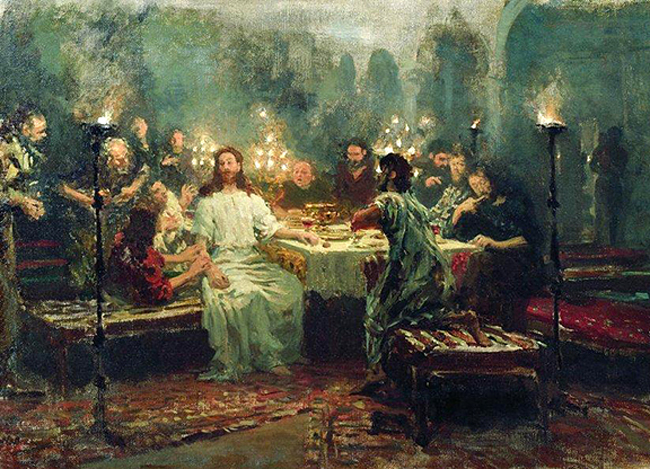
21 When Jesus had thus said, he was troubled in spirit, and testified, and said, Verily, verily, I say unto you, that one of you shall betray me.
22 Then the disciples looked one on another, doubting of whom he spake.
23 Now there was leaning on Jesus’ bosom one of his disciples, whom Jesus loved.
24 Simon Peter therefore beckoned to him, that he should ask who it should be of whom he spake.
25 He then lying on Jesus’ breast saith unto him, Lord, who is it?
26 Jesus answered, He it is, to whom I shall give a sop, when I have dipped it. And when he had dipped the sop, he gave it to Judas Iscariot, the son of Simon.
27 And after the sop Satan entered into him. Then said Jesus unto him, That thou doest, do quickly.
28 Now no man at the table knew for what intent he spake this unto him.
29 For some of them thought, because Judas had the bag, that Jesus had said unto him, Buy those things that we have need of against the feast; or, that he should give something to the poor.
30 He then having received the sop went immediately out: and it was night.
31 ¶ Therefore, when he was gone out, Jesus said, Now is the Son of man glorified, and God is glorified in him.
32 If God be glorified in him, God shall also glorify him in himself, and shall straightway glorify him.
33 Little children, yet a little while I am with you. Ye shall seek me: and as I said unto the Jews, Whither I go, ye cannot come; so now I say to you.
36 ¶ Simon Peter said unto him, Lord, whither goest thou? Jesus answered him, Whither I go, thou canst not follow me now; but thou shalt follow me afterwards.
37 Peter said unto him, Lord, why cannot I follow thee now? I will lay down my life for thy sake.
38 Jesus answered him, Wilt thou lay down thy life for my sake? Verily, verily, I say unto thee, The cock shall not crow, till thou hast denied me thrice.
This is the third day of Holy Week. Through these verses of John’s Gospel, Jesus experiences great emotion, great sorrow, as he prepares for his betrayal and passion. He has given everything to Judas. He has washed his feet along with those of the other disciples. He shares an intimate and important meal with him. Judas has been one of the closest with Jesus for three years. Even now he shows compassion and does not name his betrayer to the other disciples. Instead he says: ‘One of you shall betray me.’
The disciples seem not to know each other as well as they might. There is not the perfect transparency between them such as Jesus shows of himself for them. Peter needs to ask John, the disciple whom Jesus most loved, and who now reclines closest to Jesus, to ask him who the betrayer is. There is an air of secrecy, as of collective fear. Jesus indicates Judas with a sign. During such meals as this, and through friendly companionship, it would be usual for people to offer each other food. Jesus even now offers Judas a sign of friendship, and Judas rejects this.
When Jesus says to Judas, ‘That thou doest, do quickly,’ he leaves the other disciples free to think that Judas is being sent out for some good purpose, perhaps, as the keeper of their money, to buy something for the feast, or perhaps for some charitable act. The darkness now closes in around them: it is night.
Jesus is to be glorified. Indeed, while Judas now goes to betray him, Jesus says: ‘Now is the Son of man glorified.’ There is great power and immediacy in that ‘now’: even as the darkness of sin envelops them, Jesus’ ministry becomes complete.
God the Son and with him God the Father are together to be glorified, the Father through the witness of the Son, who will make the supreme sacrifice to fulfil the will of God and to save mankind. The cross of utter abjection is very shortly to become the sign of hope. Jesus is to free us from the power of sin.
There is a sorrowful sense of parting, and we hear as well in these verses an air of fatalism: all the decisions have now been made; it is happening. The disciples cannot now follow Jesus. That time has not yet come. They have yet to be perfected in their faith and their knowledge of our Lord.
Peter is impetuous in his response to what Jesus has spoken. He makes an impassioned declaration of his love and faith in our Lord: ‘I will lay down my life for thy sake.’ This is a sincere response, but his fortitude has yet to be tested. Jesus tells Peter that he will deny him, and quickly too: once the first cock has crowed, for the arrival of dawn, other cocks will rapidly follow that first crowing with their own. When this happens, Peter will be distraught, but this will also be a powerful lesson for Peter, helping him toward humility and the faith that is more firm thereby.
We know that Peter will follow Jesus and be crucified, head down, rooting in the soil of Rome the rock of the Church. He must be patient. Peter’s hour has not yet come.
‘So, for perfection of life it is necessary not only to imitate Christ, in the examples of gentleness, and humility, and patience which he gave us in this life, but also to imitate him in his death, as Paul the imitator of Christ says: “Becoming like him in death, that if possible I may attain the resurrection from the dead.”
‘How then do we become like him in death? By having been buried with him through baptism. But how does this burial take place? What benefit has this imitation? First of all one must break with one’s life of the past. This is impossible, unless one is born again, as the Lord said. For regeneration, as is evident from the word itself, is the beginning of a second life. Consequently, before beginning the second life, we must bring the first to an end.’ St Basil

Audio Bible KJV | Endnotes
Jesus’ Last Supper | Farewell Discourse And Betrayal | Context Of Our Sin
In John 13:21-38, Jesus sat with his disciples during the Last Supper and revealed that one of them would betray him. The disciples were confused and distraught, asking each other who could do such a thing. Jesus knew that it was Judas Iscariot, but instead of calling him out, Jesus washed Judas’ feet as a symbol of humility and love.
The betrayal is a poignant reminder of the human condition during Lent. As Catholic theologian Thomas Merton said: ‘The deeper our faith, the more doubt we must endure; the deeper our hope, the more prone we are to despair; the deeper our love, the more pain its loss will bring: these are a few of the paradoxes we must hold as human beings.’
We can understand the betrayal as challenge to our own Christian faith. Catholic priest and theologian Henri Nouwen noted: ‘In the face of the betrayals we have to suffer, we are called to trust in the infinite mercy of God.’
Jesus’ response to Judas’ betrayal is one of the most striking aspects of this story. Knowing that Judas would betray him, Jesus did not turn his back on him. Instead, Jesus continued to show Judas love and compassion, even as Judas led the soldiers to his arrest.
Protestant theologian Dietrich Bonhoeffer said: ‘Jesus Christ lived in the midst of his enemies. At the end all his disciples deserted him. On the Cross he was utterly alone, surrounded by evildoers and mockers. For this cause he had come, to bring peace to the enemies of God. So the Christian, too, belongs not in the seclusion of a cloistered life but in the thick of foes.’
This act of love is a powerful reminder of the call to love our enemies, even when they betray us. Catholic theologian Jean Vanier said: ‘The first act of love is always the giving of attention.’ We must be attentive to those around us, even when they disappoint or betray us.
Catholic theologian Scott Hahn said: ‘Christ invites us to share in his life, to become one with him, and to imitate his perfect love.’
The message is relevant during Lent – as we might reflect upon our own betrayals. Jesus’ response to Judas is forgiveness and reconciliation. Catholic theologian Henri J. M. Nouwen said: ‘Forgiveness is the name of love practiced among people who love poorly. The hard truth is that all people love poorly. We need to forgive and be forgiven every day, every hour increasingly. That is the great work of love among the fellowship of the weak that is the human family.’
Catholic priest Fr. James Martin said: ‘Christians need to work toward reconciliation in a deeply polarized world. The example of Jesus, who loved even his betrayer, reminds us that we must work toward forgiveness, mercy, and compassion, even in the face of great wrongdoing.’
Protestant theologian N.T. Wright said: ‘Lent is the season of returning to God. It is a season of confession and repentance, of prayer and fasting, of self-denial and spiritual discipline. It is a season of growth and renewal, of deepening our relationship with God.’



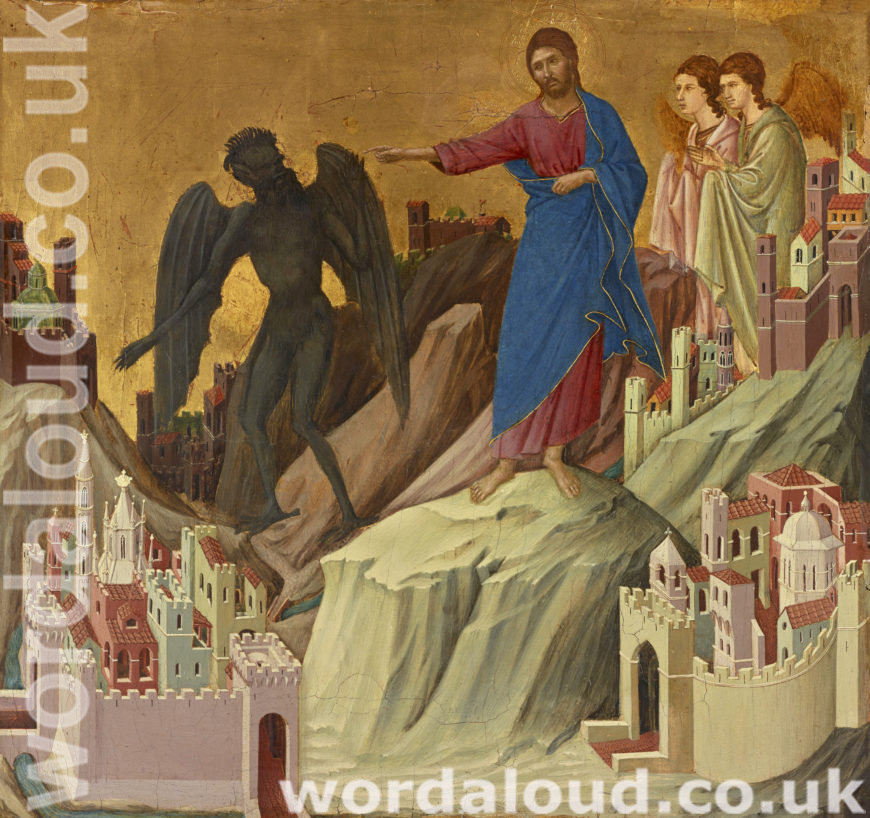
Saint Vincent of Lerins addresses one of the most enduring questions in Christian theology: how the faith can develop through time while remaining faithful to its original substance. Writing in the fifth century, at a time when the Church was clarifying its doctrine in the face of heresies, Vincent offers a nuanced account of continuity and growth. His central concern is to distinguish between true development and corruption of doctrine [ … ]

Theodoret takes his starting point from Isaiah 53, the ‘Suffering Servant’ passage, which early Christians read as a direct prophecy of Christ’s passion. The language of wounds, bruises and chastisement is interpreted not as a description of punishment deserved by Jesus himself, but as the cost he bore to heal humanity. For Theodoret, the cross is not only an act of endurance but also a medicine—a deliberate remedy for the sickness of sin [ … ]

Like and share this new collection of videos on YouTube. Each video features a young King David in the Temple, proclaiming a passage from Saint Matthew’s Gospel. Each is a striking reminder of deep connection between Jewish history, King David, and the coming of the Lord Jesus Christ [ … ]