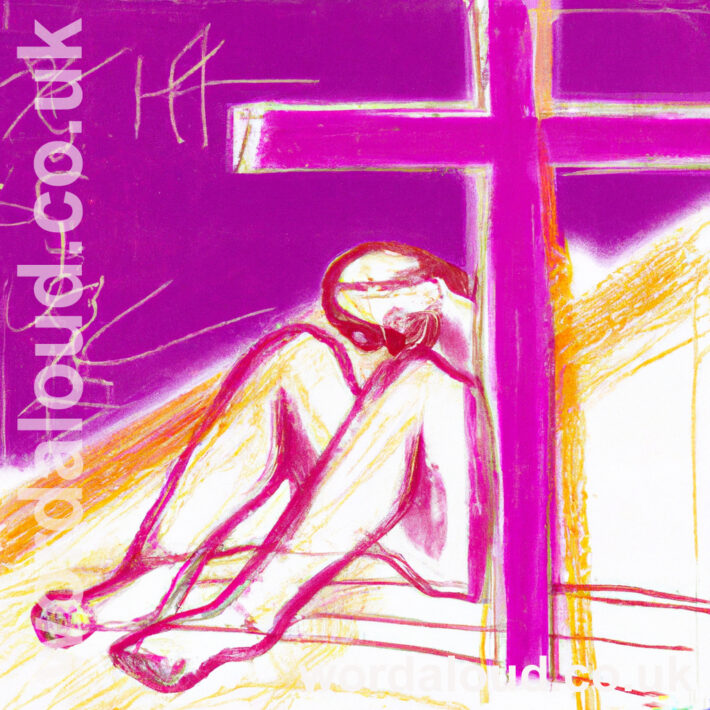
Christian Art | At The Foot Of The Cross | Imitation Of Jesus Christ | Advent Purple
Office Of Readings | Advent Tuesday Week 3 | A Reading From The Imitation Of Christ | Of Humble Submission, Of The Good, Peaceable Man
‘On humility and peace.’
This reading concerns the interior discipline required for humility and peace. It begins by redirecting attention away from other people and towards God. The question is not who supports us or opposes us, but whether our actions are aligned with God. A clear conscience before God is presented as the primary form of security.
The reading stresses patience under difficulty. Silent endurance is not described as weakness, but as a way of entrusting judgement and outcome to God. The timing and manner of deliverance are said to belong to God, not to human control.
Humility is closely linked with an honest awareness of weakness. Allowing others to see our limitations, and accepting criticism without agitation, is presented as beneficial for spiritual growth. Humility reduces conflict because it removes the need to assert oneself or to retaliate.
Peace is described as an interior condition that affects how a person interprets others. A peaceful person does not readily suspect bad intentions and is less disturbed by the behaviour of others. By contrast, inner unrest leads to suspicion, excessive speech, and misplaced concern with the faults of others.
The reading repeatedly calls for self-attention rather than comparison. The instruction is to examine one’s own conduct before judging that of others. Humility is expressed in patience with others and restraint in judgement. Peace grows where self-justification gives way to self-knowledge.

A Reading From The Imitation Of Christ | Of Humble Submission, Of The Good, Peaceable Man
Do not worry about who is and is not on your side: simply make sure that God is with you in all you do.
Have a clear conscience, and God will defend you. For if God chooses to help you, no malice can do you harm.
If you know how to suffer in silence, without doubt you will receive the help of the Lord. He knows when and how he will free you, so resign yourself into his care. It is for God to give help and give freedom from trouble.
For the sake of humility it is often good for others to know our weaknesses and tax us with them.
When a man holds himself humbly because of his weakness, it is easy for him to please others and calm those who are angry with him.
God protects and frees the humble, loves and consoles them. He leans down to the humble, he bestows great grace on them, he lifts them from their lowliness into glory.
God calls the humble gently to him, and to them he reveals his secrets.
If a humble man is humiliated, he is happy enough and at peace, because his support is God and not the world.
Do not count yourself as having made progress until you feel yourself inferior to everyone.
A peaceable man is of more use than a learned man.
If you are a slave to your feelings, you will see good actions as bad, and you will easily believe the worst; a good and peaceful man will see good in everything.
Whoever is truly at peace is not plagued by suspicion. Whoever is discontented and disturbed will be blown about by gusts of suspicion: he cannot rest and will not let others rest either.
He often says what he should not say, and fails to do what it would be best to do.
He knows what other people ought to do, but not what he should be doing himself.
Worry about your own behaviour first; you can worry about other people later.
You are good at making excuses for your own behaviour and showing it in the best light, but you do not want to accept the excuses of others. It would be fairer for you to accuse yourself and excuse your brother.
If you want other people to put up with you, put up with them first.
Christian Prayer With Jesus
Lord God,
teach us to seek your presence
rather than human approval.
Give us patience in difficulty,
truthfulness about ourselves,
and restraint in judging others.
Grant us humility of heart
and the peace that comes from trusting you.
Amen.
Glossary Of Christian Terms
The Imitation of Christ – A late medieval devotional work traditionally attributed to Thomas à Kempis, focused on interior spiritual life.
Humility – A truthful awareness of one’s condition before God, without self-exaltation.
Peace – Interior steadiness that is not dependent on circumstances or approval.
Clear conscience – Awareness of acting in accordance with God’s will.
Patience – Endurance without resentment or haste.
Self-examination – Attention to one’s own conduct rather than the faults of others.




‘The Agony’, part of Herbert’s collection ‘The Temple’, Herbert explores theological dimensions of sin, suffering, and redemption. This poem, through its triadic structure, conveys complex spiritual truths through poetic form [ … ]

The poem explores the spiritual journey of the poet, George Herbert, reflecting Herbert’s initial enthusiasm for the religious life and his later struggles with faith, disappointment, and suffering. The poem opens by recalling the poet’s early attraction to divine service, which he finds ‘brave’ and full of joy. He describes an idealized experience of religious devotion, where he expected to receive numerous blessings, both from his natural pleasures and the added benefits of God’s grace. At this stage, the poet sees everything in a positive light, imagining that both heaven and earth will provide him with endless happiness [ … ]

Jesus’ rebuke of the scribes and the Pharisees continues in today’s Gospel verses. Woe unto you – hypocrites. Jesus’ hard condemnation of the scribes and the Pharisees centres upon hypocrisy as upon clerical abuse. These two evils erode life together within the practice of the scribes and the Pharisees [ … ]