
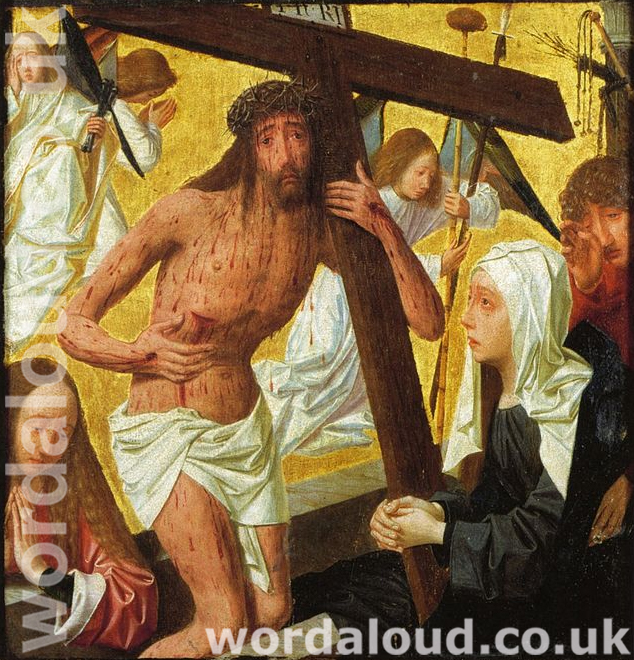
Christian Art | Life Of Jesus | Via Dolorosa | Jesus Carries His Cross
Office Of Readings | Week 21, Saturday, Ordinary Time | A Reading From The Homilies Of Saint John Chrysostom | Do Not Adorn The Church And Ignore Your Afflicted Brother
‘Do not adorn the church and ignore your afflicted brother.’
Saint John Chrysostom, preaching in the late fourth century, sets out a contrast between external honour given to Christ in the liturgy and the practical demands of charity. His central argument is that Christ’s body is not only present in the Eucharist but also in the poor, the hungry, the imprisoned, and the stranger. To neglect the afflicted while adorning the sanctuary is to dishonour Christ himself.
The homily turns on two scriptural references. First, the words of institution at the Last Supper: ‘This is my body.’ (Matthew 26:26) Chrysostom affirms that these words make the bread the body of Christ. Second, the judgement scene in Matthew 25:31–46, where Christ identifies himself with ‘the least of these’. By holding these two passages together, Chrysostom insists that reverence at the altar must be inseparable from acts of mercy.
Peter’s refusal to allow Jesus to wash his feet (John 13:6–9) serves as an example of misguided honour. What Peter thought was respect turned out to be disobedience, since true honour lies in accepting what Christ commands. By analogy, decorating the church with gold while neglecting the poor is misplaced devotion.
Chrysostom does not forbid gifts for the beautification of churches. He acknowledges their value, but he establishes a priority: almsgiving must come before ornamentation. He distinguishes between the two forms of giving: donations for church adornment benefit only the giver, whereas alms benefit both giver and recipient. Charity transforms social relations and imitates God’s generosity.
The homily employs vivid rhetorical contrasts: golden cups versus a hungry Christ, cloths of gold versus Christ in rags, silver lamps versus Christ in prison. These images emphasise the incongruity of splendid liturgy alongside social neglect. Chrysostom’s appeal is both theological and practical: the poor are themselves the temple of Christ, more precious than stone buildings or gold decoration.
The conclusion warns of eschatological consequences. While no one is judged for failing to decorate a sanctuary, judgement falls on those who neglect their neighbour. Thus, honouring Christ requires aligning worship with justice and mercy, integrating devotion with ethical responsibility.

A Reading From The Homilies Of Saint John Chrysostom | Do Not Adorn The Church And Ignore Your Afflicted Brother
Do you want to honour Christ’s body? Then do not scorn him in his nakedness, nor honour him here in the church with silken garments while neglecting him outside where he is cold and naked. For he who said: This is my body, and made it so by his words, also said: You saw me hungry and did not feed me, and inasmuch as you did not do it for one of these, the least of my brothers, you did not do it for me. What we do here in the church requires a pure heart, not special garments; what we do outside requires great dedication.
Let us learn, therefore, to be men of wisdom and to honour Christ as he desires. For a person being honoured finds greatest pleasure in the honour he desires, not in the honour we think best. Peter thought he was honouring Christ when he refused to let him wash his feet; but what Peter wanted was not truly an honour, quite the opposite! Give him the honour prescribed in his law by giving your riches to the poor. For God does not want golden vessels but golden hearts.
Now, in saying this I am not forbidding you to make such gifts; I am only demanding that along with such gifts and before them you give alms. He accepts the former, but he is much more pleased with the latter. In the former, only the giver profits; in the latter, the recipient does too. A gift to the church may be taken as a form of ostentation, but an alms is pure kindness. Of what use is it to weigh down Christ’s table with golden cups, when he himself is dying of hunger? First, fill him when he is hungry; then use the means you have left to adorn his table. Will you have a golden cup made but not give a cup of water? What is the use of providing the table with cloths woven of gold thread, and not providing Christ himself with the clothes he needs? What profit is there in that? Tell me: If you were to see him lacking the necessary food but were to leave him in that state and merely surround his table with gold would he be grateful to you or rather would he not be angry? What if you were to see him clad in worn-out rags and stiff from the cold, and were to forget about clothing him and instead were to set up golden columns for him, saying that you were doing it in his honour? Would he not think he was being mocked and greatly insulted?
Apply this also to Christ when he comes along the roads as a pilgrim, looking for shelter. You do not take him in as your guest, but you decorate floor and walls and the capitals of the pillars. You provide silver chains for the lamps, but you cannot bear even to look at him as he lies chained in prison. Once again, I am not forbidding you to supply these adornments; I am urging you to provide these other things as well, and indeed to provide them first. No one has ever been accused for not providing ornaments, but for those who neglect their neighbour a hell awaits with an inextinguishable fire and torment in the company of the demons. Do not, therefore, adorn the church and ignore your afflicted brother, for he is the most precious temple of all.
Christian Prayer With Jesus Christ
Lord Jesus Christ,
you come to us in the poor, the hungry, and the stranger.
Teach us to recognise your presence
and to honour you in works of mercy.
Make our worship true by uniting it with compassion,
so that our offerings at the altar
are joined with care for those in need.
You live and reign with the Father and the Holy Spirit,
one God, for ever and ever. Amen.
Glossary Of Christian Terms
John Chrysostom (c. 349–407) – Archbishop of Constantinople, renowned preacher, and Father of the Church. His homilies are marked by vivid imagery and moral exhortation.
Homily on Matthew – A series of sermons interpreting the Gospel of Matthew, delivered by Chrysostom in Antioch.
‘This is my body’ (Matthew 26:26) – Words of institution spoken by Christ at the Last Supper, central to Eucharistic theology.
Matthew 25:31–46 – The parable of the Last Judgement, where Christ identifies himself with those in need: the hungry, the thirsty, the stranger, the sick, and the imprisoned.
Golden vessels / golden hearts – A rhetorical contrast used by Chrysostom to show that inner purity and acts of mercy are more important than external adornment.
Alms (almsgiving) – The giving of money, food, or goods to those in need, regarded as a work of mercy and central to Christian discipleship.
Eschatological judgement – The final judgement at the end of time, when all people will give account of their actions, as described in Matthew 25.
Temple of Christ – A theological image emphasising that the human person, especially the poor and afflicted, is the true dwelling place of Christ.



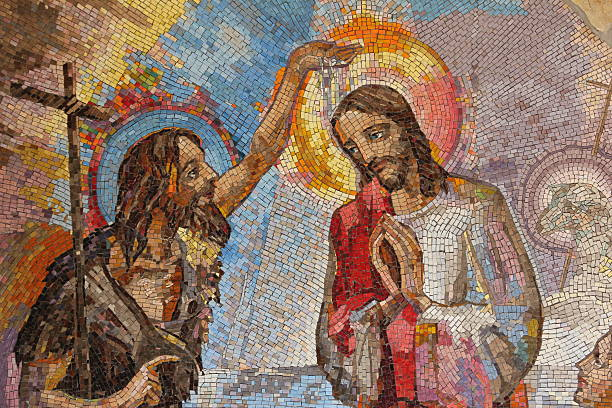
In today’s verses, Jesus pays tribute to John the Baptist, telling the crowds that John the Baptist, until the dawn of the New Testament, the arrival of the Kingdom of God, was the greatest of people. John the Baptist was a courageous, inspirational figure and had the honour of proclaiming Christ’s presence, then he looked on satisfied as his disciples went from him to follow Christ: ‘He must increase, but I must decrease.’

In this reading, taken from De Oratione, Tertullian reflects on the nature and power of Christian prayer. He emphasizes that prayer is the true spiritual sacrifice that has replaced the physical sacrifices of the Old Covenant. This reflects a fundamental theological shift in Christianity: whereas the Old Testament sacrificial system required offerings of animals and grain, the New Covenant calls for an interior offering—prayer made in spirit and truth. Tertullian draws from the Gospel of John (4:23–24), where Christ teaches that true worshippers will worship the Father in spirit and truth because God himself is spirit. In doing so, Tertullian situates prayer at the heart of Christian worship, making it an act of devotion that supersedes the old rites [ … ]
Psalm 85, attributed to the sons of Korah, explores themes of restoration, divine favour, and the intricate relationship between God and His people. The psalm emerges from a specific historical context, likely a period of return from captivity, where the gracious hand of God had already been evident in bringing back the exiles of Jacob [ … ]
