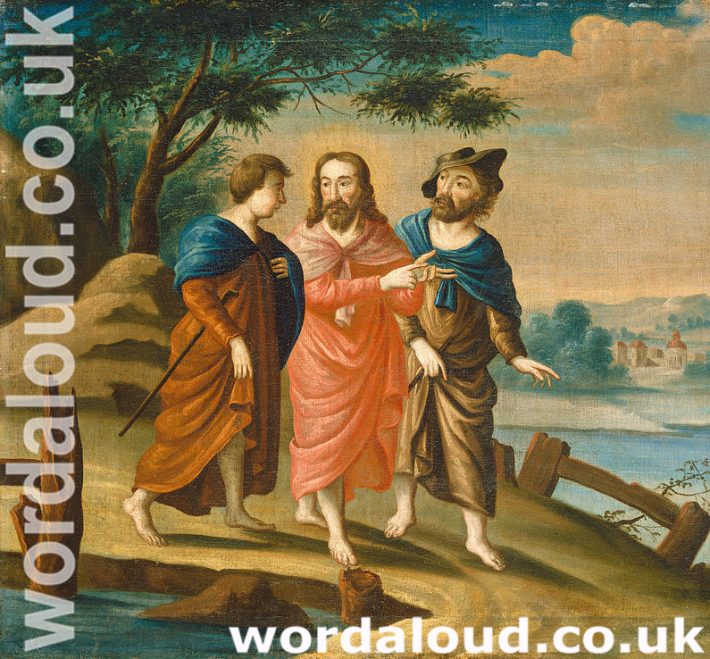
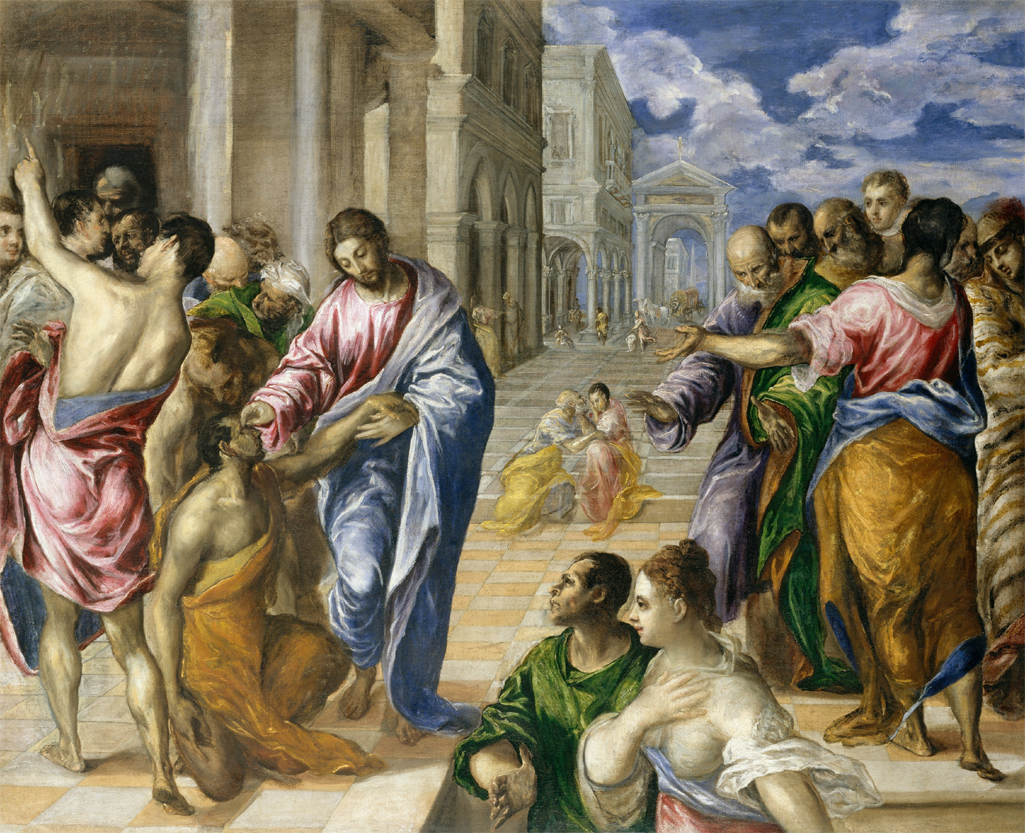
Christian Art | Jesus Walks With His Disciples | The Road To Emmaus
Office Of Readings | Week 4, Saturday, Ordinary Time | A Reading From The Pastoral Constitution On The Church In The Modern World Of The Second Vatican Council | The Regulation Of Human Activity
‘The regulation of human activity.’
This reading from the Pastoral Constitution on the Church in the Modern World reflects on human activity, especially work and social engagement, and places it within a clear theological framework. The Council seeks to affirm the value of human action while clarifying its proper orientation and limits.
The reading begins by stressing that human activity has a formative effect on the person. Through work, people do not merely change the world around them; they also develop their own capacities and grow in understanding. This inner growth is presented as more valuable than external gain. Human dignity is measured primarily by what a person becomes, not by what a person acquires.
The Council then widens the perspective to include social action. Efforts to promote justice, fraternity, and humane social structures are given priority over technological advance. Technology is acknowledged as useful, but it is described as a means rather than a source of true progress. Without moral purpose and concern for the human good, technological development remains insufficient.
From this follows a criterion for evaluating human activity. The decisive question is whether such activity corresponds to God’s plan and serves the genuine good of humanity, enabling individuals and communities to fulfil their vocation fully. Human action is therefore judged not only by efficiency or success, but by its contribution to integral human development.
The reading addresses a concern common in modern society: the fear that religion might limit human freedom or the autonomy of science and social life. The Council makes an important distinction. It fully affirms the legitimate autonomy of created realities. Sciences, arts, and social structures have their own laws and methods, which must be respected and carefully studied. This autonomy is not opposed to faith but arises from the order of creation itself.
At the same time, the Council warns against a distorted understanding of autonomy. If autonomy is taken to mean independence from God, it becomes false and self-defeating. Created realities do not sustain themselves; their meaning and permanence depend on the Creator. To ignore this dependence is ultimately to undermine the very reality one seeks to affirm.
The reading concludes by acknowledging that misunderstandings of autonomy have sometimes arisen within the Christian community itself, leading to unnecessary conflict between faith and science. The Council calls for a more balanced vision, one in which faith and reason are seen as complementary, and human activity is carried out in responsible freedom, grounded in truth and open to God.

Office Of Readings | Week 4, Saturday, Ordinary Time | A Reading From The Pastoral Constitution On The Church In The Modern World Of The Second Vatican Council | The Regulation Of Human Activity
The activity of man, as it has its origin in man, has man also as its end. Man through his work not only introduces change into things and into society; he also perfects himself. He learns a great deal; he develops his powers; he advances above and beyond himself. This kind of gain, properly understood, is more valuable than any external possessions. Man’s worth is greater because of what he is than because of what he has.
In the same way, all that men do to secure greater justice, more widespread brotherhood and a more humane structure of social relationships has more value than advance in technology. Technological development may provide the raw material for human progress, but of itself it is totally unable to bring it into being.
The criterion, therefore, for assessing man’s activity is this: does it, in accordance with God’s plan, fit in with the true good of the human race and allow man, individually and corporately, to develop and fulfill his vocation in its entirety?
Many of our contemporaries, however, seem to be afraid that a closer relationship between religion and man’s activity will injure the autonomy of men or societies or the different sciences. If by the autonomy of earthly realities we mean that created things and even societies have their own distinctive laws and values, which must be gradually identified, used and regulated by men, this kind of autonomy is rightly demanded. Not only is it insisted on by modern man, it is also in harmony with the design of the Creator. By the very fact of creation everything is provided with its own stability, its own truth and goodness, its own laws and orderly functioning. Man must respect these, acknowledging the methods proper to each science or art.
One should therefore deplore certain attitudes of mind which are sometimes found even among Christians because of a failure to recognize the legitimate autonomy of science. These mental attitudes have given rise to conflict and controversy and led many to assume that faith and science are mutually opposed.
If, on the other hand, the autonomy of the temporal order is understood to mean that created things do not depend on God, and that man may use them without reference to the Creator, all who believe in God will realize how false is this teaching. For creation without the Creator fades into nothingness.
Christian Prayer With Jesus Christ
God of wisdom and truth,
you have entrusted the world to human hands
and called us to shape it with care and responsibility.
Guide our work and our decisions,
that they may serve the true good of all people.
Teach us to value justice, solidarity, and dignity
above mere success or possession.
Grant us respect for the order of your creation
and humility in the use of our knowledge and skill.
Keep us from forgetting you
as we explore and develop the world you have made.
May all our activity lead us closer to you
and help us to fulfil our vocation
as your children and stewards of creation.
Through Christ our Lord.
Amen
Glossary Of Christian Terms
Human activity | Work and action carried out by individuals and societies
Vocation | God’s call to a full and meaningful human life
Human dignity | The worth of the person based on what one is, not what one has
Justice | Right ordering of relationships within society
Brotherhood | Solidarity and mutual responsibility among people
Technological development | Advances in tools and techniques
Autonomy of earthly realities | The proper independence and laws of created things
Created order | The structure and coherence given to creation by God
Science and art | Disciplines with their own methods and principles
Temporal order | Earthly and historical reality
Creator | God as the source of all that exists
Faith and reason | Two complementary ways of seeking truth


As Jesus died on the cross he would have looked like a leper. He had been scourged. Front and back, his skin would have been a bloody mess of welts, cuts and bruises. Being himself without sin, he died in the image of some of those most abject whom he came to save. Truly the self-sacrifice of our Lord was complete and extreme [ … ]
The psalmist stands amidst challenges. He seeks a source of strength and refuge. He shares an account of encountering God amidst life’s adversities. From the outset, he establishes a bond with the divine rooted in trust, an anchor that steadies him in life’s tempests. Through imagery as sturdy as a rock and as secure as a fortress, God is portrayed as a source of strength [ … ]
The parable of the two sons is clearly, and explicitly, an attack by Jesus upon the chief priests and the elders of the Jewish people. In the parable, Jesus places before the Jewish authorities an astonishingly blunt analogy of their rejection of God the Father and of Jesus. There is no room for quibbling or intellectual sophistry here: one son does what his father wants; the other says he will and then doesn’t [ … ]