Christian Art | Abraham And Isaac | Sacrifice | Love Revealed By God
Office Of Readings | Week 5, Tuesday, Ordinary Time | A Reading From Origen’s Homilies On Genesis | The Sacrifice Of Abraham
‘The sacrifice of Abraham.’
In this homily on Genesis, Origen offers a close and symbolic reading of the sacrifice of Abraham, interpreting it as a figure that points forward to Christ. Origen’s method is not to deny the historical reality of the event, but to read it as part of a larger pattern within God’s saving plan.
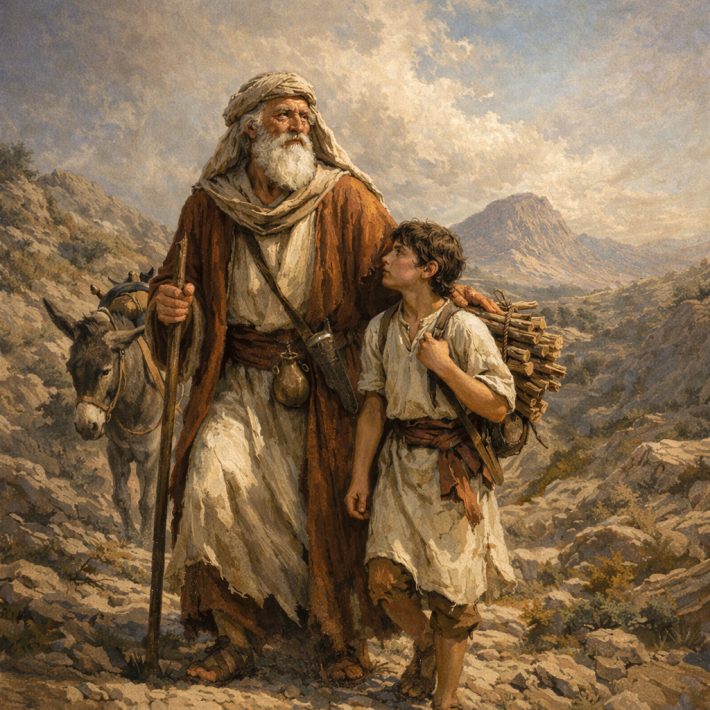
Origen begins with the detail that Isaac carries the wood for the burnt offering. This action is central to his interpretation. Isaac is not merely a passive victim but participates actively in what is to take place. By carrying the wood, he fulfils a priestly role, since the preparation of the offering belongs to the priest. This allows Origen to describe Isaac as both priest and victim. The phrase ‘together they went off’ reinforces this point: Isaac walks alongside Abraham, sharing in the action rather than following behind.
The dialogue between father and son becomes the emotional and spiritual centre of the account. Isaac’s question about the missing sacrifice is described as a moment of temptation for Abraham, testing not his obedience but his inner resolve. Abraham’s reply is measured and deliberate. He does not speak of what is present but of what God will do. For Origen, this forward-looking answer shows that Abraham speaks prophetically. His words find their fulfilment not in the ram alone, but ultimately in Christ, whom God provides as the true offering.
The intervention of the angel marks a turning point. Abraham’s willingness is acknowledged, but the sacrifice is halted. Origen then draws a deliberate comparison between Abraham and God. Abraham was ready to offer his mortal son, who was spared; God gave his immortal Son, who was not spared. The contrast is intended to underline the generosity of God, whose gift exceeds the faithfulness of Abraham.
Origen then addresses a difficulty: both Isaac and the ram are presented as figures of Christ, yet only the ram is slain. He resolves this by distinguishing between Christ according to the flesh and Christ according to the spirit. The ram represents Christ’s suffering and death in the flesh. Isaac, who is not killed, represents the Word of God, who remains incorruptible. In this way, Origen preserves both the reality of Christ’s death and the permanence of his divine life.
The reading from the homily concludes by returning to the theme introduced at the beginning. Christ is both priest and victim. According to the spirit, he offers the sacrifice to the Father; according to the flesh, he is the sacrifice offered on the cross. The narrative of Abraham and Isaac thus becomes, in Origen’s reading, a coherent and detailed prefiguration of the mystery of Christ.

A Reading From Origen’s Homilies On Genesis | The Sacrifice Of Abraham
Abraham took wood for the burnt offering and placed it upon Isaac his son, and he took fire and a sword in his hands, and together they went off. Isaac himself carries the wood for his own holocaust: this is a figure of Christ, for he bore the burden of the cross, and yet to carry the wood for the holocaust is really the duty of the priest. He is then both victim and priest. This is the meaning of the expression: together they went off. For when Abraham, who was to perform the sacrifice, carried the fire and the knife, Isaac did not walk behind him, but with him. In this way he showed that he exercised the priesthood equally with Abraham.
What happens after this? Isaac said to Abraham his father: Father. This plea from the son was at that instant the voice of temptation. For do you not think the voice of the son who was about to be sacrificed struck a responsive chord in the heart of the father? Although Abraham did not waver because of his faith, he responded with a voice full of affection and asked: What is it, my son? Isaac answered him: Here are the fire and the wood, but where is the sheep for the holocaust? And Abraham replied: God will provide for himself a sheep for the holocaust, my son.
The careful yet loving response of Abraham moves me greatly. I so not know what he saw in spirit, because he did not speak of the present but of the future: God will provide for himself a sheep. His reply concerns the future: yet his son inquires about the present. Indeed, the Lord himself provided a sheep for himself in Christ.
Abraham extended his hand to take the sword and slay his son, and the angel of the Lord called to him from heaven and said: Abraham, Abraham. And he responded: Here I am. And the angel said: Do not put your hand upon the boy or do anything to him, for now I know that you fear God. Compare these words to those of the Apostle when he speaks of God: He did not spare his own Son but gave him up for us and all. God emulates man with magnificent generosity. Abraham offered to God his mortal son who did not die, and God gave up his immortal Son who died for all of us.
And Abraham, looking about him, saw a ram caught by the horns in a bush. We said before that Isaac is a type of Christ. Yet this also seems true of the ram. To understand how both are figures of Christ – Isaac who was not slain and the ram who was – is well worth our inquiry.
Christ is the Word of God, but the Word became flesh, Christ therefore suffered and died, but in the flesh. In this respect, the ram is the type, just as John said: Behold the lamb of God, behold him who takes away the sins of the world. The Word, however, remained incorruptible. This is Christ according to the spirit, and Isaac is the type. Therefore, Christ himself is both victim and priest according to the spirit. For he offers the victim to the Father according to the spirit. For he offers the victim to the Father according to the flesh, and he is himself offered in the altar of the cross.
Christian Prayer With Jesus Christ
God of faithfulness and mercy,
you revealed your saving purpose
through the obedience of Abraham
and brought it to fulfilment in your Son.
Teach us to trust your providence
when the path before us is unclear.
Give us faith that looks beyond the present
and rests in what you will accomplish.
As Christ offered himself for our salvation,
may we learn to offer our lives to you
in obedience and trust.
Through the cross,
draw us into the life of your Son,
who is both priest and sacrifice.
Through Jesus Christ our Lord.
Amen
Glossary Of Christian Terms
Burnt offering | A sacrifice wholly offered to God
Holocaust | A complete offering consumed in sacrifice
Figure / type | A person or event that points forward to Christ
Priest | One who offers sacrifice to God
Victim | The offering presented in sacrifice
Wood | The material for sacrifice, seen here as a sign of the cross
Temptation | A testing of faith or resolve
Providence | God’s guiding care and foresight
Ram | The animal offered in place of Isaac
Word of God | Christ as the eternal Son of the Father
Flesh | Christ’s human nature
Spirit | Christ’s divine and incorruptible life
Prefiguration | An earlier sign that anticipates a later fulfilment




Technically accomplished, stylistically brilliant, Tomàs’s ‘Gospel’ is at once a tale of hope in the discovery of love in Jesus – of hope in redemption, forgiving, forgetting, and denial – and it is a journey through those troubled, complex regions of the disappearing centre of Catholic faith [ … ]

Psalm 131, attributed to David, begins with a declaration of humility: ‘Lord, my heart is not haughty, nor mine eyes lofty.’ Here, the psalmist asserts a conscious rejection of pride and arrogance, setting the tone for a meditation on humility and trust in God [ … ]
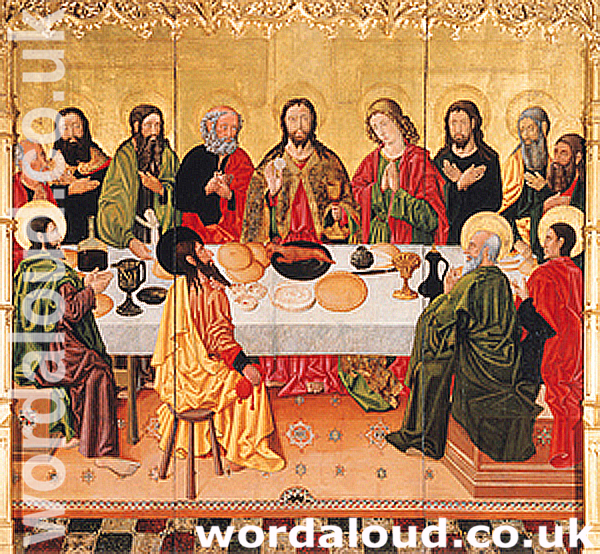
In his letter to the Corinthians, Pope Saint Clement I issues a passionate appeal for unity, humility, and fidelity within the Church. Writing towards the end of the first century, likely around 96 AD, Clement addresses a community torn by internal conflict, where certain members had unjustly deposed presbyters appointed through apostolic succession. His letter, widely considered the earliest Christian writing outside the New Testament, is both a plea and a theological meditation rooted in Scripture and the tradition of the apostles [ … ]