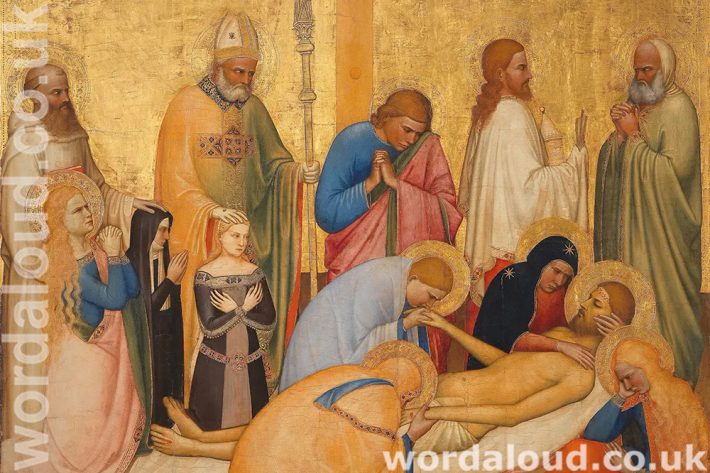
Christian Art | Lamentations Over The Body Of Jesus Christ Crucified
Office Of Readings | Week 28, Thursday, Ordinary Time | A Reading From The Homilies Of Saint Augustine On Saint John’s Gospel | Behold, I Shall Save My People
‘The light that illumines all men.’
Saint Augustine reflects on the words of Christ in John 6:44: ‘No one comes to me unless the Father draws him.’ He examines how divine grace and human freedom cooperate in faith. The verb ‘draws’ might suggest compulsion, but Augustine explains that this drawing occurs through love and desire, not force.
Augustine distinguishes between external compulsion and interior attraction. The Father draws the human person to Christ by awakening love for truth, goodness, and life — realities identified with Christ himself. This movement of desire is the will acting freely yet under the influence of grace. The soul approaches God not by constraint but by finding pleasure in what is true.
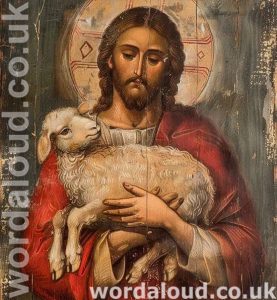
To illustrate, Augustine uses simple analogies. A sheep is drawn to fresh leaves; a child is drawn to nuts. Both act freely but are moved by attraction to what they love. In the same way, the soul is drawn by the vision of divine truth. When the Father reveals Christ, he sets before the soul the object of its deepest longing.
Augustine also interprets the language of hunger and thirst for justice in Matthew 5:6. Spiritual desire is the sign of grace already at work. Those who hunger and thirst now will be satisfied in the resurrection, when the truth they believe will become visible and complete. Thus, faith involves both present longing and future fulfilment.
For Augustine, this teaching unites divine initiative and human response. Grace kindles the desire that leads the will freely to God. The Father draws, the Son is the object of attraction, and the Spirit communicates the love that enables response. The process of salvation therefore consists not in coercion but in the transformation of desire.
A Reading From The Homilies Of Saint Augustine On Saint John’s Gospel | Behold, I Shall Save My People
No one comes to me unless the Father draws him. Do not think that you are drawn against your will; the will is drawn also by love. We must not be afraid of men who weigh words but are far from understanding what belongs above all to divine truth. They may find fault with this passage of Scripture and say to us: ‘How can I believe of my own free will if I am drawn to believe?’ I answer: ‘It is not enough that you are moved by the will, for you are drawn also by desire.’
What does this mean, to be drawn by desire? Take delight in the Lord, and he will give you the desires of your heart. The heart has its own desires; it takes delight, for example, in the bread from heaven. The poet could say: ‘Everyone is drawn by his own desire,’ not by necessity but by desire, not by compulsion but by pleasure. We can say then with greater force that one who finds pleasure in truth, in happiness, in justice, in everlasting life, is drawn to Christ, for Christ is all these things.
Are our bodily senses to have their desires, but not the will? If the will does not have its desires, how can Scripture say: The children of men will find their hope under the shadow of your wings, they will drink their fill from the plenty of your house, and you will give them drink from the running stream of your delights, for with you is the fountain of life, and in your light we shall see light.
Show me one who loves; he knows what I mean. Show me one who is full of longing, one who is hungry, one who is a pilgrim and suffering from thirst in the desert of this world, eager for the fountain in the homeland of eternity; show me someone like that, and he knows what I mean. But if I speak to someone without feeling, he does not understand what I am saying.
You have only to show a leafy branch to a sheep, and it is drawn to it. If you show nuts to a boy, he is drawn to them. He runs to them because he is drawn, drawn by love, drawn without any physical compulsion, drawn by a chain attached to his heart. ‘Everyone is drawn by his own desire.’ This is a true saying, and earthly delights and pleasures, set before those who love them, succeed in drawing them. If this is so, are we to say that Christ, revealed and set before us by the Father, does not draw us? What does the soul desire more than truth? Why then does the soul have hungry jaws, a spiritual palate as it were, sensitive enough to judge the truth, if not in order to eat and drink wisdom, justice, truth, eternal life?
Blessed are those who hunger and thirst for justice, that is, here on earth. They shall be satisfied, that is, in heaven. Christ says: I give each what he loves, I give each the object of his hope; he will see what he believed in, though without seeing it. What he now hungers for, he will eat; what he now thirsts for, he will drink to the full. When? At the resurrection of the dead, for I will raise him up on the last day.
Christian Prayer With Jesus
Father of truth,
you draw all people to your Son,
not by compulsion but through love of what is good.
Kindle in us the desire for wisdom and justice,
that our hearts may turn freely to Christ
and rest in the joy of his presence.
Grant that, hungering now for your kingdom,
we may be satisfied in the life to come,
through the same Jesus Christ our Lord.
Amen.
Glossary Of Christian Terms
Drawn by the Father – A phrase from John 6:44 expressing God’s initiative in leading people to faith through grace and love rather than compulsion.
Desire – The interior movement of the will towards what it perceives as good; for Augustine, true desire is directed towards God.
Grace – The divine gift that enables human beings to seek, believe in, and love God.
Hunger and Thirst for Justice – A biblical image for the longing of the soul for divine truth and righteousness, fulfilled in eternal life.
Freedom of the Will – The capacity to choose; in Augustine’s thought, perfected when directed towards the good by divine grace.
Resurrection of the Dead – The final fulfilment of salvation, when faith gives way to direct vision of God.


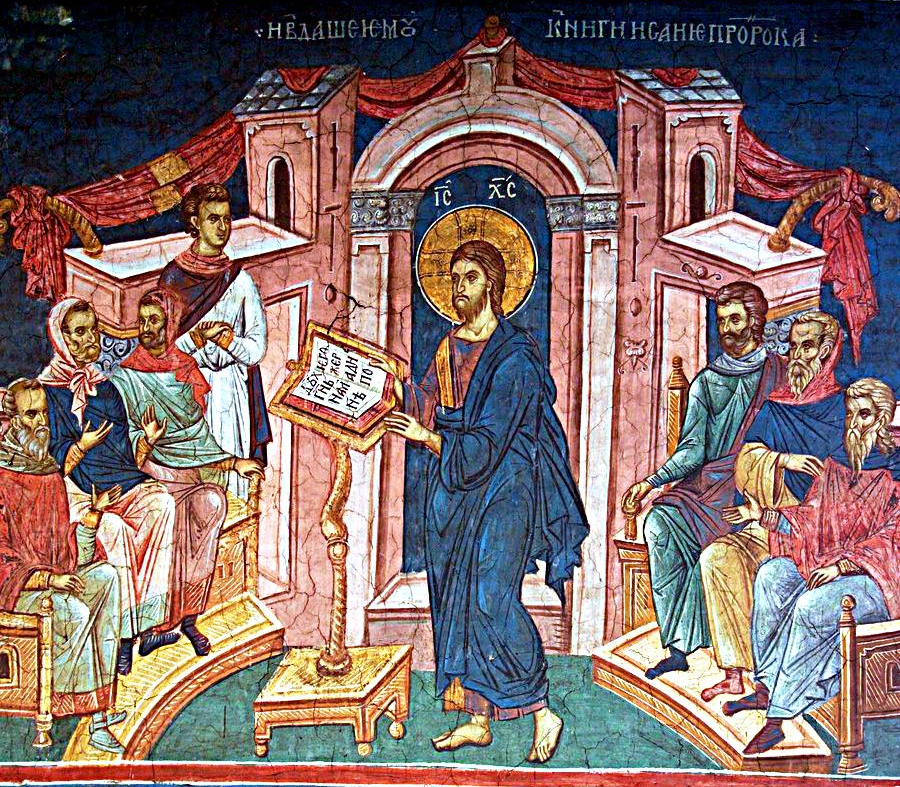
On the Sabbath, the day of rest and prayer, the Jews would gather in synagogues to recite the Shema and the eighteen blessings, which would be followed by readings from the Book of the Law, the Pentateuch, and from the Prophets. In today’s Gospel verses, Jesus has returned home to Nazareth, where, in the synagogue, he volunteers to read [ … ]

Jesus’ rebuke of the scribes and the Pharisees continues in today’s Gospel verses. Woe unto you – hypocrites. Jesus’ hard condemnation of the scribes and the Pharisees centres upon hypocrisy as upon clerical abuse. These two evils erode life together within the practice of the scribes and the Pharisees [ … ]
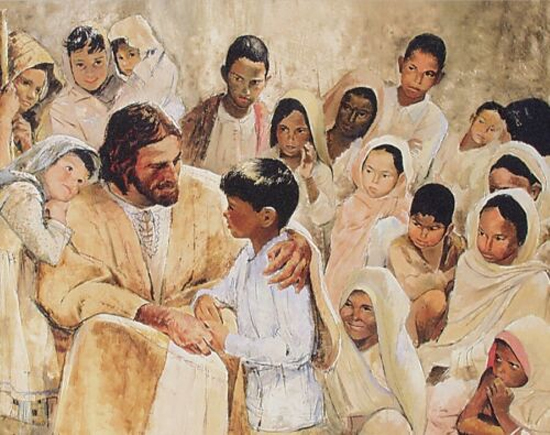
Today’s Gospel verses follow upon Jesus’ second announcement of his Passion, which the disciples do not understand and about which they are afraid to ask Jesus. This lack of understanding and fear, a certain kind of removal from Jesus, lead into an argument among the disciples about which of them was the greatest. We may sense in these verses some jockeying for position as the disciples think of themselves apart from Jesus, as, perhaps, that which is veiled is nonetheless dimly communicated, and as the hearts of the disciples are as yet far from perfect understanding of Jesus [ … ]