
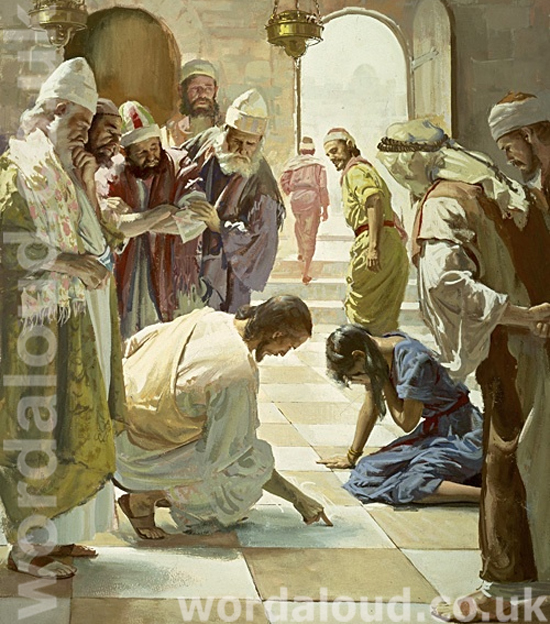
Christian Art | Jesus Forgives The Woman Taken In Adultery | Love Revealed By Jesus Christ
Office Of Readings | Week 4, Tuesday, Ordinary Time | A Reading From The Treatise Of Saint Irenaeus Against The Heresies | The First Fruits Of Resurrection In Christ
‘In Christ are the first-fruits of the Resurrection.’
In this reading from Against the Heresies, Saint Irenaeus sets out a compact and carefully reasoned account of the Incarnation and its saving purpose. His focus is on the unity between Christ and humanity, and on the resurrection as the fulfilment of that unity.
Irenaeus begins with the central claim that the Word of God became truly human in order to unite humanity to himself. Salvation is described not merely as forgiveness but as participation. Humanity could not overcome corruption and death by its own power; it required union with one who was himself free from corruption. This union, Irenaeus argues, could only take place if the Son of God truly became what we are. By assuming mortal and corruptible human nature, Christ made it possible for that nature to be transformed by his own immortality.
This transformation is described in terms of adoption. Through union with Christ, human beings receive sonship, sharing in the relationship that belongs properly to the Son. The Incarnation is therefore not incidental but necessary: without Christ’s real human birth from Mary, this exchange between mortality and immortality could not occur.
Irenaeus then turns to the biblical sign of Emmanuel, ‘God with us’. What humanity could not have imagined, God freely gave. Christ descends in order to seek what was lost, using the image of the shepherd retrieving his own sheep. Humanity belongs to Christ because it is his creation, and salvation is presented as a recovery rather than a replacement. Christ’s ascent into heaven completes this work: he brings the restored human race before the Father and entrusts it to him.
The resurrection is the decisive moment in this process. Christ is described as the first-fruits of the resurrection of humanity. His rising is not an isolated event but the beginning of a larger reality. Using the image of the body, Irenaeus explains that the whole human race, as members united to Christ the head, will share in the same destiny. Diversity is not abolished: each member has its proper place, and the many rooms of the Father’s house correspond to the many members of the body.
The reading concludes with a reflection on God’s patience. Human weakness and disobedience were not outside God’s foresight. Rather, they became the setting in which divine strength and kindness were revealed. The victory achieved through the Word shows that God’s power works not by force but through restoration, leading humanity from weakness into life.

A Reading From The Treatise Of Saint Irenaeus Against The Heresies | The First Fruits Of Resurrection In Christ
The Word of God became man, the Son of God became the Son of Man, in order to unite man with himself and make him, by adoption, a son of God. Only by being united to one who is himself immune could we be preserved from corruption and death, and how else could this union have been achieved if he had not first become what we are? How else could what is corruptible and mortal in us have been swallowed up in his incorruptibility and immortality, to enable us to receive adoptive sonship? Therefore, the Son of God, our Lord, the Word of the Father, is also the son of man; he became the son of man by a human birth from Mary, a member of the human race.
The Lord himself has given us a sign here below and in the heights of heaven, a sign that man did not ask for because he never dreamt that such a thing would be possible. A virgin was with a child and she bore a son who is called Emmanuel, which means ‘God with us.’ He came down to the earth here below in search of the sheep that was lost, the sheep that was in fact his own creature, and then ascended into the heights of heaven to offer to the Father and entrust to his care the human race that he had found again. The Lord himself became the first-fruits of the resurrection of mankind, and when its time of punishment for disobedience is over the rest of the body, to which the whole human race belongs, will rise from the grave as the head has done. By God’s aid it will grow and be strengthened in all its joints and ligaments, each member having its own proper place in the body. There are many rooms in the Father’s house because the body has many members.
God bore with man patiently when he fell because he foresaw the victory that would be his through the Word. Weakness allowed strength its full play, and so revealed God’s kindness and great power.
Christian Prayer With Jesus Christ
God of life and mercy,
you sent your Word to become one of us
so that we might share in your life.
We thank you for the mystery of the Incarnation,
in which our mortal nature
was taken up and healed in Christ.
Strengthen our hope in the resurrection,
begun in him and promised to us.
Unite us more deeply to your Son,
that we may live as children by adoption
and grow into the fullness of life you desire for us.
Give us patience in weakness
and trust in your transforming power.
Through Jesus Christ,
the first-fruits of the resurrection,
who lives and reigns for ever.
Amen
Glossary Of Christian Terms
Word of God | The Son of God, through whom all things were made
Incarnation | The Son of God becoming truly human
Adoptive sonship | Sharing in the relationship of the Son with the Father
Corruption | The tendency of human nature towards decay and death
Immortality | Life that is not subject to death
Emmanuel | A name meaning ‘God with us’
First-fruits | The first part of a harvest, guaranteeing what will follow
Resurrection | The rising of the body to new life
Head and body | An image for Christ and humanity united to him
Ascension | Christ’s return to the Father in glory
Human race | Humanity considered as one body
Patience of God | God’s forbearance and enduring mercy
Divine strength | God’s power at work in salvation




The Sabbath is rooted in God’s own example. After creating the heavens and the earth in six days, God rested on the seventh day and blessed it, setting it apart as a holy day (Genesis 2:2-3). This pattern of rest and blessing established the foundation for the observance of the Sabbath [ … ]
In the Bible, a miracle is an event that is not explicable by natural or scientific laws and is therefore attributed to a divine agency. Miracles are often seen as a sign of the intervention of God in the affairs of human beings. In the Old Testament, the most famous miracles are the Ten Plagues of Egypt, in which God punished the Pharaoh for refusing to release the Israelites from slavery, and the parting of the Red Sea, in which God allowed the Israelites to escape from the pursuing Egyptians by opening a path through the sea. In the New Testament, the miracles of Jesus are a central part of his ministry and are seen as evidence of his divinity. These include healings, such as the restoration of sight to the blind and the raising of the dead, and acts of nature, such as turning water into wine and walking on water. Is There A Theological Significance To Jesus’ Miracles? In the Christian tradition, the miracles performed by Jesus are seen as a manifestation of his divinity and as proof of his authority to teach and heal. Many of these miracles are described in the Gospels of the New Testament, which are the primary source of information about the life and teachings of Jesus. The purpose of the miracles, according to the Gospels, was to demonstrate Jesus’ power over natural forces and to show that he had the authority to forgive sins and offer salvation to those who believed in him. Why Did Jesus Ask To Keep His Miracles Secret? ‘Tell No One Of This.’ In the Gospels, there are a few instances where Jesus tells people not to tell others about what he has done for them. For example, in the Gospel of Matthew, after Jesus healed a man who was possessed by demons, he told the man, ‘See that you tell no one anything, but go, show yourself to the priest and offer the gift that Moses commanded, as a proof to them’ (Matthew 8:4). In this case, it seems that Jesus was concerned that the man’s testimony might not be believed or might be misunderstood, and so he asked him to keep the experience to himself for the time being. It is difficult to say for sure why Jesus might have asked someone to keep quiet about a miracle without knowing the specific context in which the request was made. However, some possible reasons that come to mind include: To avoid drawing unnecessary attention to himself. In the Gospels, Jesus often tries to avoid drawing too much attention to himself, especially from the authorities who are hostile to him. Asking someone to keep quiet about a miracle might be one way of avoiding unwanted attention and allowing Jesus to continue his ministry without interference. To allow the person who was healed to experience the transformation for themselves. In some cases, the person who was healed might have been skeptical or unsure of what had happened to them. Asking them to keep quiet about the miracle might have given them time to reflect on the experience and come to their own understanding of it without being influenced by others. To test the person’s faith. In some cases, Jesus might have asked someone to keep quiet about a miracle as a test of their faith. If they were truly grateful for what Jesus had done for them, they would be willing to follow his instructions and trust that he had a good reason for asking them to keep quiet. These are just a few possible reasons why Jesus might have asked someone to keep quiet about a miracle. It is important to remember that the Gospels are ancient texts and that we must be careful not to impose our own interpretations on them without considering the historical and cultural context in which they were written. To avoid creating conflict or division. In the Gospels, Jesus often encounters people who are skeptical or hostile to his teachings, and he sometimes tries to avoid confrontations with them. Asking someone to keep quiet about a miracle might be one way of avoiding a confrontation or a heated debate that could disrupt his ministry. To avoid being misunderstood or misrepresented. In some cases, the person who was healed might not have understood the full significance of what Jesus had done for them, and they might have tried to explain it in a way that distorted or misrepresented the truth. Asking them to keep quiet might have given Jesus time to explain things to them more fully and help them to understand the true meaning of the miracle. To avoid becoming a spectacle. In the Gospels, there are many instances where people are amazed by the miracles that Jesus performs, and they often try to make him into a kind of celebrity or showman. Asking someone to keep quiet about a miracle might have been one way of avoiding this kind of attention and keeping the focus on the message that Jesus was trying to convey. What Is The Significance Of Miracle Of The Wedding At Cana? In the Christian tradition, the wedding at Cana is significant because it is the first of the miracles performed by Jesus that is recorded in the Gospels of the New Testament. This event is described in the Gospel of John, where it is said that Jesus, along with his mother Mary and his disciples, attended a wedding in the town of Cana. At the wedding, the host ran out of wine, and Mary asked Jesus to help. In response, Jesus turned water into wine, which is seen as a miraculous act that demonstrated his power and authority. In the Gospel of John, after Mary asks Jesus to help with the wine at the wedding in Cana, he replies, “Woman, what does this have to do with me? My hour has not yet come” (John 2:4). This statement is often seen as indicating that Jesus was aware […]

In Jericho, we approach the end of Jesus’ journey. It was in Jericho that the long road of exodus of forty years in the desert ended. For Jesus and his fellow pilgrims, this is the last stage before the ascent to Jerusalem. Jesus’ mission on Earth is soon to be complete [ … ]