Loading...
Feature | Love Revealed By Jesus ChristJesus Prayer | Love Revealed By Jesus ChristMiracles Of Jesus | Healing Prayer With Christ

Prayer for Those Who Do Not Yet Know Jesus | Love Revealed By Jesus Christ | The Gospels | Audio Bible KJV

Prayer With Jesus | Christ The King | Christian Faith

Gospel Reading: John 12:46 (KJV)

‘I am come a light into the world, that whosoever believeth on me should not abide in darkness.’

Reflection on the Gospel

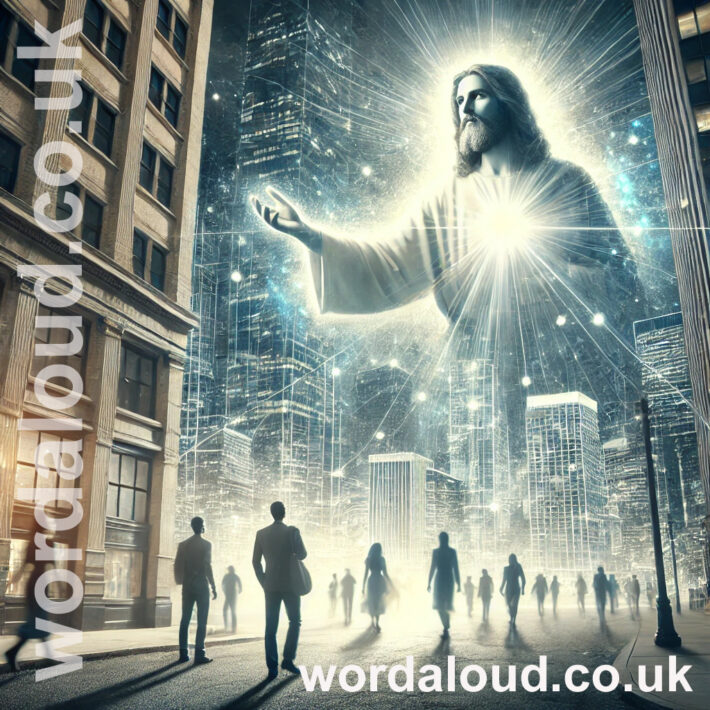
In this verse, Jesus speaks about being the light of the world. Jesus offers hope and guidance to all who believe in Jesus. This passage invites us to reflect on the mission of bringing the light of Jesus to those who are still in darkness, those who have not yet come to know Jesus personally.

Prayer With Jesus | John's Gospel | King James Audio Bible | KJV | Word Aloud

Prayer

Heavenly Father, I lift up to you all those who have not yet come to know Jesus. I pray that their hearts may be opened to the light of your love. Help them to see the truth of your Gospel and to experience the peace and joy that comes from a relationship with Jesus. Use me, Lord, as an instrument of your love and grace. Guide my words and actions so that they may reflect your light and draw others to you. Thank you for your boundless love and the gift of salvation through Jesus Christ. In Jesus’ name, I pray. Amen.

Personal Reflection

I think about people in my life who do not yet know Jesus. How can I show them the love and light of Christ? What steps can I take to be a witness to them? By living out my faith authentically and sharing the Gospel message, I can help others discover the hope and salvation found in Jesus.

Meditation on the Prayer and Gospel

Sharing the message of Jesus with those who do not yet know him is a vital part of our Christian mission. Jesus’ words in John 12:46 remind us that He came to be a light in the darkness. As followers of Jesus, we are called to reflect this light and guide others toward the truth.

As I meditate on this prayer, I remember the Great Commission given by Jesus: ‘Go ye therefore, and teach all nations.’ (Matthew 28:19) This command emphasizes the importance of spreading the Gospel and making disciples of all people. I am reminded that my actions and words can have a profound impact on those around me.

I think about individuals in my community who are searching for meaning and purpose. I visualize their faces and hold them in my thoughts. I imagine Jesus standing with me, encouraging me to share his love and truth. I feel a sense of responsibility and compassion as I commit to being a beacon of his light.

Sharing the Gospel is not only about preaching but also about living a life that exemplifies Christ’s love and grace. It involves listening, understanding, and building genuine relationships. As I practice these principles, I become a vessel of God’s grace, reflecting Jesus’ love to those around me.

Additional Prayer

Lord Jesus, thank you for being the light of the world. Help me to share your love and truth with those who do not yet know you. Grant me the courage to speak about my faith and the wisdom to do so with love and respect. Fill my heart with compassion and understanding, and let your light shine through me. Amen.

Closing Scripture Reading: Matthew 5:14-16 (KJV)

‘Ye are the light of the world. A city that is set on an hill cannot be hid. Neither do men light a candle, and put it under a bushel, but on a candlestick; and it giveth light unto all that are in the house. Let your light so shine before men, that they may see your good works, and glorify your Father which is in heaven.’

Our Blessing

May the light of Christ fill our hearts and guide our steps. May Jesus’ grace empower us to share Christian love with those who do not yet know Jesus. Let us go forth in Jesus’ love, extending hope and compassion to all we meet. Amen.

Meditations On The Love Of Jesus Christ | Bible Verses | Reflections On The Gospel | Prayer With Jesus
  • Parousia | Second Coming Of Jesus Christ | Apocalypse / Revelation

    Christian Art | Parousia | Second Coming | Lamb Of God, You Take Away The Sins Of The World Luke 17: 26-37 (Audio Bible KJV, Spoken Word) Early Christian thought about the Parousia – the second coming – was largely influenced by the teachings of Jesus and the writings of Saint Paul. In the early Christian community, expectation of Christ’s return was strong, and many Christians believed that it would happen in their lifetime. This belief is evident in the New Testament, where the authors express a sense of urgency in their writings and encourage their readers to be prepared for Christ’s imminent return. As Christianity spread throughout the Roman Empire, the idea of the Parousia became more complex and nuanced. Theological debates arose around the nature of Christ’s return and the events that would precede it. Some theologians, such as Origen and Augustine, saw the Parousia as a spiritual event that was already happening in the Church. Others, such as the Montanists and the millenarians, believed in a literal, physical return of Christ and the establishment of a new, earthly Kingdom. In the Middle Ages, the Parousia was often associated with apocalypticism and the idea of a final, cataclysmic battle between good and evil – the last battle. The idea of the Antichrist, who would precede Christ’s return, became a popular theme in Christian literature, and the book of Revelation (Apocalypse – meaning to reveal, to uncover) was interpreted as a prophetic guide to the end of the world. Biblical Basis For The Parousia | The Second Coming The concept of the Parousia, or the Second Coming of Jesus Christ, is central to Christian eschatology and is supported by numerous biblical passages in both the Old and New Testaments. In the Old Testament, there are numerous passages that refer to the coming of a Messiah who will restore Israel and bring about the final judgment. For example, in Daniel 7:13-14, it is written: ‘I saw in the night visions, and, behold, one like the Son of man came with the clouds of heaven, and came to the Ancient of days, and they brought him near before him. And there was given him dominion, and glory, and a kingdom, that all people, nations, and languages, should serve him: his dominion is an everlasting dominion, which shall not pass away, and his kingdom that which shall not be destroyed.’ This passage describes a divine figure who comes in the clouds and is given dominion over all nations. In the New Testament, the Parousia is described in greater detail, particularly in the teachings of Jesus and the writings of Saint Paul. Jesus speaks of his return in many passages, including Matthew 24:30-31, where Jesus says: ‘And then shall appear the sign of the Son of man in heaven: and then shall all the tribes of the earth mourn, and they shall see the Son of man coming in the clouds of heaven with power and great glory. And he shall send his angels with a great sound of a trumpet, and they shall gather together his elect from the four winds, from one end of heaven to the other.’ Here, Jesus describes his return in power and glory, accompanied by angels who gather Jesus’ elect from all over the world. In Saint Paul’s letters, the Parousia is also described in detail. In 1 Thessalonians 4:16-17, Saint Paul writes: ‘For the Lord himself shall descend from heaven with a shout, with the voice of the archangel, and with the trump of God: and the dead in Christ shall rise first: Then we which are alive and remain shall be caught up together with them in the clouds, to meet the Lord in the air: and so shall we ever be with the Lord.’ This passage describes a resurrection of the dead and the gathering of believers to meet the Lord Jesus in the air. The language and imagery used to describe the Parousia are often dramatic and apocalyptic in nature. The Parousia is often described as a time of judgment, when the righteous will be separated from the wicked, and God’s justice will be fully revealed. The imagery of clouds, trumpets, and angels is used to depict the power and glory of Christ’s return. Theological Interpretations Of The Parousia | Jesus’ Second Coming The concept of the Parousia has been interpreted in a variety of ways throughout Christian history. Dispensationalism Dispensationalism is a theological framework that emerged in the 19th  Century and has since become popular among some evangelical and fundamentalist Christians. Dispensationalists believe that history is divided into distinct periods or ‘dispensations’, each of which is marked by a particular mode of divine revelation and a specific plan of salvation. According to dispensationalist theology, the Parousia will be preceded by a period of tribulation, during which the Antichrist will establish a one-world government and the Jews will be restored to their homeland. The Parousia itself will involve a physical, visible return of Christ, who will establish a thousand-year reign on earth before the final judgment. Preterism Preterism is a theological interpretation of the Parousia that holds that many of the prophecies in the New Testament, particularly those in the book of Revelation, were fulfilled in the first century AD. According to this view, the Parousia occurred in a spiritual sense when Christ ascended to heaven and sent the Holy Spirit to empower the Church. Preterists argue that the tribulation and other end-time events predicted in the New Testament were fulfilled in the destruction of the Temple in Jerusalem in AD 70. Postmillennialism Postmillennialism is a theological view that holds that the Parousia will occur after a period of history in which the Church will gradually bring about the kingdom of God on earth. According to this view, the Church will spread the gospel throughout the world, and social, political, and economic conditions will gradually improve. Eventually, Christ will return to a world that has been largely transformed by the Gospel. Amillennialism […]

  • Ash Wednesday | T.S. Eliot | Christian Poetry | Faith In Jesus Christ | Transformation | Healing | Redemption | Audio | Word Aloud

     YouTube: Ash Wednesday | T.S. Eliot | Audio Christian Poetry | Word Aloud Ash Wednesday, one of T.S. Eliot’s most profound and enigmatic poems, marks a significant transition in his life and work. Written in 1930, it is the first long poem Eliot composed after his conversion to Anglicanism in 1927. The poem, often considered one of Eliot’s masterpieces, delves into themes of faith, redemption, and spiritual struggle. It reflects the poet’s personal journey towards spiritual enlightenment and serves as a testament to his newfound religious beliefs. A reading of Ash Wednesday is an exploration of the poem’s religious, literary, and personal contexts, as of the poem’s complex structure and themes. Religious Context And Symbolism Ash Wednesday is deeply embedded in Christian symbolism and tradition. The title refers to the first day of Lent in the Christian liturgical calendar, a day marked by penance, fasting, and prayer. Ash Wednesday is a time for reflection on mortality and repentance, themes that are intricately woven throughout the poem. Eliot’s conversion to Anglicanism profoundly influenced his writing; ‘Ash Wednesday’ is an expression of spiritual awakening and quest for redemption. The poem is replete with religious imagery and references, drawing on Christian doctrine and scripture. The use of liturgical language, biblical allusions, and references to saints and spiritual figures creates a tapestry of faith that invites readers to contemplate deep spiritual truths with which Eliot is grappling. The repetitive and prayer-like quality of the verses echoes meditative practices of the faithful, in part enabling the contemplative nature of the poem. Literary Influences And Techniques T.S. Eliot was a master of literary allusion and technique, and Ash Wednesday expresses Eliot’s ability to blend various influences into a cohesive whole. The poem reflects the influence of Dante, particularly The Divine Comedy, which Eliot admired for its exploration of spiritual ascent and redemption. Dante’s journey through Hell, Purgatory and Heaven parallels Eliot’s own spiritual journey, and the structure of Ash Wednesday can be seen as a reflection of this pilgrimage. Eliot’s use of fragmented narrative, a hallmark of his earlier work such as The Waste Land, is also present in Ash Wednesday. However, in this poem, the fragmentation serves a different purpose. Instead of depicting the disintegration of modern society, it mirrors the fragmented and often painful process of spiritual rebirth. The disjointed structure reflects the internal struggle of the speaker, who is torn between the pull of worldly desires and the aspiration for divine grace. The poem’s language is rich and varied, combining the lyrical and the obscure, the personal and the universal. Eliot employs a range of poetic forms and devices, including free verse, rhyme and meter, to convey the tumultuous journey of faith. The shifting tone and style reflect the complexities and contradictions inherent in the spiritual quest, capturing moments of doubt, despair, hope, and transcendence. Personal Significance Ash Wednesday is a deeply personal work. Eliot’s conversion to Anglicanism marked a profound shift in his life, providing a sense of purpose and direction that had been missing. The poem can be read as a reflection of Eliot’s own struggles with faith and his efforts to reconcile his intellectual skepticism with his desire for spiritual certainty. Eliot’s personal experiences, including his troubled marriage and professional pressures, also inform the poem. Themes of renunciation and acceptance, sin and redemption, are not merely abstract concepts but lived realities for the poet. This personal dimension adds a layer of intimacy and urgency to the poem, which thereby resonates with readers who have faced their own spiritual crises. Thematic Exploration At its core, Ash Wednesday is a meditation on the possibility of spiritual renewal in a world that often seems devoid of meaning. The poem grapples with the tension between faith and doubt, reflecting the existential struggles of modernity. The poem acknowledges the difficulties of maintaining belief in an age of skepticism but ultimately affirms the possibility of redemption and grace. The central theme of renunciation is explored through imagery of ascension and purification. The speaker’s journey is marked by a series of renunciations, symbolizing the shedding of earthly attachments in pursuit of spiritual truth. This process is neither straightforward nor easy; it involves moments of intense struggle and introspection. Yet, through this arduous journey, the speaker moves closer to a state of spiritual clarity and acceptance. Ash Wednesday | T. S. Eliot Because I do not hope to turn again Because I do not hope Because I do not hope to turn Desiring this man’s gift and that man’s scope I no longer strive to strive towards such things (Why should the agèd eagle stretch its wings?) Why should I mourn The vanished power of the usual reign? Because I do not hope to know The infirm glory of the positive hour Because I do not think Because I know I shall not know The one veritable transitory power Because I cannot drink There, where trees flower, and springs flow, for there is nothing again Because I know that time is always time And place is always and only place And what is actual is actual only for one time And only for one place I rejoice that things are as they are and I renounce the blessèd face And renounce the voice Because I cannot hope to turn again Consequently I rejoice, having to construct something Upon which to rejoice And pray to God to have mercy upon us And pray that I may forget These matters that with myself I too much discuss Too much explain Because I do not hope to turn again Let these words answer For what is done, not to be done again May the judgement not be too heavy upon us Because these wings are no longer wings to fly But merely vans to beat the air The air which is now thoroughly small and dry Smaller and dryer than the will Teach us to care and not to care Teach us to sit still. Pray for us sinners now […]

  • George Herbert | The Temple | The Church | The Reprisall | Christian Poem | Audio

    The poem contemplates the poet’s relationship to Christ’s sacrifice, focusing on themes of inadequacy, grace, and surrender. It opens with the poet’s realization that human efforts cannot ‘deal with’ or match Christ’s ‘mighty passion’, which represents Christ’s intense suffering and ultimate sacrifice. The poet acknowledges that even if he were to die for Christ, he would still ‘lag behind’, as his own sins are deserving of condemnation. This indicates a sense of spiritual and moral inferiority, highlighting a gap between human and divine capacity for sacrifice and atonement [ … ]

Search Google Here | A Holy Land Jerusalem Pilgrimage? | A Safari? | An Escape..