Loading...
Poems With Jesus | Christian Faith In Poetry

The Sacrifice | George Herbert | Christian Poems | Audio | Word Aloud | Poems With Jesus

The Sacrifice | George Herbert | Christian Poems | Audio | Word Aloud

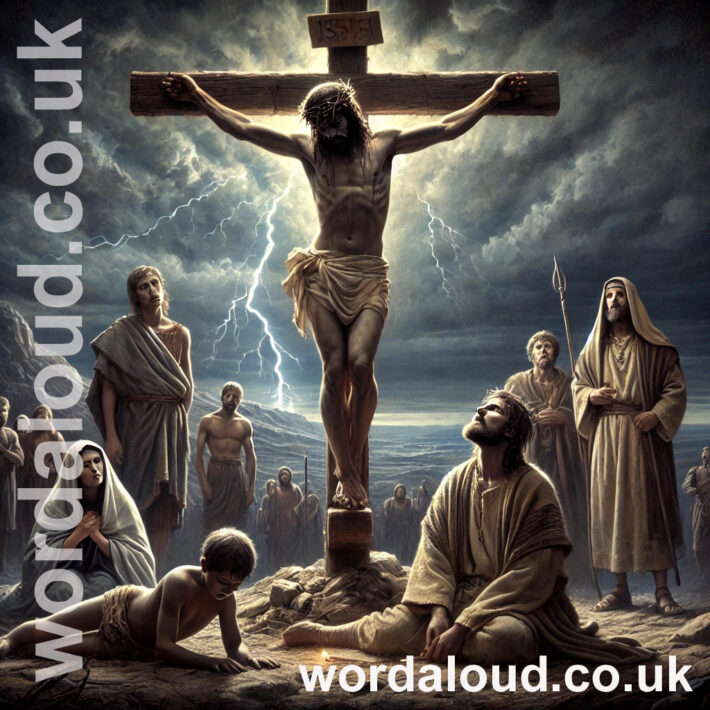
George Herbert: 1593-1633: poet and English priest. ‘The Sacrifice’, part of his collection ‘The Temple’, is a profound meditation on the Passion of Christ. The poem is distinctive for its focus on Christ’s voice and its refrain, ‘Was ever grief like mine?’ which underscores the unique nature of Christ’s suffering.

Herbert structures the poem as a dramatic monologue, with Christ narrating his journey to the Cross. The refrain not only highlights the unmatched sorrow of Christ’s ordeal but also serves as a rhetorical question that invites readers to contemplate such depth of Christ’s sacrifice. The refrain anchors each stanza and reinforces a theme of unparalleled grief.

The poem’s imagery and direct address create an intimate and immediate connection with the reader. Herbert vividly recounts scenes such as Judas’s betrayal, Peter’s denial, and the crowd’s condemnation. Each of these moments is depicted through Christ’s perspective, offering a detailed exploration of Christ’s emotional and spiritual anguish.

Herbert’s formal choices are deliberate and significant. The poem’s quatrains and regular rhyme-scheme mirror the relentless progression of Christ’s suffering. This structure reflects Herbert’s view of divine providence and order, even amidst the chaos and pain of the Passion. The disciplined form of the poem underscores the steadfast nature of Christ’s sacrifice and unwavering love it represents.

The voice of Christ in ‘The Sacrifice’ conveys a dual sense of resignation and questioning. Jesus recounts the events with calm acceptance, and yet a tension captures the mystery of the Passion: coexistence of divine foreknowledge and human pain. Christ’s voice serves as a bridge, connecting the divine to the human experience of suffering.

Themes of betrayal, injustice and sacrifice permeate the poem. Herbert does not present these acts merely as historical occurrences but as human behaviors with ongoing relevance. Judas’s kiss, Peter’s denial, and the crowd’s shouts resonate with readers, inviting us to reflect on our actions and their implications.
Jesus Is Lord | Psalms | King James Audio Bible

The Sacrifice | George Herbert | Christian Poems

Oh all ye, who pass by, whose eyes and mind To worldly things are sharp, but to me blind; To me, who took eyes that I might you find: Was ever grief like mine?

The Princes of my people make a head Against their Maker: they do wish me dead, Who cannot wish, except I give them bread: Was ever grief like mine?

Without me each one, who doth now me brave, Had to this day been an Egyptian slave. They use that power against me, which I gave: Was ever grief like mine?

Mine own Apostle, who the bag did bear, Though he had all I had, did not forbear To sell me also, and to put me there: Was ever grief like mine?

For thirty pence he did my death devise, Who at three hundred did the ointment prize, Not half so sweet as my sweet sacrifice: Was ever grief like mine?

Therefore my soul melts, and my heart’s dear treasure Drops blood (the only beads) my words to measure: Oh let this cup pass, or pass by this measure: Was ever grief like mine?


Meditations On The Love Of Jesus Christ | Word Aloud | Prayer And Reflection
  • The Virginity Of Mary And The Birth Of Christ | Hail Mary, Full Of Grace | Annunciation

    Sometimes, when I read my Bible, I pause in the reading and say to myself: ‘This bit’s real.’ It would be fair to say, I have issues with Mary, because, contrary to what we are taught to say, Mary isn’t my mother. Rather: Mum is. One bit of the Bible-text says this: And when his family heard it, they went out to seize him, for people were saying, “He is beside himself.” … And his mother and his brothers came; and standing outside they sent to him and called him. And a crowd was sitting about him; and they said to him, “Your mother and your brothers are outside, asking for you.” And he replied, “Who are my mother and my brothers?” And looking around on those who sat about him, he said, “Here are my mother and my brothers! Whoever does the will of God is my brother, and sister, and mother.” (Mark 3: 21; 31-35.) Here she comes. She is in considerable distress. I can imagine that. I can relate to that. To save her boy from whatever he’s got himself into this time. And you’re not telling me there isn’t something inside that. Her boy is beside himself. Radical. Radicalized. Radicalizing. A misunderstood word.  /ˈradɪk(ə)l/ adjective & noun. 1 Forming the root, basis, or foundation; original, primary. 2a Inherent in the nature of a thing or person; fundamental. b Of action, change, an idea: going to the root or origin; far-reaching, thorough. c Advocating thorough or far-reaching change. d Characterized by departure from tradition; progressive; unorthodox. ‘He has a demon! And he is mad!’ – thus ‘the Jews’. (e.g. John 10: 20.) Come home! It’s all she wants. His family want him back now. But it is an exclusive cult: there is an inside and there is an outside; and on the outside, they are not meant to understand, lest they be converted. He has defined himself as different from anything she was. Only at the end does Jesus say to his Mum – and with savage, bitter irony: ‘Woman, behold your son.’ And then he dies. Hail Mary, full of grace, the Lord is with thee. Blessed art thou among women and blessed is the fruit of thy womb Jesus. Holy Mary, Mother of God, pray for us sinners now and at the hour of our death.   We ask that we might find Mary in our hearts as a Yes! place for Jesus. It is also recommended that we pray to Jesus that we may be further in oneness with Mary. It is self-emptying, such that we only exist insofar as we are responsive to God’s Word. * Last term, and put-out to pasture, the old Archbishop Emeritus came over to stay for a few days and did the odd class with us. He spoke of Yes! as the meaning of Mary’s virginity. And we were not very nice about him. One or two took umbrage. One or two got the hump. In a sense, his Grace, the Arch, basically wanted to move anyone he’d ever known from a high-place – a mountain – received theological ‘truth’ – to an imminent, human plane. Earthing the spiritual. Recalibrating metrics of life’s believability toward a spiritual sense of things. He might have asked the impermissible question: what happened? His Grace described it. God’s love as a cloud. This descended upon Mary – and subsumed her. Within the cloud, Mary capitulated utterly. She became only and purely a response to God’s love. As he spoke, the Arch cradled her. He carried her in his lap – in his hands. His Grace was a consecrated bishop. He was faith. He sat squat, a rounded man, hands cupped and ankles crossed, fingers interlocked, with parted thighs. Rumpled, washed, speckled. A lifetime’s skin… There could be no doubt His Grace spoke through long-term personal relationship with Mary. It was Julian went for him: ‘So are you saying Mary was a Virgin? Or are you not saying Mary was a Virgin?’ Nasty. No, it wasn’t pretty. Julian twisting his silver ring. For a moment, what Julian had said to the Arch simply failed to communicate. No, for a moment, that dumped on the air meant nothing. Then His Grace said: ‘There is a range of possible meanings we may understand in the question of Mary’s virginity. For example, there are understandings of the word virginity entailed in the action of giving birth.’ Julian said: ‘Duh! So had she had sex or hadn’t she?’ Trigger words. No, it wasn’t pretty. On that went for a little while. At length, Julian’s point seemed reluctantly conceded. Then the Arch told us a new story, an additionally human event, the more to baffle us. Controversially, he told us that Mary could not have been Joseph’s first wife, for this would not have been the way of things in the society of that time. His belief was that Joseph must have taken Mary into his household through pity. That would be normal, he said, for Joseph to bring a young, vulnerable girl, who is about to have a baby, within his protection, not meaning to enjoy with her marital relations, but through kindness. ‘And this story of the inn and stable,’ the Archbishop said, ‘it can’t have been like that really. Joseph has travelled with Mary to stay with his family, at home in Bethlehem, and they don’t want Mary in their house, for reasons which I am sure we can understand. It must have been there was considerable resistance to Mary. But Mary gives birth, and who can resist a baby? That’s what happened. It must have been. ‘I’m convinced that must have been how it happened really.’ Later that term, toward the beginning of Advent, we met boys who had been here before, in Valladolid, and now were in regular seminary. They had heard and recited verbatim all the Archbishop had said to them. Their spot-on impressions of each of the fathers were scathing. […]

  • The Resurrection of the Dead and the Sadducees

    The Sadducees are explicitly held up for criticism in the Gospels less often than the Pharisees, even though they provided the elite which ran the Temple. This is partly because, with the destruction of the Jerusalem Temple in AD 70, the Sadducees were wiped out as a force in Jewish religious life and politics. The Judaism which survived, to regroup and forge a new identity, was that of the Pharisees. Consequently, when there were rivalries between Jews and Christians, it was the Pharisees with whom Christians would find themselves in conflict, and this would colour the memory of earlier times [ … ]

  • Prayer For The Dead | All Souls | Purgatory

    Saint Gregory Nazianzen reflects on the mystery of human existence and the continuity between life, death, and resurrection. His meditation joins theological insight with pastoral realism: to live as a creature of God is to occupy a space between mortality and immortality, frailty and glory [ … ]

Search Google Here | A Holy Land Jerusalem Pilgrimage? | A Safari? | An Escape..