
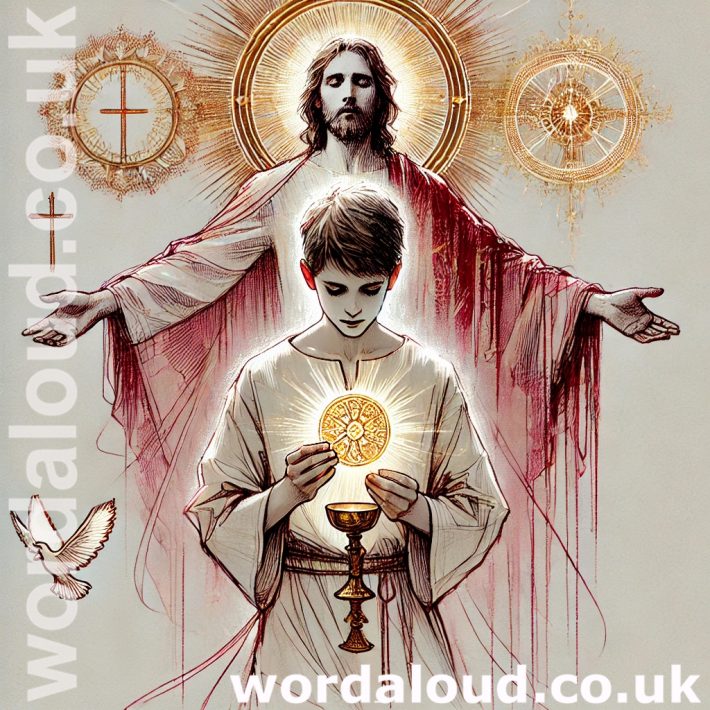
Christian Art | A Boy At Prayer With Jesus In The Eucharist | Jesus Christ The Risen Lord
Office Of Readings | Eastertide Week 5, Monday | A Reading From The Addresses Of Saint Gregory Of Nyssa | Jesus Christ Is The First-Born Of All Creation
‘Jesus is the first-born of all creation.’
Saint Gregory of Nyssa, a 4th-century Cappadocian Father and key architect of early Christian theology, offers in this Eastertide reading a profound and poetic meditation on the transformative power of the Resurrection. Rooted in the joy of Easter, the sermon explores the cosmic and personal implications of Christ’s rising from the dead. Gregory’s theology is deeply mystical, sacramental, and steeped in scriptural imagery, and this piece reveals the vast scope of the Christian vision of renewal.
The Reign Of Life And The End Of Tyranny
‘The reign of life has begun, the tyranny of death is ended.’
Gregory begins with a triumphant declaration: death, the great enemy of humankind, has been defeated. He envisions the Resurrection as a cosmic revolution—one that ends the reign of sin and death and ushers in a new kingdom where life reigns. This echoes Saint Paul’s affirmation in Romans 6:9: ‘Death no longer has dominion.’
Gregory’s language of ‘tyranny’ conveys death not merely as a natural event, but as a force of spiritual oppression—something that enslaves humanity. In contrast, the Resurrection is not only Christ’s victory but the dawn of a new divine order.
A New Birth, A New Creation
‘A new birth has taken place, a new life has come, a new order of existence has appeared…’
Here, Gregory introduces one of his most enduring theological themes: transformation. Humanity is not merely repaired or restored—it is reborn, re-created. Drawing on John 3:5 and 2 Corinthians 5:17 (‘If anyone is in Christ, he is a new creation’), he presents Easter not only as the commemoration of an event, but as the very beginning of a new creation.
This birth is not of flesh, but ‘by God’—through divine initiative. Gregory emphasizes that this rebirth happens not through human effort or lineage but by faith and baptism, reflecting the Johannine theology of spiritual regeneration.
Sacramental And Ecclesial Imagery
‘Faith is the womb… baptism the rebirth… the Church is its nurse… her teachings are its milk…’
Gregory beautifully maps the journey of the new Christian life using maternal and sacramental metaphors. Faith is where life begins; baptism is the moment of delivery into spiritual life. The Church, like a mother, nourishes this new life with doctrine and the Eucharist (the ‘bread from heaven’). This vision of the Church as both maternal and formative is central in patristic thought, tying closely with Paul’s teachings on the Church as the Body of Christ.
This reflects a holistic vision of salvation: the believer grows and matures spiritually in a living, nurturing ecclesial community, shaped by virtue, wisdom, and hope.
Creation Reimagined In Jesus Christ
‘This is the day the Lord has made… God makes a new heaven and a new earth.’
Gregory interprets Psalm 118:24 and Isaiah 65:17 in light of Easter. This ‘day’ is not like other days—it inaugurates a new cosmos, one infused with the presence and purpose of the Risen Christ. The ‘new heaven’ is our renewed faith; the ‘new earth’ is a receptive and fruitful human heart.
Gregory skilfully spiritualizes the Genesis creation narrative, overlaying it with Christian theology. Virtues become stars; wisdom becomes the sea; sound doctrine becomes plants. This allegorical approach was common among the early Fathers, especially Origen and Gregory himself. The point is clear: Easter is not merely a future hope—it transforms reality now, beginning with the inner life of the believer.
Christ The New Adam And True Man
‘On this day is created the true man, made in the image and likeness of God.’
Drawing on Genesis 1:26 and Pauline Christology (cf. 1 Corinthians 15:45–49), Gregory sees Easter as the creation of the ‘true man’—Jesus Christ, the New Adam, whose image we now bear. Where Adam introduced death, Christ introduces life. Through His Resurrection, Christ restores in us the original image of God, marred by sin but now renewed in glory.
This idea also feeds into Gregory’s doctrine of theosis—humanity’s participation in the divine life. In Christ, we are not only saved from sin but elevated to a new way of being.
The Destruction Of Death And The Firstborn Of The Dead
‘This day destroyed the pangs of death and brought to birth the firstborn of the dead.’
Here, Gregory explicitly names Christ as the ‘firstborn of the dead’ (cf. Colossians 1:18, Revelation 1:5). Christ’s resurrection is not an isolated event—it is the beginning of the general resurrection. The defeat of death is not metaphorical; it is real, permanent, and irreversible.
The Resurrection is both the validation of Christ’s divinity and the guarantee of our own future resurrection. It is the archetype and the first fruit of all who will rise in Him.
Ascension And Shared Sonship
‘I ascend to my Father and your Father, to my God and your God…’
Gregory concludes by reflecting on Christ’s words to Mary Magdalene in John 20:17. These words underscore the intimacy of our relationship with God, now made possible through Christ. Gregory marvels that the same one who took on our frail nature now leads it into the presence of the Father, bringing us with him.
This is more than poetic flourish—it expresses a central Christian mystery: Christ does not rise and ascend alone. As the God-Man, He elevates our humanity, making heaven our inheritance. The liturgical overtones here anticipate the Feast of the Ascension, drawing the Paschal mystery to its full expression.
A Reading From The Addresses Of Saint Gregory Of Nyssa | Jesus Christ Is The First-Born Of All Creation
The reign of life has begun, the tyranny of death is ended. A new birth has taken place, a new life has come, a new order of existence has appeared, our very nature has been transformed! This birth is not brought about by human generation, by the will of man, or by the desire of the flesh, but by God.
If you wonder how, I will explain in clear language. Faith is the womb that conceives this new life, baptism the rebirth by which it is brought forth into the light of day. The Church is its nurse; her teachings are its milk, the bread from heaven is its food. It is brought to maturity by the practice of virtue; it is wedded to wisdom; it gives birth to hope. Its home is the kingdom; its rich inheritance the joys of paradise; its end, not death, but the blessed and everlasting life prepared for those who are worthy.
This is the day the Lord has made – a day far different from those made when the world was first created and which are measured by the passage of time. This is the beginning of a new creation. On this day, as the prophet says, God makes a new heaven and a new earth. What is this new heaven? you may ask. It is the firmament of our faith in Christ. What is the new earth? A good heart, a heart like the earth, which drinks up the rain that falls on it and yields a rich harvest.
In this new creation, purity of life is the sun, the virtues are the stars, transparent goodness is the air, and the depths of the riches of wisdom and knowledge, the sea. Sound doctrine, the divine teachings are the grass and plants that feed God’s flock, the people whom he shepherds; the keeping of the commandments is the fruit borne by the trees.
On this day is created the true man, the man made in the image and likeness of God. For this day the Lord has made is the beginning of this new world. Of this day the prophet says that it is not like other days, nor is this night like other nights. But still we have not spoken of the greatest gift it has brought us. This day destroyed the pangs of death and brought to birth the firstborn of the dead.
I ascend to my Father and to your Father, to my God and to your God. O what wonderful good news! He who for our sake became like us in order to make us his brothers, now presents to his true Father his own humanity in order to draw all his kindred up after him.
Glossary Of Terms
Eastertide
The liturgical season of fifty days from Easter Sunday to Pentecost, celebrating the Resurrection of Jesus and the new life it brings.
Saint Gregory of Nyssa
A 4th-century Church Father and bishop, one of the Cappadocian Fathers, known for his theological depth and mysticism, especially regarding the Trinity, resurrection, and theosis.
Tyranny of death
A metaphorical phrase indicating the power that death (both physical and spiritual) held over humanity before Christ’s Resurrection.
New creation
A biblical and theological term (cf. 2 Corinthians 5:17) denoting the transformation of humanity and the world through the Resurrection of Christ. It refers to both a renewed spiritual life and the eventual renewal of all creation.
Faith as womb
A metaphor used by Gregory to express the idea that faith is the starting point or the ‘conceiving’ power of the Christian life—it initiates spiritual rebirth.
Baptism
The Christian sacrament of initiation, through which one is reborn in Christ and made a member of the Church. Gregory describes it as the moment of spiritual birth into the light of divine life.
Church as nurse
Gregory’s image of the Church as a nurturing mother who feeds and raises the newly born Christian with doctrine and the sacraments.
Bread from heaven
A term referring to the Eucharist, the body of Christ offered in Holy Communion, spiritually nourishing the faithful.
Virtue
Moral excellence or holiness. Gregory describes the Christian life as maturing through the exercise of virtue.
Wisdom
Often personified in Scripture, it represents divine understanding and is portrayed here as the ‘spouse’ of the mature Christian soul.
Hope
A theological virtue by which one desires and expects from God both eternal life and the means to attain it. Gregory describes it as the ‘offspring’ of the Christian life.
Kingdom / Paradise
Terms for the final destination of the saved—eternal communion with God in heaven.
Image and likeness of God
From Genesis 1:26, a phrase expressing the unique dignity of the human being. Gregory sees Easter as the restoration of this image, once marred by sin.
Firstborn of the dead
A Christological title (cf. Colossians 1:18) referring to Jesus as the first to rise permanently from the dead, opening the way for others to follow.
Ascension
The event of Christ rising into heaven, body and soul, forty days after his Resurrection. It is referenced here in Christ’s words: ‘I ascend to my Father and your Father.’
Theosis (deification)
A key concept in Eastern Christian theology (though not named directly here), referring to the process by which a person becomes more like God through grace and union with Christ.
Paschal Mystery
The Passion, Death, Resurrection, and Ascension of Jesus—through which salvation is accomplished. Gregory’s sermon is a meditation on its implications.
Sound doctrine
Theologically correct and spiritually nourishing teaching, viewed as vital ‘food’ for the soul.
Psalm 118:24 – ‘This is the day the Lord has made’
A verse often used liturgically during Easter to celebrate the Resurrection. Gregory interprets it spiritually as the day of new creation.
Isaiah 65:17 – ‘Behold, I create new heavens and a new earth’
A prophetic text fulfilled in the Resurrection, as read by Gregory, where spiritual renewal parallels a new cosmological order.



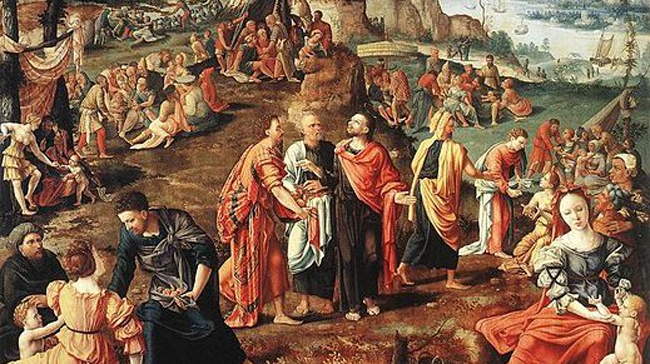
After the feeding of the five thousand, Jesus has gone into the hills alone to pray, while his disciples begin to cross over the Sea of Galilee ahead of him. Jesus has walked across the sea to join his disciples, who cannot comprehend what is happening and who Jesus truly is [ … ]
Saint Ambrose’s catechesis on baptism, drawn from his treatise On the Mysteries, offers a rich theological and scriptural reflection on the rite of Christian initiation, weaving together typology, sacramental theology, and pastoral instruction. Addressed to the newly baptized in fourth-century Milan, this passage exemplifies the mystagogical tradition — the Church’s practice of interpreting the mysteries of the sacraments only after the faithful had experienced them [ … ]

As adult children called to become like little children in the eyes of Jesus, we often face unique obstacles when it comes to asking for help. Pride and shame can hinder us, leading us to believe that seeking assistance is a sign of weakness. Society often expects us to embody resilience and self-control, making it difficult to acknowledge our vulnerability and admit that we need support [ … ]
