
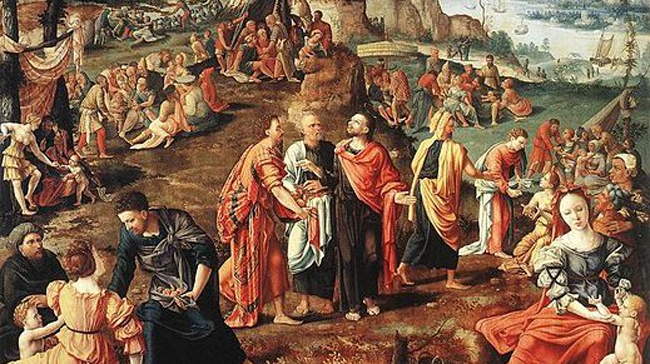
Christian Art | So Many People Flock To Jesus
Mark 6: 53-56 – Week 5 Ordinary Time, Monday (Audio Bible KJV, Spoken Word)
53 And when they had passed over, they came into the land of Gennesaret, and drew to the shore.
54 And when they were come out of the ship, straightway they knew him,
55 And ran through that whole region round about, and began to carry about in beds those that were sick, where they heard he was.
56 And whithersoever he entered, into villages, or cities, or country, they laid the sick in the streets, and besought him that they might touch if it were but the border of his garment: and as many as touched him were made whole.
After the feeding of the five thousand, Jesus has gone into the hills alone to pray, while his disciples begin to cross over the Sea of Galilee ahead of him. Jesus has walked across the sea to join his disciples, who cannot comprehend what is happening and who Jesus truly is.
We are reminded once more of just how much physical space Jesus covered during this period of his mission, and how rapidly the good news is being promulgated. It is an astonishing progress.
In today’s reading, at Gennesaret, the people immediately recognize Jesus. The news of his arrival rapidly spreads and many, many people flock to Jesus, bringing their sick to be healed.
These people might also have little real grasp of who Jesus is. Their need is simple, for their sick to be healed. This is their act of faith, as they beg Jesus just to touch the edge of his clothes. They believe in and respond to Jesus with great humility. Flowing from their most basic human need, their faith seems very pure, open and honest. All are healed.
Concluding Prayer
Lord, I am not worthy that you should enter under my roof, but only say the word and my soul shall be healed.


Audio Bible KJV | Endnotes
So Very Many People Flock To Jesus
The Gospel of Mark 6: 53-56 tells us that as soon as Jesus and his disciples had crossed over the Sea of Galilee and landed at Gennesaret, the people recognized Jesus and rushed to him from all the surrounding towns and countryside. They brought their sick on mats and begged Jesus to let them touch even the edge of his cloak, and all who touched it were healed.
This passage reveals the profound impact Jesus had on people during his ministry. There is a superabundance of faith and ministry. It is to be known in no uncertain terms that Jesus was more than just a teacher or prophet; he was a source of hope, healing, and salvation. People were drawn to Jesus like a magnet, because they sensed that Jesus possessed something they desperately needed. They recognized that Jesus was more than a man; he was the Son of God. The people sensed God.
Throughout the Gospels, we see examples of people flocking to Jesus. In Matthew 4:25, we read that ‘great crowds followed him from Galilee, the Decapolis, Jerusalem, Judea, and the region across the Jordan’. In John 12:19, the Pharisees acknowledge that ‘the whole world has gone after him’. People were drawn to Jesus because of his teachings, his miracles, and his love.
The Church Fathers, who were early Christian theologians and leaders, recognized the significance of Jesus’ ability to attract people. Saint John Chrysostom, for example, wrote in the 4th century that ‘the multitude thronged him, because they knew that by touching even the hem of his garment they could obtain health’. (Homily 46 on Matthew)
In later years, Protestant reformer John Calvin also commented on this passage, writing in his commentary on Mark that ‘Christ’s power and grace were so widely renowned, that the report of them penetrated into all quarters’. (Commentary on Mark 6:53-56) Calvin recognized that Jesus’ popularity was not merely a result of his earthly charisma, but rather a testament to his divine nature.
Today, Catholics and Protestants alike continue to draw inspiration from the Gospel accounts of Jesus’ ministry. Pope Francis, in his 2013 Apostolic Exhortation Evangelii Gaudium, emphasized the importance of evangelization and reaching out to those who are in need, just as Jesus did. Pope Francis wrote: ‘Jesus wants us to touch human misery, to touch the suffering flesh of others.’ (Evangelii Gaudium, paragraph 270)
Similarly, Protestant theologian N.T. Wright has written extensively on the significance of Jesus’ healing miracles. In his book Jesus And The Victory Of God, he argues that Jesus’ healings were a sign of the coming of God’s kingdom, which brings wholeness and restoration to all aspects of human life.
These Gospel verses highlight the profound impact Jesus had on people during his ministry. People were drawn to Jesus because of his teachings, his miracles, and his love. This attraction was not limited to a particular time or place, but rather continues to inspire Christians of all denominations to this day. Jesus remains the source of hope, healing, and salvation for all who seek him.



Baldwin of Canterbury’s reflection centres on the divine Word as the active presence of God in creation, revelation, and redemption. His argument develops from the scriptural assertion that “the Word of God is living and powerful, sharper than any two-edged sword.” The Word, identified with Christ himself, is not merely speech or symbol but a reality that possesses life, communicates life, and effects change [ … ]

Saints are individuals who are recognized by the Christian Church as having lived exemplary lives and being in heaven, in the presence of God. They are considered to be models of Christian virtue and holiness and are often invoked for their intercession in the lives of the living [ … ]

Jesus’ great Discourse of the Mission begins in these Gospel verses with the calling together of the twelve disciples and the summative naming of the twelve. These twelve apostles are mandated; they are sent to establish the first foundations of Christ’s Church, and they are empowered by Jesus to exorcise unclean spirits and to heal the sick, to perform the very miracles of Jesus as a sign that the Kingdom of God has come. Through exorcism, the apostles are called to an imitation of Christ, and so in this way to establish the Christian community [ … ]
