

Office Of Readings | Sunday, Lent Week 2 | From A Sermon Of Saint Leo The Great, Pope
‘The Law was given through Moses, grace and truth came through Jesus Christ.’
Saint Leo The Great
Saint Leo the Great’s homily on the Transfiguration presents this event as a pivotal moment in Christ’s ministry, serving both as a revelation of his divine identity and as a necessary preparation for the scandal of the cross. Christ’s humanity remains unchanged, yet his hidden divinity is made manifest in a sudden radiance. For Saint Leo, this is not merely a display of power but a deliberate act of instruction. The disciples who witness this event—Peter, James, and John—are entrusted with a vision meant to sustain their faith when they later see Christ betrayed, humiliated, and crucified. The contrast between the two realities, glory and suffering, is essential: it underscores that the Passion is not a defeat but a path to fulfilment.
Saint Leo situates this moment within the larger arc of salvation history. He draws attention to the presence of Moses and Elijah, figures who respectively embody the Law and the Prophets. Their conversation with Christ signifies that the entire structure of the Old Testament, with its commandments and prophecies, finds its culmination in him. Saint Leo emphasizes that this is not merely a moment of continuity but of fulfilment—the foreshadowing of Christ in the Law and the Prophets now gives way to Christ himself. The Father’s voice, proclaiming, ‘This is my Son, the beloved… listen to him,’ confirms Christ’s authority as the final and definitive revelation, superseding all that came before. The twofold witness of the Old Testament and the direct testimony of God establish Christ’s role beyond question.
Saint Leo’s homily moves seamlessly from theological reflection to eschatological promise. The Transfiguration is not only a disclosure of Christ’s true nature but also a prefiguration of what is to come for the faithful. The glorification of Christ’s humanity is the pattern for the transformation that awaits all who share in his suffering. Saint Leo, drawing on Saint Paul, underscores that the path to glory necessarily involves tribulation. The suffering of the present time is not merely to be endured but understood as a necessary passage toward a greater reality. The Church, as the body of Christ, must recognize that its members will also undergo transformation, following the pattern set by its head.
The final movement of Saint Leo’s homily is moral and pastoral. He insists that no one should fear suffering or shrink from the cross, for it is through toil that one finds rest, through death that one attains life. This paradox, central to Christian faith, is given renewed force in light of the Transfiguration: those who remain steadfast will one day share in the radiance that shone forth from Christ on the mountain. Saint Leo’s final exhortation returns to the Father’s command—’listen to him.’ This is not a mere suggestion but an imperative, establishing that Christ alone is the path to truth, and that conformity to his will is the means by which believers are drawn into his glory.

From A Sermon Of Saint Leo The Great, Pope
The Lord reveals his glory in the presence of chosen witnesses. His body is like that of the rest of mankind, but he makes it shine with such splendour that his face becomes like the sun in glory, and his garments as white as snow.
The great reason for this transfiguration was to remove the scandal of the cross from the hearts of his disciples, and to prevent the humiliation of his voluntary suffering from disturbing the faith of those who had witnessed the surpassing glory that lay concealed.
With no less forethought he was also providing a firm foundation for the hope of holy Church. The whole body of Christ was to understand the kind of transformation that it would receive as his gift: the members of that body were to look forward to a share in that glory which first blazed out in Christ their head.
The Lord had himself spoken of this when he foretold the splendour of his coming: Then the just will shine like the sun in the kingdom of their Father. Saint Paul the apostle bore witness to this same truth when he said: I consider that the sufferings of the present time are not to be compared to the future glory that is to be revealed in us. In another place he says: You are dead, and your life is hidden with Christ in God. When Christ, your life, is revealed, then you also will be revealed with him in glory.
This marvel of the transfiguration contains another lesson for the apostles, to strengthen them and lead them into the fullness of knowledge. Moses and Elijah, the law and the prophets, appeared with the Lord in conversation with him. This was in order to fulfil exactly, through the presence of these five men, the text which says: Before two or three witnesses every word is ratified. What word could be more firmly established, more securely based, than the word which is proclaimed by the trumpets of both old and new testaments, sounding in harmony, and by the utterances of ancient prophecy and the teaching of the Gospel, in full agreement with each other?
The writings of the two testaments support each other. The radiance of the transfiguration reveals clearly and unmistakably the one who had been promised by signs foretelling him under the veils of mystery. As Saint John says: The law was given through Moses, grace and truth came through Jesus Christ. In him the promise made through the shadows of prophecy stands revealed, along with the full meaning of the precepts of the law. He is the one who teaches the truth of the prophecy through his presence, and makes obedience to the commandments possible through grace.
In the preaching of the holy Gospel all should receive a strengthening of their faith. No one should be ashamed of the cross of Christ, through which the world has been redeemed.
No one should fear to suffer for the sake of justice; no one should lose confidence in the reward that has been promised. The way to rest is through toil, the way to life is through death. Christ has taken on himself the whole weakness of our lowly human nature. If then we are steadfast in our faith in him and in our love for him, we win the victory that he has won, we receive what he has promised.
When it comes to obeying the commandments or enduring adversity, the words uttered by the Father should always echo in our ears: This is my Son, the beloved, in whom I am well pleased; listen to him.



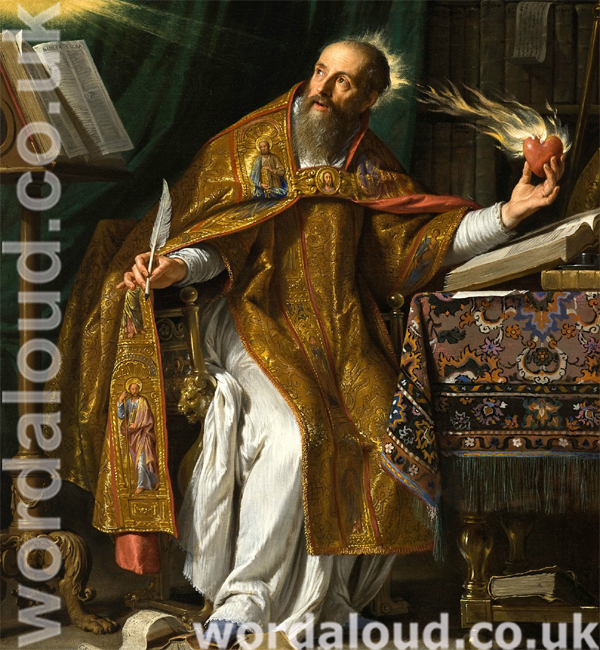
Saint Augustine contemplates the Christian life under the image of light—a light already received, yet not the fullness promised. Believers, he says, are light ‘in the Lord’, but only by participation: the true day has not yet dawned. The distinction is crucial. Our present illumination is real, but partial; it guides but does not satisfy. Thus Scripture, prophecy, and apostolic witness serve as lamps in the night of this world—trustworthy, necessary, and God-given, yet preparatory [ … ]
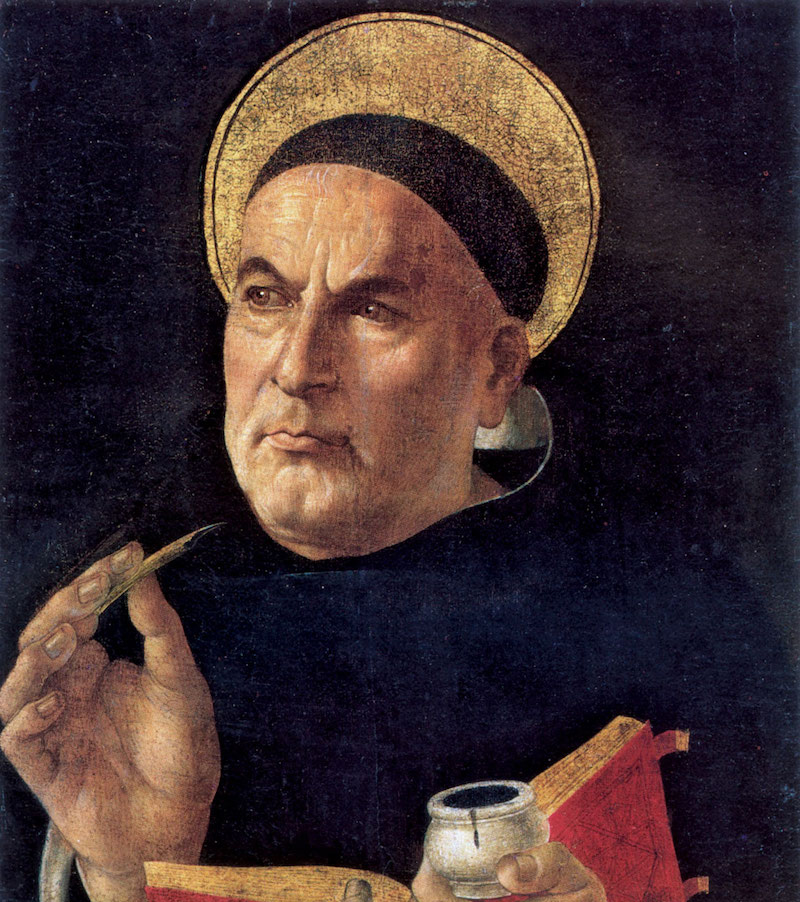
Saint Thomas Aquinas’ philosophy was grounded in Aristotelianism, but he was also heavily influenced by the works of Augustine. He sought to reconcile the insights of reason with the truths of revelation, arguing that faith and reason are complementary rather than contradictory [ … ]

In this passage, the prophet Balaam was on his way to meet King Balak of Moab, who sought to hire Balaam to curse the Israelites. However, God was displeased with Balaam’s intentions and sent an angel to stand in his path to prevent him from proceeding further. Unaware of the angel’s presence, Balaam’s donkey saw the angel with a drawn sword and reacted fearfully, trying to avoid the dangerous path [ … ]
