

Christian Art | Jesus Teaches Little Children
Office Of Readings | Week 27, Monday, Ordinary Time | A Reading From The Treatise Of Saint Ambrose On Cain And Abel | We Pray For The Whole Body Of The Church
‘Pray especially for the whole body of the Church.’
In this passage from his Treatise on Cain and Abel, Saint Ambrose reflects on the nature of Christian prayer as both personal and communal, inner and active. His interpretation moves beyond external forms and focuses on the transformation of the heart, the renewal of love, and the unity of the Church as the Body of Christ.
Ambrose begins by linking prayer to sacrifice: ‘Offer God a sacrifice of praise and fulfil your vows to the Most High.’ In the New Covenant, sacrifice is no longer measured in offerings upon the altar but in thanksgiving, gratitude, and the devotion of the heart. This interpretation aligns with the psalmist’s understanding that true worship flows from praise and obedience rather than ritual performance. Ambrose then illustrates this through the Gospel story of the Samaritan leper, whose act of returning to give thanks to Christ is presented as the model of prayer that fulfils the vow of faith. Gratitude is not merely polite acknowledgement; it is an act of worship that recognises the healing and saving power of God.
From thanksgiving, Ambrose turns to petition, teaching that Christian prayer must be ‘earnest and frequent’ rather than long or wearisome. The emphasis is on sincerity and perseverance rather than formality or verbosity. His observation that ‘lengthy prayers are usually filled with empty words’ echoes Christ’s own warning against vain repetition (Matthew 6:7). Prayer, for Ambrose, is not about display or eloquence but about attentiveness and purity of intention. At the same time, he warns against neglecting prayer, since indifference weakens the habit of turning to God and eventually dulls spiritual sensitivity.
Ambrose’s spiritual depth appears most clearly in his interpretation of Christ’s words: ‘Go into your room.’ He reads this not as a reference to a physical space but as a call to inner recollection — to withdraw into the interior ‘room’ of the heart, where thoughts and affections dwell. This interiority is characteristic of early Christian ascetic thought, which saw prayer as the meeting of the soul with God beyond external noise or distraction. ‘This room,’ Ambrose writes, ‘is always with you,’ meaning that prayer is possible in every place and circumstance, because its true location is within the believer.
The culmination of Ambrose’s teaching lies in his vision of communal prayer. Prayer, he insists, must not be restricted to personal needs; it must embrace ‘the whole body’ — the Church. The believer’s relationship with God is never private in isolation from others but always relational, embedded within the communion of the faithful. To pray for others is an act of charity that mirrors Christ’s own intercession for humanity. Moreover, Ambrose presents a striking paradox: those who pray for all receive more than those who pray only for themselves, because ‘each prays for all, and all pray for each one’. Prayer, when offered in love, draws the community together in a spiritual exchange of intercession. It is not a competition of needs but a sharing of grace.
In this vision, love becomes the true ‘badge of membership’ in the Church. The Church’s unity is sustained not by structure alone but by mutual prayer, which embodies humility and solidarity. For Ambrose, prayer for others is the most powerful expression of love, since it acknowledges that one’s own well-being is inseparable from that of the whole community. And so, to pray is not simply to ask or to thank, but to participate in the life of the Body of Christ — to share in a rhythm of giving and receiving that reflects divine charity itself.
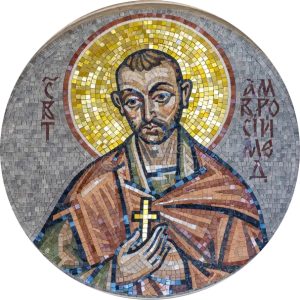
A Reading From The Treatise Of Saint Ambrose On Cain And Abel | We Pray For The Whole Body Of The Church
Offer God a sacrifice of praise and fulfill your vows to the Most High. If you praise God you offer your vow and fulfill the promise you have made. So the Samaritan leper, healed by the Lord’s word of command, gained greater credit than the other nine; he alone returned to Christ, praising God and giving thanks. Jesus said of him: There was no one to come back and thank God except this foreigner. He tells him: Stand up and go on your way, for your faith has made you whole.
The Lord Jesus, in his divine wisdom, taught you about the goodness of the Father, who knows how to give good things, so that you might ask for the things that are good from Goodness itself. He urges you to pray earnestly and frequently, not offering long and wearisome prayers, but praying often, and with perseverance. Lengthy prayers are usually filled with empty words, while neglect of prayer results in indifference to prayer.
Again, Christ urges you, when you ask forgiveness for yourself, to be especially generous to others, so that your actions may commend your prayer. The Apostle, too, teaches you how to pray; you must avoid anger and contentiousness, so that your prayer may be serene and wholesome. He tells you also that every place is a place of prayer, though our Savior says: Go into your room.
But by ‘room’ you must understand, not a room enclosed by walls that imprison your body, but the room that is within you, the room where you hide your thoughts, where you keep your affections. This room of prayer is always with you, wherever you are, and it is always a secret room, where only God can see you.
You are told to pray especially for the people, that is, for the whole body, for all its members, the family of your mother the Church; the badge of membership in this body is love for each other. If you pray only for yourself, you pray for yourself alone. If each one prays for himself, he received less from God’s goodness than the one who prays on behalf of others. But as it is, because each prays for all, all are in fact praying for each one.
To conclude, if you pray only for yourself, you will be praying, as we said, for yourself alone. But if you pray for all, all will pray for you, for you are included in all. In this way there is a great recompense; through the prayers of each individual, the intercession of the whole people is gained for each individual. There is here no pride, but an increase of humility and a richer harvest from prayer.
Christian Prayer With Jesus Christ
Lord,
teach us to pray with hearts that are steadfast and sincere.
May our thanksgiving rise before you as a living sacrifice of praise.
Grant us the grace to seek you not in many words,
but in faith, humility, and love.
Draw us into the inner room of silence
where you dwell within the soul,
and unite us in prayer for the whole Body of your Church.
May our prayers for one another bring healing and peace,
through Christ our Lord.
Amen.
Glossary Of Christian Terms
Saint Ambrose (c. 340–397) – Bishop of Milan and one of the four great Latin Doctors of the Church. A key figure in early Christian theology, known for his writings on Scripture, morality, and the spiritual life.
Treatise on Cain and Abel – A moral and theological commentary by Ambrose on Genesis 4, using the story of Cain and Abel as an allegory for the struggle between vice and virtue, selfishness and generosity.
Sacrifice of praise – A biblical phrase (from Psalm 50:14 and Hebrews 13:15) meaning worship offered through thanksgiving and obedience rather than ritual offerings.
Samaritan leper – The man healed by Jesus who returned to give thanks (Luke 17:11–19). In Ambrose’s interpretation, he represents the believer who fulfils the vow of faith through gratitude.
‘Go into your room’ – Christ’s instruction in Matthew 6:6, interpreted by Ambrose as a call to interior prayer — to withdraw into the heart, where one meets God in secret.
Communal prayer – Prayer offered on behalf of all members of the Church, expressing the unity of the Body of Christ and the mutual intercession of believers.
Body of the Church – A Pauline image (1 Corinthians 12) describing the Church as a living organism whose members are united in Christ through love and mutual care.
Intercession – Prayer on behalf of others, reflecting Christ’s own mediation before the Father.
Ascetic interiority – The discipline of turning inward in prayer and self-awareness, characteristic of early Christian spirituality.




In this address, Pope Paul VI reflects on Nazareth as the ordinary setting in which the Son of God lived most of his earthly life. Nazareth is presented not primarily as a place of historical interest, but as a school in which the Gospel is learned [ … ]
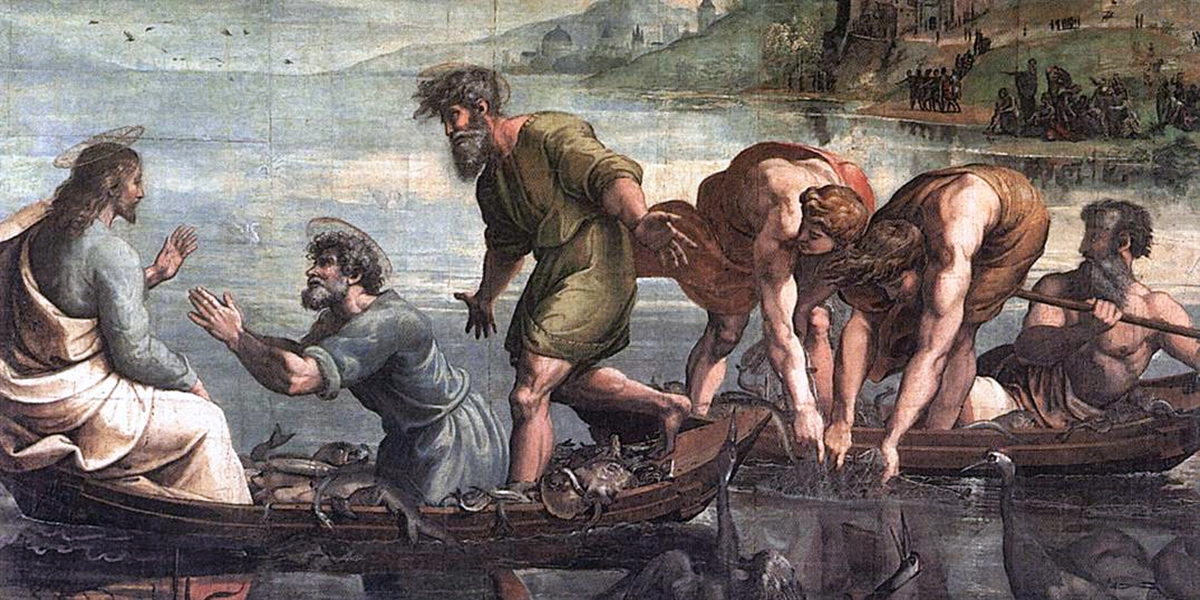
The time is come. Jesus has been baptised by John. He has spent time alone in the wilderness, symbolic of the Exodus wanderings, and is come to Galilee to begin his ministry. His first act is to call the first of the apostles to their new vocation. In Mark’s Gospel, as in Matthew’s, this follows upon the arrest of John the Baptist. This clearly differs from the account of John’s Gospel, while the Gospel of Luke could be seen as presenting a more detailed and less stylised account of the meeting of Christ with the fishermen [ … ]

Saint Christopher is believed to have been born in the third century in the region of Canaan. According to the ‘Golden Legend’ by Jacobus de Voragine, Saint Christopher was initially named Reprobus, meaning ‘Outcast’, and was of considerable physical stature, often described as a giant. Seeking to serve the greatest king in the world, he initially offered his services to a local king. However, upon seeing the king’s fear of the devil, Reprobus decided to serve the devil instead. This narrative is a critical turning point that showcases Saint Christopher’s relentless pursuit of serving true greatness [ … ]
