
Christian Art | Alexandria
Egypt | Alexandria At The Time Of Jesus | Philosophy, Revelation, And Search For Universal Truth
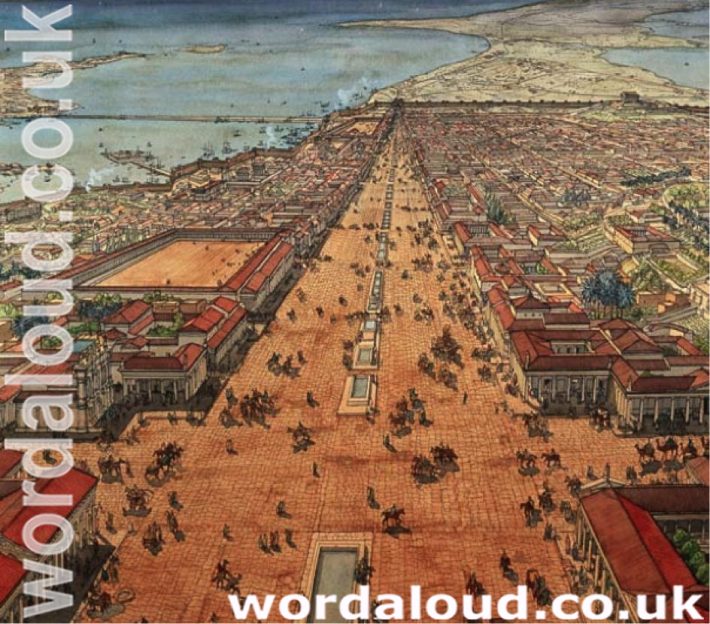
At the beginning of the first century CE, Alexandria occupied a distinctive position within the Mediterranean world. It was at once a Greek city, an Egyptian city, a Jewish city, and a Roman city. Founded by Alexander the Great in 331 BCE and governed successively by the Ptolemies and the Romans, Alexandria became one of the principal centres of commerce, administration, and intellectual life in antiquity. Yet its historical importance rests not merely upon its size or wealth, but upon the kinds of thought that emerged within it.
Alexandria brought into sustained contact intellectual traditions that had previously developed within separate cultural worlds. Greek philosophy encountered Jewish theology and Egyptian religion within a single urban environment shaped by imperial administration and cosmopolitan exchange. Philosophers, grammarians, priests, and theologians worked within overlapping intellectual frameworks. Texts were translated, compared, edited, and interpreted through methods increasingly concerned with hidden meaning and universal structure. Religious traditions began to adopt philosophical language, while philosophy itself acquired theological and spiritual dimensions.
The result was not the creation of a unified intellectual culture. Alexandria remained socially fragmented and politically unstable. Greeks, Jews, Egyptians, and Romans competed for status and influence. Riots and communal tensions formed part of the city’s history throughout the early imperial period. Yet precisely because Alexandria forced distinct traditions into proximity, it became a setting in which inherited systems of thought had to be reformulated under new conditions.
The central intellectual problem confronting Alexandrian thinkers concerned mediation. If divine reality was transcendent, immutable, and beyond ordinary language, how could it be related to the material world of change and multiplicity? How could revelation be interpreted philosophically without losing its authority? How could ancient religious traditions remain credible within a cosmopolitan environment shaped by Greek rational inquiry?
These questions became central to the work of Philo of Alexandria, whose writings represent one of the clearest expressions of Alexandrian intellectual culture during the lifetime of Jesus. Philo attempted to reconcile Jewish scripture with Platonic metaphysics by treating revelation as a form of philosophical truth expressed symbolically through sacred text. His interpretation of the Logos as the mediating principle between God and creation illustrates a broader Alexandrian attempt to unite theology, metaphysics, and textual interpretation within a universal intellectual framework.
Alexandria at the time of Jesus was therefore not simply a background setting within the Roman Empire. It was one of the principal sites in which classical philosophy was transformed into late antique theology. The intellectual developments associated with the city shaped the emergence of Christianity, influenced later Neoplatonism, and altered the relationship between revelation and philosophy throughout the Mediterranean world.
Alexandria And The Hellenistic Transformation Of Knowledge
The intellectual culture of Alexandria cannot be separated from the historical transformation initiated by the conquests of Alexander the Great. The collapse of the classical Greek polis and the emergence of large Hellenistic kingdoms altered the scale and conditions of intellectual life. Greek language and education spread across the eastern Mediterranean and Near East, bringing previously separate peoples into shared political and commercial systems.
Alexandria represented this transformation in concentrated form. Unlike Athens, whose intellectual traditions emerged gradually within an older civic culture, Alexandria was created as a planned imperial city. From the outset, it was intended to function as a centre of administration, commerce, and scholarship linking the Mediterranean with Egypt and the East.
The Ptolemaic rulers recognised that intellectual prestige could reinforce political legitimacy. The city therefore became associated with institutions devoted to the organisation and preservation of knowledge, most notably the Library of Alexandria and the Mouseion. Ancient accounts may exaggerate the scale of these institutions, yet their symbolic importance is clear. Alexandria presented itself as a city capable of collecting and systematising the intellectual inheritance of the known world.
This ambition altered the character of scholarship. Earlier Greek philosophy often centred upon oral teaching within relatively small schools. Alexandrian scholarship became increasingly textual. Scholars collected manuscripts, compared variant readings, established critical editions, and organised knowledge through catalogues and classifications. Grammar, philology, and commentary acquired new importance.
This shift had consequences extending beyond literary scholarship. Once texts became objects of systematic interpretation, intellectual authority increasingly depended upon methods of reading. Questions concerning literal and symbolic meaning, authorial intention, and hidden structure became central to philosophical and religious inquiry alike.
The translation of the Hebrew scriptures into Greek, known as the Septuagint, must be understood within this context. Translation was not merely a linguistic process. It brought Jewish revelation into the conceptual world of Hellenistic intellectual culture. Scripture became available for philosophical interpretation through the language and categories of Greek thought.
Alexandria therefore contributed to a wider transformation in the ancient world: the emergence of textual communities organised around interpretation. Religious authority increasingly depended not simply upon ritual or tradition, but upon the capacity to explain sacred texts within intellectually sophisticated frameworks.
Conclusions | Alexandria And The Transition To Late Antiquity
Alexandria at the time of Jesus was one of the principal centres in which the intellectual traditions of the ancient Mediterranean were reorganised under Hellenistic and Roman conditions. Greek philosophy, Jewish theology, Egyptian religion, and imperial administration interacted within a shared urban environment shaped by textual scholarship and cosmopolitan exchange.
The city’s significance lay not merely in the coexistence of multiple cultures but in the emergence of new forms of interpretation. Alexandrian thinkers increasingly treated revelation, myth, and philosophy as expressions of universal truths accessible through symbolic and metaphysical analysis.
Alexandria therefore marks a transition within intellectual history. Classical philosophy increasingly became theological, while religious traditions became philosophical and textual in new ways. The city contributed decisively to the formation of intellectual patterns that would influence Christianity, Judaism, and later Mediterranean thought for centuries.




In Jesus’ time, the swearing of oaths was common, and the casuistry surrounding such oaths was intricate. There were what we would now term loopholes – ‘perfectly’ legal ways of doing wrong. The letter of the Law, rather than the spirit, had proliferated – the whole of the Sermon on the Mount concerns this subject – and thereby our knowledge of the will of God had been deliberately obscured [ … ]

In this poem, Herbert expresses a yearning for divine grace to enliven and sustain his spiritual life. Herbert begins by admitting a sense of spiritual stagnation, stating, ‘My stock lies dead, and no increase / Doth my dull husbandry improve.’ Here, Herbert characterizes his inner resources or spiritual vitality as unproductive, and he attributes this lack to his own insufficient efforts, likened to a ‘dull husbandry’, or poor cultivation. This admission reveals Herbert’s dependence on external, divine intervention for renewal, as he implores grace to ‘drop from above’ [ … ]

Through these Bible verses, Jesus concludes his Priestly Prayer before his disciples. Through his prayer to his Father, Jesus is also saying goodbye to the disciples. He is about to endure his Passion. These words are Jesus’ last testament before he is glorified. Jesus has asked for the Father’s guidance and help for the disciples. They are called to be united in faith as they preach the Gospel and endure the hardships and hostility of the world. Now Jesus extends his prayer to include all Christians to come [ … ]
