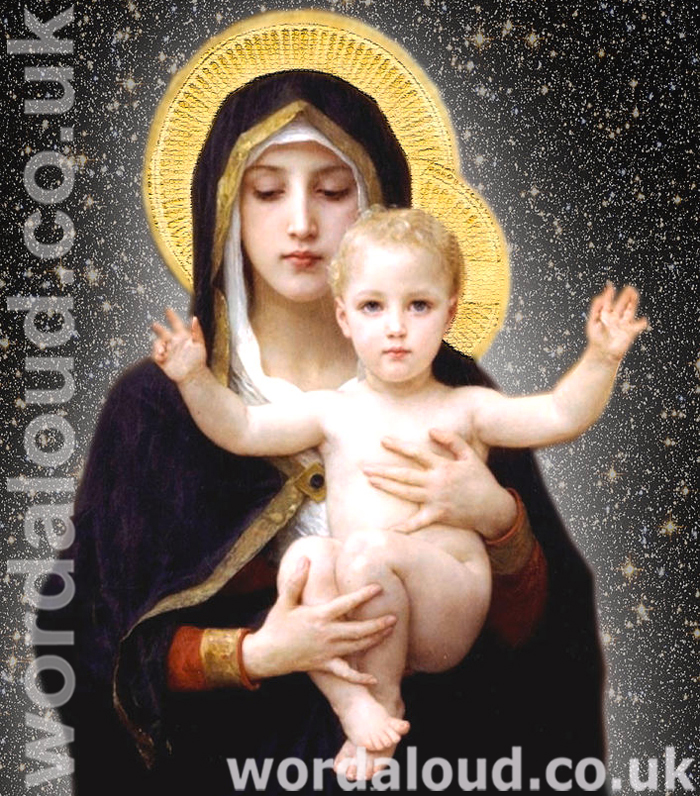
Christian Art | Mary And Baby Jesus
Matthew 1: 1-17 | 17th December Advent Weekday (Audio Bible, Spoken Word)
1 THE book of the generation of Jesus Christ, the son of David, the son of Abraham.
2 Abraham begat Isaac; and Isaac begat Jacob; and Jacob begat Judas and his brethren;
3 And Judas begat Phares and Zara of Thamar; and Phares begat Esrom; and Esrom begat Aram;
4 And Aram begat Aminadab; and Aminadab begat Naasson; and Naasson begat Salmon;
5 And Salmon begat Booz of Rachab; and Booz begat Obed of Ruth; and Obed begat Jesse;
6 And Jesse begat David the king; and David the king begat Solomon of her that had been the wife of Urias;
7 And Solomon begat Roboam; and Roboam begat Abia; and Abia begat Asa;
8 And Asa begat Josaphat; and Josaphat begat Joram; and Joram begat Ozias;
9 And Ozias begat Joatham; and Joatham begat Achaz; and Achaz begat Ezekias;
10 And Ezekias begat Manasses; and Manasses begat Amon; and Amon begat Josias;
11 And Josias begat Jechonias and his brethren, about the time they were carried away to Babylon:
12 And after they were brought to Babylon, Jechonias begat Salathiel; and Salathiel begat Zorobabel;
13 And Zorobabel begat Abiud; and Abiud begat Eliakim; and Eliakim begat Azor;
14 And Azor begat Sadoc; and Sadoc begat Achim; and Achim begat Eliud;
15 And Eliud begat Eleazar; and Eleazar begat Matthan; and Matthan begat Jacob;
16 And Jacob begat Joseph the husband of Mary, of whom was born Jesus, who is called Christ.
17 So all the generations from Abraham to David are fourteen generations; and from David until the carrying away into Babylon are fourteen generations; and from the carrying away into Babylon unto Christ are fourteen generations.
Christ is to be saviour of all mankind, in accordance with the promise to Abraham, and he is to bring an everlasting kingdom to the Jewish people, as prophesized to King David. He is identified right at the start of Matthew’s Gospel as the son of David and the son of Abraham. From one perspective, the genealogy then presented confirms these truths and roots Christ in a line that is itself a record of salvation history, which in the birth of the Son of God reaches its climax.
Genealogies were of tremendous importance for the Jews because they were seen as doing much to define a person’s identity, this because of the nomadic origins of the people, such that place of birth would be of lesser importance. Great care would be taken to record and preserve genealogies, the details of which could entail certain rights and duties. Christ’s genealogy follows a threefold division, each of 14 generations, 14 being the number of David, first from Abraham to David, then from David to the Babylonian exile, and thence to Christ. We move, then, from the promise to Abraham to the temporary fulfilment of a great kingdom under David, through the falling away through sin into defeat and exile, and the hope of the Messiah to come.
As companions to Mary, four women are, unusually, mentioned in the genealogy: Tamar, Rahab, Bathsheba and Ruth. The character of these women is also unusual. They are foreigners. Two are certainly sinners – Tamar disguised herself as a prostitute to oblige the Patriarch Judah, her father-in-law, to be faithful to the law by impregnating her (Genesis 38); Rahab was a prostitute who helped the Israelites by betraying Jericho (Joshua 2). In the case of Bathsheba, while there is sin, we might say that she perhaps is more the victim of sin, as King David seduces and has sex with her, then has her husband Uriah killed (2 Samuel 11).
The four companions, then, are quite different from Mary. They are outsiders – outside of Jewish norms – and they would be understood to need redemption, grace, to bring them into the fold. Through this, the teaching is reinforced that Christ came to call all of us. God saves us and calls us to do good despite our sins, and He has left evidence of this in the Son’s genealogy.
There is, though, a further twist on this record of ancestry, of identity. ‘Abraham begat Isaac; and Isaac begat Jacob; and Jacob begat Judas and his brethren…’ Or: ‘Abraham the father of Isaac, and Isaac the father of Jacob, and Jacob the father of…’ And so on. Only at the last step does the terminology change, the pattern abruptly halt: ‘…and Matthan begat Jacob; And Jacob begat Joseph the husband of Mary, of whom was born Jesus, who is called Christ.’ Not, then, and for obvious reasons, ‘Joseph begat Jesus’, or ‘Joseph the father of Jesus’; rather, ‘Joseph, the husband of Mary, of whom was born Jesus’.
The virgin birth – Christ born of Mary and the Holy Spirit. At the climax, the pinnacle, of Christ’s genealogy, that whole male line of father to son through the ages, since Genesis, might simply evaporate and Mary and Jesus could still be there, true, divine identity intact. It is a suggestive textual moment: Christ comes to us as the highpoint of salvation history – we have in the genealogy rehearsed the Old Testament – and he slips in, as it were, from the outside, into history, someone quite new, free of history, his identity pre-defined outside of history, and come to redeem history, through his mother.
‘Father, by your will your Son took upon himself that human nature which you fashioned and redeemed. Grant that the Word who took flesh in the womb of the ever-virgin Mary and became a man like us, may share with us his godhead. We make our prayer through Christ our Lord. Amen’


Psalm 55 is a heartfelt and poignant prayer, a cry for divine help in a time of profound distress and betrayal. The psalmist beseeches God to listen to his supplication, expressing deep anguish caused by treachery of enemies and weight of oppression [ … ]

Scripture: John 14:27 ‘Peace I leave with you; my peace I give you. I do not give to you as the world gives. Do not let your hearts be troubled and do not be afraid.’ In this verse, Jesus offers his peace to his disciples, a peace that is different from what the world provides. This divine peace is deep, abiding, and capable of calming troubled hearts and dispelling fear. It is a peace that surpasses all understanding and is rooted in the presence and promises of Christ. Prayer Dear Jesus, I come before you, seeking your peace in my life. The world around me is filled with chaos and uncertainty, but I know that your peace can calm the storm within my heart. Help me to trust in you more deeply, to rest in your promises, and to feel your presence in every moment. Fill me with your peace that surpasses all understanding, and help me to be a vessel of your peace to those around me. Amen. Personal Reflection What areas of your life are causing you anxiety or fear? How can you invite Jesus’ peace into these areas? Reflect on a time when you experienced Christ’s peace amidst turmoil. Meditation On Prayer And Gospel John 14:27 reveals a profound truth about the nature of Jesus’ peace. Unlike the fleeting and often superficial peace offered by the world, Jesus’ peace is enduring and deeply transformative. This peace is not dependent on external circumstances but is anchored in the character and promises of Christ. As we navigate through life’s challenges, it’s crucial to understand and embrace this divine peace. Jesus’ peace is rooted in his presence. When he says, ‘Peace I leave with you; my peace I give you,’ Jesus is assuring us of his continual presence. This peace is a gift that flows from his abiding presence in our lives. It is a reminder that we are never alone, no matter what we face. his presence brings comfort and security, allowing us to rest even in the midst of life’s storms. Furthermore, Jesus contrasts his peace with the peace that the world gives. The world’s peace is often conditional and temporary, based on circumstances that can change in an instant. In contrast, Jesus’ peace is steadfast and eternal. It is a peace that reassures us in our deepest fears and anxieties, reminding us that he is in control. This peace transcends our understanding, as it is grounded in the eternal and unchanging nature of God. To experience Jesus’ peace, we must cultivate a relationship with him. This involves spending time in prayer, meditating on his word, and seeking his presence in our daily lives. It also means surrendering our worries and fears to Jesus, trusting that Jesus will provide and protect. As we draw closer to Jesus, his peace fills our hearts and minds, transforming our outlook and calming our spirits. One practical way to embrace Jesus’ peace is through prayer and meditation. By setting aside time each day to be still before the Lord, we create space for his peace to fill us. Reflecting on scriptures like John 14:27 can remind us of his promises and help us focus on his presence. Additionally, practicing gratitude can shift our focus from our worries to the many blessings in our lives, further opening our hearts to his peace. Another aspect of embracing Jesus’ peace is learning to let go of control. Often, our anxiety stems from a desire to control our circumstances. Jesus invites us to trust in his sovereign plan, even when we do not understand it. By surrendering our need for control and placing our trust in Him, we open ourselves to the peace that comes from knowing that He holds all things in his hands. Living in Jesus’ peace also means becoming peacemakers in our relationships and communities. As we experience his peace, we are called to extend that peace to others. This involves forgiving those who have wronged us, seeking reconciliation, and promoting harmony wherever we go. By being agents of his peace, we reflect his love and grace to a world in desperate need of his presence. Prayer Lord Jesus, Your peace is a precious gift that the world cannot give. In times of turmoil and distress, remind me to turn to you. Let your peace guard my heart and mind, dispelling all fear and anxiety. Teach me to trust in your unfailing love and to rest in your promises. Help me to be a peacemaker, sharing your peace with those around me. May your peace reign in my heart, my home, and my relationships. Thank you for your constant presence and the gift of your peace. Amen. Scripture: Matthew 5:9 ‘Blessed are the peacemakers, for they will be called children of God.’ Blessing May the peace of our Lord Jesus Christ fill your heart and mind, guiding you through every challenge and bringing you comfort and joy. May you rest in his unending peace and share it generously with those around you. Amen.

In the Catholic Church, Purgatory is believed to be a place or state of suffering that is temporary and where the souls of those who have died in a state of grace but are not yet fully purified are purified before they can enter heaven. It is believed to be a place of spiritual and moral purification, where the soul is cleansed of any remaining attachments to sin [ … ]