John 3: 14-21 – Lent Week 4 (Year B), Sunday (Audio Bible, Spoken Word)
14 ¶ And as Moses lifted up the serpent in the wilderness, even so must the Son of man be lifted up:
15 That whosoever believeth in him should not perish, but have eternal life.
16 ¶ For God so loved the world, that he gave his only begotten Son, that whosoever believeth in him should not perish, but have everlasting life.
17 For God sent not his Son into the world to condemn the world; but that the world through him might be saved.
18 ¶ He that believeth on him is not condemned: but he that believeth not is condemned already, because he hath not believed in the name of the only begotten Son of God.
19 And this is the condemnation, that light is come into the world, and men loved darkness rather than light, because their deeds were evil.
20 For every one that doeth evil hateth the light, neither cometh to the light, lest his deeds should be reproved.
21 But he that doeth truth cometh to the light, that his deeds may be made manifest, that they are wrought in God.
Through the time of Lent, we recall the Exodus. We recall the release of the then chosen people of God from their slavery in Egypt and their time in the wilderness on their way to the promised land, during which time God provided for them.
We may or may not regard the history of the Jewish people as recounted in the Bible in the book of Exodus as literal historical fact or as anagogical history, or as ongoing Midrash, as the scholars of the Jewish people sought to understand and to define their history during the period of the Babylonian exile.
When Moses lifted up the serpent in the wilderness (Numbers 21: 8-9), he transmitted to the people a cure, established by God, for those who had been bitten by poisonous serpents in the wilderness. This is a healing moment for the people on their journey from imprisonment, as their time had become in Egypt, toward freedom. We see in our own time the difficulties that lie in wait for us on our journey from imprisonment, by Satan, to the freedom of Christ. There may be significant difficulties on this journey. However, when we look to God while we make this journey, He will help us.
‘The Son of Man in the desert of the world will be raised up on the cross as a sign of salvation for all those who will feel the need to continue to live and will not allow themselves to be bitten by poisonous mistaken choices. Christ is there: cursed is he who has no faith, blessed is he who believes… We also, like the Israelites in the desert have been “bitten” by the serpent in Eden.’ (From the Carmelites’ Lectio Divina.)
From this account of the teaching of Jesus, John launches into a glorious affirmation of the truth of the incarnation of our Saviour. This Bible reading is through and through a message of love, of God’s love and of the love of which we are capable and which we should attain. Through this passage of the Bible, we are called, and resoundingly, to follow the light of truth and not to hide our sins away in the darkness of evil.
We know the truth of good and evil. We know the truth of eternal reward or the failure of this reward. We know the truth of God’s judgement. And this is while we ourselves are not to judge our fellow man because we are sinners too. There is a danger of moral relativity clouding the knowledge God gave to us concerning how we should live.
We need not be afraid of God’s judgement. ‘For God so loved the world, that he gave his only begotten Son, that whosoever believeth in him should not perish, but have everlasting life.’ That is how we stand in relation to God as we confess our sins and seek reconciliation.
God gave his son. Imagine a father or mother not being willing to lay down his or her life to save his or her child’s life. God has already done this. The crucifixion is a true, historical event which is for all mankind through eternity. As we confess our sins and repent, this is the saving event of history with which we align ourselves.
‘If you love, then follow. I do love, you say, but what way am I to follow? If the Lord your God said to you, “I am the way, the truth and the life,” you, desiring truth and eager for life, would immediately seek the way to attain these. You would say to yourself, “What a tremendous thing truth is, what a tremendous thing life is, were there only the means by which my soul could reach them.”
‘Do you ask, by what way? Listen to him saying to you first of all, “I am the way.” Before telling you whither, he told you by what way. “I am the way,” he said. The way where? “And the truth and the life.” First he told you the way to come, then where. I am the way, I am the truth, I am the life. While remaining with the Father, he was truth and life; putting on flesh, he became the way.’ St Augustine
Audio Bible KJV | Endnotes
As Moses Lifted Up The Serpent In The Wilderness | The Meaning Of The Cross In Saint John’s Gospel
John 3:14-21 underscores the significance of Jesus’ crucifixion as the means of salvation. Jesus tells Nicodemus, a Jewish leader, that ‘just as Moses lifted up the serpent in the wilderness, so the Son of Man must be lifted up, that whoever believes in him may have eternal life’ (John 3:14-15, KJV).
This metaphorical language echoes the story in Numbers 21:4-9, in which the Israelites suffered a plague of venomous snakes. God instructed Moses to fashion a bronze serpent and to lift it up on a pole so that anyone who looked at it would be healed.
The lifting up of the serpent in the wilderness is a powerful symbol of healing and renewal. The Greek god Asclepius was depicted with a staff around which a serpent was coiled, symbolizing his power to heal. The serpent was also a symbol of the Egyptian god Wadjet, who was associated with protection and renewal.
We may conjecture that religious and indeed magical connotations of the serpent are deeply rooted in traditions from which the Bible as well as other belief systems draw.
In John’s Gospel, Jesus is presented as the one who is lifted up on the cross, in clear parallel to the serpent on the pole. This lifting up represents not only the means of Jesus’ execution but also his triumph over sin and death. In the words of John 12:32, Jesus says: ‘And I, if I be lifted up from the earth, will draw all men unto me.’ This lifting up is the ultimate act of love, as Jesus willingly gives his life for the salvation of humanity.
John’s Gospel above all gives confident expression to the triumph of Jesus on the Cross. Throughout the Gospel, from the first verse, we anticipate the crucifixion as triumph, as love, as salvation, rather than as scandalous defeat – God the Son become a human corpse.
Religious leaders and authorities have reflected on the significance of Jesus’ crucifixion in the context of John 3:14-21.
Pope Francis has spoken about the connection between the lifting up of the serpent in the wilderness and the lifting up of Jesus on the cross, stating: ‘The serpent lifted up by Moses in the desert is the symbol of sin, and Jesus becomes sin for us on the cross. Jesus lowered himself to raise us up.’ (General Audience, March 14, 2018)
Theologian and author N.T. Wright has written: ‘The cross is not only the ultimate demonstration of God’s love; it is also the means by which that love is made known, and by which the sin of the world is dealt with.’ (The Day The Revolution Began, p. 202)
Protestant theologian John Stott has written: ‘The essence of sin is man substituting himself for God, while the essence of salvation is God substituting himself for man. Man asserts himself against God and puts himself where only God deserves to be; God sacrifices himself for man and puts himself where only man deserves to be.’ (The Cross of Christ, p. 160)



The psalm opens with an exuberant summons: ‘O come, let us sing unto the Lord: let us make a joyful noise to the rock of our salvation.’ This lively call to worship sets the tone for a collective celebration, a harmonious expression of gratitude and joy directed towards God. The reference to the ‘rock of our salvation’ reminds of God’s steadfastness and reliability, a foundation on which believers can confidently stand [ … ]

Fear is a powerful destroyer of the mind, stripping away confidence and holding us captive. It clouds our thoughts and overwhelms us with doubt, eroding our ability to take action. It keeps us stagnant, preventing us from reaching our full potential [ … ]
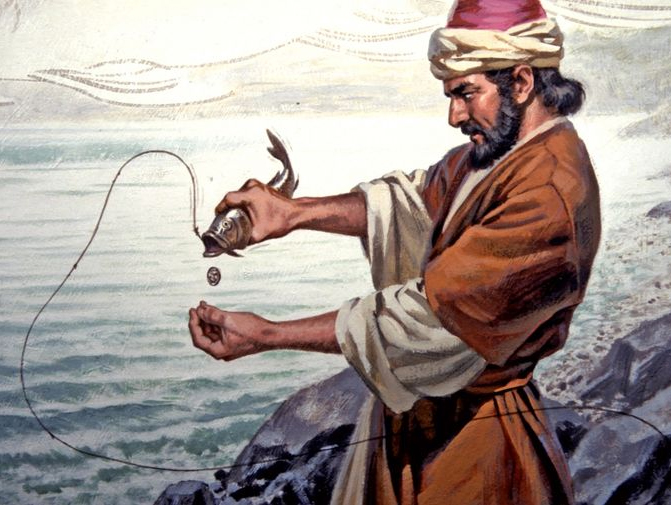
In Matthew’s Gospel, this is Jesus’ second announcement of his Passion. This time, the reaction of the disciples has mellowed. It is less extreme, while they remain very sorry. The disciples begin to recognize the cross as a necessary step on Jesus’ journey. We may think of our own tears mingled with joy as we contemplate Christ’s sacrifice, for example as we give ourselves in prayer, in adoration of the Blessed Sacrament. We may also note that the sorrow of the disciples follows upon Jesus’ saying that he will be raised again. Our sorrow as we contemplate Jesus’ death includes the resurrection. We may weep for the necessity and the absolute love and self-giving of Jesus’ sacrifice [ … ]