

Christian Art | Come And See! | Jesus
John 1: 35-42 – 2nd Sunday Year B (Audio Bible KJV, Spoken Word)
35 ¶ Again the next day after John stood, and two of his disciples;
36 And looking upon Jesus as he walked, he saith, Behold the Lamb of God!
37 And the two disciples heard him speak, and they followed Jesus.
38 Then Jesus turned, and saw them following, and saith unto them, What seek ye? They said unto him, Rabbi, (which is to say, being interpreted, Master,) where dwellest thou?
39 He saith unto them, Come and see. They came and saw where he dwelt, and abode with him that day: for it was about the tenth hour.
40 One of the two which heard John speak, and followed him, was Andrew, Simon Peter’s brother.
41 He first findeth his own brother Simon, and saith unto him, We have found the Messias, which is, being interpreted, the Christ.
42 And he brought him to Jesus. And when Jesus beheld him, he said, Thou art Simon the son of Jona: thou shalt be called Cephas, which is by interpretation, A stone.
‘Behold the Lamb of God.’ Throughout the Bible, we are called to know and to develop our relationship with the Lamb. It is in Genesis the Lamb is first mentioned, provided by God as a sacrifice to take the place of Isaac. Through the history of Jewish ritual, a lamb is offered in sacrifice, for expiation, reparation, sanctification. The prophets speak of a meek, tame lamb, sheared without opening its mouth. In the Book of Revelation, or Apocalypse, the full meaning of the Lamb will be revealed, as the king, the Spouse, the lamp, the temple, the place of our eternal dwelling. The Lamb spans all history. And John the Baptist has already, in John’s Gospel, recognised and declared Christ as the Lamb of God who will take away the sins of the world.
John the Baptist calls on his own disciples to recognise Christ. As Christ begins his ministry, John hands over all authority to him. The response of John’s disciples is instant. They follow Jesus. Asked by him what they want, they address him as Rabbi and ask where he is living. They are invited to Jesus’ house and there stay with him. A relationship follows very quickly upon the recognition of Christ and the welcoming offered and shared. So we are invited to recognise Jesus, to develop our relationship with him, to visit, to spend the day becoming close. This is to find our vocation, our relationship with Christ.
There is a further call, to missionary activity. The first thing Andrew does is to take his brother to meet Jesus, telling him that they have found the Messiah. Jesus looks at Simon, assessing him, seeing him as he truly is. It is a feature of Christ’s seeing Simon’s true identity and calling, his true vocation, that he gives Simon an additional name, Cephas or Peter, the Rock who will be the foundation of Christ’s church.
As we pray to discern our own true vocation, we remember that this is really to develop our own living relationship with Jesus. We are called to dwell with him. We are called to dwell within him, and to invite Jesus to dwell within us.
As we pray for vocation, we pray that the light of Christ may shine through us and that we may help to take Christ’s message to the world. We pray that we may see through outward appearances, and perhaps anything we try to show about ourselves which may not be quite true to who we really are. We pray to find and to foster a deep, loving, inward relationship with Christ. Christ fixes his eyes on us. He asks us what we are looking for. May we be true to ourselves as we search and find our search complete in Jesus.
God’s call is mysterious; it comes in the darkness of faith. It is so fine, so subtle, that it is only with the deepest silence within us that we can hear it. And yet nothing is surer or stronger, nothing is so decisive and overpowering, as that call. This call is uninterrupted: God is always calling us.
Audio Bible KJV | Endnotes
Come And See | Easy Invitation To Jesus
The invitation to ‘come and see’ is at the heart of Christian faith and evangelization. It is an invitation to encounter Jesus personally and to experience Jesus’ transformative love and grace.
In the Gospel of John, we see this invitation in action when Andrew and another disciple hear John the Baptist proclaim that Jesus is the Lamb of God. They follow Jesus and ask where Jesus is staying. Jesus responds with the invitation, ‘Come and see.’ They go with Jesus and spend time with him, experiencing Jesus’ presence and teachings.
For some, this encounter with Jesus may happen in a moment of profound conversion, while for others it may be a gradual process of growth and learning.
In the New Testament, we see many examples of people responding to Jesus’ invitation to ‘come and see.’ The Samaritan woman at the well encountered Jesus and went back to her community to tell them about him. Nicodemus came to Jesus at night to ask him questions and ended up becoming a disciple. And the apostles themselves left everything to follow Jesus after encountering him.
As Christians, we are called to live out our faith in all aspects of our lives, both in our personal relationship with Jesus and in our interactions with others. We are called to be a light in the world, to share the love and message of Jesus with those around us.
In the book of Acts, we see the early Church responding to this invitation to ‘come and see’ by spreading the message of the Gospel throughout the world. Those Christians encountered Jesus personally and were transformed by Jesus’ love, and they felt compelled to share this message with others. This evangelization was not always easy, and early Christians faced opposition and persecution, but they continued to spread the message of the Gospel with boldness and conviction.
Today, we are called to continue this work of evangelization. We are called to share the message of the Gospel with those around us, whether it be through our words or through our actions. We are called to be witnesses to the world of the transformative power of Jesus’ love and grace.
The invitation to ‘come and see’ is not just for new believers, but for all at every stage of a faith journey. Christians are constantly invited to deepen relationship with Jesus and to encounter Jesus in new and surprising ways.
This invitation challenges Christians to share faith. So the disciples went and told others about their encounter with Jesus, so we called to share the good news with those around us.
We may not always have all the answers. Ultimately, the invitation to ‘come and see’ is an invitation to experience the love of God in a profound and life-changing way. It is an invitation to enter into a relationship with Jesus that transcends all other relationships and gives meaning and purpose to our lives.



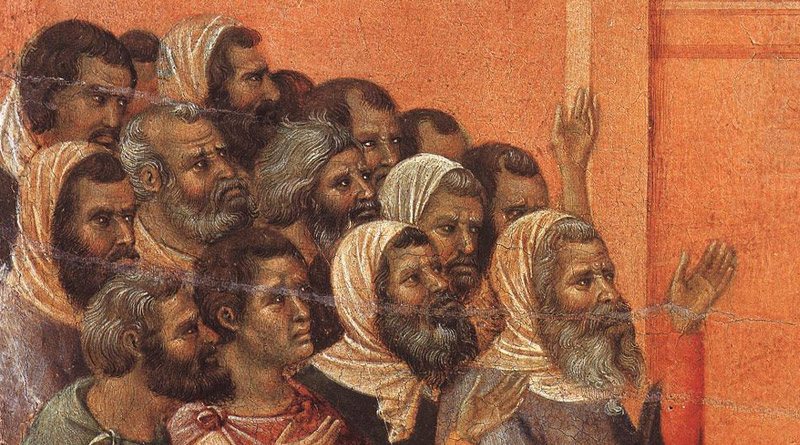
The Gospel verses reflect a time when Christianity has split from Judaism, and also a time after the destruction of Jerusalem. In depictions of Jesus’ rebuke of the Pharisees, we discover an astonishing claim to transcendence on the part of the burgeoning Christian communities. There is too ambivalence: the Law remains intact in every detail, and yet it is overhauled. The truth of Christ so far surpasses the Pharisaic understanding of the Law, that it may be considered a New Law even as at the same time it is a fulfilment of the Old. We discover through these Gospel verses an astonishing claim on the part of the Christian writers, which is that they are the true recipients of God’s revelation to Moses, and that it is the Pharisees who have got it wrong [ … ]

In listening to these Gospel verses, questions present themselves. We might ask both why the children are brought to Jesus to be blessed, and why then the disciples rebuke the people bringing the children. We try to see within this scene [ … ]

In this, the Magnificat, Mary’s soul overflows with joy as she contemplates the wonderful blessing God has bestowed on her, surpassing indeed the gifts to any other person in history. Through her obedience and humility, Mary has been magnified herself by the Lord, such that we now recognize her greatness and call her blessed – each day, indeed, as we recite or sing the canticle as part of evening prayer [ … ]
