
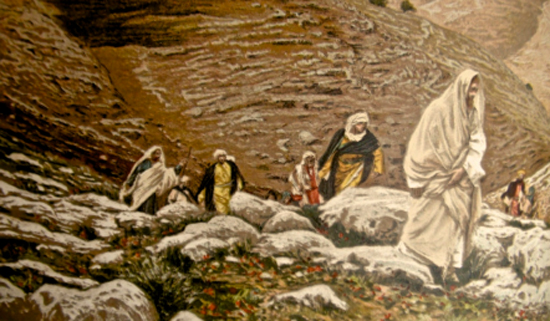
Christian Art | Jesus And His Apostles Seek A Desert Place
Mark 6: 30-34 – Week 4 Ordinary Time, Saturday (Audio Bible KJV, Spoken Word)
30 And the apostles gathered themselves together unto Jesus, and told him all things, both what they had done, and what they had taught.
31 And he said unto them, Come ye yourselves apart into a desert place, and rest a while: for there were many coming and going, and they had no leisure so much as to eat.
32 And they departed into a desert place by ship privately.
33 And the people saw them departing, and many knew him, and ran afoot thither out of all cities, and outwent them, and came together unto him.
34 And Jesus, when he came out, saw much people, and was moved with compassion toward them, because they were as sheep not having a shepherd: and he began to teach them many things.
The apostles have returned exhausted and energized to Jesus. They have succeeded in their mission and they are full of the glory of what they have accomplished. They long to tell Jesus all that they have done in Jesus’ name. This is a triumph for the disciples. They long to share.
Jesus’ feels all the apostles’ urgent need to tell him just how well they have done what they were instructed to do. When those disciples first set out, perhaps it was inevitable that they would have had their doubts, and now there is joy when those doubts and fears are overcome and proven groundless. This must be emotionally overwhelming for the reunion of Jesus and his disciples.
Jesus celebrates these feelings with the disciples while drawing them in to reflect awhile. It is as a mother or a careful teacher would manage the learning of a child.
There is to be no escape for Jesus and his disciples, however. This is now become a mass movement, indeed a frenzy: everybody wants to be near Jesus. It is truly terrifying. All privacy has been taken away. Jesus’ mission has become exhausting.
Jesus is not cowed by this mass influx of people begging for spiritual leadership. He knows that this is why he is here, and while it may be so hard on him, this is the mission that he is here to fulfil.
Jesus is exhausted and needs time with his closest disciples. Nonetheless, he has pity and chooses to give himself yet more, to teach the crowds. The giving is absolute.
24 For I will take you from among the heathen, and gather you out of all countries, and will bring you into your own land.
25 ¶ Then will I sprinkle clean water upon you, and ye shall be clean: from all your filthiness, and from all your idols, will I cleanse you.
26 A new heart also will I give you, and a new spirit will I put within you: and I will take away the stony heart out of your flesh, and I will give you an heart of flesh.
27 And I will put my spirit within you, and cause you to walk in my statutes, and ye shall keep my judgments, and do them.
28 And ye shall dwell in the land that I gave to your fathers; and ye shall be my people, and I will be your God. (Ezekiel: 36: 24-28)
Concluding Prayer
All-powerful, eternal God,
splendour of true light and never-ending day:
at the return of the morning hour
chase away the night of sin,
and fill our minds with the glory of your coming.
We make our prayer through our Lord.


Audio Bible KJV | Endnotes
The Power Of Solitude – Learning From Jesus’ Example
In Mark 6:30-34, we see Jesus and his disciples seeking solitude in a desert place. While the disciples were eager to report to Jesus all that they had done and taught during their ministry, Jesus recognized that they needed a break. Jesus invited them to come away with him to a place where they could rest and be refreshed – to a desert place.
The desert place is both literally so and it can serve as metaphor. There is a stillness and a poverty in the desert. There is an exposure – both to the environment and to ourselves – and so to God.
The importance of solitude in the Christian life cannot be overstated. Throughout the Bible, we see many examples of people seeking solitude in order to connect with God. Moses, for example, spent 40 days alone with God on Mount Sinai, and Elijah heard the still, small voice of God while he was alone in a cave.
Similarly, Jesus often sought solitude in order to pray and to connect with his Father. In Mark 1:35, we see Jesus rising early in the morning to go to a solitary place to pray. In Luke 5:16, we see that Jesus often withdrew to lonely places to pray.
In today’s fast-paced world, it can be difficult to find moments of solitude in our busy lives. However, the benefits of solitude are numerous. Solitude provides us with the space and time we need to reflect on our lives, to connect with God, and to gain clarity and perspective.
In his book The Power Of Solitude, Henri Nouwen writes: ‘Solitude is the furnace of transformation.’ Nouwen goes on to explain that when we enter into solitude, we open ourselves up to the transformative power of God’s love. Through prayer, meditation, and other spiritual practices, we can deepen our relationship with God and experience His presence in new and powerful ways.
In addition to the benefits of solitude for our personal spiritual growth, there are also benefits for our relationships with others. When we take time to step away from the noise and distractions of the world, we become more attuned to the needs and feelings of others. We are able to approach our relationships with a greater sense of compassion and understanding.
Furthermore, when we take time for solitude, we are better able to discern God’s will for our lives. In the quiet of solitude, we can more clearly hear God’s voice and direction. This allows us to make decisions that are in line with God’s plan for our lives and to approach challenges and opportunities with confidence and clarity.
One of the challenges of seeking solitude is that it can be difficult to find the time and space for it in our busy lives. However, there are many ways to incorporate moments of solitude into our daily routines. Whether it is taking a walk in nature, finding a quiet spot in our homes to pray, or simply turning off our devices for a few minutes each day, we can all find ways to prioritize solitude in our lives.
In addition, there are many Christian retreat centers and programs that offer opportunities for extended periods of solitude and reflection. These retreats can be a wonderful way to step away from the demands of daily life and to focus on deepening our relationship with God.
Pope Francis has spoken on the importance of retreat and solitude in the Christian life on several occasions. In his 2018 apostolic exhortation Gaudete Et Exsultate, Pope Francis writes: ‘We need to set aside a time each day for God, with prayer and Bible reading, while also setting aside moments of recollection throughout the day, particularly at night before retiring. Gradually, we can calm our anxious hearts, and we will be more serene and self-possessed.’
In addition, Pope Francis has frequently emphasized the importance of taking time for spiritual renewal through retreat. In a 2019 message to participants in a retreat for priests in the Diocese of Rome, Pope Francis encouraged the priests to take time for ‘silence, reflection, and prayer’ in order to ‘recharge their spiritual batteries’ and to be ‘better equipped to serve the people of God’.
The example of Jesus and His disciples in Mark 6:30-34 teaches us the importance of seeking solitude in order to rest, reflect, and connect with God. As we follow Jesus’ example, may we be intentional about carving out moments of solitude in our lives, and may we be open to the transformative power of God’s love as we do so.



There are people who say: I forgive, but I do not forget. Why? we may ask. Of what use is this? It is as if we were to attach a condition to our forgiveness, saying, in effect, that we forgive up to a point, but that our forgiveness is not total. Our forgiveness comes with a threat: Your crime is noted. We are really saying: we don’t forgive you all [ … ]

Psalm 139 meditates on the nature of God and God’s relationship with humanity. The psalm combines awe for God’s transcendent knowledge and presence with a deep sense of personal connection and care. This psalm resonates with themes of God’s unfathomable knowledge, unwavering presence, and the sacredness of human life, making it a significant piece for contemplation and spiritual reflection [ … ]

Jesus’ Passion is near. It is almost time for Jesus to permit himself to be crucified. It is true to this that the Greeks, non-Jews, have come to seek Jesus and to hear his word. Jesus’ mission, to come to earth to save everyone, is becoming fulfilled [ … ]