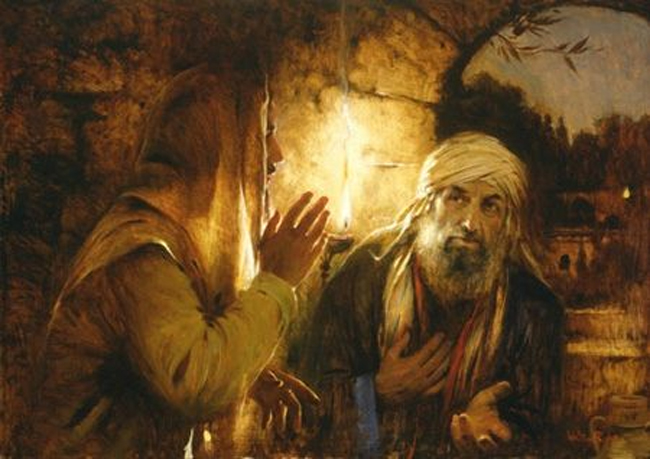
Christian Art | Easter To Pentecost | Nicodemus Visits Jesus
John 3: 1-8 Audio Bible KJV | King James Audio Bible | King James Version | Daily Verses
1 THERE was a man of the Pharisees, named Nicodemus, a ruler of the Jews:
2 The same came to Jesus by night, and said unto him, Rabbi, we know that thou art a teacher come from God: for no man can do these miracles that thou doest, except God be with him.
3 Jesus answered and said unto him, Verily, verily, I say unto thee, Except a man be born again, he cannot see the kingdom of God.
4 Nicodemus saith unto him, How can a man be born when he is old? can he enter the second time into his mother’s womb, and be born?
5 Jesus answered, Verily, verily, I say unto thee, Except a man be born of water and of the Spirit, he cannot enter into the kingdom of God.
6 That which is born of the flesh is flesh; and that which is born of the Spirit is spirit.
7 Marvel not that I said unto thee, Ye must be born again.
8 The wind bloweth where it listeth, and thou hearest the sound thereof, but canst not tell whence it cometh, and whither it goeth: so is every one that is born of the Spirit.
It is a striking moment. Nicodemus, a member of the Sanhedrin of Jerusalem, has come to visit Jesus. He does so secretly, by night, his whole reputation at risk. He must not be seen to be associating with Jesus, and yet he is compelled to seek Jesus and to ask him the questions he has.
Nicodemus acknowledges Jesus as a teacher and master: Rabbi. He knows that Jesus’ teaching is truth and needs to speak with him more. Nicodemus would know every word of the teachings of Moses and the Old Testament. If anyone could be saved by adherence to the Old Law, it would have been him. However, Nicodemus knows that something is missing, that there is more. He is drawn to Jesus, a good man seeing and wanting the truth that Jesus can give to him.
Nicodemus must have been amazed by what Jesus had to say to him: You must be born again. What could this mean? We know that our rebirth is through baptism and our faith in Jesus, in his life, death and resurrection from the dead. These are great mysteries. This is the astonishing truth of our relationship with Jesus Christ.
What we may understand from these Bible verses is the potential of those men, those people, who know all there is to know about the letter of the law, and yet still are potentially receptive to the gift of God, to his great sacrifice, who know that there is infinitely more than the mere letter of the law and turn to Jesus to discover exactly what that excess is, which is the gift of grace, the gift, of himself, of Christ.
We are called to be born anew. This is Christ’s message. We are spirit, born of the spirit, and we are flesh. There is a mortal and immortal aspect to ourselves. The flesh will die, dust to dust; it is the spirit which is truly immortal. It is for us to decide to align ourselves with the spirit, rather than the flesh. This is to hear Christ’s call. Through baptism, through our death and our rebirth in Christ, we are absolved of the sins of the flesh and awakened to our new life of the spirit. We are called through Christ to live in the spirit, in this life and everlasting.
‘It is no great thing that one should escape death for a short time, if he will die soon afterwards; but it is certainly a great thing to escape death altogether. That is what happens for us, because Christ, our paschal lamb, has been sacrificed for us.
‘The very name of the feast points to the way in which it is surpassed, if it is correctly explained. The word ‘Pasch’ means ‘passage’, because when the angel of death was striking down the first-born in Egypt, he passed over the houses of the Hebrews (God’s chosen people). But with us the passage of the angel of death is a reality, for it passes over us once and for all, when Christ raises us up to eternal life.
‘We should be eager to welcome this beginning of the new life, and never run back to the old, for it has reached its end. How can we, who died to sin, still live in it?’ An ancient author.

Audio Bible KJV | King James Audio Bible | Endnotes
Who Was Nicodemus In The Bible?
Nicodemus was a Pharisee and a member of the Jewish ruling council who is mentioned in the New Testament in the Gospel of John. He is first introduced in John 3:1-21, where he seeks out Jesus by night to learn more about his teachings.
As a Pharisee, Nicodemus was a member of a prominent Jewish sect that placed great emphasis on the interpretation and application of Jewish law. They believed in the resurrection of the dead and in the existence of angels and spirits, and they were known for their strict adherence to the Law of Moses.
Nicodemus’s position as a member of the Jewish ruling council, known as the Sanhedrin, was one of great influence and authority within the Jewish community. The Sanhedrin was a council of 70 members that acted as the supreme judicial and legislative body in Jewish society, and it was responsible for upholding the Law of Moses and enforcing Jewish traditions.
Nicodemus’s decision to seek out Jesus by night has been interpreted in various ways by scholars. Some suggest that he may have been afraid of being seen with Jesus, given the political climate and the hostility of the ruling authorities towards him. Others believe that Nicodemus may have chosen to visit Jesus at night as a sign of respect, since rabbis were often visited in the evening.
Regardless of the reason for his visit, Nicodemus’s encounter with Jesus is significant in that it demonstrates his willingness to seek out the truth and learn from a teacher who was not part of his own religious tradition. It also reveals his curiosity and openness to new ideas, despite his position of authority within the Jewish community.
The conversation between Nicodemus and Jesus in John 3:1-21 centers around the concept of being born again, which Jesus explains as being born of the Spirit. This idea of spiritual rebirth is central to the Christian faith, and Nicodemus’s encounter with Jesus has been seen by many as a symbol of the potential for spiritual transformation and renewal in all people, regardless of their background or beliefs.
Nicodemus’s later appearance in John 7:50-52 and John 19:38-42, where he defends Jesus against his accusers and provides spices for his burial, further demonstrates his loyalty and devotion to Jesus, despite the risks to his own reputation and standing within the Jewish community.
In Christian tradition, Nicodemus has been venerated as a saint, and his story has been used as a symbol of the potential for spiritual transformation and renewal in all people. His openness to new ideas and willingness to seek the truth, even at great personal risk, serves as an example for Christians to follow in their own spiritual journeys.



‘Henceforth I call you not servants; for the servant knoweth not what his lord doeth: but I have called you friends; for all things that I have heard of my Father I have made known unto you.’ In this verse, Jesus elevates the relationship with his followers from servants to friends. He shares his knowledge and heart with us, inviting us into a deep and intimate friendship. This passage encourages us to reflect on the significance of being called friends by Jesus and the responsibilities and blessings that come with such a relationship [ … ]

Tomàs is in trouble. If truth is love and love is truth, then the Church is wrong. A time in seminary…
Psalm 48 is a tribute to the city of God – Mount Zion. This psalm extols the greatness of the Lord and splendour of the holy city, portraying Zion as a place of refuge and rejoicing. The psalm underscores the enduring nature of God’s protection and guidance [ … ]