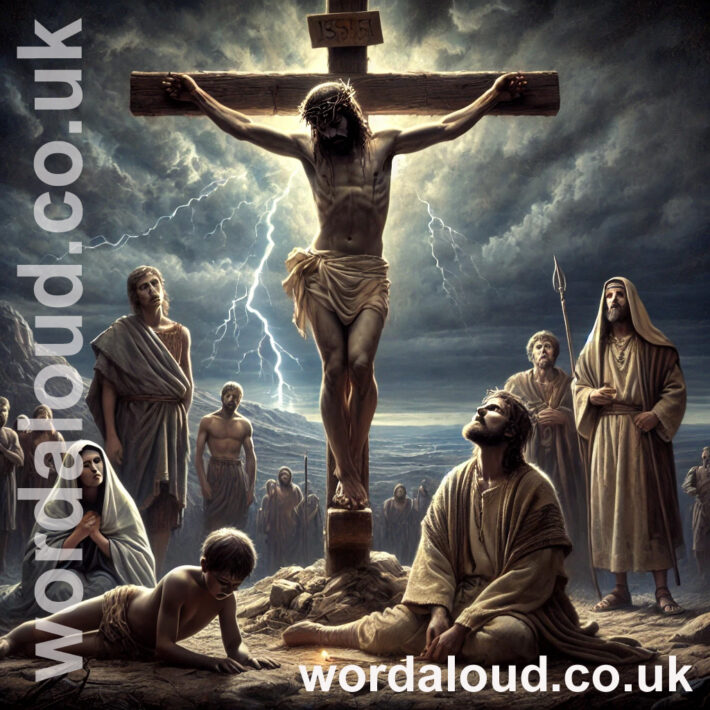
George Herbert: 1593-1633: poet and English priest. ‘The Sacrifice’, part of his collection ‘The Temple’, is a profound meditation on the Passion of Christ. The poem is distinctive for its focus on Christ’s voice and its refrain, ‘Was ever grief like mine?’ which underscores the unique nature of Christ’s suffering.
Herbert structures the poem as a dramatic monologue, with Christ narrating his journey to the Cross. The refrain not only highlights the unmatched sorrow of Christ’s ordeal but also serves as a rhetorical question that invites readers to contemplate such depth of Christ’s sacrifice. The refrain anchors each stanza and reinforces a theme of unparalleled grief.
The poem’s imagery and direct address create an intimate and immediate connection with the reader. Herbert vividly recounts scenes such as Judas’s betrayal, Peter’s denial, and the crowd’s condemnation. Each of these moments is depicted through Christ’s perspective, offering a detailed exploration of Christ’s emotional and spiritual anguish.
Herbert’s formal choices are deliberate and significant. The poem’s quatrains and regular rhyme-scheme mirror the relentless progression of Christ’s suffering. This structure reflects Herbert’s view of divine providence and order, even amidst the chaos and pain of the Passion. The disciplined form of the poem underscores the steadfast nature of Christ’s sacrifice and unwavering love it represents.
The voice of Christ in ‘The Sacrifice’ conveys a dual sense of resignation and questioning. Jesus recounts the events with calm acceptance, and yet a tension captures the mystery of the Passion: coexistence of divine foreknowledge and human pain. Christ’s voice serves as a bridge, connecting the divine to the human experience of suffering.
Themes of betrayal, injustice and sacrifice permeate the poem. Herbert does not present these acts merely as historical occurrences but as human behaviors with ongoing relevance. Judas’s kiss, Peter’s denial, and the crowd’s shouts resonate with readers, inviting us to reflect on our actions and their implications.

The Sacrifice | George Herbert | Christian Poems
Oh all ye, who pass by, whose eyes and mind To worldly things are sharp, but to me blind; To me, who took eyes that I might you find: Was ever grief like mine?
The Princes of my people make a head Against their Maker: they do wish me dead, Who cannot wish, except I give them bread: Was ever grief like mine?
Without me each one, who doth now me brave, Had to this day been an Egyptian slave. They use that power against me, which I gave: Was ever grief like mine?
Mine own Apostle, who the bag did bear, Though he had all I had, did not forbear To sell me also, and to put me there: Was ever grief like mine?
For thirty pence he did my death devise, Who at three hundred did the ointment prize, Not half so sweet as my sweet sacrifice: Was ever grief like mine?
Therefore my soul melts, and my heart’s dear treasure Drops blood (the only beads) my words to measure: Oh let this cup pass, or pass by this measure: Was ever grief like mine?

Psalm 3 reads like a personal entry in a diary. The psalmist opens up about the challenges he’s facing and how he discovers resilience through his faith in God. The psalmist finds himself surrounded by difficulties and doubters. Yet, amidst it all, he senses a protective presence from the divine [ … ]
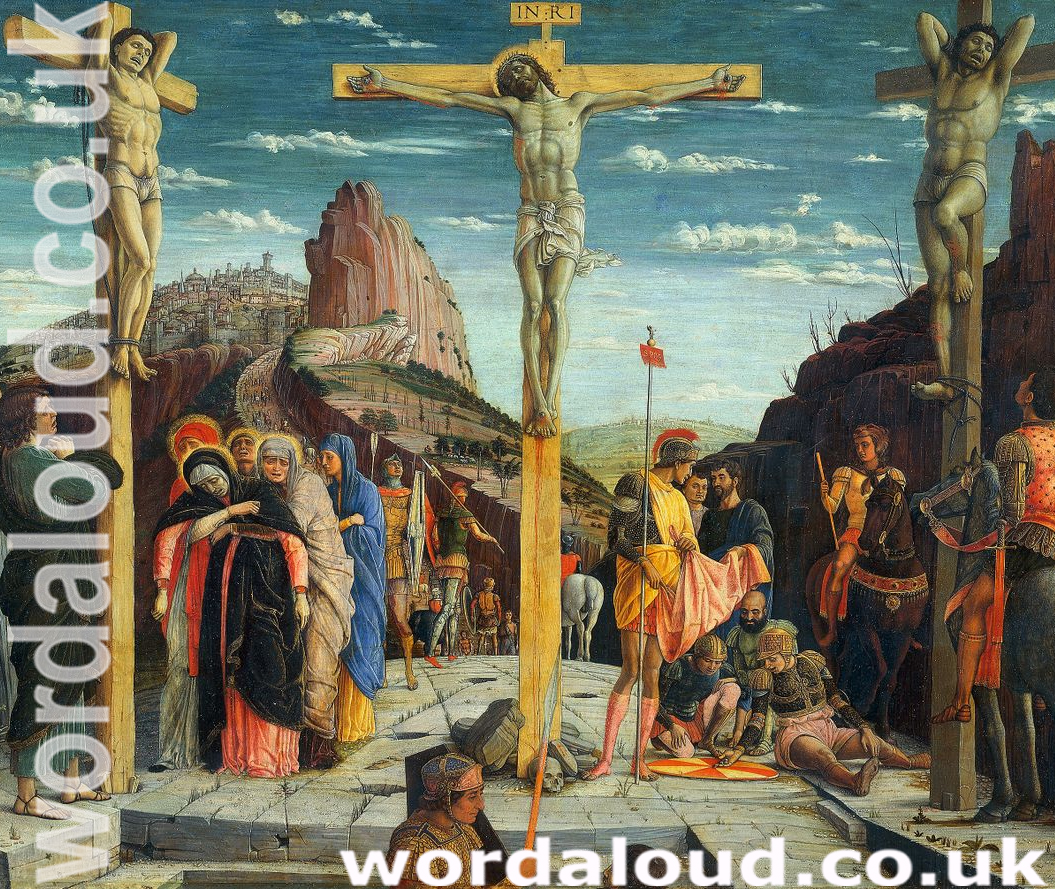
Christian Art | Our Lord Jesus On The Cross | God The Father | God The Son Office Of Readings | Advent December 23rd | A Reading From The Treatise Of Saint Hippolytus Against The Heresy Of Noetus | The Hidden Sacrament Is Revealed ‘The hidden sacrament is revealed.’ In this reading, Saint Hippolytus writes against the Noetic heresy, which denied the real distinction between the Father and the Son by treating them as the same person acting under different names. The purpose of Saint Hippolytus is to defend the Church’s confession of one God who is not solitary, but who exists with his Word and Spirit. Hippolytus begins by setting a principle: knowledge of God comes from the Holy Scriptures, not from speculation or private reasoning. Faith is not shaped by human preference but by what God has chosen to reveal. The Father determines how He is believed, the Son how He is glorified, and the Spirit how He is received. This establishes Scripture as the rule of faith and guards against theological invention. Hippolytus then affirms that God existed alone before creation, with nothing co-eternal alongside Him. At the same time, God was not without reason, wisdom, or power. Hippolytus insists that plurality within God does not compromise divine unity. God contains within himself Word, wisdom, and counsel. Creation begins when God wills and manifests His Word. The Word is not created from nothing but proceeds from God and acts as the agent of creation. The Word is first invisible to the created world, though known to God. When God chooses, He makes the Word visible, described as ‘Light of Light’. This language safeguards both distinction and unity: the Word comes from God and reveals God, without being separate from Him. The manifestation of the Word is ordered towards salvation, so that the world may see and be saved. Hippolytus identifies this Word clearly with the Son of God. Through him all things were made, and he alone comes forth from the Father. The Law and the prophets belong to the same saving plan. God speaks through them by the Holy Spirit, so that they proclaim not their own ideas but the Father’s will. Revelation is therefore coherent: creation, prophecy, and incarnation belong to one divine purpose. Hippolytus appeals to the Gospel of John to show continuity between prophecy and fulfilment. The Word spoken of by the prophets is the Word made flesh. Though the world was made through him, it failed to recognise him. This failure does not negate God’s plan but reveals the depth of the mystery now disclosed. A Reading From The Treatise Of Saint Hippolytus Against The Heresy Of Noetus | The Hidden Sacrament Is Revealed There is, brethren, one God, the knowledge of whom we gain from the Holy Scriptures and from no other source. Whatever things the Holy Scriptures declare, at these let us look; and whatever they teach, let us learn it; and as the Father wills our belief to be, let us believe; and as he wills the Son to be glorified, let us glorify him; and as he wills the Holy Spirit to be bestowed, let us receive him. Not according to our own will, nor according to our own mind, nor yet storming by force the things which are given by God, but even as he has chosen to teach them by the Holy Scriptures, so let us discern them. God, subsisting alone, and having nothing coeval with himself, chose to create the world. And conceiving the world in mind, and willing and uttering the Word, he made it; and at once it appeared, formed it in the way he desired. For us it is sufficient simply to know that nothing was coeval with God. Outside him there was nothing; but he, while existing alone, yet existed in plurality. For he did not lack reason, or wisdom, or power, or counsel. All things were in him, and he was the All. At a time and in a manner chosen by him he made his Word manifest, and through his Word he made all things. He bears this Word in himself, as yet invisible to the created world. He makes him visible, uttering the voice first, and begetting him as Light of Light. He presents him to the world as its Lord; and whereas the Word was visible formerly to God alone, and invisible to the world which is made, God makes the Word visible in order that the world might see him and be able to be saved. This is the mind which came forth into the world and was manifested as the Son of God. All things came into being through him, and he alone comes from the Father. He gave us the Law and the prophets; and in giving them, he made them speak by the Holy Ghost, in order that, receiving the inspiration of the Father’s power, they might declare the Father’s counsel and will. Thus, then, was the Word made manifest, even as the blessed John says. For he sums up the things that were said by the prophets, and shows that this is the Word, by whom all things were made. In the beginning was the Word, and the Word was with God, and the Word was God. All things were made by him, and without him nothing was made. And later, The world was made by him, and the world did not know him; he came to his own, and his own did not receive him. Christian Prayer With Jesus Lord God,You are one, and from You come the Word and the Spirit.You have chosen to make Yourself known, not by human effort,but by what You have revealed in the scriptures. You spoke Your Word, and all things were made.You made that Word visible, so that the world might see and be saved.Grant that we may receive what You give,believe what You teach,and worship You as You have shown Yourself to be. Keep us […]
In this address, Pope Paul VI reflects on Nazareth as the ordinary setting in which the Son of God lived most of his earthly life. Nazareth is presented not primarily as a place of historical interest, but as a school in which the Gospel is learned [ … ]