
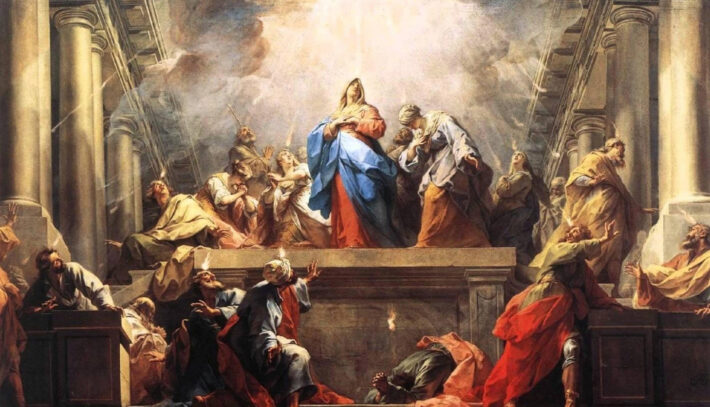
Christian Art | King James Audio Bible KJV | Christ’s Hymn Of Joy | Love Revealed By Jesus Christ
Luke 10: 21-24 | Advent Tuesday Week 1 | King James Audio Bible KJV
21 ¶ In that hour Jesus rejoiced in spirit, and said, I thank thee, O Father, Lord of heaven and earth, that thou hast hid these things from the wise and prudent, and hast revealed them unto babes: even so, Father; for so it seemed good in thy sight.
22 All things are delivered to me of my Father: and no man knoweth who the Son is, but the Father; and who the Father is, but the Son, and he to whom the Son will reveal him.
23 ¶ And he turned him unto his disciples, and said privately, Blessed are the eyes which see the things that ye see:
24 For I tell you, that many prophets and kings have desired to see those things which ye see, and have not seen them; and to hear those things which ye hear, and have not heard them.
Jesus, as he journeys to Jerusalem, has dispatched seventy disciples to go on ahead to preach and heal. The seventy have returned with wonderful news, that Christ’s name is power over demons, and, we sense, that the Gospel is preached and received; the harvest is truly plentiful.
This is, then, a great evangelizing moment, even as people are still confused, many preferring to focus on the miracles only rather than on the life everlasting which is to be in heaven, and even while there is disbelief. Still, there is so much belief swelling in the land, so prompting Christ’s hymn of joy.
Jesus rejoices that, while the so-called wise and educated have failed to see the truth of his teaching, such that salvation remains hidden from them, the truth has been revealed to babes – The humble people understand and accept the word of God in ways the wise scholars cannot. We are reminded that we are to become like children to enter the kingdom of heaven. (Matthew 18: 3) This does not imply a regression to weakness, softness, and infantilism; rather a relinquishing of pride, conceit, worldly knowledge and standing, and claims to spiritual self-sufficiency. It is the recognition that we absolutely need God’s grace.
Jesus now announces himself as the Son of God, in such close relationship with the Father, consubstantial with the Father, and able also to reveal God the Father to us. Jesus rejoices in the custodial role that the Father has given him. This is the fulfilment of history the prophets longed for.
‘He who enriches others becomes poor. He took to himself the poverty of my flesh so that I might obtain the riches of his godhead. He who is full empties himself. He emptied himself of his godhead for a brief time so that I might share in his fullness… It was necessary that holiness be conferred on man through the humanity of God took to himself. In this way, conquering the tyrant by force, he freed us and led us back to himself through his Son, the mediator. The Son brought this about to the honour of the Father to whom, in all things, he is seen to defer.’ St Gregory Nazianzen


King James Audio Bible | Endnotes
Luke 10:21-24, often referred to as the ‘Hymn of Joy’, is a powerful passage that highlights the importance of joy and gratitude in our lives as followers of Christ. Pope Francis and Pope Benedict XVI have both spoken about the significance of this passage and its impact on our spiritual journeys.
Pope Francis has emphasized the idea that true joy comes from within, and is not dependent on external circumstances. He states, ‘Joy is a gift from God, and it is the fruit of our relationship with Him. When we are connected to Jesus, we are filled with a deep sense of peace and contentment, even in the midst of trials and difficulties.’
Pope Benedict XVI also reflects on the importance of joy in our lives as Christians, saying, ‘Joy is not just an emotion or a feeling, but it is a state of being that is rooted in our relationship with God. It is a sign of our connection to the divine, and it is a powerful witness to the world.’
Jesus rejoices in the Holy Spirit and gives thanks to God for revealing the mysteries of the kingdom to the lowly, rather than the wise and powerful. This passage teaches us that true joy is found in humility and in recognizing the blessings that God has given us.
Pope Francis emphasizes this message, stating: ‘Joy is not something that we can manufacture or attain on our own. It is a gift from God, and it is only by embracing His love and surrendering ourselves to Him that we can experience true joy.’
Pope Benedict XVI similarly notes: ‘The Hymn of Joy in Luke 10:21-24 reminds us that our joy is rooted in our relationship with God and our recognition of His love for us. When we are focused on God, we are able to find joy in all circumstances, and we are able to share that joy with others.’


YouTube: Ash Wednesday | T.S. Eliot | Audio Christian Poetry | Word Aloud Ash Wednesday, one of T.S. Eliot’s most profound and enigmatic poems, marks a significant transition in his life and work. Written in 1930, it is the first long poem Eliot composed after his conversion to Anglicanism in 1927. The poem, often considered one of Eliot’s masterpieces, delves into themes of faith, redemption, and spiritual struggle. It reflects the poet’s personal journey towards spiritual enlightenment and serves as a testament to his newfound religious beliefs. A reading of Ash Wednesday is an exploration of the poem’s religious, literary, and personal contexts, as of the poem’s complex structure and themes. Religious Context And Symbolism Ash Wednesday is deeply embedded in Christian symbolism and tradition. The title refers to the first day of Lent in the Christian liturgical calendar, a day marked by penance, fasting, and prayer. Ash Wednesday is a time for reflection on mortality and repentance, themes that are intricately woven throughout the poem. Eliot’s conversion to Anglicanism profoundly influenced his writing; ‘Ash Wednesday’ is an expression of spiritual awakening and quest for redemption. The poem is replete with religious imagery and references, drawing on Christian doctrine and scripture. The use of liturgical language, biblical allusions, and references to saints and spiritual figures creates a tapestry of faith that invites readers to contemplate deep spiritual truths with which Eliot is grappling. The repetitive and prayer-like quality of the verses echoes meditative practices of the faithful, in part enabling the contemplative nature of the poem. Literary Influences And Techniques T.S. Eliot was a master of literary allusion and technique, and Ash Wednesday expresses Eliot’s ability to blend various influences into a cohesive whole. The poem reflects the influence of Dante, particularly The Divine Comedy, which Eliot admired for its exploration of spiritual ascent and redemption. Dante’s journey through Hell, Purgatory and Heaven parallels Eliot’s own spiritual journey, and the structure of Ash Wednesday can be seen as a reflection of this pilgrimage. Eliot’s use of fragmented narrative, a hallmark of his earlier work such as The Waste Land, is also present in Ash Wednesday. However, in this poem, the fragmentation serves a different purpose. Instead of depicting the disintegration of modern society, it mirrors the fragmented and often painful process of spiritual rebirth. The disjointed structure reflects the internal struggle of the speaker, who is torn between the pull of worldly desires and the aspiration for divine grace. The poem’s language is rich and varied, combining the lyrical and the obscure, the personal and the universal. Eliot employs a range of poetic forms and devices, including free verse, rhyme and meter, to convey the tumultuous journey of faith. The shifting tone and style reflect the complexities and contradictions inherent in the spiritual quest, capturing moments of doubt, despair, hope, and transcendence. Personal Significance Ash Wednesday is a deeply personal work. Eliot’s conversion to Anglicanism marked a profound shift in his life, providing a sense of purpose and direction that had been missing. The poem can be read as a reflection of Eliot’s own struggles with faith and his efforts to reconcile his intellectual skepticism with his desire for spiritual certainty. Eliot’s personal experiences, including his troubled marriage and professional pressures, also inform the poem. Themes of renunciation and acceptance, sin and redemption, are not merely abstract concepts but lived realities for the poet. This personal dimension adds a layer of intimacy and urgency to the poem, which thereby resonates with readers who have faced their own spiritual crises. Thematic Exploration At its core, Ash Wednesday is a meditation on the possibility of spiritual renewal in a world that often seems devoid of meaning. The poem grapples with the tension between faith and doubt, reflecting the existential struggles of modernity. The poem acknowledges the difficulties of maintaining belief in an age of skepticism but ultimately affirms the possibility of redemption and grace. The central theme of renunciation is explored through imagery of ascension and purification. The speaker’s journey is marked by a series of renunciations, symbolizing the shedding of earthly attachments in pursuit of spiritual truth. This process is neither straightforward nor easy; it involves moments of intense struggle and introspection. Yet, through this arduous journey, the speaker moves closer to a state of spiritual clarity and acceptance. Ash Wednesday | T. S. Eliot Because I do not hope to turn again Because I do not hope Because I do not hope to turn Desiring this man’s gift and that man’s scope I no longer strive to strive towards such things (Why should the agèd eagle stretch its wings?) Why should I mourn The vanished power of the usual reign? Because I do not hope to know The infirm glory of the positive hour Because I do not think Because I know I shall not know The one veritable transitory power Because I cannot drink There, where trees flower, and springs flow, for there is nothing again Because I know that time is always time And place is always and only place And what is actual is actual only for one time And only for one place I rejoice that things are as they are and I renounce the blessèd face And renounce the voice Because I cannot hope to turn again Consequently I rejoice, having to construct something Upon which to rejoice And pray to God to have mercy upon us And pray that I may forget These matters that with myself I too much discuss Too much explain Because I do not hope to turn again Let these words answer For what is done, not to be done again May the judgement not be too heavy upon us Because these wings are no longer wings to fly But merely vans to beat the air The air which is now thoroughly small and dry Smaller and dryer than the will Teach us to care and not to care Teach us to sit still. Pray for us sinners now […]

‘The Agony’, part of Herbert’s collection ‘The Temple’, Herbert explores theological dimensions of sin, suffering, and redemption. This poem, through its triadic structure, conveys complex spiritual truths through poetic form [ … ]

The First Letter of Clement is one of the earliest post-New Testament Christian writings, dating to around 95 A.D. Clement was the third successor of Saint Peter as Bishop of Rome, and his letter was written to address a crisis in the Corinthian church, where a group of younger Christians had ousted their elders from leadership. Clement’s primary aim was to restore harmony and proper ecclesial order. Against this background, his call for unity, humility, and order takes on profound urgency [ … ]
