

Mark 6: 34-44 – Tuesday after Epiphany (Audio Bible, Spoken Verse)
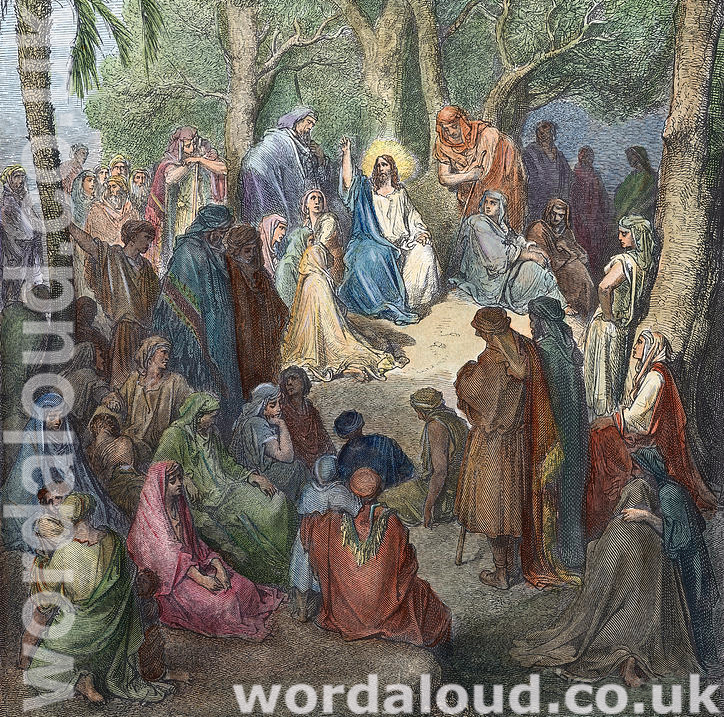
34 And Jesus, when he came out, saw much people, and was moved with compassion toward them, because they were as sheep not having a shepherd: and he began to teach them many things.
35 And when the day was now far spent, his disciples came unto him, and said, This is a desert place, and now the time is far passed:
36 Send them away, that they may go into the country round about, and into the villages, and buy themselves bread: for they have nothing to eat.
37 He answered and said unto them, Give ye them to eat. And they say unto him, Shall we go and buy two hundred pennyworth of bread, and give them to eat?
38 He saith unto them, How many loaves have ye? go and see. And when they knew, they say, Five, and two fishes.
39 And he commanded them to make all sit down by companies upon the green grass.
40 And they sat down in ranks, by hundreds, and by fifties.
41 And when he had taken the five loaves and the two fishes, he looked up to heaven, and blessed, and brake the loaves, and gave them to his disciples to set before them; and the two fishes divided he among them all.
42 And they did all eat, and were filled.
43 And they took up twelve baskets full of the fragments, and of the fishes.
44 And they that did eat of the loaves were about five thousand men.
Jesus has invited the disciples to come away with him to find a lonely place, where they might rest. The pressures of the apostolic ministry have been so great, there has not been time even to eat. Jesus and the apostles have gone away from the crowds in a boat, but the people have seen them leave and have run ahead to find them, arriving at the place before Jesus does. Jesus, then, changes his plans. The rest period is not to be. Jesus feels compassion for the spiritual needs of the people. They need the teaching Jesus is able to give to them. They are as sheep without a shepherd. This need is paramount.
Immediately prior to these verses, the Gospel of Mark has recorded the martyrdom of John the Baptist, recounting the banquet of death, during which Herodias’ daughter pleases Herod and demands the head of John the Baptist as her reward, to which demand Herod succumbs.
We see, then, the great contrast between the Gospel episodes. Where Herod’s was a banquet of death, Jesus’ teaching of the multitude who have followed him out into the wilderness becomes a banquet of life.
The crowds have spent the day listening to Jesus, and now the day is spent; the disciples recognize and tell Jesus of the hunger of the people. The disciples do not, though, understand what Jesus means when he tells them to feed the crowds. They respond in amazement: Are they to go and buy two hundred denarii worth of bread? A denarius was a day’s wage for an artisan – this would be a significant sum of money.
Where the disciples have looked outside of the crowds for a solution to the hunger of the crowds, Jesus directs them not to look elsewhere but rather to look within. Jesus says to his disciples: How many loaves do you have? Go and see.
The disciples do so and return to Jesus with a seemingly hopeless answer: in all the crowds, there are five loaves, and two fishes. This is what is seemingly on offer among so many people – 5000 men. It doesn’t matter if others are hiding their food, and this is only the offering of one good person when that person is asked if he has any food to share. Perhaps it was so. Either way, now the miracle happens.
Jesus accepts this little offering, offered in what must have been such a loving and selfless manner, and Jesus asks the people present to perform a symbolic action: And he commanded them to make all sit down by companies upon the green grass. Jesus tells the apostles to make all of those present sit down, to adopt an attitude of peace, of passivity. We may remind ourselves that Jesus is preaching in a sectarian environment, and this sitting down is akin to a laying down of arms, and beyond this of differences and possible grievances.
At the supper of the Lord, we resolve our differences and we admit in a lowly way that we are all equal before God. We all equally crave God’s help – grace. We acknowledge our own shortcomings, known as sins, and we embrace our neighbours with all commonality and friendliness.
Mark’s Gospel account of Jesus’ words and actions tells of Jesus celebrating what would later become the Eucharist, and in similar words: he looked up to heaven, and blessed, and brake the loaves. The Last Supper and the Eucharist to come are anticipated, and the multitudes are fed abundantly. Of the five loaves and two fishes, twelve baskets of scraps remain to be gathered, symbolic of the people of Israel, and also of the preciousness of everything we do and of all that we offer to God and as we live with Jesus.
Moses told the people to gather just as much as they needed each day of the manna in the wilderness, and not to save anything for the next day, save prior to the Sabbath, else it would become corrupt and breed worms. Elijah gave the widow just enough to meet her needs. Jesus gives superabundantly.
For Zion’s sake will I not hold my peace, and for Jerusalem’s sake I will not rest, until the righteousness thereof go forth as brightness, and the salvation thereof as a lamp that burneth. (Isaiah 62:1)
God, our Father,
when your Only-begotten Son revealed himself in flesh and blood,
we came to know him as our fellow man.
May he transform us inwardly until we bear his likeness,
who lives and reigns with you and the Holy Spirit,
God, for ever and ever.




Pope Saint Leo the Great moves from Christ’s blessing on the meek to those beatitudes pronounced on those who ‘hunger and thirst for righteousness’ (Matthew 5:6), the merciful (v.7), and the pure of heart (v.8). His reflection reveals the interconnectedness of these dispositions, which together form a path of Christian wisdom [ … ]
The Epistle To The Romans combines the occasional character of an early Christian letter with extended theological argument concerning law, the Law, covenant, sin, salvation, and the relation between Jews and Gentiles. Written probably in the late 50s AD, and during Paul’s stay in Corinth, the letter was addressed to Christian communities in Rome which Paul had not himself founded. Unlike several of his other letters, Romans was not written primarily in response to a specific local crisis already familiar to him. Instead, it functions partly as an introduction to his teaching and partly as an attempt to address tensions emerging within mixed Jewish / Gentile communities in the imperial capital [ … ]

Saint Cyprian’s reflections on prayer provide a timely reminder of the essential posture a Christian must adopt when approaching God: one of humility, modesty and inward sincerity. He addresses not only the physical form of prayer but the disposition of the heart, drawing together scripture and practice in a coherent and edifying whole [ … ]
