
Christian Art | George Herbert | The Temple | The Church | Holy Baptism (2)
George Herbert | The Temple | The Church | Holy Baptism (2)
Since, Lord, to thee
A narrow way and little gate
Is all the passage, on my infancie
Thou didst lay hold, and antedate
My faith in me.
O let me still
Write thee great God, and me a childe:
Let me be soft and supple to thy will,
Small to my self, to others milde,
Behither ill.
Although by stealth
My flesh get on, yet let her sister
My soul bid nothing, but preserve her wealth:
The growth of flesh is but a blister;
Childhood is health.


George Herbert | The Temple | The Church | Holy Baptism (2)
The poem contemplates the nature of spiritual growth and the relationship between the soul and the body in a Christian context. It begins with a recognition of the ‘narrow way and little gate’, referencing a biblical metaphor for the difficult path of righteousness (Matthew 7:13-14). The poet reflects on his early spiritual awakening (‘on my infancy / Thou didst lay hold’) and the idea that God preemptively initiated his faith before he could fully comprehend it (‘antedate my faith in me’). This expresses the belief that faith is a gift from God, implanted at an early stage.
The next stanza introduces the poet’s desire to maintain humility before God. He prays, ‘Let me still / Write thee great God, and me a child,’ meaning he wishes to always recognize God’s greatness while remaining childlike in humility and obedience. The poet desires to remain ‘soft and supple’ to God’s will, indicating a readiness to submit to divine guidance, free from the ego or self-centeredness that might obstruct spiritual growth (‘Small to myself, to others mild’). This submission and humility contrast with ‘ill’, a term likely signifying sin or moral wrongdoing, which he wishes to avoid.
The third stanza contrasts the ‘flesh’ and the ‘soul’, reflecting a common Christian theme of the inner battle between physical desires and spiritual purity. The poet observes that his flesh, symbolizing earthly or sinful tendencies, grows ‘by stealth’—subtly and almost imperceptibly. However, he asks that his soul, the spiritual sister to the body, remain unaffected by these physical desires (‘let her sister / My soul bid nothing’). The poet sees the body’s physical growth as ultimately harmful or misleading, calling it ‘but a blister’, a temporary and ultimately inconsequential swell that distracts from the true health of the soul. In contrast, he equates spiritual innocence, which he links to ‘childhood’, with true ‘health’.
The central theme of the poem revolves around the importance of spiritual humility, purity, and dependence on God’s guidance in life. By comparing the soul’s relationship to the body with the innocence and dependence of a child, the poet suggests that spiritual health is maintained not by worldly achievements or physical growth, but by staying close to God and resisting the temptations and distractions of the flesh.
In its overall structure, the poem is composed of three stanzas, each reflecting a different aspect of the poet’s inner life: his early faith, his ongoing humility, and the tension between the soul and the flesh. Each stanza builds on the theme of spiritual vulnerability, asking for God’s help in preserving the innocence and purity of faith in the face of life’s complexities and temptations. The poem reflects a deep understanding of Christian spirituality, emphasizing the need for divine grace in navigating the challenges of earthly existence.


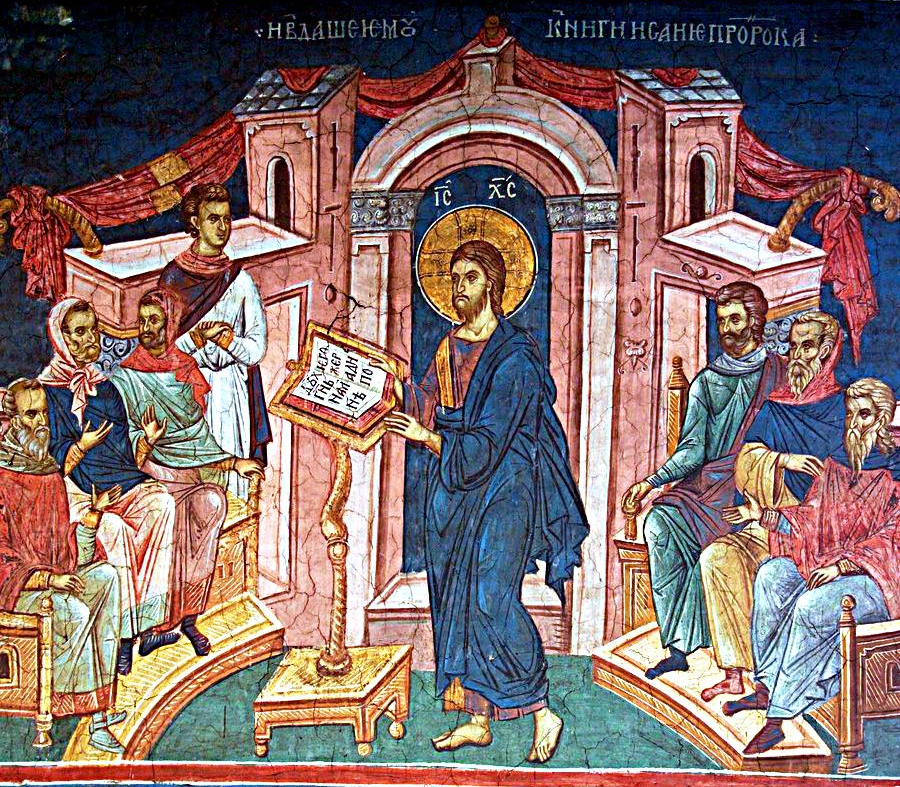
On the Sabbath, the day of rest and prayer, the Jews would gather in synagogues to recite the Shema and the eighteen blessings, which would be followed by readings from the Book of the Law, the Pentateuch, and from the Prophets. In today’s Gospel verses, Jesus has returned home to Nazareth, where, in the synagogue, he volunteers to read [ … ]

Psalm 125, one of the Psalms of Ascent, opens with a comparison of those who trust in the Lord to mount Zion. This comparison signifies stability and permanence. The psalmist uses the physical geography of Jerusalem and its surrounding mountains to illustrate the protection provided by the Lord to God’s people. This imagery serves as a metaphor for divine security and steadfastness [ … ]
Saint Gregory begins by contrasting superficial knowledge of God with actual participation in God’s life. It is not enough to know about God; we must come to possess Him inwardly. Drawing on the doctrine of the imago Dei (image of God), Gregory teaches that the divine image implanted within us at creation has been tarnished by sin. Yet this image is not destroyed—it can be restored. The human heart, when purified, becomes like a polished mirror capable of reflecting divine light [ … ]
