

Christian Art | George Herbert | The Temple | The Church | Vanitie (1)
George Herbert | The Temple | The Church | Vanitie (1)
The fleet Astronomer can bore,
And thred the spheres with his quick-piercing minde:
He views their stations, walks from doore to doore,
Surveys, as if he had design’d
To make a purchase there: he sees their dances,
And knoweth long before,
Both their full-ey’d aspects, and secret glances.
The nimble Diver with his side
Cuts through the working waves, that he may fetch
His dearely-earned pearl, which God did hide
On purpose from the ventrous wretch;
That he might save his life, and also hers,
Who with excessive pride
Her own destruction and his danger wears.
The subtil Chymick can devest
And strip the creature naked, till he finde
The callow principles within their nest:
There he imparts to them his minde,
Admitted to their bed-chamber, before
They appeare trim and drest
To ordinarie suitours at the doore.
What hath not man sought out and found,
But his deare God? who yet his glorious law
Embosomes in us, mellowing the ground
With showres and frosts, with love and aw,
So that we need not say, Where’s this command?
Poore man, thou searchest round
To finde out death, but missest life at hand.


George Herbert | The Temple | The Church | Vanitie (1)
George Herbert’s poem explores humanity’s relentless pursuit of knowledge and mastery over the natural world, juxtaposing these achievements with the failure to recognize and embrace God’s immediate presence. The poem is structured around vivid images of human ingenuity, drawing on the astronomer, diver, and chemist (or ‘chymick’) as archetypes of humanity’s intellectual and physical endeavors. Yet, beneath these triumphs lies a critique: the neglect of the divine, who resides ‘at hand’ rather than in the distant realms humanity seeks to conquer.
Herbert begins by depicting the astronomer, whose ‘quick-piercing minde’ enables him to traverse the heavens. The astronomer ‘thred[s] the spheres,’ mapping their ‘stations’ and ‘dances’. This mastery of celestial movements suggests both awe and futility. While the astronomer appears to possess dominion over the stars, his efforts are framed as acquisitive, likened to a surveyor seeking to ‘make a purchase there’. The implication is clear: this pursuit of knowledge, though impressive, remains fundamentally material and incomplete, lacking the transformative insight found in divine truth.
The second stanza turns to the diver, whose daring pursuit of pearls reflects human determination and ingenuity. The diver’s ability to ‘cut through the working waves’ speaks to the strength and skill required to unearth treasures ‘God did hide’. Yet Herbert introduces a moral caution: the pearls are hidden deliberately, both to preserve the diver’s life and to temper the destructive pride of the one who wears them. The diver’s quest, like the astronomer’s, is fraught with spiritual peril. It highlights humanity’s tendency to risk all for fleeting rewards, neglecting the eternal.
The third stanza shifts focus to the ‘chymick’, whose precision and analytical prowess enable him to ‘devest and strip’ creation to its essence. Herbert portrays this figure as penetrating the inner sanctum of nature, uncovering the ‘principles’ hidden within. Yet, even as the chemist unravels the mysteries of the material world, Herbert implies a spiritual blindness. The ‘callow principles’ laid bare are insufficient without divine illumination, and the chemist’s successes, while remarkable, cannot substitute for the transformative power of God’s presence.
In the final stanza, Herbert reflects on the irony of human endeavour. ‘What hath not man sought out and found,’ he asks, ‘but his deare God?’ This rhetorical question underscores humanity’s misplaced priorities. Despite possessing the ‘glorious law’ within, ‘embosom’d’ by God, man searches outwardly, missing the life-giving presence of the divine. Herbert’s imagery of the earth ‘mellowing…with love and aw’ reminds the reader that God’s commandments are not distant or inaccessible but are embedded in the fabric of creation.
The poem concludes with a stark juxtaposition: humanity’s relentless search for knowledge leads not to life but to death. The repeated image of ‘searching round’ reinforces the futility of this pursuit. Herbert’s critique is not of knowledge itself but of the neglect of God, who offers a life ‘at hand’ that is continually overlooked. The final admonition, though unspoken, is clear: to seek God within, embracing immediacy of God’s presence rather than chasing after the transient and the distant.
By interweaving imagery of human achievement with divine proximity, Herbert challenges the reader to reconsider what it means truly to ‘find’. The poem’s tensions – seeking and presence, knowledge and wisdom – express a central theme of Herbert’s work: the eternal is not discovered in farthest reaches but within the heart attuned to God.


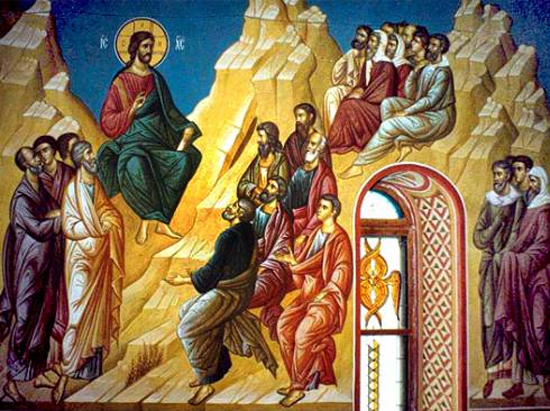
When we are offended or injured, Jesus teaches us not to demand pay-back, an eye for our eye, a tooth for our tooth, but rather to forgive, and where there was hatred, to bring instead to the situation the opposite of hatred, which is love [ … ]

In Matthew’s Gospel, this is Jesus’ second announcement of his Passion. This time, the reaction of the disciples has mellowed. It is less extreme, while they remain very sorry. The disciples begin to recognize the cross as a necessary step on Jesus’ journey. We may think of our own tears mingled with joy as we contemplate Christ’s sacrifice, for example as we give ourselves in prayer, in adoration of the Blessed Sacrament. We may also note that the sorrow of the disciples follows upon Jesus’ saying that he will be raised again. Our sorrow as we contemplate Jesus’ death includes the resurrection. We may weep for the necessity and the absolute love and self-giving of Jesus’ sacrifice [ … ]

Origen of Alexandria (c. 185–c. 253) was a prolific early Christian scholar and theologian whose works shaped Christian thought. His method of biblical interpretation often sought deeper, spiritual meanings beyond the literal text, emphasizing typology—the idea that events and figures in the Old Testament prefigure their fulfilment in the New Testament. His homily on the high priest’s atonement exemplifies this approach, presenting Christ as the ultimate realization of the Levitical priesthood [ … ]
