

Christian Art | Theophany | Baptism Of Jesus In The River Jordan By John The Baptist
Office Of Readings | 9th January | A Reading From The Orations Of Saint Proclus Of Constantinople | The Sanctifying Of The Waters
‘The sanctifying of the waters.’
In this reading, Saint Proclus reflects on the feast of the Epiphany as a revelation that completes and deepens the mystery of Christmas. At Christmas, Jesus Christ is revealed in weakness, as an infant sharing fully in human vulnerability. At Epiphany, and especially in the baptism in the Jordan, Jesus Christ is revealed in his public mission and divine authority. The same Lord who lay in a manger now stands in the waters, sanctifying creation itself.
Proclus places strong emphasis on water. The Jordan is not simply the setting for Christ’s baptism but becomes a sign of renewal for the whole created order. By entering the water, Christ does not receive holiness; rather, he communicates holiness to the waters. This reflects an early Christian understanding of baptism as a cosmic event, restoring what was disordered by sin and renewing both humanity and creation.
The contrast with the flood in the time of Noah is deliberate. The flood brought destruction and judgement; baptism brings life and restoration. Where the ancient waters wiped out corruption by force, the waters of baptism heal and raise by grace. The descent of the Spirit as a dove recalls the dove of Genesis, but now the sign is fulfilled rather than anticipated. What was once a promise becomes a reality.
Proclus also stresses the universality of salvation. Epiphany reveals Christ not only to Israel but to all nations. Baptism is described as a ‘common grace’, offered equally to Jews and Gentiles. The revelation of Christ is therefore not private or limited, but public and inclusive.
Throughout the reading, paradox is central. Fire enters water without being extinguished. God is touched by human hands. The creator sanctifies creation by sharing its condition. These images are not meant to be explained away, but held together as expressions of the mystery of the incarnation. For Proclus, Epiphany shows that salvation is not abstract or distant, but worked out within the material world, through water, flesh, and history.
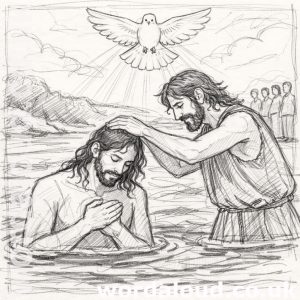
A Reading From The Orations Of Saint Proclus Of Constantinople | The Sanctifying Of The Waters
Christ appeared in the world, and, bringing beauty out of disarray, gave it lustre and joy. He bore the world’s sin and crushed the world’s enemy. He sanctified the fountains of waters and enlightened the minds of men. Into the fabric of miracles he interwove ever greater miracles.
For on this day land and sea share between them the grace of the Saviour, and the whole world is filled with joy. Today’s feast of the Epiphany manifests even more wonders than the feast of Christmas.
On the feast of the Saviour’s birth, the earth rejoiced because it bore the Lord in a manger; but on today’s feast of the Epiphany it is the sea that is glad and leaps for joy; the sea is glad because it receives the blessing of holiness in the river Jordan.
At Christmas we saw a weak baby, giving proof of our weakness. In today’s feast, we see a perfect man, hinting at the perfect Son who proceeds from the all-perfect Father. At Christmas the King puts on the royal robe of his body; at Epiphany the very source enfolds and, as it were, clothes the river.
Come then and see new and astounding miracles: the Sun of righteousness washing in the Jordan, fire immersed in water, God sanctified by the ministry of man.
Today every creature shouts in resounding song: Blessed is he who comes in the name of the Lord. Blessed is he who comes in every age, for this is not his first coming.
And who is he? Tell us more clearly, I beg you, blessed David: The Lord is God and has shone upon us. David is not alone in prophesying this; the apostle Paul adds his own witness, saying: The grace of God has appeared bringing salvation for all men, and instructing us. Not for some men, but for all. To Jews and Greeks alike God bestows salvation through baptism, offering baptism as a common grace for all.
Come, consider this new and wonderful deluge, greater and more important than the flood of Noah’s day. Then the water of the flood destroyed the human race, but now the water of baptism has recalled the dead to life by the power of the one who was baptized. In the days of the flood the dove with an olive branch in its beak foreshadowed the fragrance of the good odour of Christ the Lord; now the Holy Spirit, coming in the likeness of a dove, reveals the Lord of mercy.
Christian Prayer With Jesus Christ
Lord Jesus Christ,
You entered the waters of the Jordan to sanctify creation and to reveal your saving work.
Cleanse us by your Spirit, renew our hearts, and draw us into the life you offer to all nations.
May we live as people restored by grace and made new through baptism.
Amen
Glossary Of Christian Terms
Epiphany | The feast celebrating the manifestation of Christ to the world, especially through his baptism, the visit of the Magi, and the revelation of his divine identity.
The Jordan | The river in which Christ was baptised, understood by the Church as a sign of the renewal of creation through Christ.
Baptism | The sacrament by which a person is cleansed from sin, reborn in Christ, and incorporated into the Church.
Sanctification | The act by which God makes persons or creation holy, setting them apart for himself.
The dove | A biblical symbol of the Holy Spirit, recalling both the flood narrative in Genesis and the Spirit’s descent at Christ’s baptism.
Incarnation | The mystery of the Son of God taking human flesh in Jesus Christ.
Common grace | God’s saving gift offered to all people without distinction, particularly through Christ and the sacraments.
Creation | The whole created order, understood here as participating in redemption through Christ’s saving work.




This poem reflects an intense and deeply personal experience of spiritual desolation, longing, and eventual hope for renewal. Herbert describes a state of spiritual barrenness, where prayer seems to fail in reaching God, leaving the soul in turmoil and disarray. The journey unfolds through an exploration of frustration, despair, and a heartfelt plea for divine intervention [ … ]
Psalm 3 reads like a personal entry in a diary. The psalmist opens up about the challenges he’s facing and how he discovers resilience through his faith in God. The psalmist finds himself surrounded by difficulties and doubters. Yet, amidst it all, he senses a protective presence from the divine [ … ]

It is astonishing to think that very, very few people in the western world do not live in a manmade environment. There may be acres upon acres of farmers’ fields and forests in front of us, and every acre is managed by people, often in situations of great anxiety as they worry about whether they might make some money from their work here. There is little in the way of wilderness remaining in our territories, and each day more is taken away. We may anticipate that, in very little time, all human beings will be living in an obviously man-made environment. It may be that our life on earth will become quite claustrophobic [ … ]