
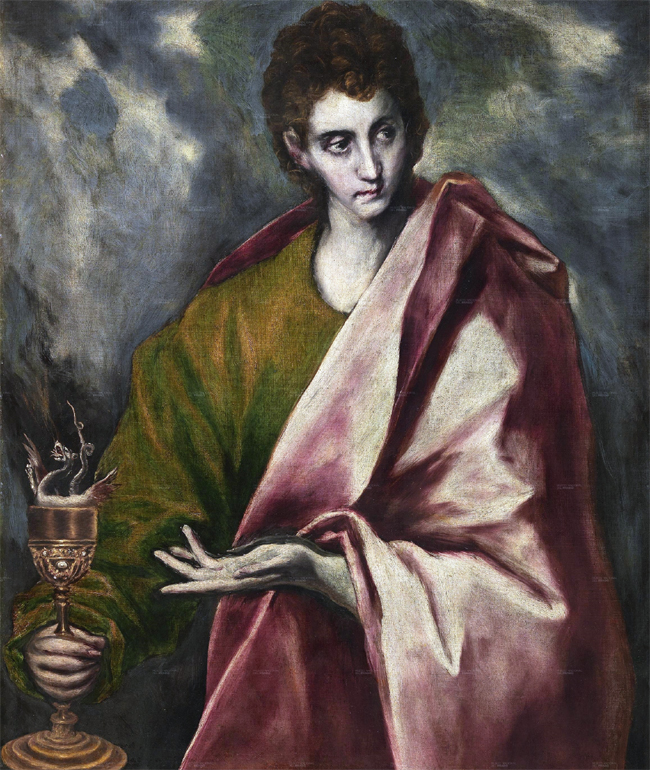
Christian Art | Saint John | Apostle, Disciple, Evangelist
Office Of Readings | Christmas 27 December | Saint John, Apostle, Evangelist | From A Treatise By Saint Augustine On The First Epistle Of John | The Flesh Revealed Life Itself
‘The flesh revealed Life itself.’
In this reading, Saint Augustine reflects on the opening of the first letter of John and explains how the incarnation makes communion with God possible. A central concern is the reality of Christ: the eternal Word truly became flesh and was encountered through the senses.
Augustine begins with the claim that the Word, who existed from the beginning, could be touched only because he became flesh. The incarnation does not mark the beginning of the Word’s existence, but the beginning of his visibility in human history. John’s letter is read in continuity with his Gospel, where the Word is said to be with God from the beginning.
A possible misunderstanding is addressed. The phrase ‘the Word of life’ might be taken to mean a message about Christ rather than Christ himself. Augustine rejects this reading. Life itself, he says, was revealed. Christ is not only the bearer of life but life in person. What was formerly known only in heaven has now appeared on earth.
Augustine then explains why this revelation took place in the flesh. The Word can be perceived by the heart, not by bodily sight. Human beings, however, were unable to see the Word because their hearts needed healing. By becoming flesh, the Word made himself visible to the eyes, in order to heal the inner faculty by which God is known. The visible humanity of Christ leads to faith in his invisible divinity.
The apostolic witness is central. The disciples saw and heard Christ directly and handed on what they received. Later believers have heard but not seen. Augustine insists that this difference does not diminish faith. Fellowship does not depend on physical sight, but on shared belief in the same Christ.
The purpose of this proclamation is communion. Fellowship with the apostles leads to fellowship with the Father and the Son. Joy, in this context, is not an emotion detached from belief, but the result of unity, love and participation in the life of God made known in Christ.

Saint John, Apostle, Evangelist | From A Treatise By Saint Augustine On The First Epistle Of John | The Flesh Revealed Life Itself
We announce what existed from the beginning, what we have heard, what we have seen with our own eyes, what we have touched with our own hands. Who could touch the Word with his hands unless the Word was made flesh and lived among us?
Now this Word, whose flesh was so real that he could be touched by human hands, began to be flesh in the Virgin Mary’s womb; but he did not begin to exist at that moment. We know this from what John says: What existed from the beginning. Notice how John’s letter bears witness to his Gospel, which you just heard a moment ago: In the beginning was the Word, and the Word was with God.
Someone might interpret the phrase the Word of life to mean a word about Christ, rather than Christ’s body itself which was touched by human hands. But consider what comes next: and life itself was revealed. Christ therefore is himself the Word of life.
And how was this life revealed? It existed from the beginning, but was not revealed to men, only to angels, who looked upon it and feasted upon it as their own spiritual bread. But what does Scripture say? Mankind ate the bread of angels.
Life itself was therefore revealed in the flesh. In this way what was visible to the heart alone could become visible also to the eye, and so heal men’s hearts. For the Word is visible to the heart alone, while flesh is visible to bodily eyes as well. We already possessed the means to see the flesh, but we had no means of seeing the Word. The Word was made flesh so that we could see it, to heal the part of us by which we could see the Word.
John continues: And we are witnesses and we proclaim to you that eternal life which was with the Father and has been revealed among us – one might say more simply ‘revealed to us.’
We proclaim to you what we have heard and seen. Make sure that you grasp the meaning of these words. The disciples saw our Lord in the flesh, face to face; they heard the words he spoke, and in turn they proclaimed the message to us. So we also have heard, although we have not seen.
Are we then less favoured than those who both saw and heard? If that were so, why should John add: so that you too may have fellowship with us? They saw, and we have not seen; yet we have fellowship with them, because we and they share the same faith.
And our fellowship is with God the Father and Jesus Christ his Son. And we write this to you to make your joy complete – complete in that fellowship, in that love and in that unity.
Christian Prayer With Jesus
Lord Jesus Christ,
eternal Word made flesh,
you made yourself known in human form
so that we might come to know the Father.
Strengthen our faith in what has been proclaimed to us,
though we have not seen with our eyes
what the apostles saw.
Draw us into true fellowship with you,
with the Father, and with one another,
so that our joy may be complete
in faith, love and unity.
Amen.
Glossary Of Christian Terms
Incarnation | The taking of human flesh by the eternal Word in the womb of the Virgin Mary.
The Word | The Son of God, who exists from all eternity with the Father and through whom all things were made.
Word of life | A title for Christ himself, who is not only the giver of life but life in person.
Fellowship | Shared participation in faith and life with the apostles, with one another, and with God.
Apostolic witness | The testimony of the apostles, who saw and heard Christ and handed on what they received.
Healing of the heart | The restoration of the inner capacity to know God, made possible through faith in Christ.
Eternal life | Participation in the life of God, revealed in Christ and shared with believers.



Saint Gregory’s theology is deeply shaped by the Eastern Christian doctrine of theosis, or divinisation. For Gregory, salvation is not merely juridical or moral but ontological: to be saved is to become by grace what Christ is by nature. When Gregory writes that Christians must examine their thoughts, words, and deeds to see whether they are ‘directed toward Christ’, he is describing a dynamic process of transformation. This process, which begins in baptism and continues throughout life, involves increasing conformity to the divine image. In this sense, Christian perfection is not a static achievement but an unending ascent towards God, as expressed in his Life of Moses [ … ]
Psalm 44 is an expression of tension between faith and adversity. It wrestles with the question of why suffering exists despite unwavering devotion to God. It is a poignant reminder that faith does not exempt individuals from trials and tribulations but rather serves as an anchor during these challenging times, keeping hope alive in the midst of uncertainty [ … ]
Today’s Bible verses, as per the Roman lectionary, notably elide Matthew 10: 5: ‘Go not into the way of the Gentiles, and into any city of the Samaritans enter ye not.’ This omission is curious, though understandable: during the Mass especially, we are to contemplate inclusion rather than exclusion, and the intentions behind Jesus’ initial injunctions to those he sends to preach might well require explanation. Jesus, then, tells his missionary disciples: you are sent now to preach to the Jews alone, not to Gentiles, not to Samaritans, but to Jews alone [ … ]
