
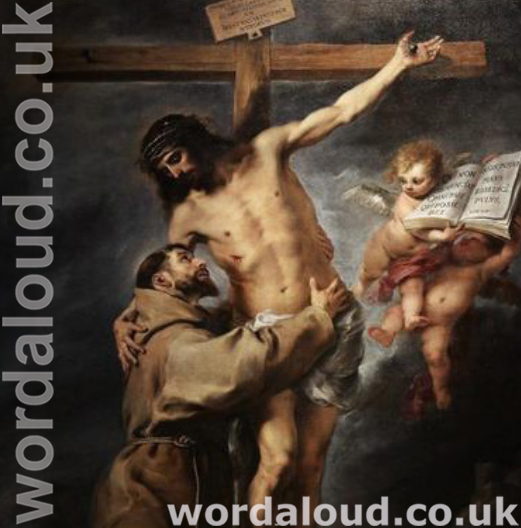
Christian Art | The Crucified Lord Jesus Expresses His Love For Saint Francis
Office Of Readings | Week 26, Monday, Ordinary Time | From The Letter Of Saint Polycarp To The Philippians | Let Us Be Armed With The Armour Of Integrity
‘Let us put on the armour of righteousness.’
Writing to the Philippians in the early second century, Saint Polycarp consciously places himself in continuity with Saint Paul, who had both preached in their city (Acts 16) and written to them decades earlier. His humility is striking: he openly acknowledges that he cannot rival the ‘wisdom of the blessed and glorious Paul’, yet he exhorts the faithful to live according to the same gospel Paul proclaimed. In this way, Polycarp embodies the role of a bishop as both guardian of apostolic teaching and shepherd of souls.
Faith, Hope, And Love | Framework Of Righteousness
Polycarp summarises the Christian life in three virtues: ‘faith, the mother of us all, followed by hope, preceded by love.’ This triad echoes Paul’s teaching, especially in 1 Corinthians 13 and 1 Thessalonians 1:3, where faith, hope, and love are described as the essence of Christian existence. By calling faith ‘the mother’, Polycarp underlines its foundational role in giving birth to the life of grace. Hope naturally follows, sustaining believers on their journey. Yet it is love—placed before both—that he describes as the true guardian of righteousness: ‘Whoever has love is far from sin.’ Here Polycarp anticipates later Fathers, such as Augustine, who would stress that love is the fulfilment of the law.
Armour Of Righteousness | Biblical Imagery Of Spiritual Warfare
The image ‘putting on the armour of righteousness’ draws directly from Paul’s letters (cf. Ephesians 6:11–17; 2 Corinthians 6:7). For early Christians, life was understood as a spiritual battle against sin and the powers of darkness. To be armed with righteousness meant to live with integrity before God, protected by the virtues that enable perseverance. Polycarp’s exhortation would have resonated with a community conscious of persecution and temptation. In a society marked by Roman imperial cults and social pressures, righteousness was not merely private virtue but a public witness of loyalty to Christ.
Order Within The Household And The Church
Polycarp extends his teaching into practical exhortations for Christian households and Church ministries. Wives are urged to live in fidelity and chastity; widows are to be dedicated to prayer, avoiding gossip and greed; deacons are to be blameless, serving not men but Christ himself. These instructions echo Paul’s so-called ‘household codes’ in the pastoral epistles (e.g., Titus 2; 1 Timothy 3). Yet Polycarp gives them a distinctly spiritual depth: widows, he says, must remember that ‘they are God’s sacrificial altar’. This striking image conveys the early Christian understanding of consecrated life—where personal holiness itself becomes an offering to God.
Greed And Detachment
One of Polycarp’s strongest warnings concerns avarice: ‘the source of all evil is the desire to possess.’ This again reflects the apostolic tradition (cf. 1 Timothy 6:10). In a bustling Roman colony such as Philippi, economic life was integral to identity and status. Polycarp calls Christians to radical detachment: remembering that ‘we brought nothing into this world and can take nothing out of it’. By rejecting greed and selfish ambition, the community could remain free for the service of God and neighbour.
Resurrection and hope of glory
Finally, Polycarp anchors his exhortations in the ultimate Christian hope: resurrection with Jesus Christ. Just as God raised Jesus, so too will he raise those who live according to his commandments. Polycarp links moral living and eschatological hope with striking clarity. The life to come is not a vague promise but a concrete reality, assured by Christ’s own rising from the dead. To ‘reign with him’ is the reward promised to those who persevere in faithfulness.
From The Letter Of Saint Polycarp To The Philippians | Let Us Be Armed With The Armour Of Integrity
It is not out of presumption that I write to you, my brothers, on what righteousness means, but rather because you asked me to do so. For neither I nor anyone like me can equal the wisdom of the blessed and glorious Paul. When he was in your city, he fully and courageously taught the men of that time the word of truth; when he was absent, he wrote you letters. By carefully studying these letters, you can strengthen yourselves in the faith that has been given to you. This faith is the mother of us all, followed by hope, preceded by love – love of God, of Christ, of our neighbor. Whoever lives within this framework has fulfilled the commandment of righteousness. For anyone who has love is far from sin.
Now the source of all evil is the desire to possess. Mindful that we brought nothing into this world and can take nothing out of it, let us put on the armor of righteousness. We must begin by teaching ourselves how to walk in the commandment of the Lord. Then you should teach your wives to walk in the faith that has been handed down to them, in love and in chastity. They must love their husbands with complete fidelity, but they must cherish all others equally, and with self-control; they must raise their children in the discipline that comes from fear of God. We must teach widows to be discreet in all that concerns the faith of the Lord; they must pray without ceasing for all men, shunning all calumny, gossip, false witness, greed, in a word, every sort of evil. They must bear in mind that they are God’s sacrificial altar. He sees everything clearly, nothing escapes his vigilance, be it calculation, thought or some secret desire of the heart.
God, as we know, is not mocked. Let us walk in a way that is worthy of his commands and his purposes. Deacons, in the same way, must be blameless in the sight of his goodness, for they are servants of God and of Christ, not of men. They must avoid calumny, hypocritical talk and greed. Merciful and diligent, they must control all their desires, walking according to the truth of the Lord who became the servant of all. If we please him in this life, we shall receive the life to come; for he has promised us that he will raise us from the dead, and that, if we lead lives worthy of him, we shall reign along with him. This is what our faith tells us.
Christian Prayer With Jesus Christ
Lord Jesus Christ,
you clothed yourself in humility and bore the burden of our sins.
Strengthen us to put on the armour of righteousness,
that our thoughts, words, and deeds may be pleasing in your sight.
Keep us free from greed and pride,
and deepen in us faith, hope, and love.
As you were raised in glory,
raise us also on the last day,
that we may reign with you for ever.
Amen.
Glossary Of Christian Terms
Armour of righteousness – A biblical image (cf. Ephesians 6:11–17) for the virtues and graces that protect Christians in their spiritual struggle against sin and temptation.
Faith, hope, and love – The three theological virtues. Faith is trust in God’s promises, hope is confidence in his future salvation, and love (charity) is the highest virtue, directing us to God and neighbour.
Household codes – Instructions found in the New Testament and early Christian writings that guide the moral and spiritual life of family members (wives, husbands, children, widows) and church officers (such as deacons).
Widows as God’s sacrificial altar – Polycarp’s striking phrase, suggesting that the prayer and holiness of widows are an offering to God, comparable to sacrifices in the Temple.
Greed (avarice) – Described here as ‘the source of all evil’, meaning an excessive desire to possess wealth or material goods, which leads the heart away from God.
Resurrection – The Christian hope that, just as Christ was raised from the dead, so too his followers will be raised to eternal life and share in his reign.




In this reading, Saint Bernard reflects on the revelation of God’s kindness through the Incarnation. Bernard links the coming of Christ to what Saint Paul calls ‘the fullness of time’, when God’s purposes are no longer promised but realised [ … ]
Today’s Bible verses, as per the Roman lectionary, notably elide Matthew 10: 5: ‘Go not into the way of the Gentiles, and into any city of the Samaritans enter ye not.’ This omission is curious, though understandable: during the Mass especially, we are to contemplate inclusion rather than exclusion, and the intentions behind Jesus’ initial injunctions to those he sends to preach might well require explanation. Jesus, then, tells his missionary disciples: you are sent now to preach to the Jews alone, not to Gentiles, not to Samaritans, but to Jews alone [ … ]

Psalm 148 calls to praise extending from the highest heavens to depths of the earth. This psalm is of the final doxology of the Book of Psalms, which includes Psalms 146 to 150, each beginning and ending with the Hebrew phrase ‘Hallelujah’, translated as ‘Praise ye the LORD’. Structure and content of Psalm 148 delineate a comprehensive cosmology of worship, where every element of creation is summoned to honour God [ … ]
