
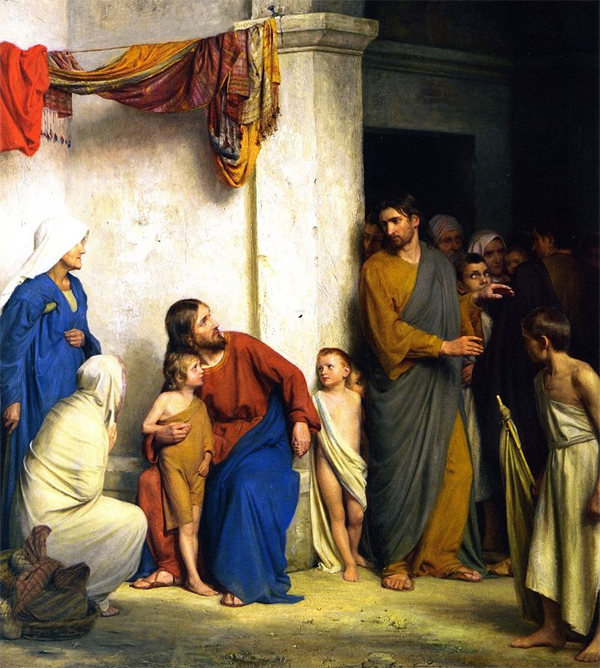
Christian Art | Jesus And Children | Jesus Prayer | Kingdom Of Heaven
Matthew 18: 1-5, 10, 12-14 – Week 19 Ordinary Time, Tuesday (King James Audio Bible KJV)
1 AT the same time came the disciples unto Jesus, saying, Who is the greatest in the kingdom of heaven?
2 And Jesus called a little child unto him, and set him in the midst of them,
3 And said, Verily I say unto you, Except ye be converted, and become as little children, ye shall not enter into the kingdom of heaven.
4 Whosoever therefore shall humble himself as this little child, the same is greatest in the kingdom of heaven.
5 And whoso shall receive one such little child in my name receiveth me.
10 Take heed that ye despise not one of these little ones; for I say unto you, That in heaven their angels do always behold the face of my Father which is in heaven.
12 How think ye? if a man have an hundred sheep, and one of them be gone astray, doth he not leave the ninety and nine, and goeth into the mountains, and seeketh that which is gone astray?
13 And if so be that he find it, verily I say unto you, he rejoiceth more of that sheep, than of the ninety and nine which went not astray.
14 Even so it is not the will of your Father which is in heaven, that one of these little ones should perish.
Chapter 18 of Matthew’s Gospel records Jesus’ Discourse on the Church, or Discourse of the Community. This is Jesus’ teachings regarding how his Church is to be administered, how Christian communities are to conduct themselves. Jesus emphasises the humility that is necessary for Christian life, this in response to his disciples’ imperfect attitude, as they seek to know from Jesus who will be greatest in the Kingdom of heaven. This attitude, of pride and egotism, is completely contrary to life in Jesus. We are not called to try to be more important than other people, but to give ourselves in a spirit of poverty to a life of service.
Jesus presents a little child to his disciples as an exemplar of how the disciples must strive to be. Here is the opposite of pride, indeed of pure humility, which is the essence of Christian life. This overhaul of values recalls the Beatitudes, Jesus’ great promise that those who live their lives far from the riches and pomp and power of the world are truly blessed. Our life in the spirit demands a turning away from the allure of worldly goods.
Jesus identifies himself with the little children, and then with all little ones, all those people who do not seem to be of importance, when considered in worldly terms. Each one is important to God. Jesus our shepherd came to call each one of us. There is rejoicing in heaven when each little one of us is recalled to life in Christ. It is God’s intention, which is why he sent his Son, so that not one of us should perish.
Concluding Prayer
Almighty God,
who revealed to Peter your plan for the salvation of all men,
grant that our work may be acceptable to you,
and that, by your grace, it may further your loving purpose of redemption.
Through Christ our Lord.

King James Audio Bible | Endnotes
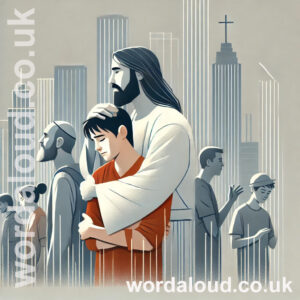
Except Ye Be Converted And Become As Little Children | Jesus Revolution Christian Faith
When the disciples ask Jesus who will be the greatest in the kingdom of heaven, Jesus responds by calling a little child to stand before them and saying, ‘Verily I say unto you, except ye be converted, and become as little children, ye shall not enter into the kingdom of heaven’ (Matthew 18:3, KJV). In this Gospel passage, Jesus teaches the disciples that humility and childlike faith are essential for entry into the kingdom of heaven.
Christians have written extensively about what Jesus said about children. Saint Augustine wrote in his Confessions: ‘For the one who is little in himself and lifted up in God, is truly the greatest of all.’ (Book 1, Chapter 20). Augustine understood that true greatness comes not from our own achievements or status, but from our relationship with God.
Similarly, Martin Luther wrote in his Commentary On Matthew, ‘Christ’s meaning, therefore, is that whoever would be great must become small, and whoever would be first must be last.’ (Chapter 18, Verse 4). Luther emphasized the importance of humility and selflessness in following Christ.
In recent times, Pope Francis has spoken about the importance of childlike faith and humility in his teachings. In a homily of 2013, he said: ‘The Lord tells us that in order to enter into the Kingdom of Heaven we must become like children, that is, we must have a heart that is simple, pure, and humble.’ Pope Francis understands that childlike faith is not a simplistic or naïve view of the world, but a humble and trusting attitude towards God.
So what does it mean to become as little children? Jesus gives us some clues in the passage itself. He says: ‘Whosoever shall humble himself as this little child, the same is greatest in the kingdom of heaven.’ (Matthew 18:4) To become as little children means to approach God with humility, recognizing that we are not self-sufficient and that we need His guidance and grace in our lives.
Furthermore, Jesus tells us that ‘it is not the will of your Father which is in heaven, that one of these little ones should perish’ (Matthew 18:14). To become as little children means to trust in God’s love and mercy, knowing that He desires our salvation and will go to great lengths to save us.
Children In The Gospels
In addition to this passage in Matthew, children play a significant role in other parts of the Gospels as well. For example, in Mark 10:13-16, people were bringing their children to Jesus so that he could bless them. The disciples rebuked those who brought the children, but Jesus said: ‘Suffer the little children to come unto me, and forbid them not: for of such is the kingdom of God.’ (Mark 10:14) Jesus then took the children in his arms and blessed them. This story shows us that Jesus has a special love and concern for children, and that he welcomes them into his kingdom.
Moreover, in Luke 18:15-17, people were bringing their infants to Jesus so that he could touch them. The disciples rebuked them, but Jesus’ words are again: ‘Suffer little children to come unto me, and forbid them not: for of such is the kingdom of God. Verily I say unto you, Whosoever shall not receive the kingdom of God as a little child shall in no wise enter therein.’ (Luke 18:16-17) This passage reinforces the importance of childlike faith in entering the kingdom of God.
Jesus speaks of children to teach about the nature of the kingdom of God. In Matthew 19:14, Jesus says: ‘Suffer little children, and forbid them not, to come unto me: for of such is the kingdom of heaven.’ Later in Matthew 21:16, when the children in the temple cried out, ‘Hosanna to the Son of David,’ Jesus quotes Psalm 8:2, saying: ‘Yea; have ye never read, Out of the mouth of babes and sucklings thou hast perfected praise?’ (Matthew 21:16) These passages suggest that children are not only welcomed into the kingdom of God, but that they have a unique role to play in praising and glorifying God.
In addition to these Gospel passages, children have played a prominent role in Christian tradition. The early Christian church saw children as symbols of innocence and purity, and many saints and theologians have written about the importance of protecting and nurturing children. For example, Saint John Chrysostom in the fourth-century wrote: ‘Let us take care of the children and bring them up in the discipline and instruction of the Lord, that they may become our crowns and our glory.’ (Homilies On Ephesians, Homily 20)
In the Catholic Church, the sacrament of baptism is often performed on infants and young children, as a way of bringing them into the church and initiating them into the Christian faith. The Catechism Of The Catholic Church teaches that ‘baptism is the sacrament of faith’ and that ‘through baptism we are freed from sin and reborn as sons of God; we become members of Christ, are incorporated into the Church and made sharers in her mission.’ (CCC 1213)
In many churches, children are acknowledged as a gift from God and are encouraged to participate in the life of the church from a young age. Many churches offer Sunday school classes and youth programs as a way of nurturing children’s faith and helping them grow in their relationship with God.



Psalm 119 explores the relationship between a believer and the divine law. This acrostic Psalm is structured with each of its 22 sections corresponding to a letter of the Hebrew alphabet, and each verse within a stanza beginning with that letter. This meticulous arrangement is not merely a literary flourish; it serves to emphasize the depth and breadth of the Psalm’s central themes. The Psalm’s opening verses, ‘Blessed are those whose ways are blameless, who walk according to the law of the LORD’ (Psalm 119:1), immediately set the tone for its primary theme: a deep reverence and love for God’s commandments, statutes, and laws [ … ]
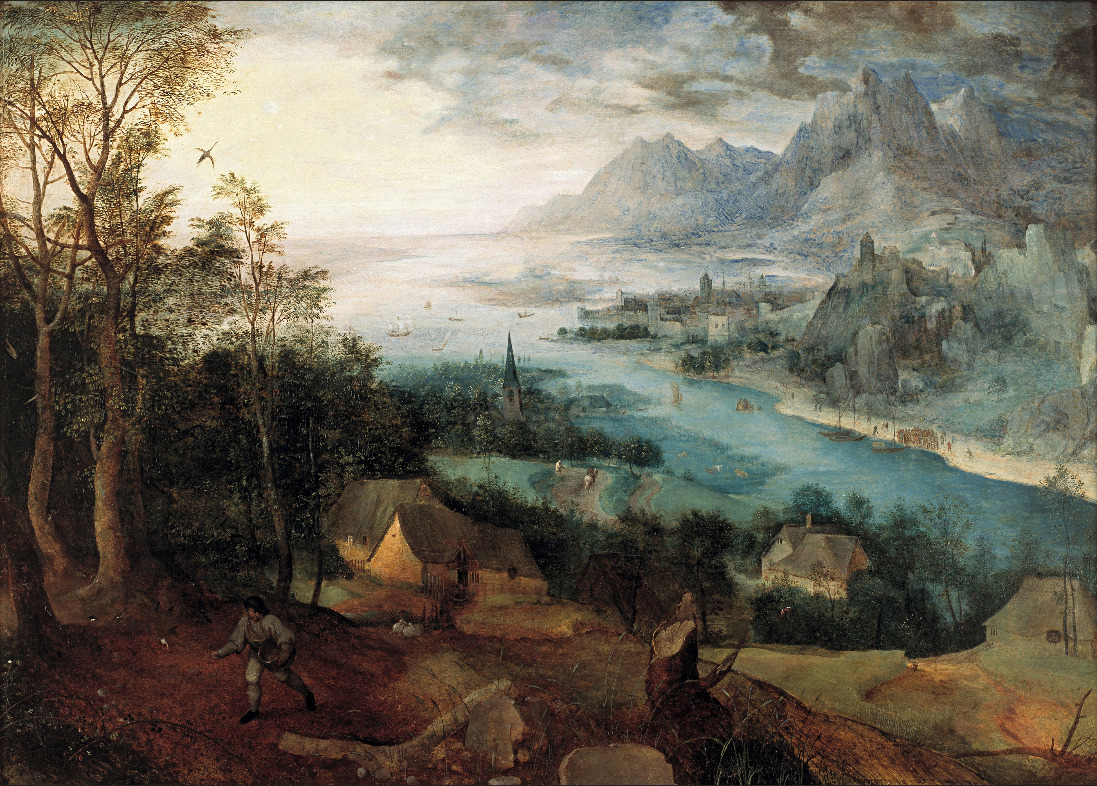
In teaching his parables, Jesus draws on a range of lived experience which would be familiar to his listeners. Often the parables describe work situations, reminding us that we are to root our Christian faith in a life that is useful to others, and that the whole texture of our lives should reflect our love of Jesus [ … ]
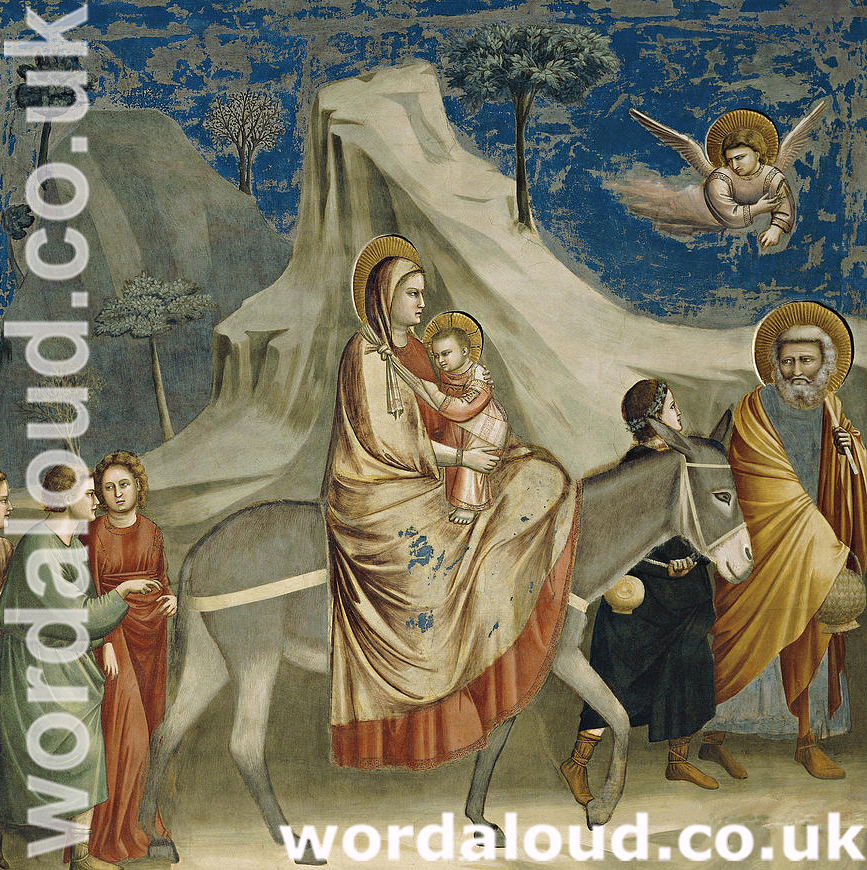
Saint Cyril of Alexandria interprets the prophecy of Haggai as a vision of the Church’s universal fulfilment in Christ. When he writes that ‘our Saviour came and appeared as a divine temple’, he identifies Jesus Christ himself as the true dwelling-place of God among men — the reality of which the old Jerusalem temple was only a shadow. The worship of the old covenant, confined to one people and one sanctuary, is surpassed by the worship of the new covenant, offered everywhere in spirit and in truth [ … ]
