
Office Of Readings | Eastertide Week 3, Tuesday | A Reading From The Sermons Of Saint Augustine | Let Us Sing To The Lord A Song Of Love
‘Let us sing to the Lord a song of love.’
Commentary | ‘Let Us Sing To The Lord A Song Of Love’ By Saint Augustine
Saint Augustine’s sermon on Psalm 149, expounding the verse ‘Sing to the Lord a new song’, draws on his deeply theological, philosophical, and pastoral mind to deliver a rich meditation on love, new life in Christ, and the moral integrity of worship. This reading, likely delivered in the context of the Easter season and baptismal catechesis, reflects the tone of joyful renewal that characterizes the liturgical spirit of this time.
Singing As The Expression Of Love
At the heart of Augustine’s sermon is the identification of song not simply as musical praise, but as a metaphor for love itself. Augustine draws a profound connection: ‘A song is a thing of joy; more profoundly, it is a thing of love.’ In Augustine’s view, everyone loves something, but the challenge of the Christian life lies in rightly ordering that love. This echoes his central theme in the Confessions and De Doctrina Christiana: that disordered love lies at the root of sin, while properly ordered love leads the soul back to God.
Augustine’s theology of love is Trinitarian. He cites 1 John 4:19, ‘We love him because he first loved us,’ to emphasize that divine love originates with God and is poured into our hearts through the Holy Spirit (Romans 5:5). Thus, the capacity to love God is itself a gift of grace, not a natural human achievement. This affirms a core teaching of Augustine’s mature theology: human will is insufficient for salvation without divine initiative.
The ‘New Song’ And The New Life
The idea of the ‘new song’ sung by ‘new men’ belongs to a broader Augustinian anthropology and eschatology. The ‘new song’ corresponds to the ‘new covenant’ and the ‘new man’, who has been reborn through Christ. Baptism, as Augustine suggests, is the gateway into this renewal, aligning this sermon with the mystagogical homilies delivered during the Octave of Easter. It is in the newness of life, rather than in the novelty of melody, that the ‘new song’ truly resides.
The liturgical element of the sermon is reinforced by the line ‘his praise is in the assembly of the saints’. Augustine emphasizes that singing praise is a communal act of the Church, the Body of Christ, which is itself the locus of love, truth, and divine indwelling. This is reminiscent of the ecclesiology of the early Church as found in Acts 2:42-47 and carried forward in Augustine’s vision of the City of God.
Integration Of Worship And Moral Life
Augustine challenges his listeners to ensure that their outward praise is matched by their inner life: ‘Sing with your voices, your hearts, your lips and your lives.’ This insistence on the unity of worship and ethics is characteristic of his pastoral emphasis. It also reflects the prophetic tradition (cf. Amos 5:23-24, Isaiah 1:13-17), where God rejects worship that is not accompanied by justice and righteousness.
To sing truly, then, is to live truly. Augustine’s call to his congregation to be the praise of God with their lives mirrors the Pauline exhortation in Romans 12:1, to ‘present your bodies as a living sacrifice’. Thus, the life of the believer is liturgy enacted in the world.
Philosophical Underpinnings
Underlying this sermon is a distinctly Neo-Platonic structure of thought. Augustine conceives of love as both a participation in the divine and as the means of ascent to God. When he writes, ‘Love me and you will have me, for you would be unable to love me if you did not possess me already,’ he echoes Plotinian ideas of the soul’s return to the One, yet he firmly roots them in a Christian framework where God acts first in love.
Practical Exhortation
Augustine’s conclusion is a call to moral and spiritual authenticity. He exhorts his listeners, recently baptized or long initiated, to be not only singers of praise but embodiments of it: ‘If you desire to praise him, then live what you express. Live good lives, and you yourselves will be his praise.’ In this, Augustine provides not only doctrinal teaching but a concrete rule of life.
This sermon is a microcosm of Augustine’s theological genius: biblical exegesis, Trinitarian theology, pastoral urgency, and philosophical depth converge in his exhortation to sing a new song. In post-Easter joy, Augustine invites all believers to live out their baptismal identity by becoming praise itself. Worship, for him, is not merely what the Church does; it is what the Church is when it lives in love.

A Reading From The Sermons Of Saint Augustine | Let Us Sing To The Lord A Song Of Love
Sing to the Lord a new song; his praise is in the assembly of the saints. We are urged to sing a new song to the Lord, as new men who have learned a new song. A song is a thing of joy; more profoundly, it is a thing of love. Anyone, therefore, who has learned to love the new life has learned to sing a new song, and the new song reminds us of our new life. The new man, the new song, the new covenant, all belong to the one kingdom of God, and so the new man will sing a new song and will belong to the new covenant.
There is not one who does not love something, but the question is, what to love. The psalms do not tell us not to love, but to choose the object of our love. But how can we choose unless we are first chosen? We cannot love unless someone has loved us first. Listen to the apostle John: We love him, because he first loved us. The source of man’s love for God can only be found in the fact that God loved him first. He has given us himself as the object of our love, and he has also given us its source. What this source is you may learn more clearly from the apostle Paul who tells us: The love of God has been poured into our hearts. This love is not something we generate ourselves; it comes to us through the Holy Spirit who has been given to us.
Since we have such an assurance, then, let us love God with the love he has given us. As John tells us more fully: God is love, and whoever dwells in love dwells in God, and God in him. It is not enough to say: Love is from God. Which of us would dare to pronounce the words of Scripture: God is love? He alone could say it who knew what it was to have God dwelling within him. God offers us a short route to the possession of himself. He cries out: Love me and you will have me for you would be unable to love me if you did not possess me already.
My dear brothers and sons, fruit of the true faith and holy seed of heaven, all you who have been born again in Christ and whose life is from above, listen to me; or rather, listen to the Holy Spirit saying through me: Sing to the Lord a new song. Look, you tell me, I am singing. Yes indeed, you are singing; you are singing clearly, I can hear you. But make sure that your life does not contradict your words. Sing with your voices, your hearts, your lips and your lives: Sing to the Lord a new song.
Now it is your unquestioned desire to sing of him whom you love, but you ask me how to sing his praises. You have heard the words: Sing to the Lord a new song, and you wish to know what praises to sing. The answer is: His praise is in the assembly of the saints; it is in the singers themselves. If you desire to praise him, then live what you express. Live good lives, and you yourselves will be his praise.

Saint Augustine Of Hippo
Saint Augustine of Hippo (354–430 AD) was one of the most influential theologians and philosophers in the history of Christianity. Born in Thagaste (modern-day Algeria), Augustine was raised by a Christian mother, Saint Monica, and a pagan father. He led a restless and intellectually driven youth, exploring various philosophies and religions, including Manichaeism and Neoplatonism, before his dramatic conversion to Christianity at the age of 31 under the influence of Bishop Ambrose of Milan.
He was baptized in 387 AD and later became Bishop of Hippo Regius (present-day Annaba, Algeria), where he served for 35 years. Augustine wrote extensively, and his works—especially Confessions and The City of God—have shaped Western Christian thought on subjects ranging from original sin and grace to time, memory, and the nature of the Church.
Augustine died in 430 AD as the Vandals besieged Hippo. He was declared a Doctor of the Church, and his legacy remains foundational for both Catholic and Protestant theology.


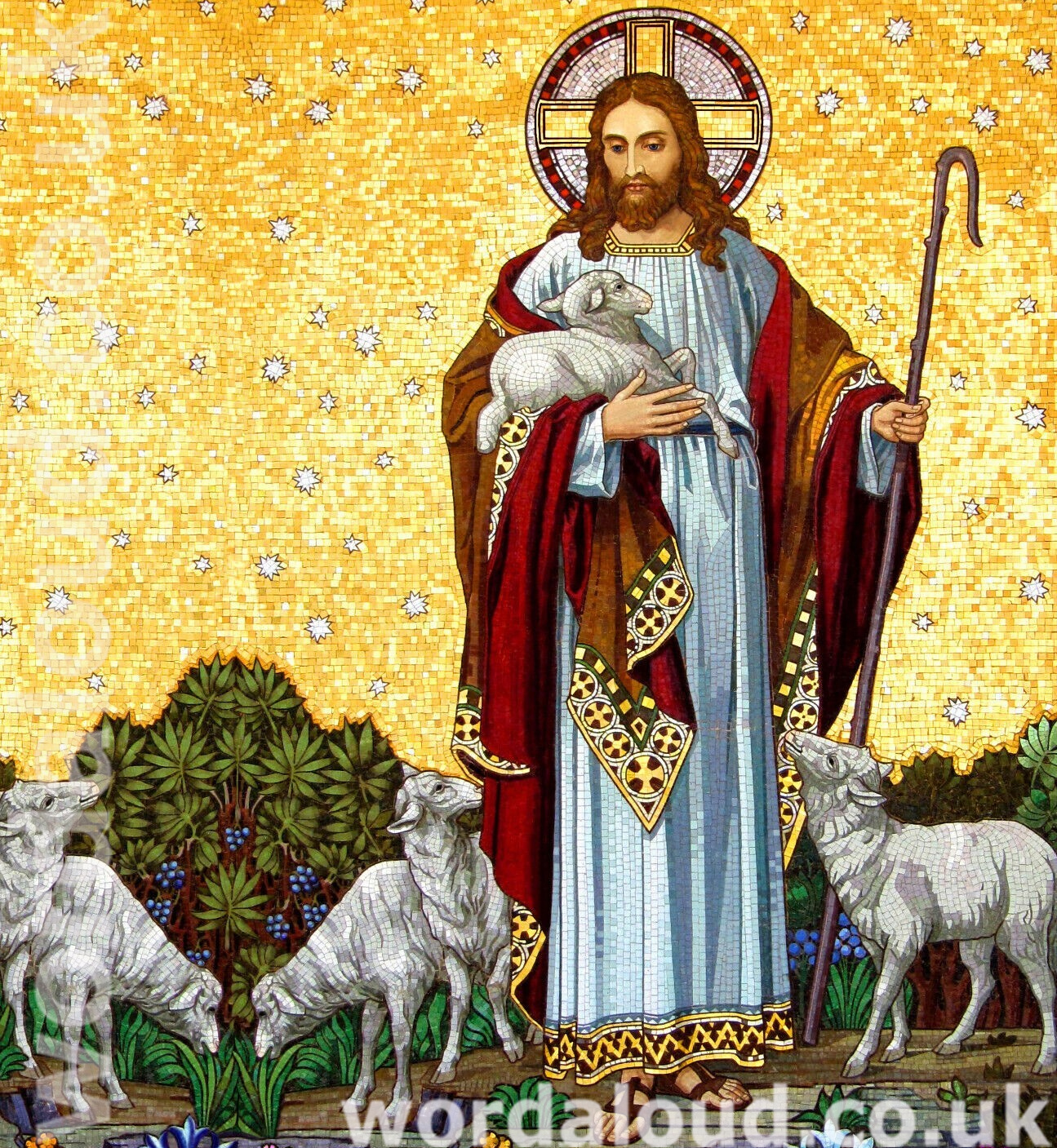
Saint Augustine speaks directly to humanity and frames the Incarnation as God’s action for our sake. His repeated call to ‘awake’ stresses that what God has done in Christ concerns human life now, not only at the end of time. God becomes man so that humanity may be restored to life [ .. ]
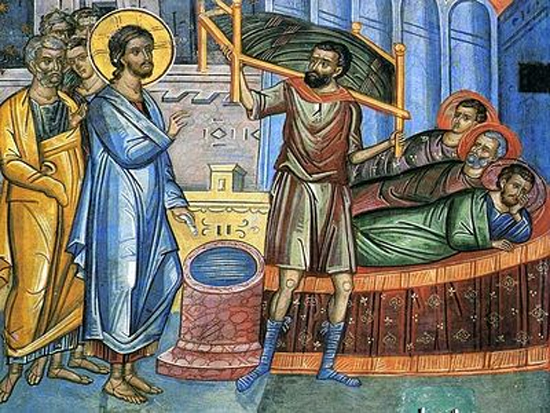
For the Jewish people, the sickness of the paralyzed man was a symptom of underlying sin. It was a punishment, a consequence of one’s own moral evil or of one’s parents. We can imagine the social consequences for the paralyzed man, in the light of the various exclusions which were applied to disabled people [ … ]

Man, then, was thus snared by the assault of the arch-fiend, and broke his Creator’s command, and was stripped of grace and put off his confidence with God, and covered himself with the asperities of a toilsome life (for this is the meaning of the fig-leaves); and was clothed about with death, that is, mortality and the grossness of flesh (for this is what the garment of skins signifies); and was banished from Paradise by God’s just judgment, and condemned to death, and made subject to corruption. (John Of Damascus, An Exact Exposition Of The Orthodox Faith, III.1)