
Christian Art | Easter To Pentecost
Office Of Readings | Eastertide Week 6, Saturday After The Ascension | A Reading From The Homilies Of Saint Augustine On Saint John’s Gospel | Two Kinds Of Christian Life
‘Two kinds of Christian life.’
Duality Of Christian Living | Active And Contemplative
Saint Augustine’s reflection presents a profound theological anthropology: that the human soul, redeemed and graced, is called to live out two complementary forms of life—the active and the contemplative. These are not merely individual spiritual preferences but dimensions of the Church’s total life and mission.
Augustine follows a tradition rooted in Scripture (e.g., the Martha and Mary narrative, Luke 10:38–42), echoing what would later be elaborated by Pope Gregory the Great and the medieval mystics. Augustine symbolizes the active life in Peter, the impetuous fisherman called to lead, suffer, and labour for the Church. The contemplative life is seen in John, the beloved disciple who reclined at Jesus’ breast at the Last Supper, receiving not commands but intimacy, silence, and mystery.
Peter And John As Ecclesial Symbols
Peter and John do not merely represent personal journeys but ecclesial archetypes. In Peter we see the hierarchical, sacramental, missionary Church—charged with preaching, governing, binding and loosing. In John we glimpse the mystical Church—absorbed in prayer, contemplation, and theological insight.
- Peter is the Church in motion—preaching, suffering, sacrificing. His life, Augustine says, ‘is passed on pilgrimage in time,’ a reference to the ecclesia peregrinans—the Church on earth, journeying toward its fulfilment.
- John is the Church at rest—waiting for Christ’s return, contemplating divine mysteries. His life remains ‘imperfect till the end of this world,’ yet it points to the ecclesia triumphans—the Church in glory.
Yet both apostles, Augustine insists, lived both lives: active ministry and spiritual longing. Their duality is not exclusive but interwoven, reflecting the unity of the Church’s mission and destiny.
Christ’s Commands | Follow And Remain
Augustine’s brilliant exegesis of Jesus’ words in John 21 — ‘Follow me’ (to Peter) and ‘If I want him to remain until I come…’ (of John) — reveals a subtle theological distinction. Peter is called to martyrdom and action; John to await the eschaton, the final event in God’s plan, the end of the world.
This is not about longevity or privilege, but about vocation. Peter’s path is obedience through suffering; John’s is receptivity through waiting. One is the road of the cross, the other the path of mystical union.
But both lead to the same end: life in the vision of God. This is the beatific vision, which Augustine refers to as the life of ‘repose,’ a state of eternal contemplation and love.
Living In The ‘Land Of The Dying’ In Hope Of The ‘Land Of The Living’
Augustine’s contrast between ‘the land of the dying’ and ‘the land of the living’ draws on Psalm 27:13: ‘I believe that I shall see the goodness of the Lord in the land of the living.’ Here he reminds believers that the suffering of the present age must be endured with patient fidelity—symbolized by Peter—until the eternal joy of vision is fully realized—symbolized by John.
The saints, therefore, walk both paths:
- They suffer, work, endure, and lead, like Peter.
- They contemplate, yearn, and seek divine intimacy, like John.
So too must the Church today balance mission and mysticism, charity and contemplation, action and prayer.
The Whole Church As Bride, Priest, And Mystic
Augustine’s language is inclusive: ‘not Peter alone… not John alone… but the whole Church’ is caught up in this mystery. All the baptized are called to participate in the apostolic inheritance. Through:
- Peter, the Church receives the keys to the kingdom—the authority of the sacraments, the stewardship of divine grace.
- John, the Church drinks from the bosom of Christ—the mysteries of the Incarnation, the Trinity, the Logos.
Thus, the Church is:
- Apostolic, acting in the world;
- Mystical, oriented toward eternity.
It binds and looses, preaches and serves, but also adores and awaits. Every Christian, in some measure, is called to both—through active charity and interior contemplation.
Related Theological Insights
- Gregory the Great, in Homily 5 on the Gospels, compares Mary and Martha to John and Peter and teaches that ‘the active life leads to the contemplative’.
- Thomas Aquinas calls the contemplative life ‘the more excellent’ because it consists in loving union with God, though the active life is ‘more necessary’ for others.
- John Paul II and Pope Benedict XVI both emphasized the need for today’s Church to recover its contemplative depth, especially amid activism and secular pressures.
The Church Today | 21st Century Jesus
In an age of constant activity and distraction, Saint Augustine’s teaching is more vital than ever:
- Are we making space for contemplation—for prayer, stillness, and intimacy with Christ?
- Is our action—our ministry, our outreach—rooted in and nourished by that interior life?
Peter and John are not competitors, but companions. The Church needs both hands—one to work, one to pray. Like them, we are pilgrims and mystics, apostles and lovers.

A Reading From The Homilies Of Saint Augustine On Saint John’s Gospel
The Church recognizes two kinds of life as having been commended to her by God. One is a life of faith, the other a life of vision; one is a life passed on pilgrimage in time, the other in a dwelling place in eternity; one is a life of toil, the other of repose; one is spent on the road, the other in our homeland; one is active, involving labor, the other contemplative, the reward of labor.
The first kind of life is symbolized by the apostle Peter, the second by John. All of the first life is lived in this world, and it will come to an end with this world. The second life will be imperfect till the end of this world, but it will have no end in the next world. And so Christ says to Peter: Follow me; but of John he says: If I wish him to remain until I come, what is that to you? Your duty is to follow me.
You are to follow me by imitating my endurance of transient evils; John is to remain until my coming, when I will bring eternal blessings. A way of saying this more clearly might be: Your active life will be perfect if you follow the example of my passion, but to attain its full perfection John’s life of contemplation must wait until I come.
Perfect patience is to follow Christ faithfully, even to death, but for perfect knowledge we must await his coming. Here, in the land of the dying, the sufferings of the world must be endured; there, in the land of the living, shall be seen the good things of the Lord.
Christ’s words, I wish him to remain until I come, should not be taken to imply that John was to remain on earth until Christ’s coming, but rather that he was to wait because it is not now but only when Christ comes that the life he symbolizes will find fulfillment. On the other hand, Christ says to Peter: Your duty is to follow me, because the life Peter symbolizes can attain its goal only by action here and now.
Yet we should make no mental separation between these great apostles. Both lived the life symbolized by Peter; both were to attain the life symbolized by John. Symbolically, one followed, the other remained, but living by faith they both endured the sufferings of this present life of sorrow and they both longed for the joys of the future life of happiness.
Nor were they alone in this. They were one with the whole Church, the bride of Christ, which will in time be delivered from the trials of this life and live for ever in the joy of the next. These two kinds of life were represented respectively by Peter and John, yet both apostles lived by faith in this present, passing life and in eternal life both have the joy of vision.
And so for the sake of all the saints inseparably united to the body of Christ, to guide them through the storms of this life, Peter, the chief of the apostles, received the keys of the kingdom of heaven with the power to bind and loose sins; and for the sake of those same saints, to plumb the depths of that other, hidden life, John the evangelist reclined on the breast of Christ.
For it is not only Peter but the whole Church that binds and looses from sin; and as for the sublime teaching of John about the Word, who in the beginning was God with God, and everything else he told us about Christ’s divinity, and about the trinity and unity of the Godhead, which now, until the Lord comes, is all like a faint reflection in a mirror, but which will be seen face to face in the kingdom of heaven – it was not only John who drank in this teaching that came forth from the Lord’s breast as from a fountain. All who belong to the Lord are to drink it in, each according to his capacity, and this is why the Lord himself has spread John’s gospel throughout the world.

Glossary Of Terms
Active Life: The life of external service, ministry, action, and labor for the sake of God and others—symbolized by Peter and often compared to Martha in Luke 10:38–42. It includes works of mercy, evangelization, leadership, and sacrifice.
Contemplative Life: The life of interior prayer, stillness, reflection, and loving union with God—symbolized by John and likened to Mary of Bethany. Its primary activity is spiritual receptivity and union with divine mysteries.
Beatific Vision: The direct, eternal vision of God enjoyed by the blessed in heaven. This is the full realization of the contemplative life, where faith gives way to sight and hope is fulfilled in love.
Ecclesia peregrinans: Latin for ‘the pilgrim Church’; it refers to the Church on earth, journeying in faith through the trials of time toward her final home.
Ecclesia triumphans: Latin for ‘the triumphant Church’; it refers to the saints in heaven, now at peace in the presence of God.
Mysticism: In the Christian tradition, the pursuit of a direct, experiential union with God, especially through contemplative prayer. It is not opposed to doctrine or action but flows from and deepens them.
Apostolic Life: The missionary and sacramental dimension of the Church’s life, handed down through the apostles, especially Peter, as seen in preaching, sacraments, and pastoral authority.
Trinitarian Theology: The doctrine concerning the nature of the triune God—Father, Son, and Holy Spirit. John’s Gospel deeply informs this theology, especially in its reflections on the Logos (the Word).
Vision vs. Faith: Augustine contrasts faith (belief in what is unseen) with vision (direct seeing of divine realities in eternity). Faith sustains us in this life; vision fulfills us in the next.
Union with Christ: The central Christian doctrine that believers, through grace, are united to Christ as members of his mystical Body. This union underlies both active service and contemplative prayer.
Prayer With Jesus | Love Of Jesus Christ Revealed
‘Lord, teach me the life of Peter and the love of John.’
O Jesus,
You walked among us in both word and silence,
in service and solitude,
in toil and in prayer.
Help me to live with a heart balanced between
the urgency of your mission
and the quiet of your mysteries.
Give me the courage of Peter—
to follow you,
to endure hardship,
to shepherd others
and bind what must be bound in love.
Give me the intimacy of John—
to rest upon your heart,
to listen deeply,
to ponder your Word,
and to see your glory,
even now, in shadows.
Let me not flee the road of suffering
nor lose hope in the waiting.
Let me work with hands consecrated to you
and sit in stillness with a soul open to your whisper.
One day, Lord,
may I pass from this land of toil
to the land of vision—
and there see you face to face,
in joy without end.
Amen.



Born Jorge Mario Bergoglio in Buenos Aires (1936), Pope Francis embraced a life of service through the Jesuits, becoming Archbishop and then Pope in 2013. Choosing the name Francis, he called the Church to humility and solidarity with the poor. He bowed before the people asking for their prayers, carrying the Cross of Peter in simplicity [ … ]
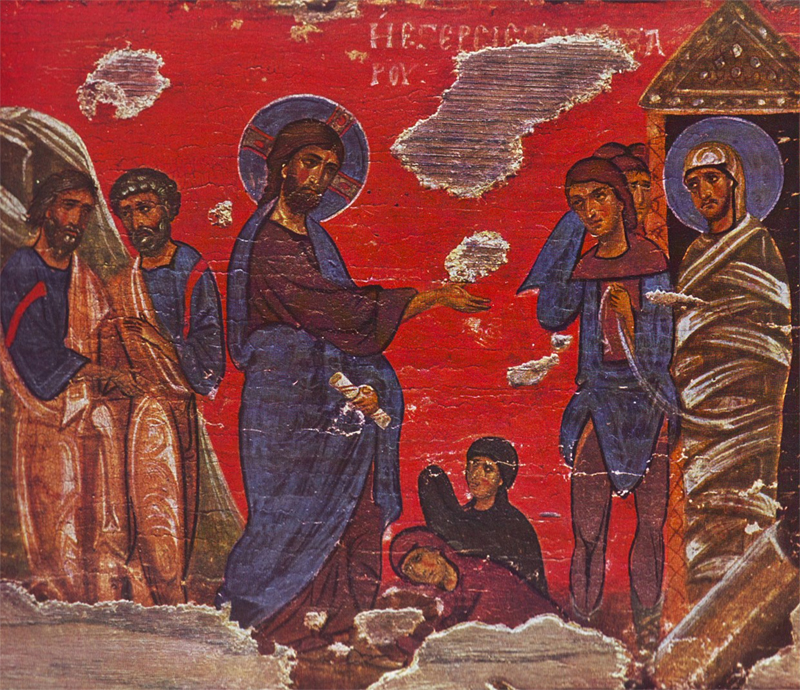
The Gospel Of Saint John, Chapter 11 | Jesus Wept | Death And Resurrection Of Lazarus | KJV The account of Lazarus’s death and resurrection in John 11:1-45 is profound and moving. Central to the story is the shortest verse in the Bible: ‘Jesus wept’ (John 11:35). At first glance, ‘Jesus wept’ appears to be a simple statement of human emotion. It shows Jesus expressing sorrow and empathy, sharing in the grief of Lazarus’s sisters, Mary and Martha, and the mourning community. The moment reveals profound humanity of Jesus. Despite Jesus’ divine knowledge that he would raise Lazarus from the dead, Jesus yet experiences fully human emotions. Jesus is not distant or detached but is intimately connected with the suffering of those he loves. The verse also underscores the reality of death’s impact, even for the Son of God. Although Jesus knows that death is not the final word and that he has power over it, Jesus still mourns. This weeping is not only for Lazarus but for the brokenness of the world that death represents. It reflects sorrow that God feels over the pain and suffering that humanity endures as a result of sin and death. The verse ‘Jesus wept’ highlights compassion of Jesus. Jesus’ tears are an expression of his deep love for Lazarus and Lazarus’ family. In the act of weeping, Jesus demonstrates that God’s response to human suffering is not indifference or cold logic, but rather profound empathy and compassion. The God of the universe is not immune to our pain but enters into it with us. Theologically, this moment is also significant because it foreshadows the passion of Christ. Just as Jesus wept over Lazarus, Jesus would later weep in Gethsemane over the soon-to-be agony of the Cross. Jesus’ tears in John 11 anticipate the suffering he will endure to conquer death once and for all. In weeping for Lazarus, Jesus reveals such depth of his commitment to overcome death and bring life. See also: Daily Bible Verses | Jesus Weeps Over Jerusalem | That Jesus Wept Means He Prayed For The Loss And The Futility | King James Audio Bible KJV
We are called once more by Jesus to seek perfection as our acts of mercy imitate, insofar as we are able, the mercy of God. We are taught again of the inseparability of our relationship with each other in the body of Christ, in the brotherhood of man, and of our relationship with God [ … ]
