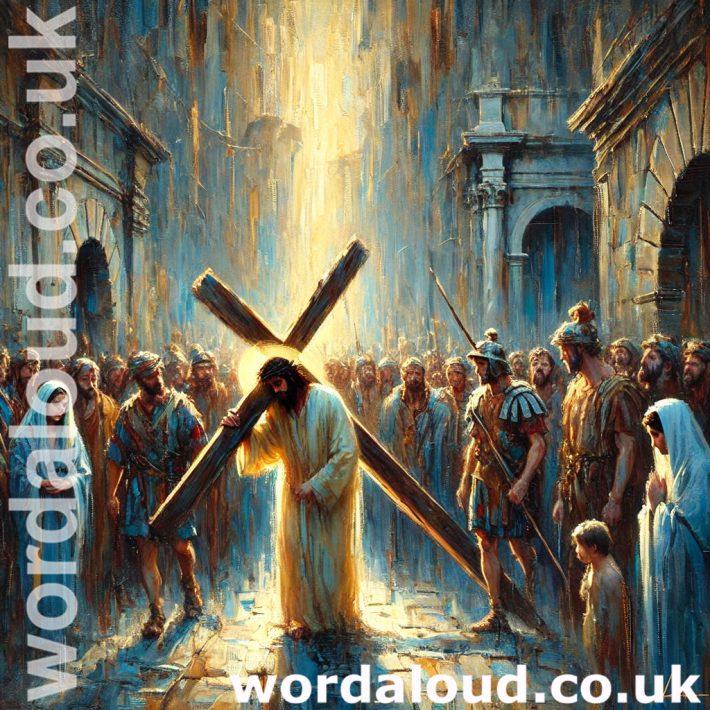
Christian Art | Jesus Carries His Cross | Via Dolorosa | Lent
Office Of Readings | Friday, Lent Week 5 | A Reading From The Treatise Of Saint Fulgentius Of Ruspe To Peter On Faith
‘Jesus Christ offered himself for us.’
Commentary | ‘Christ Offered Himself For Us’ By Saint Fulgentius Of Ruspe
This powerful reading from Saint Fulgentius offers a rich meditation on the meaning of Christ’s sacrifice, drawing us deeply into the mystery at the heart of the Christian faith. It’s a fitting reflection for the final days of Lent, as we prepare to enter into Holy Week and contemplate Christ’s passion, death, and resurrection.
From The Shadows To The Reality
Fulgentius begins by looking backward — to the long history of sacrifice in the Old Testament. These animal offerings, commanded by God, were never meant to be ends in themselves. Instead, they were signs, foreshadowings of something much greater to come. They pointed toward the perfect and final offering: the self-giving of Jesus Christ.
For centuries, God’s people had performed ritual sacrifices — bulls, goats, lambs — to express repentance, thanksgiving, and the desire for reconciliation with God. But these sacrifices, while important in their time, could never fully heal the rift between humanity and God. They were symbolic gestures awaiting their fulfilment in Christ. As the Letter to the Hebrews says, ‘It is impossible for the blood of bulls and goats to take away sins’ (Hebrews 10:4). Fulgentius echoes this, emphasizing that these earlier sacrifices were given meaning only because they pointed to Christ.
Christ Who Is Everything
In one of the most striking and beautiful passages of the reading, Fulgentius presents Christ as not only the priest who offers, but also the sacrifice, the temple, and the God to whom the offering is made. This is a profound theological insight.
Christ is the priest because he offers himself to the Father on our behalf. He is the sacrifice because it is his own body and blood that are given. He is the temple because in him, divinity and humanity meet — the place where God dwells among his people. And he is also God, the recipient of the offering, one with the Father and the Spirit.
This unity of roles is unique to Christ. In the Old Testament, the priest, the sacrifice, and the temple were all separate. In Jesus, they are brought together — he is everything needed for our salvation. This completeness shows the depth of God’s love: nothing is left to chance or to us; Christ himself has accomplished it all.
Sacrifice Continues In The Eucharist
But Fulgentius doesn’t stop with Christ’s death on the cross. He goes on to show how this sacrifice continues to shape the life of the Church. In the Old Testament, God’s people offered animal sacrifices; now, in the New Covenant, the Church offers the Eucharist — the bread and wine that become the body and blood of Christ.
This sacrifice is not a new or separate offering. It is the same sacrifice of Christ, made present sacramentally at every Mass. What once happened in time — on the cross — is now made present to us in mystery. In every Eucharist, we join in Christ’s offering to the Father, giving thanks and being drawn into communion with him.
A Sacrifice For Sinners
Fulgentius ends with a powerful reminder of who this sacrifice is for: not for the righteous, but for sinners. Christ died, he says, ‘for the wicked’ — for us, in all our weakness and failure. While we were still enemies, Christ reconciled us to God through his death. This is the heart of the Gospel. God does not wait for us to become worthy; rather, he meets us in our unworthiness and offers us mercy.
This reminder is especially important during Lent. As we examine our hearts and turn back to God, we are not trying to earn his love. We are responding to a love that has already been given, a grace that has already been poured out. Christ’s death is not the end of the story — it is the doorway into new life.
A Reading From The Treatise Of Saint Fulgentius Of Ruspe To Peter On Faith
The sacrifices of animal victims which our forefathers were commanded to offer to God by the holy Trinity itself, the one God of the old and the new testaments, foreshadowed the most acceptable gift of all. This was the offering which in his compassion the only Son of God would make of himself in his human nature for our sake.
The Apostle teaches that Christ offered himself for us to God as a fragrant offering and sacrifice. He is the true God and the true high priest who for our sake entered once for all into the holy of holies, taking with him not the blood of bulls and goats but his own blood. This was foreshadowed by the high priest of old when each year he took blood and entered the holy of holies.
Christ is therefore the one who in himself alone embodied all that he knew to be necessary to achieve our redemption. He is at once priest and sacrifice, God and temple. He is the priest through whom we have been reconciled, the sacrifice by which we have been reconciled, the temple in which we have been reconciled, the God with whom we have been reconciled. He alone is priest, sacrifice and temple because he is all these things as God in the form of a servant; but he is not alone as God, for he is this with the Father and the Holy Spirit in the form of God.
Hold fast to this and never doubt it: the only-begotten Son, God the Word, becoming man offered himself for us to God as a fragrant offering and sacrifice. In the time of the old testament, patriarchs, prophets and priests sacrificed animals in his honour, and in honour of the Father and the Holy Spirit as well.
Now in the time of the new testament the holy catholic Church throughout the world never ceases to offer the sacrifice of bread and wine, in faith and love, to him and to the Father and the Holy Spirit, with whom he shares one godhead.
Those animal sacrifices foreshadowed the flesh of Christ which he would offer for our sins, though himself without sin, and the blood which he would pour out for the forgiveness of our sins. In this sacrifice there is thanksgiving for, and commemoration of, the flesh of Christ that he offered for us, and the blood that the same God poured out for us. On this Saint Paul says in the Acts of the Apostles: Keep watch over yourselves and over the whole flock, in which the Holy Spirit has appointed you as bishops to rule the Church of God, which he won for himself by his blood.
Those sacrifices of old pointed in sign to what was to be given to us. In this sacrifice we see plainly what has already been given to us. Those sacrifices foretold the death of the Son of God for sinners. In this sacrifice he is proclaimed as already slain for sinners, as the Apostle testifies: Christ died for the wicked at a time when we were still powerless, and when we were enemies we were reconciled with God through the death of his Son.



The poem presents a spiritual progression from weariness and disconnection to renewed purpose and communion with the divine. Herbert describes a personal journey marked by exhaustion, seeking rest after being drawn away by worldly pleasures. Imagery of travel, with Herbert and his horse both ‘tired, body and mind’, introduces a state of spiritual depletion. The search for respite in an inn, a place of temporary shelter, symbolizes the soul pausing in its pursuit of lasting fulfillment. The moment of pause becomes transformative, as Herbert unexpectedly encounters Christ, described as ‘my dearest Lord’, waiting as a silent presence, ready to offer comfort once the grief brought by pleasures subsides [ … ]
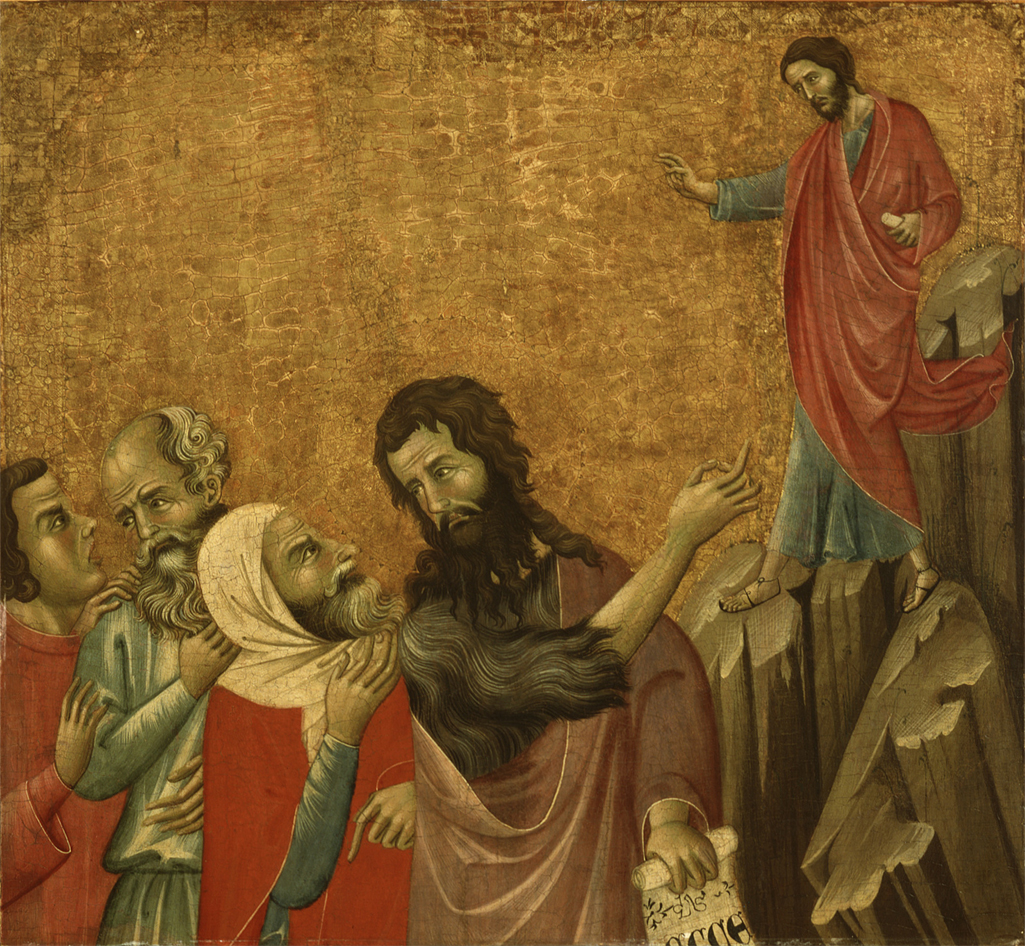
Jesus and his disciples have moved south into Judea, and Jesus and John are baptizing people very near to one other. John’s location is precisely stated in these Gospel verses: he is at Aenon, an Aramaic word meaning wells, near Salim, which was to the northeast of Samaria, about thirteen miles to the south of the Sea of Galilee. In these verses, John’s Gospel develops the information given to us in the Synoptics: we learn that Jesus’ public ministry began while John the Baptist’s was current, and that there was no rivalry between Jesus and John; indeed, that John the Baptist rejoiced in Jesus’ beginning his ministry [ … ]
Psalm 112 centralizes the concept of the righteous life. The psalm praises those who fear the Lord and delight in his commandments. This fear is not about being afraid, but about respecting and revering God, and finding joy in following his teachings. This respect for divine commandments sets the stage for a life guided by ethical and moral values [ … ]