

Christian Art | A Child’s Prayer To Jesus
Office Of Readings | Sunday, Lent Week 3 | From The Homilies Of Saint Augustine On Saint John’s Gospel
‘There came a woman of Samaria to draw water.’
Saint Augustine
Saint Augustine (354–430), one of the most influential theologians in Christian history, devoted much of his work to explaining Scripture in light of the Church’s teachings. As Bishop of Hippo, he sought to guide believers in their understanding of divine grace, human nature, and salvation. His homily on the Samaritan woman at the well (John 4:1-42) is a striking example of his theological depth, illustrating key themes of conversion, the universality of salvation, and the transformative power of divine grace.
In this homily, Augustine approaches the passage with an allegorical and doctrinal lens. He sees the Samaritan woman as a symbol of the Church, which initially stood outside God’s covenant but was drawn into His grace through Christ. Her gradual recognition of Jesus reflects the way the Church, and by extension every soul, comes to faith: first through an initial encounter, then through growing understanding, and finally through full acceptance of Christ’s truth. Augustine emphasizes that Christ, in his request for water, is not merely speaking of physical thirst but is ‘thirsting for her faith.’
One of the central theological points Augustine draws from this passage is the contrast between earthly and spiritual fulfillment. The Samaritan woman comes seeking water, a basic human necessity, but Jesus redirects her toward something far greater: the ‘living water’ that only he can give. Augustine identifies this living water with the Holy Spirit, the source of divine grace that alone can quench the soul’s deepest thirst. He sees in this moment a reflection of the human condition—how people often seek satisfaction in transient things, yet remain unfulfilled until they encounter Christ. This mirrors Augustine’s own personal journey, as described in his Confessions, where he famously declares, ‘You have made us for yourself, O Lord, and our heart is restless until it rests in you.’
A significant aspect of Augustine’s interpretation is his understanding of the universality of salvation. The Samaritan woman is an outsider in multiple ways: she is not only a Samaritan (a group in conflict with the Jews), but also someone whose personal life suggests moral failings. Yet Jesus does not reject her; instead, he engages in a deep theological dialogue, revealing that true worship is not tied to a specific place or ritual but must be done ‘in spirit and in truth.’ Augustine sees this as a foreshadowing of the Church’s mission to the Gentiles. The message of salvation is not restricted to the Jewish people but is extended to all nations, fulfilling Christ’s role as the savior of the entire world.
Augustine also highlights the progressive nature of faith and understanding. At first, the Samaritan woman perceives Jesus only as a Jew, then as a prophet, and finally as the Messiah. This gradual revelation mirrors how faith develops: people often begin with a limited understanding, but through grace and deeper engagement with Christ, they come to full knowledge of the truth. Augustine sees this process as essential to the life of every believer—conversion is not a single moment, but a journey of increasing insight and transformation.
Moreover, Augustine draws attention to the role of witness and evangelization. Once the Samaritan woman understands who Jesus is, she leaves behind her water jar—symbolizing her old way of life—and goes to tell others about Christ. This act of proclamation reflects the Church’s mission: once a person has encountered Christ, they are called to share that experience with others. The Samaritan woman, an unlikely evangelist, becomes an example of how God uses all people, regardless of their past, to spread His message.
For Augustine, this passage ultimately serves as both a theological teaching and a call to personal conversion. He urges his listeners to recognize their own thirst for God and to seek the living water that Christ offers. As he frequently emphasized, true fulfillment is not found in worldly things but in communion with the One who is the source of all life and truth. The encounter at the well is not just a historical event—it is a paradigm for every soul’s journey to faith, illustrating how Christ meets us where we are, draws us into deeper understanding, and invites us to share in the life-giving grace of God.

From The Homilies Of Saint Augustine On Saint John’s Gospel
A woman came. She is a symbol of the Church not yet made righteous. Righteousness follows from the conversation. She came in ignorance, she found Christ, and he enters into conversation with her. Let us see what it is about, let us see why a Samaritan woman came to draw water. The Samaritans did not form part of the Jewish people: they were foreigners. The fact that she came from a foreign people is part of the symbolic meaning, for she is a symbol of the Church. The Church was to come from the Gentiles, of a different race from the Jews.
We must then recognise ourselves in her words and in her person, and with her give our own thanks to God. She was a symbol, not the reality; she foreshadowed the reality, and the reality came to be. She found faith in Christ, who was using her as a symbol to teach us what was to come. She came then to draw water. She had simply come to draw water; in the normal way of man or woman.
Jesus says to her: Give me water to drink. For his disciples had gone to the city to buy food. The Samaritan woman therefore says to him: How is it that you, though a Jew, ask me for water to drink, though I am a Samaritan woman? For Jews have nothing to do with Samaritans.
The Samaritans were foreigners; Jews never used their utensils. The woman was carrying a pail for drawing water. She was astonished that a Jew should ask her for a drink of water, a thing that Jews would not do. But the one who was asking for a drink of water was thirsting for her faith.
Listen now and learn who it is that asks for a drink. Jesus answered her and said: If you knew the gift of God, and who it is that is saying to you, ‘Give me a drink,’ perhaps you might have asked him and he would have given you living water.
He asks for a drink, and he promises a drink. He is in need, as one hoping to receive, yet he is rich, as one about to satisfy the thirst of others. He says: If you knew the gift of God. The gift of God is the Holy Spirit. But he is still using veiled language as he speaks to the woman and gradually enters into her heart. Or is he already teaching her? What could be more gentle and kind than the encouragement he gives? If you knew the gift of God, and who it is that is saying to you, ‘Give me a drink,’ perhaps you might ask and he would give you living water.
What is this water that he will give if not the water spoken of in Scripture: With you is the fountain of life? How can those feel thirst who will drink deeply from the abundance in your house?
He was promising the Holy Spirit in satisfying abundance. She did not yet understand. In her failure to grasp his meaning, what was her reply? The woman says to him: Master, give me this drink, so that I may feel no thirst or come here to draw water. Her need forced her to this labour, her weakness shrank from it. If only she could hear those words: Come to me, all who labour and are burdened, and I will refresh you. Jesus was saying this to her, so that her labours might be at an end; but she was not yet able to understand.




Saint Cyril begins with the assertion that Christians, having been filled with the Spirit and promised resurrection, can live as though the future glory has already broken into the present. His exposition of 2 Corinthians 5:17 (‘If anyone is in Christ, he is a new creation’) emphasizes a radical transformation of the human person. This is not mere moral improvement but a mystical renewal in which believers are no longer defined by the limitations of the flesh or the corruptibility of sin [ … ]

George Herbert’s poem ‘Lent’ reflects theological and ethical principles underlying the Christian practice of fasting. The poem emphasizes self-discipline, spiritual reflection, and the redirection of personal resources toward charity, situating these practices within the broader context of Christian obedience and devotion [ … ]
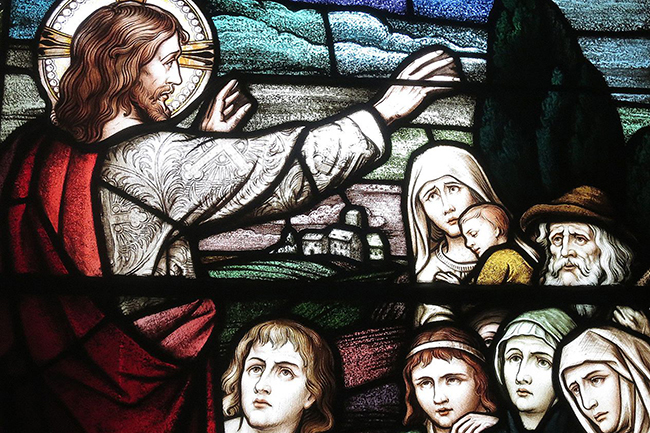
We all face difficulties in our lives. The crowds who listen to Jesus must have felt cruelly burdened, labouring and seeming to find no true reward. They must have sensed injustice and longed for their Messiah to set them free [ … ]
