

Office Of Readings | Tuesday, Lent Week 1 | From A Treatise On The Lord’s Prayer By Saint Cyprian, Bishop And Martyr
‘He has given us life: he has also taught us how to pray.’
Saint Cyprian
Saint Cyprian of Carthage, a third-century bishop and martyr, profoundly reflected on the Lord’s Prayer in his treatise: ‘On the Lord’s Prayer’. Saint Cyprian viewed the Gospel’s commands as foundational teachings that nourish faith, Strengthen hope, and guide believers toward salvation. Saint Cyprian emphasized that, while prophets conveyed God’s messages, Christ, the Word incarnate, personally delivered these teachings, illuminating the path from the darkness of death to the light of grace.
Central to Saint Cyprian’s reflection is the Lord’s Prayer, which he regarded as a divine gift teaching believers how to pray. He believed that praying with the words Christ provided aligns believers with God’s will, fostering a familial relationship with the Father. Saint Cyprian warned against deviating from this model, asserting that to do so stems from ignorance or sin. He underscored that using Christ’s words in prayer ensures that believers’ petitions resonate with divine truth and spirit.
Saint Cyprian’s insights highlight the Lord’s Prayer as a comprehensive guide for Christian life, encompassing worship, petition, and moral guidance. By adhering to this prayer, believers participate in a tradition that unites them with Christ’s own expressions, reinforcing their identity as children of God and members of a spiritual family.
From A Treatise On The Lord’s Prayer By Saint Cyprian, Bishop And Martyr
Dear brothers, the commands of the Gospel are nothing else than God’s lessons, the foundations on which to build up hope, the supports for strengthening faith, the food that nourishes the heart. They are the rudder for keeping us on the right course, the protection that keeps our salvation secure. As they instruct the receptive minds of believers on earth, they lead safely to the kingdom of heaven.
God willed that many things should be said by the prophets, his servants, and listened to by his people. How much greater are the things spoken by the Son. These are now witnessed to by the very Word of God who spoke through the prophets. The Word of God does not now command us to prepare the way for his coming: he comes in person and opens up the way for us and directs us towards it. Before, we wandered in the darkness of death, aimlessly and blindly. Now we are enlightened by the light of grace, and are to keep to the highway of life, with the Lord to precede and direct us.
The Lord has given us many counsels and commandments to help us towards salvation. He has even given us a pattern of prayer, instructing us on how we are to pray. He has given us life, and with his accustomed generosity, he has also taught us how to pray. He has made it easy for us to be heard as we pray to the Father in the words taught us by the Son.
He had already foretold that the hour was coming when true worshippers would worship the Father in spirit and in truth. He fulfilled what he had promised before, so that we who have received the spirit and the truth through the holiness he has given us may worship in truth and in the spirit through the prayer he has taught.
What prayer could be more a prayer in the spirit than the one given us by Christ, by whom the Holy Spirit was sent upon us? What prayer could be more a prayer in the truth than the one spoken by the lips of the Son, who is truth himself? It follows that to pray in any other way than the Son has taught us is not only the result of ignorance but of sin. He himself has commanded it, and has said: You reject the command of God, to set up your own tradition.
So, my brothers, let us pray as God our master has taught us. To ask the Father in words his Son has given us, to let him hear the prayer of Christ ringing in his ears, is to make our prayer one of friendship, a family prayer. Let the Father recognise the words of his Son. Let the Son who lives in our hearts be also on our lips. We have him as an advocate for sinners before the Father; when we ask forgiveness for our sins, let us use the words given by our advocate. He tells us: Whatever you ask the Father in my name, he will give you. What more effective prayer could we then make in the name of Christ than in the words of his own prayer?





In today’s Gospel reading, Jesus continues to teach the people the true meaning of purity. In preceding verses, Jesus has told the scribes they are hypocrites, with a mistaken idea of what truly constitutes prayer, who lead people through their teachings to distorted and false understandings of how to love God and how to do well by other people within the community [ … ]
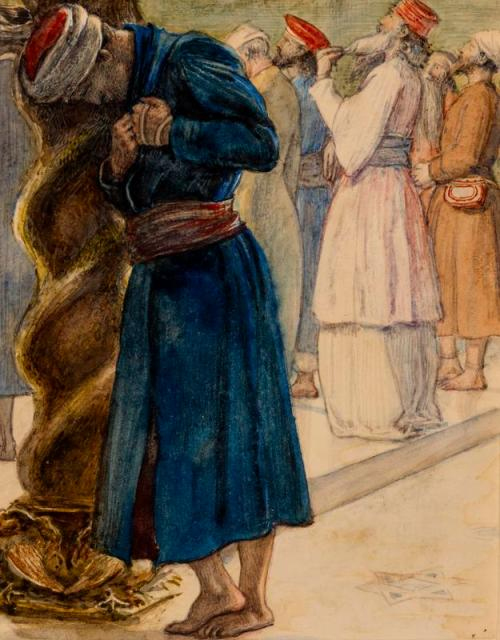
The scribes and Pharisees were two groups of religious leaders in ancient Judea, during the time of Jesus. The scribes were scholars who were responsible for copying and interpreting the Hebrew Scriptures (also known as the Old Testament). They were experts in the law and were often consulted on matters of religious practice and doctrine [ … ]
In this reading, Saint Ambrose reflects on Saint Paul’s teaching about life in the Spirit and the dignity given to believers as children of God. His focus is on adoption, inheritance, and hope, all of which shape the Christian understanding of suffering and future glory [ … ]
